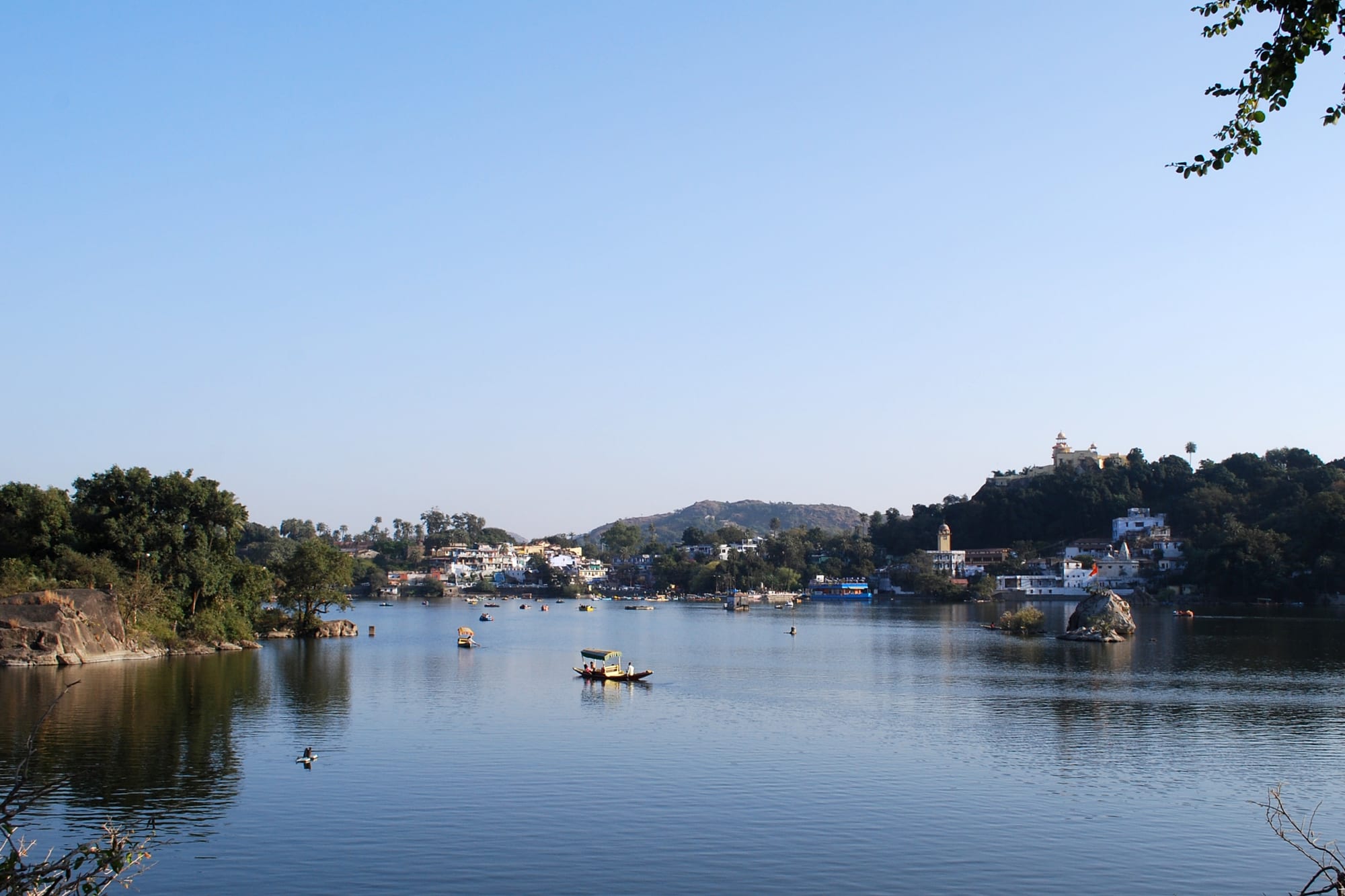
Nakki Lake at Mount Abu under a clear sky, with rowing boats on the water, rocky islets and the town's white buildings on the far shore

Rajasthan, India

Mount Abu

Nakki Lake, the centre of Mount Abu, with the town along its eastern shore. (Sanyam Bahga / Wikimedia Commons · CC BY-SA 3.0)

Rajasthan's only hill station, a small town on a granite plateau in the Aravalli range at about 1,200 metres, near the Gujarat border. Sacred to Jains for the marble Dilwara temples and to Hindus as the abode of sages, it became the seat of the British agent for Rajputana and is now a cool, crowded holiday town around Nakki Lake, with a spiritual university on its edge.

Neighbourhoods

  • Nakki Lake and the main bazaar
    • First-time visitors
    • Best for food
    • Evening strolls

    The centre of the town, where the main road runs down past the bus stand to the lake, with boat hire, the Raghunath temple, snack stalls and shops along the shore. Most of the hotels and restaurants cluster within a few minutes' walk, and the lakeside fills with holidaymakers in the evening.

    Open in Maps
  • Dilwara
    • Temples
    • Quiet and residential

    The village about 2.5 km north of the lake around the Dilwara Jain temples, with pilgrim rest houses, a few hotels and quiet lanes among the trees; the walk or ride up from the town passes the Brahma Kumaris campus.

    Open in Maps
  • The Sunset Point road
    • Views
    • Walks
    • Resort hotels

    The western side of town, where a road and footpaths lead through scrub and granite boulders to the lookouts over the plains, Sunset Point and Honeymoon Point, with larger resort hotels set in grounds along the way.

    Open in Maps
  • The Brahma Kumaris campus
    • Retreats
    • Gardens

    The world headquarters of the Brahma Kumaris spiritual movement spreads over several sites in and around the town, with a museum, the Peace Park and many visiting followers.

    Open in Maps

Things to do

Temples

  • Dilwara Templeslandmark

    Five Jain temples built between the 11th and 16th centuries whose white marble interiors, carved into ceilings, pillars and doorways in intricate detail, are among the most famous Jain temples; the Vimal Vasahi and Luna Vasahi are the finest.

    Open in Maps
  • Adhar Devi Templelandmark

    A temple to the goddess Arbuda Devi carved out of solid rock on the mountain, one of the town's main Hindu shrines.

    Open in Maps
  • Achalgarhlandmark

    A hilltop fort about 7 km north-east, first built by the Paramara rulers and rebuilt by Rana Kumbha of Mewar in 1452, with the Achaleshwar Mahadev temple just outside and Jain temples inside.

    Open in Maps

The lake and viewpoints

  • Nakki Lakeattraction

    The sacred lake at the heart of the town, said in legend to have been dug out with fingernails (nakh), ringed by hills and granite outcrops and busy with hired rowing and paddle boats.

    Open in Maps
  • Toad Rockviewpoint

    A granite boulder shaped like a crouching toad on the hill above Nakki Lake, climbed for the view over the water and the town.

    Open in Maps
  • Sunset Pointviewpoint

    A lookout on the western edge of the plateau where crowds gather each evening to watch the sun drop over the plains far below.

    Open in Maps
  • Guru Shikharviewpoint

    The highest point of the Aravalli range at about 1,720 metres, some 9 km from the town, with a small temple to Dattatreya on the summit and a view over the whole plateau and the plains.

    Open in Maps

Nature and gardens

  • Mount Abu Wildlife Sanctuarypark

    The sanctuary covering most of the plateau's forested slopes, home to leopards, sloth bears, sambar and many birds, crossed by the roads to Guru Shikhar and Achalgarh and by walking trails from the town.

    Open in Maps
  • Trevor's Tankpark

    A tank and picturesque spot about 5 km from the town, among the forests of the sanctuary.

    Open in Maps

Short trips from the town

  • Ambajilandmark

    One of the 51 Shakta pithas, the great goddess shrines, across the Gujarat border about 32 km away.

    Open in Maps
  • Ranakpur Jain Templelandmark

    The 15th-century marble Jain temple in a wooded valley to the north-east, famous for its 1,444 carved pillars, no two alike, and a long day's round trip by road.

    Open in Maps

Seasonal events

  • Winter FestivalWinter

    The town's annual winter festival, with folk performances and cultural events.

Eat and drink

Long-standing places and food districts in Mount Abu. Hours, ratings and directions come from your maps app, always current.

Mount Abu classics

  • Nakki Lake road eateriesneighborhood

    The road down to the lake and the lanes around it are lined with thali restaurants, snack counters and ice-cream parlours serving the town's Gujarati and Rajasthani visitors — unlimited Gujarati thalis, dal baati churma, kachori and rabri.

    Open in Maps
  • Main bazaar snack stallsmarket

    Stalls and sweet shops in the bazaar sell pakoras, bhel, hot jalebi, and chai and coffee to the evening crowds, with roasted peanuts and corn on the lakeside.

    Open in Maps
  • Dilwara pilgrim kitchensneighborhood

    Around the Jain temples, simple vegetarian dining halls and the pilgrim rest houses serve Jain-style meals without onion or garlic.

    Open in Maps

Experience Mount Abu

History

The Abu plateau has been a holy mountain for far longer than it has been a town. Hindu tradition makes it the home of the sage Vashishtha, whose fire sacrifice, in the Paramara legend, created the first fire-born (Agnikula) Rajput, and names it Arbudaranya, the forest of Arbuda, after a serpent said to have saved Shiva's bull on the hill. Jains revere it among their most sacred sites: the Dilwara temples were raised between the 11th and 16th centuries, the two finest, of 1031 and 1230, by ministers of the Chaulukya (Solanki) and Vaghela rulers of Gujarat, and carved in white marble with intricate detail. The Paramara dynasty held the plateau in the medieval period, and Rana Kumbha of Mewar rebuilt Achalgarh fort in 1452.

In the 19th century the mountain belonged to the Rajput state of Sirohi, and the British leased the plateau from its ruler and made it the headquarters of the Rajputana Agency, the political office that managed the princely states. A municipality was set up in 1864, bungalows and residences of Rajput rulers, a Jaipur palace among them, were built around Nakki Lake, and the town took the shape it has now. After independence the Abu area was joined to Bombay State in 1950 and returned to Rajasthan in 1956.

In 1950 the Brahma Kumaris, a spiritual movement founded in Hyderabad, Sindh, in the 1930s, moved to Mount Abu, which became its headquarters, and its campuses are now a major presence in the town. Since then the plateau has lived on pilgrims and holidaymakers from Gujarat and Rajasthan, with the wildlife sanctuary declared over the forest in 1960 and a long argument over how much the fragile hill can be built upon.

Culture & Customs

Three religious communities give the town its character. The Jains come to Dilwara, where the temples' custodians keep strict rules of dress and conduct; the Hindu pilgrims climb to Adhar Devi, Achaleshwar and Guru Shikhar; and the Brahma Kumaris, who teach a form of Raja Yoga meditation and are known for the white-clad women who lead the movement, bring followers from across the world to their halls and gardens. The result is a town that is overwhelmingly vegetarian, largely teetotal in public and calm in manner despite the crowds.

The holiday culture is Gujarati as much as Rajasthani: families from Ahmedabad, Surat and Palanpur fill the lakeside in the evenings, hire boats, eat ice cream and thalis, and climb Toad Rock for photographs. Rajasthani folk music and dance appear at the winter festival and in the hotels. The old British and princely layer survives in the palaces of former rulers and a handful of colonial-era bungalows.

Manners are those of a conservative, religious region: modest dress, shoes off at the threshold, respect for sadhus and for the many cows and monkeys, and a general expectation that visitors will keep the plateau clean, a cause the town has campaigned on. Sport is boating and, for the plains visitors, a walk.

Daily Life

About 23,000 people live in the town, and the figure swells many times over on holiday weekends. Tourism is the economy: hotels, restaurants, boat hire, jeep taxis, shops and the services that support them, with the Brahma Kumaris and the state administration as the other steady employers. Many workers come up from Abu Road and the Sirohi villages, where many people speak Bhili.

Residents live in the lanes behind the bazaar and on the slopes around the lake, in Dilwara village, and in colonies along the Abu Road descent. The day begins with temple bells and the early pilgrims to Dilwara, the bazaar opens by mid-morning, and the lake and Sunset Point draw everyone at dusk; in winter the nights are cold and the town is quiet by ten. Water on the plateau depends on the lake and on monsoon storage, and shortages in a dry year are a familiar problem.

The town's chief argument is about building. An eco-sensitive zone around the wildlife sanctuary was notified in 2020, and construction, hotel expansion and traffic on holiday weekends are regulated and disputed. Wildlife wandering into the town, sloth bears above all, is a growing concern as the forest edge is built up.

Food

The food of Mount Abu is the food of its visitors, which means Gujarati as much as Rajasthani. The unlimited Gujarati thali, a tray of rotis, several vegetable dishes, dal, kadhi, rice, pickles, a sweet and buttermilk, is the standard restaurant meal around the lake, often with a Rajasthani thali of dal baati churma, gatte ki sabzi and ker sangri offered alongside. Both are vegetarian, and many kitchens cook Jain-style, without onion, garlic or root vegetables, for the pilgrims.

Snacks are the real local pleasure: kachori and samosa with chutney, pakoras in the monsoon, bhel and sev-topped chaats, hot jalebi from the bazaar's sweet shops, and rabri, thickened sweet milk, eaten by the lake. Gujarati farsan, the fried and steamed snacks such as dhokla, khandvi and fafda, appear on every counter. Ice cream and kulfi, the dense frozen milk sweet, sell on the promenade all year, and roasted corn and peanuts are hawked to the sunset crowds.

Tea is drunk constantly, and the hill grows little of its own, with seasonal fruit coming up from the surrounding valleys. Meat and alcohol are available in a few hotel restaurants but play little part in the town's eating.

Planning tools

Budget

Mount Abu is a domestic resort and prices follow the Gujarati and Rajasthani holiday calendar: rooms rise sharply at Diwali, over the Christmas–New Year week, at long weekends and in May, and fall in the monsoon and midweek in winter. Food is cheap and vegetarian, and the sights cost little; the extras are boat hire, a jeep or taxi for Guru Shikhar and Achalgarh, and resort-hotel rooms.

Daily Budget Midrange
USD 50–110 (good hotel near the lake, restaurant meals, a taxi for the day to the outlying temples and peak)
Daily Budget Shoestring
USD 15–35 (guesthouse room, thalis and snacks, shared jeeps and walking)

Avoid Diwali and the New Year week unless rooms are booked well ahead; midweek in October–November or February–March is quiet and pleasant.

Best Time to Visit

October to March for clear, cool days and cold nights; the New Year week is the busiest of the year. April to June is warm rather than hot, far cooler than the plains, and the traditional peak for families escaping the heat. The monsoon from July to September turns the plateau green and misty, with waterfalls and low prices, but views disappear and some trails close.

Suggested Number of Days

One to two days are enough for the town, its temples and the outlying fort, peak and sanctuary at an easy pace. Three days allow a longer excursion across the Gujarat border or into the hills to the north-east.

First Visit
1–2 days
With Surroundings
3 days

Transportation

The town centre is walked, and the lake, bazaar and bus stand are within a few hundred metres of each other. Taxis and shared jeeps run to Dilwara, Achalgarh and Guru Shikhar from the bus stand, and most hotels arrange a car for a half-day round of the outlying sights. State buses and the private minibuses from Abu Road are the links to the plains.

Parking in the centre is scarce on holiday weekends.

Airport & Station Connections

The railhead is Abu Road, about 27 km below the town on the main Delhi–Ahmedabad line, with buses and taxis up the winding hill road. Daily buses run from Udaipur, Ahmedabad, Jodhpur and Jaipur; Udaipur and Ahmedabad also have the nearest airports.

Walkability

Mount Abu is small and mostly flat around the lake, and the bazaar, the lakeside and Toad Rock are an easy stroll. Dilwara is about 2.5 km, a pleasant walk or a short ride; Sunset Point is a walk to the west. Beyond that the roads climb and wind through the sanctuary and are better by jeep. Monkeys and, rarely, bears and leopards frequent the forest edge, and walking the outer roads after dark is discouraged.

Safety

A quiet family resort with little crime; the usual cautions are pickpockets in holiday crowds, aggressive touts around the lake, and the twisting road up from Abu Road, where driving at night or in monsoon fog needs care. Wild animals from the sanctuary, including sloth bears, are seen on the edge of town.

Keep food away from monkeys, stay on marked paths in the sanctuary, and do not walk the forest roads after dark. Check current official travel advice before travelling.

Climate

A mild highland climate, cooler and wetter than the Rajasthan plains: warm summers, a real monsoon with heavy rain and mist from July to September, and winters of sunny days and cold nights, with occasional frost on the plateau.

Summer
warm — April to June days of 28–34°C with cool evenings
Winter
cool — December and January days around 18–22°C, nights falling to near freezing and sometimes below

Local Customs

Mount Abu is a religious town for Jains, Hindus and the Brahma Kumaris alike, and its temples set the manners: shoes off, modest dress, and the rules set by the custodians of the Dilwara temples. The Brahma Kumaris campus expects quiet and plain dress. The usual greeting is 'namaste'; tipping is modest, around 10 per cent in restaurants and small sums for drivers.

Most of the town is vegetarian and much of it is Jain; alcohol is available in licensed hotel bars and shops but not drunk in public.

Common Payment Methods

The currency is the Indian rupee. Hotels and the larger restaurants take cards, UPI phone payments work for those with an Indian bank account, and cash is needed for boats, jeeps, stalls and temple donations. There are ATMs in the bazaar and near the bus stand, fewer elsewhere on the plateau.