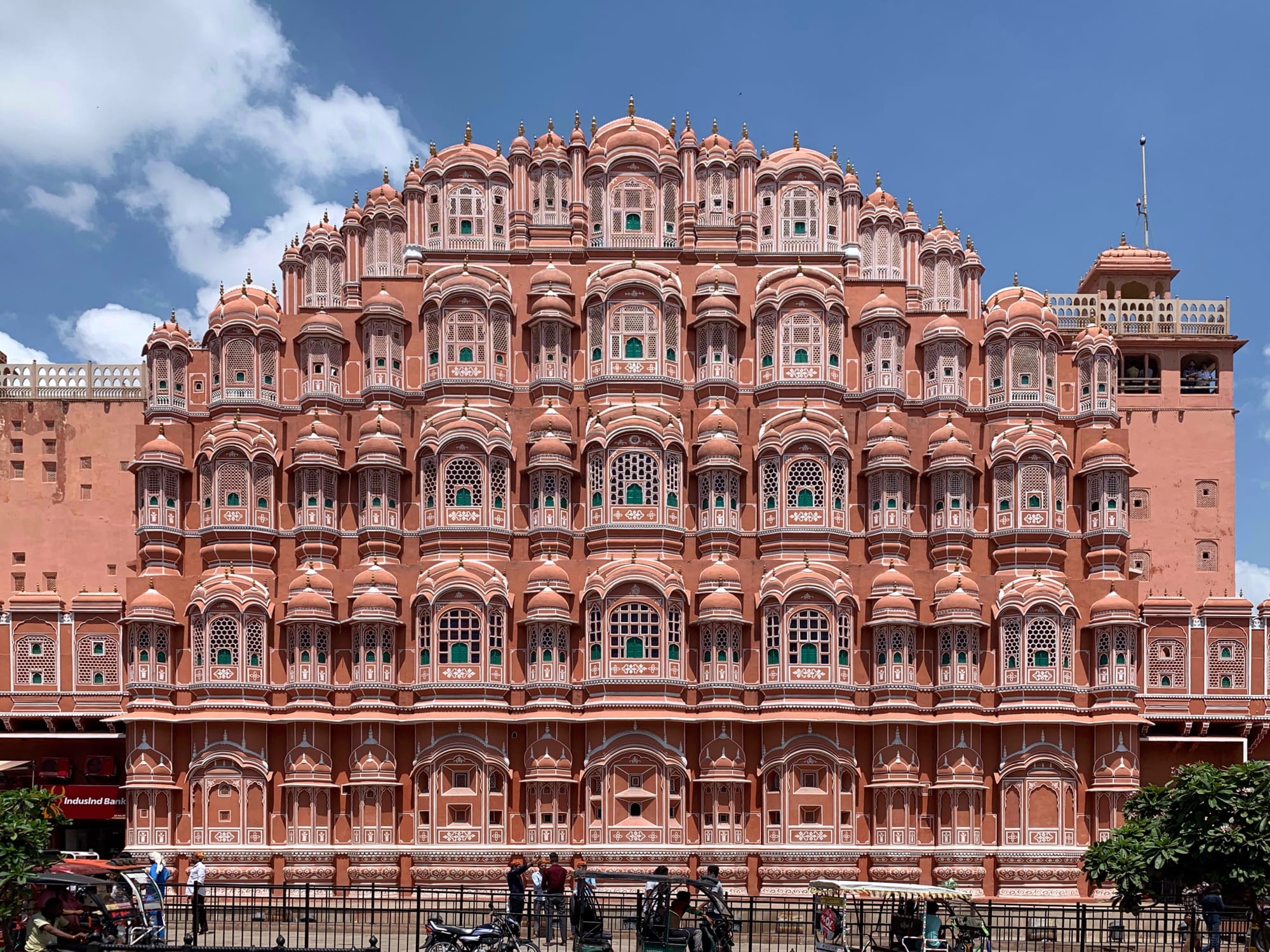
A tall pink sandstone façade of hundreds of small latticed windows and domed balconies rising in tiers under a blue sky

Rajasthan, India

Jaipur

The east façade of the Hawa Mahal in the old city of Jaipur. (Chainwit. / Wikimedia Commons · CC BY-SA 4.0)

The capital of Rajasthan, founded in 1727 by Sawai Jai Singh II as a planned city of straight streets and walled blocks at the foot of the Aravalli hills. Its pink-washed old town, palaces, bazaars and the Jantar Mantar observatory are World Heritage listed, and the city is now a manufacturing and gem-trading centre of some three million people.

Neighbourhoods

  • The Walled City
    • First-time visitors
    • Historic district
    • Markets

    The planned old town of 1727, laid out in a grid of wide straight streets inside gated walls and painted terracotta pink. The City Palace, Jantar Mantar and Hawa Mahal stand at its centre, surrounded by the bazaars that still do most of the city's traditional trade.

    Open in Maps
  • Johari Bazaar and Tripolia Bazaar
    • Shopping
    • Best for food
    • Markets

    The two great commercial streets of the walled city, the first for jewellery, gems and saris, the second for metalware, textiles and household goods. Sweet shops and snack counters are packed between the arcades, and the lanes behind them hold the workshops.

    Open in Maps
  • C-Scheme and the Civil Lines
    • Quiet and residential
    • Restaurants
    • Green streets

    The leafy planned district west of the old city, built from the 1940s, with tree-lined avenues, government bungalows, galleries, cafés and many of the city's better restaurants. It is the calmest part of central Jaipur.

    Open in Maps
  • Ashok Nagar and MI Road
    • Close to public transport
    • Shopping
    • Restaurants

    The modern commercial spine running south-west from the old city, lined with hotels, cinemas, banks and long-standing sweet and snack shops, and close to the metro line.

    Open in Maps
  • Amer and the northern hills
    • Historic district
    • Views
    • Quiet and residential

    The old Kachwaha capital in a gorge about 11 kilometres north, below its fort, with stepwells, temples and small streets that predate Jaipur itself. Hotels and homestays on the surrounding ridges look over the lakes and hill forts.

    Open in Maps
  • Malviya Nagar and Tonk Road
    • Quiet and residential
    • Local life

    Planned residential colonies in the south, near the airport, the World Trade Park shopping centre and technology offices, where much of middle-class Jaipur actually lives.

    Open in Maps

Things to do

The planned city

  • Hawa Mahallandmark

    The 1799 palace of the winds, a five-storey screen of 953 latticed windows built so that royal women could watch the street unseen.

    Open in Maps
  • City Palacelandmark

    The royal complex at the centre of the walled city, with courtyards, the Mubarak Mahal, an armoury and textile collection, and part of it still the family's residence.

    Open in Maps
  • Jantar Mantarlandmark

    Sawai Jai Singh's observatory of nineteen masonry instruments, completed in 1734, including the world's largest stone sundial; it is a World Heritage Site.

    Open in Maps
  • Govind Dev Ji Templelandmark

    One of the city's most visited temples, in the palace gardens, holding an image of Krishna brought from Vrindavan and drawing crowds at each of its daily viewings.

    Open in Maps
  • Albert Hall Museummuseum

    The state museum of 1887 in Ram Niwas Garden, an Indo-Saracenic building by Samuel Swinton Jacob, with carpets, arms, miniatures and an Egyptian mummy.

    Open in Maps
  • Jawahar Kala Kendraattraction

    An arts centre designed by Charles Correa on a nine-square plan echoing the city's own layout, with galleries, theatres and a museum.

    Open in Maps

Forts and palaces

  • Amer Fortlandmark

    The hilltop palace of the Kachwaha rulers above Maota Lake, begun in the late 16th century by Raja Man Singh, with mirrored halls and marble courtyards; part of the Hill Forts of Rajasthan World Heritage Site.

    Open in Maps
  • Jaigarh Fortlandmark

    The military fort on the ridge above Amer, holding Jaivana, one of the largest wheeled cannons ever cast, and a long water-supply system.

    Open in Maps
  • Nahargarh Fortviewpoint

    A fort of 1734 on the hills directly above the walled city, with the Madhavendra Bhawan suites and wide views down over Jaipur at dusk.

    Open in Maps
  • Jal Mahallandmark

    A sandstone palace standing in the water of Man Sagar lake on the road to Amer, its lowest storey submerged when the lake is full.

    Open in Maps

Temples, gardens and hills

  • Galtajilandmark

    A temple complex in a gorge east of the city, with spring-fed tanks, painted pavilions and large troops of monkeys.

    Open in Maps
  • Birla Mandirlandmark

    A white marble temple to Lakshmi and Narayana below Moti Dungri hill, completed in 1988 and lit at night.

    Open in Maps
  • Central Parkpark

    The city's largest open space in the C-Scheme district, with a jogging track, a golf course alongside and a very tall national flag.

    Open in Maps
  • Sawai Mansingh Stadiumattraction

    The city's cricket ground, home to Indian Premier League matches and occasional international fixtures.

    Open in Maps

Markets and crafts

  • Sanganerneighborhood

    A southern suburb known for hand block printing on cotton and for handmade paper, with workshops that can be visited.

    Open in Maps
  • Anokhi Museum of Hand Printingmuseum

    A museum at Amer showing the tools, blocks and dyeing techniques of Rajasthani block printing, with demonstrations by craftspeople.

    Open in Maps

Seasonal events

  • Jaipur Literature FestivalJanuary

    One of the world's largest literary festivals, drawing writers and very large crowds to the city for several days.

  • Makar Sankranti kite flyingmid-January

    Rooftops across the old city fill with kite flyers on the mid-winter harvest festival, and the sky over Jaipur is covered in paper kites.

  • GangaurMarch or April

    A sixteen-day festival for the goddess Gauri, a form of Parvati, ending with processions of decorated images from the City Palace through the old city.

  • TeejJuly or August

    The monsoon festival, marked by a royal procession, green clothes, swings and the sweet ghevar sold in every shop.

  • Diwali illuminationsOctober or November

    Jaipur's bazaars compete to light their façades for the festival, and the walled city is one of the most heavily decorated places in India.

Eat and drink

Long-standing places and food districts in Jaipur. Hours, ratings and directions come from your maps app, always current.

Jaipur classics

  • Rajasthani thali restaurantsrestaurant

    Dal baati churma, gatte ki sabzi, ker sangri and a sweet, served on a steel tray; the traditional thali houses of the city are the easiest way to eat the state's cooking in one sitting.

    Open in Maps
  • Pyaaz kachori and mirchi badarestaurant

    Fried pastries stuffed with spiced onion, and batter-fried stuffed green chillies, sold hot from the snack counters on MI Road and in the bazaars.

    Open in Maps
  • Ghevar and Rajasthani sweetsrestaurant

    A honeycomb disc of fried batter soaked in syrup and topped with thickened milk, made above all for Teej, alongside ghee-rich sweets of gram flour and milk.

    Open in Maps

Food districts and markets

  • Johari Bazaarmarket

    The jewellery street doubles as the city's sweet and snack row, with long-established shops selling kachori, lassi in clay cups and trays of mithai.

    Open in Maps
  • MI Roadneighborhood

    The modern commercial street running from the old city, lined with sweet shops, bakeries, coffee houses and mid-century restaurants.

    Open in Maps
  • C-Schemeneighborhood

    The garden district holds most of Jaipur's contemporary cafés, bars and restaurants, including kitchens serving lighter versions of Rajasthani cooking.

    Open in Maps
  • Chandpole and the walled city lanesneighborhood

    Vegetable markets, chaat carts, kulfi sellers and tea stalls fill the gates and side lanes of the old city, busiest in the evening.

    Open in Maps

Experience Jaipur

History

Jaipur was built to a plan, which makes it unusual among Indian cities. The Kachwaha Rajputs had ruled from Amer, in a gorge in the hills to the north, since the 12th century, and grew powerful as generals and allies of the Mughal emperors. By the early 18th century Amer was crowded and short of water, and in 1727 Sawai Jai Singh II laid out a new capital on the plain below. His scheme, worked out with the architect Vidyadhar Bhattacharya, divided the walled city into nine rectangular blocks on the principles of Hindu treatises on architecture, with streets of set widths, gates, and trades assigned to particular quarters.

Jai Singh was an astronomer as well as a ruler; the Jantar Mantar he completed in 1734 was the chief of five observatories he built. His successors added the Hawa Mahal in 1799 and hill forts above the town. In 1876 the city was painted the terracotta pink it still wears, in honour of a visit by the Prince of Wales. Under British paramountcy the state modernised early: Sawai Ram Singh II opened a Sanskrit college in 1865 and a girls' school in 1867, and public works followed.

The state acceded to India in 1949 and Jaipur became the capital of the new state of Rajasthan. The city grew far beyond its walls in the second half of the 20th century, taking in industry, the gem trade and tourism. In 2019 UNESCO inscribed the walled city as a World Heritage Site for its 18th-century town planning, adding to earlier listings for the Jantar Mantar and Amer Fort.

Culture & Customs

Jaipur is a city of craftsmen. The court drew in jewellers, enamellers, stone carvers, miniature painters, potters and block printers, and their descendants still work in the same quarters of the old city. The gem trade is the largest of these: emeralds and other stones are cut and set here for buyers worldwide. Jaipur blue pottery, glazed in cobalt and worked without clay, and the meenakari enamelling of gold jewellery are the city's signature crafts, with block printing at Sanganer and Bagru just outside.

Royal ritual survives in public form. The former ruling family still lives in part of the City Palace, and processions at Gangaur and Teej carry images of the goddess through the streets with camels, elephants and bands, in a formality inherited from the court. Kathputli string puppetry, Manganiyar and Langa musicians from the desert, and the whirling Ghoomar dance appear at festivals and hotel performances alike.

Modern Jaipur has a strong civic and literary culture — the Literature Festival each January is one of the largest events of its kind anywhere — alongside cricket, which fills the Sawai Mansingh Stadium, and polo, a relic of princely days. Manners are courteous and fairly conservative: elders are greeted first, hands joined in namaste, and hospitality is taken seriously. Most residents are Hindu, with a substantial Muslim population and important Jain temples and merchant families.

Daily Life

About three million people live in Jaipur, making it Rajasthan's largest city and the tenth most populous in India. Government, tourism, gems and jewellery, textiles, handicrafts, marble and a growing information technology and education sector carry the economy; the city is also a regional centre for hospitals and universities, drawing students from across the state.

The rhythm differs sharply between old and new. Inside the walls the bazaars open late in the morning, close for a long afternoon rest in the heat and stay busy well into the night, with workshops above the shops and families living in the same buildings. Outside, in Malviya Nagar, Mansarovar and Vaishali Nagar, life runs on office hours, school runs, shopping malls and the metro.

The strains are those of rapid growth. Water is drawn from distant reservoirs and groundwater is falling; traffic has outgrown a street plan designed for carts; and air quality deteriorates in winter. Heat is an increasing public health concern, with summer temperatures regularly above 40°C. Conservation of the walled city, now a World Heritage Site, has to be balanced against the needs of the tens of thousands of people who work and live in it, and unauthorised building and signage remain contested issues.

Food

Jaipur eats Rajasthani food at its most elaborate. Dal baati churma is the defining meal: hard wheat balls baked in coals, broken and doused in ghee, eaten with spiced lentils and a sweet crumble of the same dough. Gatte ki sabzi, gram flour dumplings in a yoghurt curry, and ker sangri, dried desert berries and beans, come from a cooking tradition built for a place with little fresh produce. Laal maas, mutton in a fiery red chilli gravy, is the best-known meat dish, though much of the city is vegetarian and Jain cooking without onion or garlic is easy to find.

Snacks are a civic speciality. Pyaaz kachori, a flaky pastry filled with spiced onion, and mirchi bada, a batter-fried stuffed chilli, are eaten standing at counters; kachori is followed by mawa kachori, the sweet version. Chaat carts sell golgappa and aloo tikki in the evening, and lassi is served thick in unglazed clay cups that are thrown away after use.

Sweets fill Johari Bazaar. Ghevar, a disc of fried batter with a honeycomb texture soaked in syrup, is made for the monsoon festival of Teej; mishri mawa, feeni and gram flour sweets are sold by weight all year. Masala chai is the constant, brewed with ginger and cardamom at stalls on every corner, and in summer the city drinks buttermilk, sugarcane juice and kulfi.

Planning tools

Budget

Jaipur offers the full range, from cheap guesthouses inside the walls to palace hotels that are among the most expensive rooms in India, with many converted havelis in between. Monument tickets for foreign visitors are significantly higher than for residents, and a combined ticket covers several sites. A car with driver, gem and textile shopping, and the Literature Festival week are the main variables.

Daily Budget Midrange
USD 50–130 (heritage haveli hotel, restaurant meals, a car with driver, monument tickets)
Daily Budget Shoestring
USD 15–25 (guesthouse room, thalis and street food, buses, the metro and shared autos)

Buy the composite monument ticket if visiting more than two major sites, and agree auto-rickshaw fares before setting off.

Best Time to Visit

October to March is the season: sunny days, cool nights, festivals and the Literature Festival in January. April to June is severely hot, often above 40°C, and many visitors leave the sightseeing to early morning. The monsoon from July to September brings short heavy showers, green hills around Amer and much smaller crowds.

Suggested Number of Days

Two or three days suit a first visit, given the distances between the old city and the hill forts. Allow four or five to add the craft villages and day trips into the countryside, and more if travelling on to other Rajasthani cities by road.

First Visit
2–3 days
With Surroundings
4–5 days

Transportation

Auto-rickshaws, app-based taxis and cycle rickshaws in the old city cover most journeys; a metro line runs from Mansarovar through the walled city, and city buses fill the rest. A car with driver is the usual way to link Amer, Nahargarh and Jaigarh in one outing. Traffic inside the walls is dense, and the bazaars are best walked.

Elephant rides at Amer are widely criticised on welfare grounds; jeeps and a short walk reach the same gate.

Airport & Station Connections

Jaipur International Airport at Sanganer, about 13 kilometres south of the centre, has domestic flights and a smaller number of international routes. Trains and the expressway link the city with Delhi in around four to five hours, and trains and buses run to Agra, Udaipur, Jodhpur and Ahmedabad. Jaipur is the usual first stop on India's Golden Triangle circuit.

Walkability

The walled city is laid out on a grid and is rewarding on foot, though pavements are occupied by stalls and parked vehicles, traffic is heavy and crossing the main bazaars takes patience. Distances within the old town are short; everything else — the forts, C-Scheme, the museums south of the wall — needs transport. Heat from April to June makes long walks hard.

Safety

Jaipur is generally safe, and violent crime against visitors is rare, but it is the most touristed city in Rajasthan and the commercial pressure is constant: gem scams promising resale profits, commission-driven shops and drivers, and fake guides at the forts. Women report staring and harassment in crowded bazaars. Heat, traffic and monkeys at Galtaji and the hill forts are the everyday hazards.

Never buy gems or stones to resell, book guides through the monument office rather than at the gate, and carry water and sun protection from April to June. Check current official travel advice before travelling.

Climate

A hot semi-arid climate. Winters are dry and pleasant with cold nights, the pre-monsoon months are extremely hot, and the monsoon from late June to September brings most of the year's rain in short bursts. Dust and haze are common in the dry months.

Summer
very hot — often around 40°C in May and June, easing when the monsoon arrives
Winter
mild and dry — around 22–28°C by day, with nights that can fall to 5–8°C in January

Local Customs

Shoes and leather are left outside temples, and heads are covered at some shrines; photography is often restricted inside. Modest dress is expected in the old city, especially for women. Bargaining is normal in the bazaars and not in fixed-price shops. Alcohol is served in hotels and licensed restaurants but is not part of public life, and many restaurants are strictly vegetarian.

Ask before photographing people, particularly women and craftspeople at work, and treat offers to visit a 'government' emporium as commission-driven.

Common Payment Methods

The currency is the Indian rupee. Cards are widely accepted in hotels, restaurants and larger shops, and mobile QR payments are used by nearly everyone, including rickshaw drivers and street stalls. ATMs are plentiful. Small notes are useful for autos, tips and bazaar purchases.