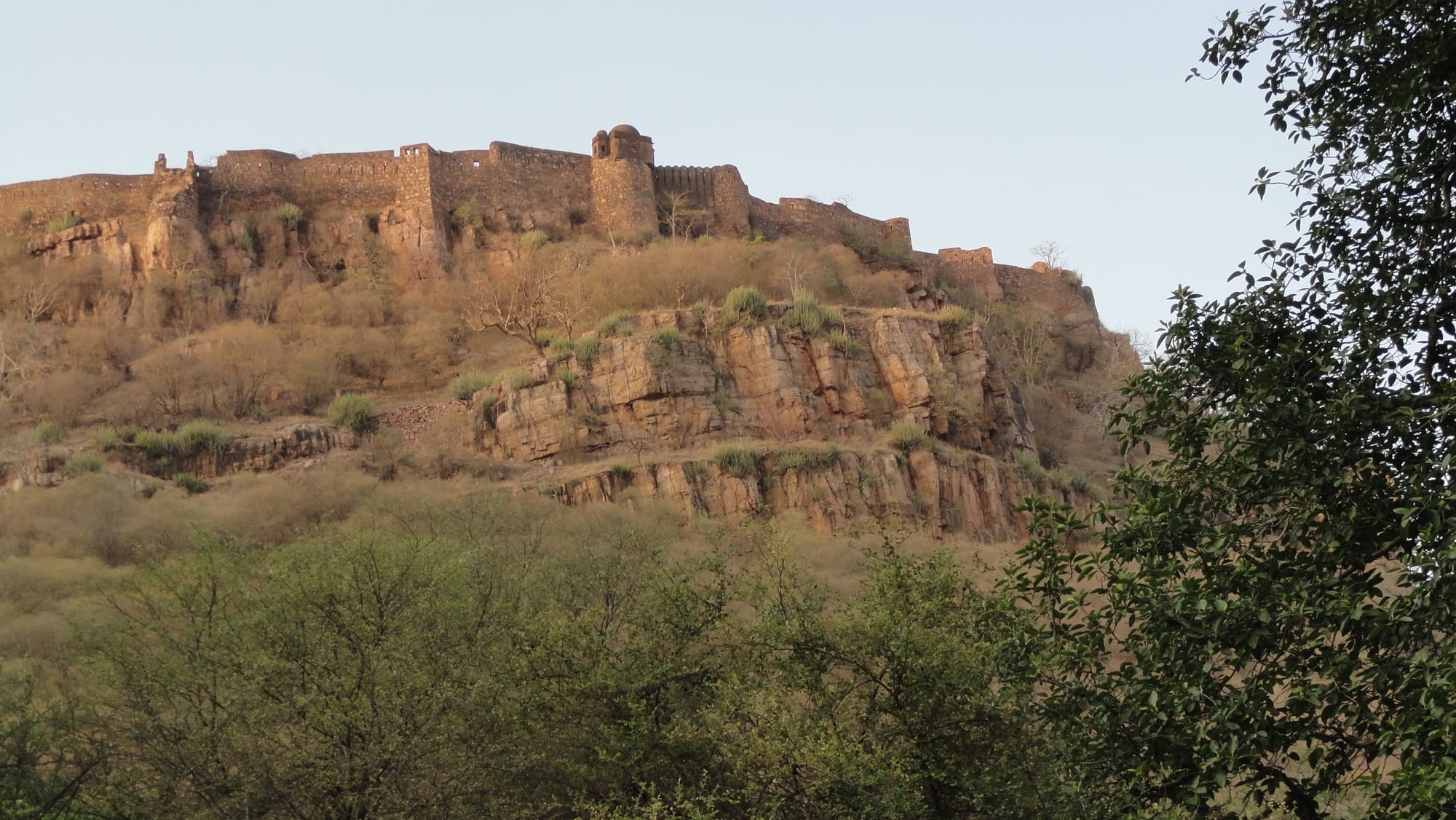
Stone ramparts along the top of a sheer rocky hill above dry scrub forest in evening light

Rajasthan, India

Sawai Madhopur

The walls of Ranthambore Fort on their cliff above the forest of the tiger reserve. (RahulDogra264 / Wikimedia Commons · CC BY-SA 4.0)

A district town in eastern Rajasthan founded in the 18th century by the rulers of Jaipur and now known almost entirely as the gateway to Ranthambore National Park. Dry forest, lakes and a ruined hilltop fort lie a few kilometres from its streets, and the town's hotels, guides and jeep drivers work around the tiger reserve's safari seasons.

Neighbourhoods

  • The Ranthambore road
    • First-time visitors
    • Hotels
    • Safaris

    The road running north-east from the town towards the park gate holds most of the hotels, lodges and camps, spread out among fields and scrub. Safari jeeps and canters collect guests here before dawn and in the afternoon, and craft workshops and a few restaurants line the route.

    Open in Maps
  • The town centre and the bazaar
    • Local life
    • Markets
    • Best for food

    A working Rajasthani market town of shops, sweet sellers, banks and temples around the main roads. Few visitors stay here, but it shows the ordinary district-town life that the safari strip does not, and prices are lower.

    Open in Maps
  • Around the railway station
    • Close to public transport
    • Budget stays

    Sawai Madhopur Junction is the arrival point for most visitors, with hotels, eating houses and rickshaw stands around it. The station is on the main line between Delhi, Kota and Mumbai, so trains come through at all hours.

    Open in Maps
  • Khilchipur and the park edge
    • Quiet and residential
    • Countryside

    The villages and settlements between the town and the reserve boundary, where farming, grazing and tourism overlap. It is quiet, close to the forest gates and the usual base for early morning starts.

    Open in Maps

Things to do

The reserve

  • Ranthambore National Parkpark

    A reserve of dry deciduous forest, lakes and rocky ridges covering about 1,300 square kilometres with the adjoining Kailadevi and Sawai Man Singh sanctuaries, and among the best-known places in India to see wild tigers, along with leopards, sloth bears, crocodiles and deer.

    Open in Maps
  • Ranthambore Fortlandmark

    A large fort founded in the mid-10th century on a flat-topped hill inside the reserve, taken by Alauddin Khalji in 1301 and by Akbar in 1568, and now part of the UNESCO-listed Hill Forts of Rajasthan.

    Open in Maps

In and around the town

  • Sawai Madhopur Junction railway stationtransit hub

    The town's station on the Delhi–Mumbai main line, the arrival point for most visitors to the park and a short drive from the reserve gates.

    Open in Maps
  • Chauth Ka Barwaraattraction

    A small town about 20 kilometres away built around a hill crowned by the temple of the goddess Chauth Mata, which draws crowds of pilgrims.

    Open in Maps

Short trips

  • Khandar Fortlandmark

    A ruined hill fort about 25 kilometres south-east, on the boundary of the reserve, its three great gateways and ramparts now broken.

    Open in Maps

Seasonal events

  • Ganesh ChaturthiAugust or September

    The fort temple's biggest days, when large numbers of pilgrims climb to the hilltop shrine and a fair is held below.

  • The safari seasonOctober to June

    The park's core zones open after the monsoon and close again for it, and the town's hotels, guides and drivers work to that calendar.

  • HoliMarch

    The spring festival of colours, marked in the bazaar and the surrounding villages with music, powder and street crowds.

Eat and drink

Long-standing places and food districts in Sawai Madhopur. Hours, ratings and directions come from your maps app, always current.

Sawai Madhopur classics

  • Thali kitchens of the bazaarneighborhood

    Eating houses in the town serve vegetarian Rajasthani thalis — dal, gatte ki sabzi, seasonal vegetables, chapatis and rice — with dal baati churma on request.

    Open in Maps
  • Guava and sweet stallsneighborhood

    The district is known across Rajasthan for its guavas, sold from carts and stalls in winter alongside kachoris, samosas and milk sweets.

    Open in Maps

The safari strip

  • Hotel and lodge restaurants on the Ranthambore roadneighborhood

    Most visitors eat where they sleep, and lodges along the park road serve buffet Indian and international food timed around the morning and afternoon safaris.

    Open in Maps
  • Station-side eating housesneighborhood

    Simple places near the railway station serve thalis, parathas, omelettes and tea at the hours trains arrive.

    Open in Maps

Experience Sawai Madhopur

History

The fort came long before the town. Ranthambore's walls crown a flat hill above the surrounding plain and are usually dated to the 10th century; the fort became the stronghold of a branch of the Chauhan dynasty, and its best-remembered ruler, Hammir Dev, was killed when Alauddin Khalji's army took it in 1301 after a long siege, an episode recorded in later Rajput and Persian accounts alike. The fort changed hands repeatedly afterwards, passing to the Mughals under Akbar and later to the rulers of Jaipur, who kept the surrounding forest as a hunting ground.

Sawai Madhopur itself was founded in 1763 by Maharaja Sawai Madho Singh I of Jaipur, who fortified the existing village of Sherpur and renamed it after himself; Sawai was a title used by the Jaipur house. It grew as a planned settlement below the hills and then, from the late 19th century, as a railway town on the line between Delhi and Bombay, which brought trade, workshops and a mixed population of railway families.

The forest's modern history begins with conservation. The hunting reserve became a wildlife sanctuary in 1955, one of the first areas chosen for Project Tiger in 1974, and a national park in 1980. Villages inside the core were moved out in the 1970s, which remains a contested memory locally, and the conservationist Fateh Singh Rathore became closely identified with the park's protection. Tiger numbers fell sharply around the turn of the century through poaching and have since recovered. Ranthambore Fort was inscribed with five other Rajasthan hill forts as a UNESCO World Heritage Site in 2013, and the town has grown around the safari economy.

Culture & Customs

This is eastern Rajasthan rather than the desert, and its culture belongs to the old Jaipur state: Dhundhari speech alongside Hindi, Rajput and Meena communities in the villages, and the same festival calendar of Teej, Gangaur, Holi and Diwali kept across the region. The Meena, one of the largest communities of the district, have long-standing ties to this country and its hills.

Religion here is local and busy rather than monumental. The Ganesha temple inside Ranthambore Fort is the focus, drawing thousands of visitors every Wednesday and very large crowds at Ganesh Chaturthi, when pilgrims climb the ramp to the gates. The goddess temple at Chauth Ka Barwara nearby draws pilgrims from across the district. Both are ordinary religious life rather than tourist sights, and visitors are expected to behave accordingly.

Wildlife has become part of local identity in a way that is unusual for a small town. Guides, drivers, trackers and lodge staff make up a substantial part of the working population, tiger names and individual histories are common knowledge, and photography of the park is a serious local craft. A craft project established near the town has trained women in embroidery and textile work, and shops along the park road sell that work alongside the standard Rajasthani block prints and silver. The relationship between the reserve and the villages on its edge — over grazing, crop damage and livestock losses — is a live and long-running subject.

Daily Life

About 120,000 people live in Sawai Madhopur, which serves as the headquarters of its district and as a market for a large farming area. Wheat, mustard and vegetables are grown on the plain, and the district is known across Rajasthan for its guavas, which are now a business worth billions of rupees a year. Large industry is limited by the rules protecting the forest, so the railway, which has been a major employer since the line was built, government service and tourism carry much of the rest.

The visitor economy is concentrated along the road to the park and runs on the safari timetable: staff and drivers begin before dawn, the middle of the day is quiet, and a second shift runs into the evening. Work is strongly seasonal, with the monsoon closure of the core zones in July and August the slackest period of the year, and many households combine tourism with farming or a government job.

In the town itself life is that of any district centre in Rajasthan: markets that open mid-morning and stay busy after dark, tea stalls, schools and colleges, a district hospital, and the noise of the highway and the railway. Water supply, crop damage by wild animals near the reserve, and the fair distribution of tourism income are the recurring local issues.

Food

Food here is Rajasthani in the eastern, less arid style, and vegetarian in most households. The standard meal is a thali of dal, a seasonal vegetable, chapatis or bajra roti, rice, pickle and buttermilk. Dal baati churma, the state's signature dish of coal-baked wheat balls with lentils and a sweet crumble, is cooked at home for guests and served in restaurants; gatte ki sabzi, gram-flour dumplings in a spiced yoghurt gravy, and kadhi are everyday dishes, and besan and gram flour stand in for vegetables in the dry months.

Snacks come from the same tradition as the rest of Rajasthan — pyaaz kachori, mirchi bada, samosas and pakoras fried through the afternoon and eaten with sweet masala chai. Sweet shops sell ghevar in the monsoon festival season, milk fudges and syrup-soaked malpua. Lassi and chaach, salted buttermilk, are the drinks of the hot months.

The district's own speciality is fruit: Sawai Madhopur guavas have a regional reputation and appear in winter on carts around the bazaar, eaten raw with salt and chilli or made into preserves. Lodges along the park road cook buffet food for an international clientele, with north Indian dishes alongside pasta and salads, while the town's kitchens stay closer to what people actually eat at home.

Planning tools

Budget

Rooms range from plain guesthouses in the town to a small number of expensive lodges and tented camps along the park road. The fixed extra here is the safari: seats are sold by zone in shared jeeps or larger canters, with separate vehicle, guide and park fees, and most visitors take more than one drive. Foreign-visitor entry rates are higher than Indian rates.

Daily Budget Midrange
USD 50–130 (lodge on the park road, restaurant meals, jeep safaris, a car with driver)
Daily Budget Shoestring
USD 20–35 (budget hotel in town, thalis and street food, a shared canter safari, trains and rickshaws)

Safari permits are booked online and sell out for weekends and holidays, so arrange them as far ahead as possible and treat any sighting as a matter of luck.

Best Time to Visit

October to April for comfortable weather, and February to June for the best chance of seeing tigers, as water dries up and animals concentrate around the lakes. April to June is very hot but rewarding for wildlife. The core zones close during the monsoon from July, when only limited buffer zones operate.

Suggested Number of Days

Two days allow several safaris, which is what most visitors come for, and time for the fort. A third suits the buffer forests, the town itself or a slower pace between drives. Sightings are unpredictable, so more drives mean better odds rather than a fuller itinerary.

First Visit
2 days
With Surroundings
3 days

Transportation

Auto-rickshaws and taxis cover the few kilometres between the station, the town and the hotels on the park road; many lodges send their own vehicles. Inside the reserve only registered jeeps and canters with licensed drivers and guides are allowed, on fixed routes by zone. Buses serve district towns, and a car with driver is the usual way to reach Jaipur or Agra.

Safari vehicles leave very early and return after dusk, so arrange transport and a packed breakfast with the hotel the night before.

Airport & Station Connections

Sawai Madhopur Junction is on the Delhi–Mumbai main line, with trains from Delhi in around four to five hours and services from Jaipur, Kota and Agra; it is the usual way to arrive. By road Jaipur is about 120 kilometres north-west and Agra roughly 230 kilometres north-east, both reachable in a few hours by car. Jaipur has the nearest large airport.

Walkability

The town centre and the station area are walkable, though pavements are patchy and traffic is heavy on the main roads. The hotel strip along the park road is spread over several kilometres and is walked only in stretches. The reserve itself cannot be entered on foot; the only walking inside is the ramp up to the fort and its temple.

Safety

A quiet district town where the risks are practical rather than criminal: heat, dust, traffic on the highway and the road to the park, and macaque monkeys around the fort that snatch food and bags. Inside the reserve the rules exist for good reason — animals are wild and vehicles must stay on their routes. Touts offering unofficial safaris or guaranteed sightings are best avoided.

Book safaris only through the official system or an established hotel, stay in the vehicle and quiet during drives, and carry water, sun protection and warm layers for cold winter mornings. Check current official travel advice before travelling.

Climate

Semi-arid with a stronger monsoon than western Rajasthan. Hot dry springs, a wet July and August that closes much of the park, and cool clear winters with cold early mornings in open jeeps.

Summer
very hot — April to June days often reach 40–45°C, with the forest dry and open
Winter
pleasant by day at about 22–27°C, with nights near 5–10°C and cold dawn safaris

Local Customs

Ordinary Rajasthani manners apply: modest dress, shoes removed at temples and the fort shrine, greetings with folded hands, and the right hand used for eating and giving. Many households here are vegetarian, and meat is not usually part of a local meal. Villagers living beside the reserve may not welcome being photographed, and monkeys at the fort are attracted by food of any kind.

Wear muted colours on safari, keep noise down near animals, and tip drivers and guides modestly in cash at the end of a drive.

Common Payment Methods

The currency is the Indian rupee. Hotels and lodges take cards and Indian phone-based payment apps are widely used, but rickshaws, stalls, village shops and tips are cash matters. ATMs are in the town and near the station rather than along the park road, so it is worth drawing money before settling into a lodge.