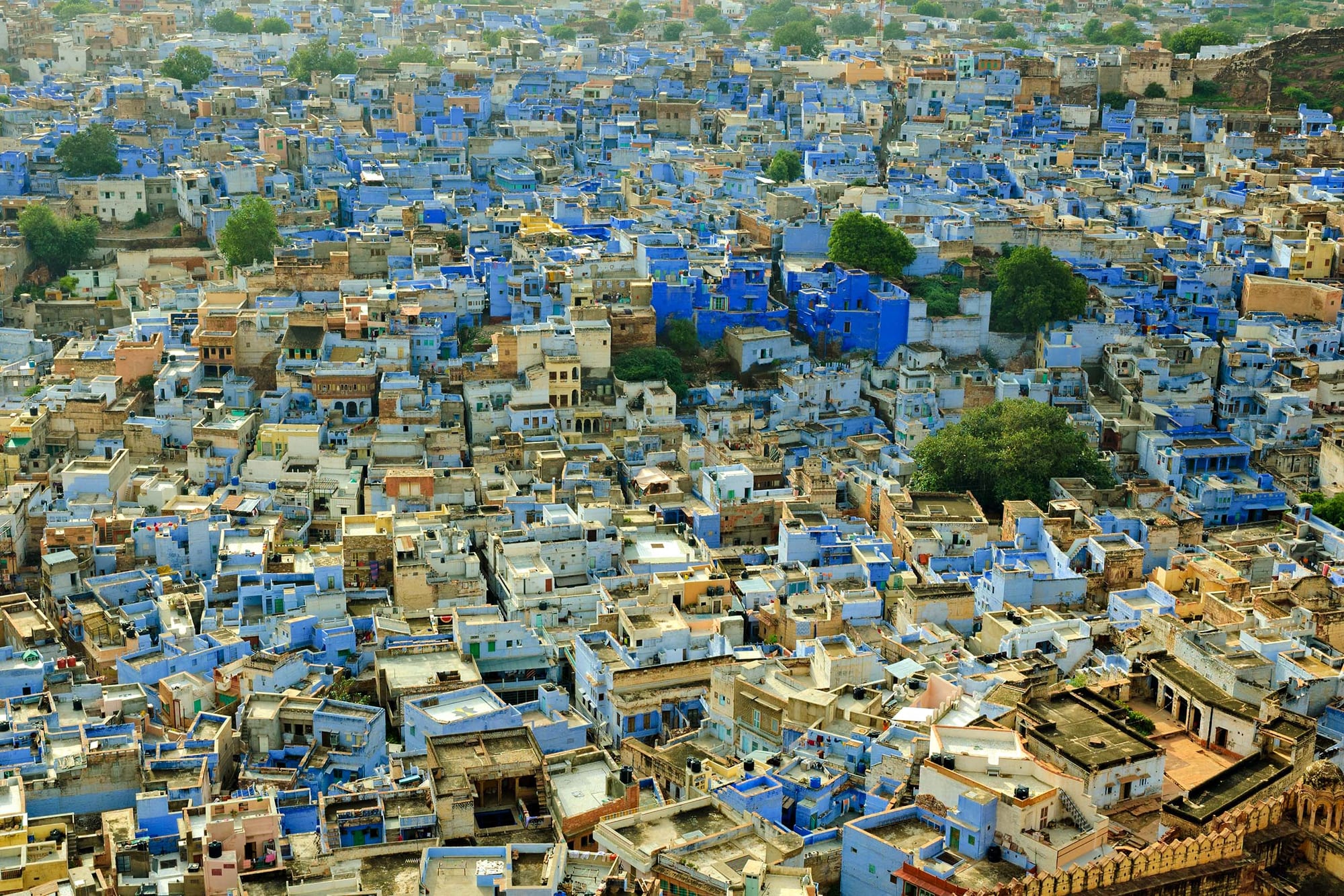
A dense maze of flat-roofed houses painted in shades of blue, seen from above with a few trees between them

Rajasthan, India

Jodhpur

The indigo-washed houses of Jodhpur's old city, seen from the rock above. (Everhard van Eimeren / Wikimedia Commons · CC BY-SA 4.0)

The second city of Rajasthan, founded in 1459 as the capital of the Rathore kingdom of Marwar on the eastern edge of the Thar Desert. Mehrangarh, a fort complex covering some 480 hectares, stands on a rock above a walled old town whose indigo-washed houses give Jodhpur its name of the Blue City, while a modern city of trade, handicrafts and universities spreads around it.

Neighbourhoods

  • The old city and the Clock Tower
    • First-time visitors
    • Historic district
    • Markets

    The walled town below the fort, built around the Ghanta Ghar clock tower and the bazaar that surrounds it. Lanes too narrow for cars lead between shops selling spices, textiles, bangles and sweets, and most of the guesthouses and rooftop restaurants with a view of Mehrangarh are here.

    Open in Maps
  • Navchokiya
    • Photography
    • Quiet and residential
    • Close to the fort

    The western part of the old town, where the blue-washed houses are densest and the lanes climb towards the fort walls. It is quieter and more residential than the bazaar side, with stepwells, small temples and long flights of steps between the houses.

    Open in Maps
  • Sardarpura
    • Best for food
    • Shopping
    • Nightlife

    A planned grid of numbered roads laid out in the 20th century south of the old city, and the centre of middle-class Jodhpur. Restaurants, cafés, banks, cinemas and clothing shops line the main roads, and it is an easy base for anyone who prefers wide streets to alleys.

    Open in Maps
  • Ratanada and the southern districts
    • Quiet and residential
    • Hotels

    Leafier suburbs on the rising ground below Umaid Bhawan Palace, holding many of the larger hotels, government offices and the airport road. Little happens here at street level, but it is calm, green by Jodhpur standards and a short drive from both the palace and the old city.

    Open in Maps
  • Paota and the north
    • Local life
    • Close to public transport

    The area around the main bus stand and the roads out towards Mandore, with markets, workshops and offices serving the surrounding districts of Marwar. It is where much of the city's everyday business is done, and the departure point for buses across western Rajasthan.

    Open in Maps

Things to do

Forts and palaces

  • Mehrangarhlandmark

    The fort begun by Rao Jodha in 1459 on a hilltop about 120 metres above the plain, with seven gates, carved sandstone palaces, courtyards and a museum of arms, paintings, palanquins and royal howdahs; most of what stands is 17th-century work by his successors.

    Open in Maps
  • Jaswant Thadalandmark

    A white marble memorial built in 1899 for Maharaja Jaswant Singh II, standing above a small lake a short walk from the fort, with the cenotaphs of later Rathore rulers beside it.

    Open in Maps
  • Umaid Bhawan Palacelandmark

    A vast golden sandstone palace built between 1929 and 1943, partly as famine relief work, now divided between the royal family, a hotel and a museum with a collection of vintage cars.

    Open in Maps
  • Mandoreattraction

    The capital of Marwar before Jodhpur was founded, about nine kilometres north, where gardens hold the red sandstone cenotaphs of the Rathore rulers among rock outcrops and langurs.

    Open in Maps

Museums and stepwells

  • Toorji Ka Jhalralandmark

    A stepwell in the old city, usually dated to 1740 and attributed to Rani Tanwarji, cut in tiers of sandstone steps far below street level and holding water mainly in the monsoon months.

    Open in Maps
  • Sardar Government Museummuseum

    The state museum in the Umaid Gardens, with sculpture, arms, textiles and local archaeological finds in an early 20th-century building.

    Open in Maps

Lakes and parks

  • Rao Jodha Desert Rock Parkpark

    A restored stretch of volcanic rock below the fort walls, replanted with the desert species of the region and crossed by walking trails.

    Open in Maps
  • Kaylana Lakepark

    An artificial lake among rocky hills about eight kilometres west of the city, made in 1872 and a common place for an evening walk and birdwatching in winter.

    Open in Maps
  • Balsamand Lakepark

    A reservoir of the 12th century north of the city, with a later royal garden palace on its bank and mango, papaya and pomegranate trees around it.

    Open in Maps

Getting around and short trips

  • Jodhpur Junction railway stationtransit hub

    The main station, on the edge of the old city, with overnight services to Delhi and Jaisalmer and daytime trains across Rajasthan.

    Open in Maps
  • Osianattraction

    A desert town about 70 kilometres north by road, with a group of ruined Hindu and Jain temples of the 8th to 12th centuries, among them a Surya temple and a Jain temple to Mahavira.

    Open in Maps
  • Khichanattraction

    A village about 150 kilometres north-west of Jodhpur, beside a wetland where thousands of demoiselle cranes gather each winter to be fed by the villagers.

    Open in Maps

Seasonal events

  • Rajasthan International Folk FestivalOctober, around the full moon

    Concerts of Rajasthani folk music and visiting musicians held in the courtyards and on the ramparts of Mehrangarh.

  • GangaurMarch or April

    A spring festival in honour of Parvati in which women carry decorated images through the streets in procession.

  • TeejJuly or August, at the start of the monsoon

    Swings, green clothes and processions mark the monsoon festival, one of the busiest days of the year in the old city.

Eat and drink

Long-standing places and food districts in Jodhpur. Hours, ratings and directions come from your maps app, always current.

Jodhpur classics

  • Kachori and mirchi bada stalls of the old cityneighborhood

    Jodhpur's best-known snacks are pyaaz kachori, a flaky pastry filled with spiced onion, and mirchi bada, a large green chilli stuffed with potato and fried in gram-flour batter; both are sold from stalls and small shops around the bazaar.

    Open in Maps
  • Lassi shops near the Clock Towerneighborhood

    Makhaniya lassi, thickened with butter, saffron and cardamom and served in a tall glass, is a Jodhpur speciality sold by long-standing shops in the lanes around the market.

    Open in Maps

Markets and food streets

  • The Clock Tower bazaarmarket

    The bazaar around the clock tower, selling vegetables, spices, chillies, sweets, tie-dyed cloth and lacquer bangles, and busiest in the evening.

    Open in Maps
  • The old city shopping lanesneighborhood

    Shopping streets running into the walled town, lined with textile shops, sweet sellers and small eating houses serving thalis and desert dishes.

    Open in Maps
  • Rooftop restaurants below Mehrangarhneighborhood

    Guesthouses in the blue lanes open their roofs to the public for Rajasthani and north Indian food eaten with the floodlit fort above.

    Open in Maps

Cafés and Sardarpura

  • Sardarpura restaurantsneighborhood

    The modern city's eating district, with cafés, bakeries, south Indian and Punjabi restaurants and ice cream shops along the numbered roads.

    Open in Maps

Experience Jodhpur

History

Jodhpur was founded in 1459, when Rao Jodha of the Rathore clan moved his capital from Mandore to a defensible sandstone rock nine kilometres to the south and began the fort of Mehrangarh. Marwar, the kingdom he ruled, covered much of what is now western Rajasthan, and its new capital sat on the trade routes that carried opium, copper, sandalwood, silk and dates between Delhi, Gujarat's ports and the desert towns further west. A wall pierced by gates, which still mark the edges of the old city, was thrown around the town below the fort.

Relations with the Mughals shaped the next two centuries. Rathore rulers served as Mughal generals, and Maharaja Jaswant Singh I fought for the empire far from home; after his death in 1678 Aurangzeb's attempt to take control of Marwar led to a long resistance associated above all with the noble Durgadas Rathore. In 1818 the state signed a treaty with the British and became part of the Rajputana Agency, keeping its own rulers under indirect rule.

The modern city grew outside the walls in the 19th and 20th centuries, with a railway, new roads and planned suburbs. Umaid Bhawan Palace was built between 1929 and 1943, a project begun partly to give work during years of famine. Marwar merged into the new state of Rajasthan in 1949. The riding breeches called jodhpurs take their name from the city: Pratap Singh, a son of its maharaja, popularised the local style of riding trouser in England around 1890.

Culture & Customs

Jodhpur thinks of itself as the capital of Marwar rather than simply a city in Rajasthan, and Marwari, a form of Rajasthani, is heard alongside Hindi. The Marwari merchant families who spread from this region became one of India's best-known business communities, and their patronage shows in the havelis, temples and charitable buildings of the old town. Rathore martial tradition runs the other way, through the fort museum's armouries and the state's horses and polo.

Music is the strongest living art. The hereditary Manganiyar and Langa musicians of the desert, who sang for patrons in the villages of Marwar, now perform internationally, and each autumn the Rajasthan International Folk Festival brings them together with visiting musicians inside Mehrangarh. Ghoomar, the whirling women's dance, and puppet shows with kathputli string puppets are the other familiar forms.

Craft is everywhere in the bazaar: bandhani tie-dye, block-printed cloth, lacquer bangles, leather, and the antique and reproduction furniture for which the city exports worldwide. The blue wash that names the old town is variously explained as a Brahmin custom, a cooling measure and an insect repellent, and householders still renew it. Festivals follow the Hindu calendar, with Teej at the start of the monsoon, Gangaur in spring and Diwali lighting the lanes below the fort; the Bishnoi villages south of the city keep their own tradition of protecting trees and wild animals.

Daily Life

About 1.6 million people live in Jodhpur, making it the second-largest city in Rajasthan after Jaipur, and it serves a much larger desert hinterland as the market, hospital and university town of western Rajasthan. The economy runs on handicrafts and furniture export, textile dyeing and printing, stone quarrying, tourism, coaching institutes for national entrance exams and a long-established Indian Air Force presence. Newer institutions, among them an Indian Institute of Technology and a national medical institute, have added students and research jobs.

Most residents live in the districts beyond the walls — Sardarpura, Shastri Nagar, Ratanada, Chopasni and the newer colonies spreading south and east — while the old city has lost population to them and has gained guesthouses and shops in their place. The working day starts early, pauses through the hottest hours and picks up again in the late afternoon, when the bazaar around the Clock Tower is at its busiest and families walk by the lakes.

Water is the city's long-running problem. Traditional tanks and stepwells once held the monsoon, and much of the municipal supply now comes from the Indira Gandhi Canal system far to the north. Dust, traffic in the narrow lanes and the pressure of tourism on the old town are the other familiar local issues.

Food

Jodhpur has a reputation across India for snacks. The pyaaz kachori, a round flaky pastry filled with spiced onion and eaten with tamarind chutney, is claimed as a local invention, and the mirchi bada — a long green chilli stuffed with spiced potato, dipped in gram-flour batter and fried — is sold by the thousand around the bazaar. The mawa kachori is the sweet version, filled with reduced milk and soaked in syrup.

Full meals follow the desert pattern of the region. Dal baati churma pairs hard wheat balls baked in coals and dipped in ghee with lentils and a sweet crumble of the same dough; gatte ki sabzi cooks gram-flour dumplings in a yoghurt gravy; ker sangri combines a desert berry with dried beans from the khejri tree; and bajre ki roti, millet bread, is the village staple. Meat-eating households cook laal maas, mutton in a fierce red chilli gravy, a Rajput dish associated with the courts of Marwar and Mewar.

Sweets and drinks matter as much. Makhaniya lassi, thickened with butter and scented with saffron and cardamom, is the city's signature glass; ghevar, a honeycomb disc of fried batter in syrup, appears at Teej; and besan chakki and malpua fill the sweet shops. Masala chai is drunk through the day, and buttermilk cools the hottest afternoons.

Planning tools

Budget

Jodhpur is inexpensive by international standards and slightly cheaper than Jaipur or Udaipur. Guesthouses in the blue lanes cost very little, while converted havelis and the palace hotel reach the top of the Indian market. The main extras are fort and museum tickets, a car with driver for Mandore, Osian or the villages, and shopping in the bazaar.

Daily Budget Midrange
USD 50–130 (heritage haveli hotel, restaurant meals, a car with driver, fort and palace tickets)
Daily Budget Shoestring
USD 15–25 (guesthouse room in the old city, kachori and thalis, buses, auto-rickshaws and trains)

Rooms with a fort view cost more than those without; agree a rickshaw fare before setting off, and expect commission-driven shopping stops if a driver suggests them.

Best Time to Visit

October to March, when days are warm and dry and the desert light is clearest. December and January are busiest and the nights cold. The folk music festival falls in October. April to June brings temperatures above 40°C and the monsoon from July can turn the old city's lanes into streams, although it also leaves the rocks green.

Suggested Number of Days

Two days are enough for the fort, the walled town and the palace at an unhurried pace. Longer stays are for the lakes, the villages of the surrounding Marwar countryside and the desert temple towns further out. Heat in late spring slows everything down.

First Visit
2 days
With Surroundings
3–4 days

Transportation

Auto-rickshaws are the standard way to move around, with app-based taxis and motorbike taxis widely used and city buses covering the main roads. Cars cannot enter much of the walled town, so journeys usually end at a gate or at the Clock Tower. Many visitors hire a car with driver for the day to reach Mandore, the lakes or villages outside town.

Fix the fare before boarding a rickshaw, and allow extra time in the old city, where lanes are narrow and often blocked by deliveries, cows or a wedding procession.

Airport & Station Connections

Jodhpur Airport, a domestic airport sharing its airside with an Indian Air Force base just south of the centre, has flights from Delhi, Mumbai, Bengaluru, Ahmedabad and other Indian cities. Jodhpur Junction is a major railway station with overnight trains from Delhi and services to Jaipur, Jaisalmer, Udaipur and Ahmedabad. By road Jaipur is around 330 kilometres east and Jaisalmer about 285 kilometres west, both served by long-distance buses.

Walkability

The old city is walked rather than driven: it is compact, but the lanes are steep, uneven and confusing, and the climb to Mehrangarh from the Clock Tower is a hard twenty to thirty minutes in the heat. Sardarpura and the southern districts are laid out for traffic, with long blocks, busy junctions and patchy pavements, so most people take a rickshaw between districts.

Safety

Jodhpur is an easy city to travel in, and the usual problems are commercial rather than criminal: touts at the station and the fort gate, commission-driven shops for textiles and handicrafts, and inflated prices for rickshaws and village safaris. Heat is the real physical danger from April to June. Women travelling alone report persistent staring and occasional harassment in the busier bazaars.

Agree prices before any ride or village tour, buy handicrafts only where the price is clear, and carry water and sun protection outside winter. Check current official travel advice before travelling.

Climate

Hot and dry on the desert's eastern edge, with a short and unreliable monsoon in July and August and a warm, sunny winter. Nights cool sharply all year, and dust in the air is common in the pre-monsoon months.

Summer
very hot — April to June days are commonly 38–44°C, with hot winds and low humidity
Winter
sunny and mild — December and January days of about 22–27°C with nights that can fall close to 5°C

Local Customs

Shoes are removed before entering temples and many homes, and shoulders and knees should be covered in religious places. Greetings are made with folded hands rather than a handshake, particularly with women and elders. Blue houses and doorways are private property, so it is polite to ask before photographing people or stepping into a courtyard for a picture. Rajasthan restricts the sale of alcohol, which is sold through licensed shops and hotels rather than ordinary restaurants.

Tipping is modest — rounding up a fare, or about ten per cent where service is not included. Eat and pass items with the right hand, and expect bargaining in the bazaar to be normal and good-humoured.

Common Payment Methods

The currency is the Indian rupee. Cards are accepted in hotels, larger restaurants and shops, and Indian phone-based payment systems are used almost everywhere, but market stalls, rickshaws and small eating houses work in cash. ATMs are common in Sardarpura and near the station, fewer inside the walled city, and small notes are useful.