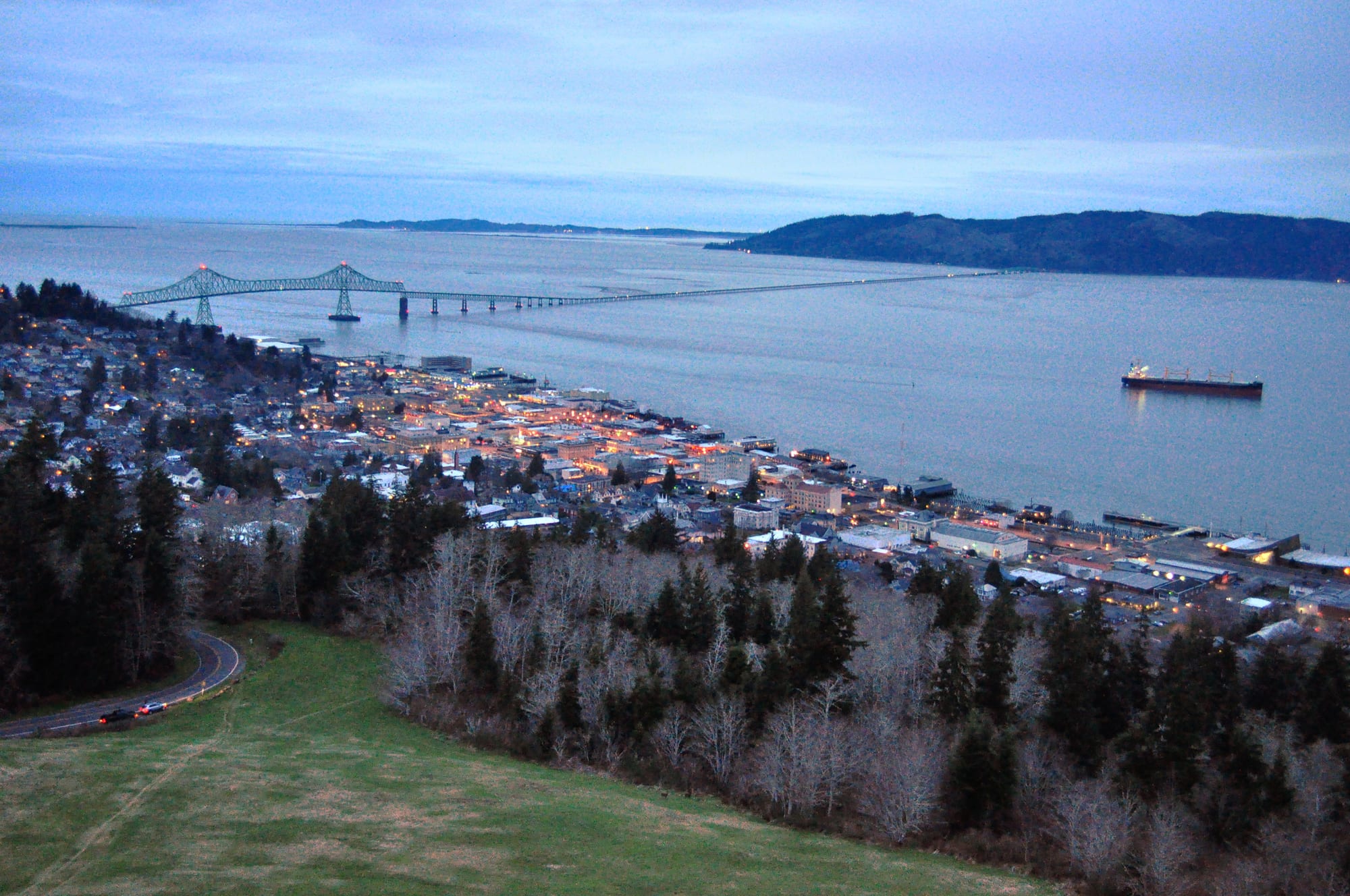
Lit-up downtown Astoria along the wide Columbia River at dusk, with the long Astoria–Megler Bridge and a cargo ship at anchor

The Pacific Northwest, United States

Astoria

Downtown Astoria and the Astoria–Megler Bridge over the Columbia River, seen from the Astoria Column at dusk. (Joe Mabel / Wikimedia Commons · CC BY 3.0)

A port town on a steep hillside near the mouth of the Columbia River in north-west Oregon, founded in 1811 as a fur-trading post and later built on salmon canning. Today its Victorian houses, old cannery piers and working waterfront draw visitors for maritime history, seafood, breweries and the wild coast nearby.

Neighbourhoods

  • Downtown
    • First-time visitors
    • Best for food
    • Historic district

    The flat grid along the river, rebuilt after a fire in 1922, with shops, cafés, brewpubs and the old theatres. The riverwalk and the waterfront piers are a block or two away.

    Open in Maps
  • The hillside
    • Historic homes
    • Viewpoints
    • Quiet and residential

    Steep streets climbing from downtown towards Coxcomb Hill, lined with Victorian and Queen Anne houses built for sea captains, cannery owners and merchants, many restored. The views over the river are the reward for the climb.

    Open in Maps
  • Uppertown
    • Breweries
    • Sea lions
    • Waterfront

    The eastern end of the waterfront, beyond the maritime museum, with the Uppertown Firefighters Museum, the East Mooring Basin where sea lions haul out, and the eastern end of the riverwalk.

    Open in Maps
  • Uniontown
    • Close to the bridge
    • Local life

    The west end of town below the approach to the Astoria–Megler Bridge, historically home to Nordic fishing families, with older houses, small restaurants and the start of the riverwalk.

    Open in Maps

Things to do

Landmarks and history

  • Astoria Columnviewpoint

    A 1926 concrete tower on Coxcomb Hill decorated with a spiral frieze of the region's history, with a staircase to a viewing platform over the river mouth, the bridge and the coast.

    Open in Maps
  • Astoria–Megler Bridgelandmark

    The bridge of 1966 that crosses the mouth of the Columbia to Washington, more than four miles long, with a high steel span over the shipping channel at the Oregon end.

    Open in Maps
  • Flavel Housemuseum

    The 1880s Queen Anne mansion of a Columbia River bar pilot and businessman, now a house museum.

    Open in Maps

Museums

  • Columbia River Maritime Museummuseum

    The town's main museum, on the riverfront, telling the story of the Columbia River Bar, shipwrecks, the Coast Guard and the salmon fishery, with the lightship Columbia moored outside.

    Open in Maps
  • Oregon Film Museummuseum

    A small museum in the old county jail, which appears in The Goonies, about films shot in Oregon.

    Open in Maps

The waterfront

  • Astoria Riverfront Trolleyattraction

    A restored early 20th-century streetcar that runs in the warmer months along the old railway line by the river, beside a paved riverwalk past piers and canneries.

    Open in Maps

Short trips from the town

  • Fort Clatsoplandmark

    A reconstruction of the fort where the Lewis and Clark Expedition spent the winter of 1805–06, part of Lewis and Clark National Historical Park.

    Open in Maps
  • Fort Stevens State Parkpark

    A large park around an old coastal fort at the river mouth, with beaches, forest trails and the rusting wreck of the Peter Iredale on the sand.

    Open in Maps
  • Cape Disappointment State Parkpark

    Across the bridge in Washington, a headland at the river mouth with two lighthouses, forts and a Lewis and Clark interpretive centre.

    Open in Maps
  • Cannon Beachbeach

    A beach town to the south, known for the tall sea stack of Haystack Rock standing off its long sandy shore.

    Open in Maps

Seasonal events

  • FisherPoets Gatheringlate February

    A weekend of poetry, songs and stories by commercial fishermen and women, held in bars and halls around town.

  • Scandinavian Midsummer FestivalJune

    A long-running celebration of the Scandinavian heritage brought to the town and the North Coast by emigrants.

Eat and drink

Long-standing places and food districts in Astoria. Hours, ratings and directions come from your maps app, always current.

Astoria classics

  • Bowpicker Fish and Chipsrestaurant

    A fish-and-chips stand inside an old gillnet boat parked across from the maritime museum, serving albacore tuna fried in batter.

    Open in Maps
  • Fort George Breweryrestaurant

    A downtown brewpub, one of the town's best-known breweries.

    Open in Maps
  • Buoy Beerrestaurant

    A brewery and restaurant on the riverfront, where seals or sea lions can sometimes be seen on the rocks below through a glass floor panel.

    Open in Maps

Markets and districts

  • Astoria Sunday Marketmarket

    A street market downtown on Sundays from May to October, with farm produce, crafts and food stalls.

    Open in Maps
  • Downtown seafood restaurantsneighborhood

    Restaurants and cafés across downtown and along the waterfront serving Dungeness crab, salmon, oysters, chowder and fish and chips.

    Open in Maps

Experience Astoria

History

The Clatsop and Chinook peoples lived around the mouth of the Columbia for thousands of years, trading and fishing for salmon. Captain Robert Gray sailed into the river in 1792, and in the winter of 1805–06 the Lewis and Clark Expedition camped at Fort Clatsop, a few miles south-west of the present town. In 1811 John Jacob Astor's Pacific Fur Company built Fort Astoria here, the first permanent American settlement west of the Rocky Mountains. During the War of 1812 it was sold to the British North West Company and renamed Fort George, and it was returned to American control after the war.

The town grew slowly until the salmon canning boom of the later 19th century, when dozens of canneries operated along the river and the town grew quickly. Chinese workers staffed the canneries, while Finnish, Swedish, Norwegian and other immigrants fished the river in small gillnet boats. Pilots guided ships across the Columbia River Bar, one of the most dangerous river entrances in the world, and sea captains and merchants built large houses on the hill.

A fire in 1922 destroyed much of downtown, which was rebuilt over the following years. The salmon runs declined through the 20th century and the canneries closed one by one; Bumble Bee shut its last Astoria cannery in 1980. Astoria then turned towards tourism, helped by its film locations — The Goonies of 1985 above all — and by the restoration of its old buildings, while the port, fishing and the bar pilots remain part of its economy.

Culture & Customs

Astoria's identity is maritime. The Columbia River Bar, ships waiting to cross it, the pilots and the Coast Guard are constant presences, and the maritime museum is the town's main institution. The fishing tradition is celebrated each winter at the FisherPoets Gathering, where people from the industry read poetry and sing songs about the work.

The town's Scandinavian and Finnish heritage is marked by the Scandinavian Midsummer Festival in June and by old halls and churches, and the Chinese contribution to the canneries is remembered in a garden by the river. Astoria has also become something of a destination for artists and craftspeople, with galleries and a performing-arts scene in its restored theatres.

Films have given the town a second identity: The Goonies, Kindergarten Cop and Short Circuit were all shot here, and Goonies fans still visit the locations. Locals are informal, outdoorsy and proud of the weather-beaten character of the place, and conversation often turns to fishing, ships and the rain.

Daily Life

About 10,000 people live in Astoria at the 2020 census, and it is the county seat of Clatsop County. The economy has shifted from canning and timber towards tourism, health care, education, government and the port, with fishing and seafood processing still important. A community college and a branch of the state university's seafood research programme are in town.

Most residents live on the hillside streets above downtown or in the older districts at each end of the waterfront, in wooden houses with views of the river. Ships passing to and from Portland and the Columbia ports are a constant sight, and fog horns and sea lions are part of the soundscape.

Housing costs, short-term rentals and a shortage of homes for workers are local concerns, as is the town's vulnerability to earthquakes and tsunamis from the Cascadia Subduction Zone offshore. The rain sets the rhythm of much of the year, and the long summer evenings bring everyone out to the riverwalk.

Food

Astoria's food comes from the river and the ocean. Dungeness crab, salmon, albacore tuna, rockfish and oysters from nearby bays appear on menus across town, often as clam chowder, fish and chips or simply grilled. Fish and chips made with albacore tuna is a local favourite, and smoked salmon is sold in fish markets and delis.

The town's brewing scene is one of the most active on the Oregon coast, with brewpubs in restored downtown buildings and old cannery piers, and local beer is part of almost every meal out. The Finnish and Scandinavian past survives in pastries, pickled fish and festival food, and coffee roasters and bakeries are scattered through downtown.

The Sunday market brings farm produce from the valleys to the south and east, along with berries in summer. Cranberries are grown in bogs along the coast nearby, and blackberries grow wild along the roads and trails in late summer.

Planning tools

Budget

Astoria is cheaper than the beach towns further down the coast, and food and beer are reasonably priced. Rooms are the main cost and rise on summer weekends and during festivals. A car is useful for the forts, beaches and Lewis and Clark sites around the river mouth.

Daily Budget Midrange
USD 220–400 (mid-range lodging, seafood dinners, museum tickets, a hire car)
Daily Budget Shoestring
USD 90–150 (hostel bed or budget motel, fish and chips and brewpub meals, local buses)

The riverwalk, the hillside streets and the views from Coxcomb Hill cost nothing.

Best Time to Visit

July to September is the driest and sunniest time, though fog can roll in from the ocean. Spring and autumn are quieter and often mild between showers. Winters are wet and windy, with dramatic storms and big swells at the river mouth, and the town is at its quietest.

Suggested Number of Days

The town itself fills a day or two. Three or four days allow for the forts, beaches and historic sites around the river mouth and on the Washington side, and for the coast to the south. Bad weather in winter can slow travel.

First Visit
1–2 days
With Surroundings
3–4 days

Transportation

Downtown and the waterfront are easy on foot, and the riverfront trolley runs along the waterfront in season. A regional bus network links Astoria with Warrenton, Seaside and Cannon Beach, but a car is more practical for the forts, parks and beaches.

The hillside streets are very steep; in wet weather allow extra time and take care on slick pavements.

Airport & Station Connections

Most visitors drive from Portland, along US Route 30 by the Columbia or via US Route 26 and the coast highway. Portland International Airport is the nearest major airport. Buses link Astoria with Portland and coastal towns, and cruise ships call at the port.

Walkability

The flat downtown grid and the riverwalk are easy to walk, and most restaurants, museums and breweries are within a mile of each other. The hillside is very steep, and the walk up to the Astoria Column is a stiff climb; most people drive or take a taxi.

Safety

Astoria is generally safe, with petty theft and car break-ins the main concerns. The real dangers are natural: the river mouth and nearby beaches have strong currents, sneaker waves and cold water, and the town is in a tsunami zone along the coast.

On nearby beaches keep watching the ocean, stay away from logs in the surf, and note tsunami evacuation signs near the water. Check current official travel advice before travelling.

Climate

A mild, very wet marine climate. Rain falls on many days from October to May, while summers are cool, often foggy in the morning and much drier. Snow is uncommon.

Summer
cool and mostly dry — August afternoons are usually in the upper 60s °F
Winter
mild, wet and windy — January days around 50°F, nights in the upper 30s °F, with frequent heavy rain

Local Customs

The town is relaxed and working-class at heart, with fishing, the port and the pilots still part of everyday life. Dress is casual and waterproof. Tipping is expected, roughly 18–20 per cent in restaurants. Oregon has no sales tax, so prices are what is paid.

The legal age for buying alcohol is 21. Cannabis is legal for adults in Oregon but may not be used in public or taken out of the state.

Common Payment Methods

The currency is the US dollar. Cards and contactless payment are accepted almost everywhere and ATMs are common downtown. Cash is useful at market stalls, food carts and the trolley.