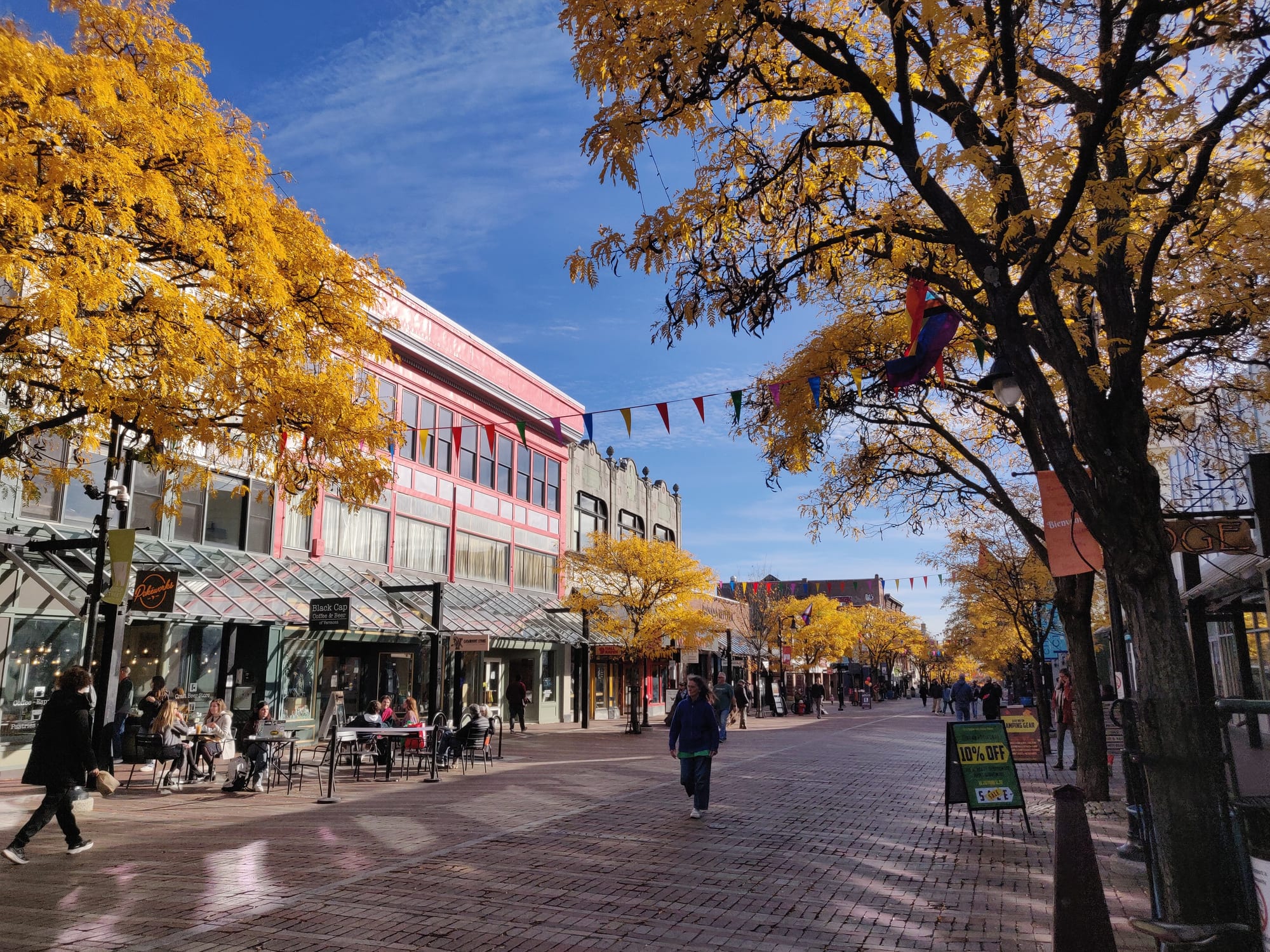
Brick-paved Church Street Marketplace under yellow autumn trees, with café tables, bunting and a pink three-storey building on the left

New England, United States

Burlington

Church Street Marketplace, the pedestrian street at the centre of downtown Burlington, in October. (Sdkb / Wikimedia Commons · CC BY-SA 4.0)

Vermont's largest city, on a hillside above Lake Champlain with the Adirondacks across the water and the Green Mountains behind. A 19th-century lumber port that became a university town, it is known today for the brick pedestrian street at its centre, a long lakeside path, a strong local-food and craft-beer culture and a progressive politics that once elected Bernie Sanders as mayor.

Neighbourhoods

  • Downtown and Church Street
    • First-time visitors
    • Best for food
    • Nightlife

    The grid of streets between the university hill and the lake, centred on the four brick-paved blocks of Church Street Marketplace, closed to cars since 1981. Shops, restaurants, bars, street performers and the Flynn theatre are all here, and most of the city's hotels stand within a few blocks.

    Open in Maps
  • The Waterfront
    • Lake views
    • Walks and cycling
    • Families

    A former railway and industrial shore at the bottom of the hill, remade since the late 1980s as a strip of parks, a marina, a boathouse, the ECHO science centre and the start of the lakeside bike path. Sunsets over the Adirondacks draw crowds in summer.

    Open in Maps
  • Old North End
    • Local life
    • Best for food
    • Budget

    The city's oldest and most densely populated neighbourhood, a grid of wooden houses north of downtown that has long housed newcomers to the city. Small grocers, bakeries and cheap restaurants reflect that mix.

    Open in Maps
  • South End
    • Arts and breweries
    • Street art

    An old industrial district along Pine Street where warehouses and former factories now hold artists' studios, galleries, breweries, a cider house and food trucks. The annual South End Art Hop opens the studios to the public.

    Open in Maps
  • Hill Section and the University
    • Quiet and residential
    • Students
    • Historic homes

    The slope east of downtown, where the University of Vermont's green and the brick and stone buildings of Champlain College stand among tree-lined streets of large 19th-century houses. Student rentals, fraternity houses and quiet family streets sit side by side.

    Open in Maps
  • Winooski
    • Best for food
    • Nightlife
    • Close to public transport

    A small separate city just across the Winooski River, built around a huge brick woollen mill complex now converted to flats and offices. Its roundabout downtown has a cluster of restaurants and bars, and buses run frequently to Burlington.

    Open in Maps

Things to do

Famous landmarks

  • Church Street Marketplacelandmark

    Four blocks of brick pedestrian street between the Unitarian church and Main Street, opened in 1981 and lined with shops, restaurants, outdoor tables and street musicians.

    Open in Maps
  • Flynn Centerattraction

    A refurbished Art Deco former cinema on Main Street, the main venue for touring theatre, music and the city's jazz festival.

    Open in Maps
  • Burlington Union Stationtransit hub

    A 1916 railway station at the bottom of Main Street on the waterfront, back in use since 2022 as the terminus of Amtrak's Ethan Allen Express from New York.

    Open in Maps
  • Ethan Allen Homesteadmuseum

    The farmhouse, built about 1787, of the Green Mountain Boys leader and Vermont founder, in the Winooski River valley on the north edge of the city.

    Open in Maps

Museums and science

  • ECHO, Leahy Center for Lake Champlainmuseum

    A science centre and aquarium on the waterfront devoted to the ecology and history of Lake Champlain, with live fish, reptiles and amphibians from the lake and hands-on exhibits for children.

    Open in Maps
  • Fleming Museum of Artmuseum

    The University of Vermont's museum, in a McKim, Mead & White building on the campus that opened in 1931, with a wide-ranging collection from ancient Egypt to American painting.

    Open in Maps
  • Lake Champlain Maritime Museummuseum

    On the lakeshore at Vergennes, about 20 miles south, a museum of the lake's shipwrecks, canal boats and naval history, with a replica Revolutionary War gunboat.

    Open in Maps

Parks and the waterfront

  • Waterfront Parkpark

    The grassy park along the lake at the foot of downtown, the setting for summer festivals and the classic Burlington sunset over the Adirondacks.

    Open in Maps
  • Burlington Greenway and the Island Line Trailtrail

    A paved lakeside path on a former railway running the length of the city's shore and continuing north on a causeway far out into Lake Champlain, with a seasonal bike ferry across the gap to the Champlain Islands.

    Open in Maps
  • Battery Parkpark

    A bluff-top park above the waterfront where a shore battery fired on British ships in 1813, now a viewpoint for the lake and mountains.

    Open in Maps
  • Oakledge Parkpark

    A lakeside park at the south end of the bike path with a small beach, rocky ledges and picnic lawns.

    Open in Maps
  • North Beachbeach

    The city's main sandy swimming beach on the lake, north of downtown beside a campground, with lifeguards in summer.

    Open in Maps

Markets

  • Burlington Farmers Marketmarket

    A Saturday market of Vermont farmers, cheesemakers, bakers and food stalls, held outdoors in summer and indoors in winter.

    Open in Maps

Short trips from the city

  • Shelburne Museummuseum

    About 7 miles south, a large museum of American art and folk art spread over 39 buildings, many of them historic, on 45 acres, including a steamboat, a lighthouse and a round barn.

    Open in Maps
  • Shelburne Farmsattraction

    A 1,400-acre former Vanderbilt-Webb estate on the lake at Shelburne, now a working farm and education centre with walking trails, a cheese dairy and a grand house.

    Open in Maps
  • Mount Philo State Parkviewpoint

    Vermont's first state park, about 14 miles south, with a short road or trail to a summit view over the Champlain Valley and the Adirondacks.

    Open in Maps
  • Stowe and Mount Mansfieldattraction

    A ski village beneath Vermont's highest mountain, about 25 miles east, with hiking, the Smugglers' Notch road and autumn colour.

    Open in Maps
  • Lake Champlain Islandsattraction

    A chain of flat, farmed islands in the northern lake reached by causeway or bike ferry, with orchards, vineyards and quiet shoreline.

    Open in Maps

Seasonal events

  • Vermont City Marathonlate May

    A marathon and relay run through the city's neighbourhoods and along the lake since 1989.

  • Burlington Discover Jazz FestivalJune

    Concerts over the first two weeks of June at the Flynn, in clubs and on Church Street and the waterfront — the largest event of its kind in Vermont.

  • Independence Day on the waterfrontearly July

    Fireworks over Lake Champlain, launched from a barge in the bay on the evening of 3 July and watched from Battery Park and the waterfront.

  • South End Art Hoponce a year

    A weekend when studios, galleries and warehouses along Pine Street open to the public.

Eat and drink

Long-standing places and food districts in Burlington. Hours, ratings and directions come from your maps app, always current.

Burlington classics

  • Al's French Frysrestaurant

    A South Burlington restaurant serving hand-cut fries, burgers and hot dogs since 1946, named an "America's Classic" by the James Beard Foundation in 2010.

    Open in Maps
  • Creemee standsrestaurant

    Vermont's soft-serve ice cream, called a creemee, is sold at seasonal stands and on the waterfront; the maple flavour is the one to try.

    Open in Maps

Food districts and markets

  • Church Street and the downtown blocksneighborhood

    The city's densest stretch of restaurants, pubs and cafés, spilling onto the pedestrian street and the side streets down to the lake, from farm-to-table dining rooms to pizza and pubs.

    Open in Maps
  • Pine Street breweriesneighborhood

    The South End's warehouses hold several of the city's breweries and a cider house, with taprooms, food trucks and the galleries of the arts district alongside.

    Open in Maps
  • Burlington Farmers Marketmarket

    Saturday stalls of Vermont cheese, maple syrup, bread, vegetables and prepared food from across the Champlain Valley.

    Open in Maps
  • Winooski's restaurantsneighborhood

    The small mill city across the river has a compact cluster of restaurants and bars around its central traffic circle, often less crowded than downtown Burlington.

    Open in Maps

Experience Burlington

History

The Abenaki lived and fished along this shore long before the land was granted by New Hampshire's governor, Benning Wentworth, in 1763 to Samuel Willis and 63 others. Settlers began clearing land in 1775, but the Revolutionary War delayed permanent settlement until after it ended, and Ira Allen founded the University of Vermont in 1791, the year Vermont became the fourteenth state. Lake Champlain gave the town its purpose: the Champlain Canal to the Hudson opened in 1823, and Burlington became a port of entry and a centre of trade. During the War of 1812 a shore battery on the bluff above the harbour exchanged fire with British ships.

The railway arrived in 1849, and the second half of the 19th century was Burlington's industrial age. Canadian lumber came across the lake to be planed and shipped on, and for a time the town was the third-largest lumber market in the world; the woollen mills at Winooski Falls drew workers across the river. The city was incorporated in 1865 and acquired its brick business blocks, its mansions on the hill and the Union Station of 1916.

The lumber trade faded in the 20th century and the waterfront decayed into railway yards and oil tanks. Recovery came from the university, from IBM's plant in nearby Essex Junction, and from a wave of newcomers in the 1960s and 1970s who gave Vermont its progressive politics. Bernie Sanders, elected mayor by ten votes in 1981, served four terms and oversaw the Church Street Marketplace and the beginning of the waterfront's return to public use. Ben and Jerry's first ice cream shop opened in a former petrol station downtown in 1978. Today the city is Vermont's commercial, medical and educational centre.

Culture & Customs

Burlington is a university town of about 45,000 that behaves like a much larger city. The University of Vermont and Champlain College fill it with students from late August to May, and the Flynn, a refurbished Art Deco former cinema on Main Street, anchors a music and performing-arts scene out of proportion to the population. The band Phish formed at the university in 1983, and the Burlington Discover Jazz Festival takes over the Flynn, the clubs, Church Street and the waterfront for the first two weeks of every June.

Politics is part of the culture. The city has a long progressive tradition, elected the independent socialist Bernie Sanders as mayor in 1981, and has been a pioneer in municipal renewable energy: the city's electricity comes entirely from hydro, wind, solar and wood. Environmentalism is everyday behaviour rather than a cause: composting is widespread, farmers' markets thrive, and the local-food movement that spread across the United States has deep roots here.

The outdoors sets the rhythm. People sail, paddle and swim in the lake in summer, cycle the Island Line Trail, ski at Stowe, Bolton Valley and Smugglers' Notch in winter, and treat the first sunny day of spring as a holiday. The South End's annual Art Hop and a busy studio and gallery culture along Pine Street show the city's artistic side. Manners are informal, friendly and understated in the Vermont way: people dress down, talk to strangers in queues and are quietly proud of their small state.

Daily Life

About 45,000 people live in the city itself and about 168,000 in Chittenden County, which includes South Burlington, Winooski, Essex and Colchester — over a quarter of Vermont's population. The University of Vermont and its medical centre are the largest employers, with GlobalFoundries' semiconductor plant at Essex Junction, state and federal offices, Burton Snowboards, and a cluster of small technology, food and craft-beverage companies behind them. Tourism matters but does not dominate as it does in Stowe or on the coast.

Housing is the pressing issue. A small city hemmed in by the lake and the university, with a large student population, Burlington has a tight rental market and high housing costs. Residents live in the wooden triple-deckers and single-family houses of the Old North End and South End, the larger homes of the Hill Section, and the newer suburbs over the city line.

The day is shaped by the seasons more than by commuting, which is short. Summer evenings end on the waterfront or a Church Street patio; winter means shovelling snow, skiing at the weekend and dark afternoons. The Saturday farmers' market, a strong cycling culture, and a Vermont habit of knowing one's farmer and one's brewer set the tone.

Food

Vermont's food identity is strongest in its largest city. Maple syrup appears in everything from breakfast to beer, and the creemee — the state's name for soft-serve ice cream, best in maple flavour — is sold from stands and waterfront windows from spring to autumn. Cheddar from Cabot and the state's many small creameries, apples and cider from the Champlain Valley orchards, and vegetables from the Intervale farms along the Winooski River are the local staples, and the farm-to-table idea is simply how restaurants here cook.

Ben and Jerry's began in a renovated petrol station downtown in 1978, and its factory at Waterbury, opened in 1985, offers public tours. Al's French Frys in South Burlington has served hand-cut fries since 1946. The Old North End adds the food of its immigrant communities in small grocers, bakeries and restaurants.

Beer is a serious matter. Vermont is known for its craft breweries, and the South End's warehouses along Pine Street hold several of Burlington's, together with a cider house; the Vermont Brewers Festival is held in the city each July. Church Street and the blocks running down to the lake hold the densest concentration of restaurants in the city, from farmhouse-style dining rooms to pizza, pubs and bakeries, and the Saturday farmers' market gathers the whole Champlain Valley's producers in one place.

Planning tools

Budget

Burlington is cheaper than Boston or the coast but not cheap: hotel rooms are limited and rise sharply in the autumn foliage weeks, at university graduation in May and for the summer festivals. Food is good value for the quality, and the waterfront, the bike path and Church Street cost nothing.

Daily Budget Midrange
USD 230–400 (downtown hotel or inn, restaurant dinners, museum tickets, bike hire or a rental car for the surroundings)
Daily Budget Shoestring
USD 100–160 (hostel bed or budget motel, pizza, creemees and market food, buses and walking)

Book months ahead for late September to mid-October and for graduation weekend; South Burlington motels near the airport are the cheaper option.

Best Time to Visit

June to early October. Summer brings the festivals, swimming, sailing and long evenings on the waterfront; late September and early October bring foliage in the Green Mountains and crowds to match. Winters are long, cold and snowy, with skiing an hour away, and the city empties a little when the university is out.

Suggested Number of Days

The city itself fills a day or two. Add two or three more for the museums and farms along the lake to the south, the Champlain Islands and the mountains to the east, most of which need a car.

First Visit
1–2 days
With Surroundings
3–4 days

Transportation

Downtown and the waterfront are covered on foot. Green Mountain Transit buses run from the downtown transit centre to the university, the airport, Winooski and the suburbs. Bike hire is common, and the lakeside path is the pleasant way north or south. A car is needed for Shelburne, the islands and the mountains; parking downtown is in garages and metered streets.

Rent a bike for the Island Line Trail and check the bike ferry season before riding to the islands.

Airport & Station Connections

Burlington International Airport is in South Burlington, about 3 miles east of downtown — ten to fifteen minutes by taxi or bus — with flights to the main east-coast hubs. Amtrak's Ethan Allen Express runs daily from New York to the waterfront station in about seven and a half hours, and the Vermonter stops at Essex Junction a few miles east. Montreal is about two hours north by road, Boston about three and a half hours south-east.

Walkability

Compact and walkable, though hilly: the university sits well above the lake and the climb back up from the waterfront is steep. Church Street, the waterfront, the Old North End and the South End are all within a mile or so of each other, and the bike path makes the shore easy. Pavements are often snowy or icy from December to March.

Safety

Burlington is a small, generally safe city, and violent crime against visitors is rare; the usual city precautions against petty theft apply. The lake is cold outside high summer and the weather in the mountains changes quickly.

Lock bikes properly, keep valuables out of parked cars, and take care on the hilly streets in ice. Check current official travel advice before travelling.

Climate

A humid continental climate with long, snowy winters and warm summers, moderated a little by the lake. Spring is late and muddy; autumn is crisp and clear.

Summer
warm — July averages about 72°F, warmer in the afternoons, with cool lake breezes and occasional thunderstorms
Winter
cold and snowy — January averages about 21°F, nights can fall well below zero, and about 86 inches of snow a year

Local Customs

Tipping is expected: 18–22 per cent in restaurants, a dollar or two a drink. Prices usually exclude sales tax. The city is informal and outdoorsy — fleece and boots are fine almost everywhere — and strongly environmentalist, with composting and recycling expected. Residents are proud of local food and of their politics, and conversation about either is welcome.

The drinking age is 21 and identification is asked for; cannabis is legal for adults in Vermont but not in public places.

Common Payment Methods

The currency is the US dollar. Cards and contactless payment are accepted almost everywhere, including at the farmers' market, though a little cash is useful for creemee stands and small vendors. ATMs are common downtown. Canadian dollars are not generally accepted despite the border being under an hour away.