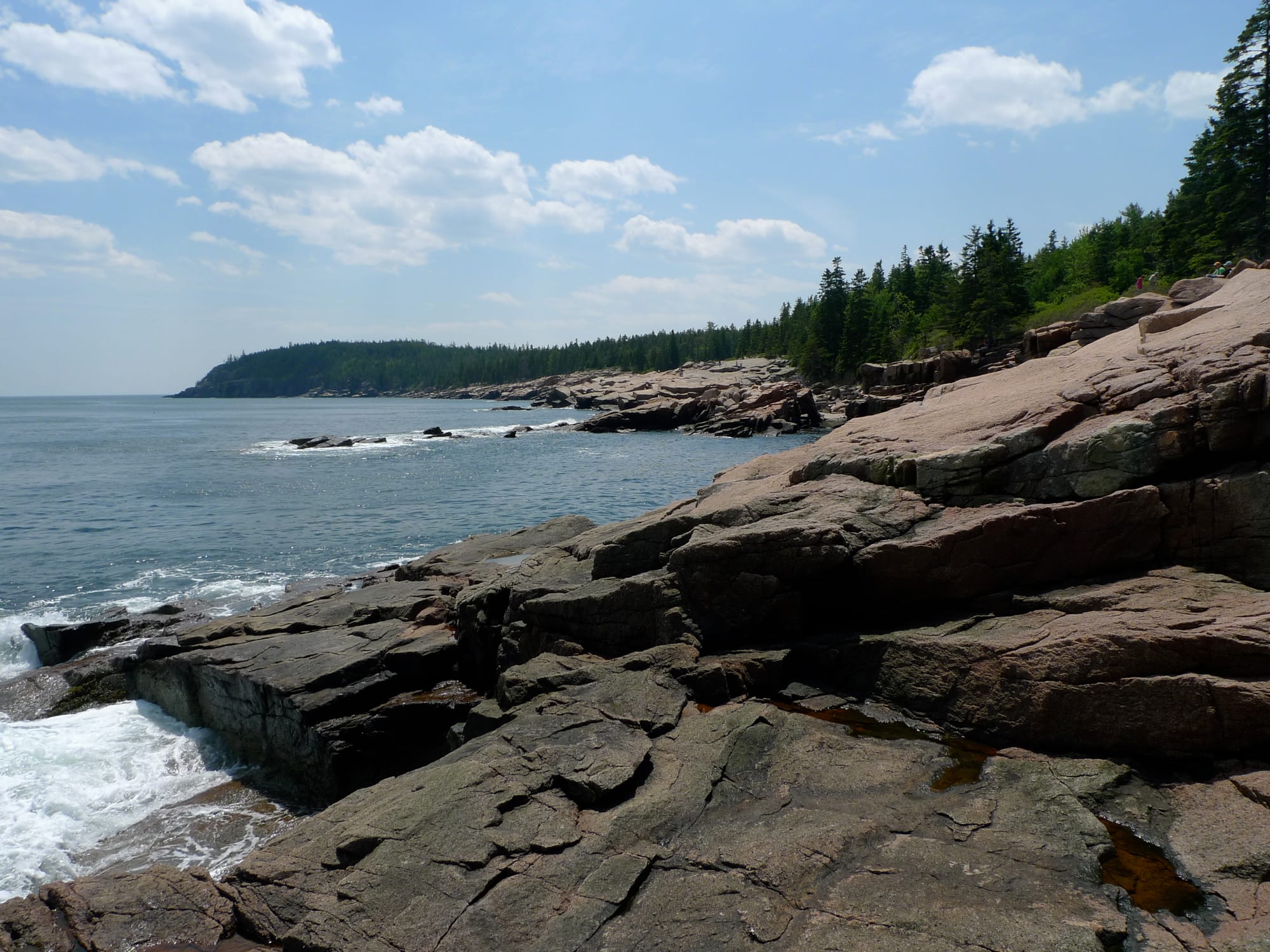
Pink granite ledges meeting a calm blue sea, with a spruce-covered headland under white summer clouds

United States

New England

The granite shoreline of Acadia National Park on Mount Desert Island, Maine. (Nadya Peek / Wikimedia Commons · CC BY 2.0)

The six states of the far north-east — Maine, New Hampshire, Vermont, Massachusetts, Rhode Island and Connecticut — where the Pilgrims landed and the Revolution began, now a region of old colonial towns, elite universities, rocky Atlantic coast, wooded mountains and some of the country's most famous autumn colour.

Explore New England

History

Algonquian-speaking peoples — the Wampanoag, Massachusett, Narragansett, Pequot, Mohegan, Abenaki, Penobscot and Passamaquoddy among them — farmed, fished and hunted here for thousands of years. Epidemics brought by European traders killed a large share of the coastal population shortly before the Pilgrims landed at Plymouth in 1620. Puritans founded Boston in 1630 as the centre of the Massachusetts Bay Colony, Roger Williams founded Providence in 1636 as a refuge for religious dissenters, and Connecticut grew along its river valley. Wars with Native nations, above all the Pequot War of 1636–38 and King Philip's War of 1675–78, broke Indigenous power in southern New England.

Boston led resistance to British rule: the Boston Massacre of 1770, the Boston Tea Party of 1773 and the first shots of the Revolutionary War at Lexington and Concord in April 1775. Vermont was briefly an independent republic before joining the Union in 1791, and Maine split from Massachusetts in 1820.

In the 19th century New England became the cradle of American industry, with water-powered textile mills at Pawtucket, Lowell and Manchester, while whaling made New Bedford and Nantucket rich. Boston was a centre of the abolitionist movement, and Irish, French-Canadian, Italian and Portuguese immigrants filled the mill towns. When the mills moved south in the 20th century, the region reinvented itself around universities, hospitals, finance, insurance and technology.

Culture & Customs

New Englanders have a reputation for reserve, thrift and dry humour, and for a strong attachment to local self-government: many towns in Vermont, New Hampshire and Maine still decide budgets at an annual town meeting. New Hampshire guards its first-in-the-nation presidential primary. The Boston accent, which drops the "r" after vowels, and the all-purpose intensifier "wicked" are regional markers, though they are fading among younger people.

The white Congregational church on the town green is the classic image, but waves of Irish, Italian, French-Canadian and Portuguese immigration made the region heavily Catholic, and Cape Verdean and Portuguese communities remain strong in New Bedford and Fall River. Harvard, Yale, Brown and Dartmouth give the region an outsized academic culture, and its literary tradition runs from Emerson and Thoreau in Concord to Emily Dickinson in Amherst and Mark Twain in Hartford.

Sport is close to a civic religion in Boston, where the Red Sox rivalry with the New York Yankees is widely considered the fiercest in American sport. The Boston Marathon is run on Patriots' Day in April, and the Head of the Charles rowing regatta fills the river each October. Autumn "leaf peeping", maple sugaring in early spring and country fairs mark the rural calendar.

Daily Life

About 15 million people live in New England, most of them in southern New England's urban belt. Boston has about 670,000 residents at the centre of a metropolitan area of nearly five million; Worcester, Providence, Springfield, Hartford and New Haven are the other large cities, while the largest city in northern New England, Portland, Maine, has under 70,000 people and Burlington, Vermont, about 45,000.

The economy leans on knowledge work: universities, teaching hospitals and biotechnology clustered in Cambridge, financial firms in Boston, insurance in Hartford, and defence industries in Connecticut and Massachusetts. Further north the picture changes to tourism, forestry, dairy farming, maple syrup — Vermont is the largest producer in the country — and Maine's lobster fishery.

Commuting into Boston by car or train, a coffee from Dunkin' (founded in Quincy, Massachusetts), and winters of snow shovelling shape the routine. Housing costs are the pressing issue across southern New England, while northern New England faces an ageing population and a shortage of workers in its small towns.

Food

The coast defines the menu. New England clam chowder is a creamy soup of clams, potatoes and salt pork; the lobster roll is lobster meat in a toasted bun, served cold with mayonnaise in Maine and warm with butter in Connecticut; and the clambake steams lobster, clams, corn and potatoes together. Fried clams from roadside clam shacks, stuffed quahogs (large hard-shell clams) called stuffies in Rhode Island, and cod and haddock complete the seafood.

Boston's old nickname "Beantown" comes from baked beans slow-cooked with molasses, and the city also gave its name to Boston cream pie, a sponge cake filled with custard and topped with chocolate. Massachusetts cranberry bogs supply Thanksgiving tables, Maine grows wild blueberries and makes whoopie pies, sandwich-like cakes filled with cream, and New Haven is known for its thin, charred pizza, locally called apizza.

Vermont contributes maple syrup, sharp cheddar and a pioneering craft-beer scene, and autumn orchards across the region sell apple cider and cider doughnuts. Rhode Island's official state drink is coffee milk, milk sweetened with coffee syrup.

Attractions & Natural Wonders

Boston packs its history into a walkable centre: the Freedom Trail from Boston Common past Faneuil Hall and the Old North Church to the USS Constitution, the brick streets of Beacon Hill, Fenway Park, the Museum of Fine Arts and the Isabella Stewart Gardner Museum, with Harvard across the river in Cambridge. Short trips lead to Lexington and Concord, Walden Pond, Salem and Plymouth.

South-east of the city, Cape Cod curls into the Atlantic, with the Cape Cod National Seashore's dunes, Chatham and Provincetown at its tip, and the islands of Martha's Vineyard and Nantucket offshore. In Rhode Island, Newport's Gilded Age mansions such as The Breakers line the Cliff Walk, and Providence has a well-kept colonial hill. Connecticut offers Mystic Seaport, Yale in New Haven and the Mark Twain House in Hartford, while the Berkshires in western Massachusetts hold summer music at Tanglewood.

Northern New England is the outdoor half. Vermont's Green Mountains run from Stowe, below Mount Mansfield, to the village of Woodstock, with Burlington on Lake Champlain. New Hampshire's White Mountains rise to Mount Washington, reached by road or cog railway, with Franconia Notch and the Kancamagus Highway famous in autumn. Along the Maine coast, Portland Head Light, Kennebunkport and Camden lead to Acadia National Park, where Cadillac Mountain and the carriage roads overlook Bar Harbor; inland, Baxter State Park's Mount Katahdin marks the northern end of the Appalachian Trail.

Cities in New England

Planning basics

Budget

New England sits at the expensive end of the US scale. Boston and Cambridge hotels are among the dearest in the country, and Cape Cod, Nantucket, Martha's Vineyard, Newport and coastal Maine charge peak prices in July, August and the October foliage season. Inland Maine, New Hampshire and Vermont, and cities such as Providence, Hartford and Worcester, are noticeably cheaper.

Daily Budget Midrange
USD 260–500 (mid-range hotel or inn, restaurant dinners with tax and tip, rental car, museum and ferry tickets)
Daily Budget Shoestring
USD 110–180 (hostel or motel, diners and clam shacks, buses and commuter rail, state-park camping)

Book summer weekends on the Cape and islands and foliage weekends in Vermont and New Hampshire months ahead; midweek rates are much lower.

Safety

New England has some of the lowest crime rates in the country. The practical risks are winter driving, sudden weather changes on the high summits, cold water off the Maine coast, moose on rural roads at dusk, and ticks carrying Lyme disease, named after the town of Lyme in Connecticut.

Check the Mount Washington forecast before hiking, drive slowly at night in moose country, and check for ticks after walks in the woods. Check current official travel advice before travelling.

Climate

Humid continental, with four distinct seasons. The south coast is milder, while northern Maine, the Green Mountains and the White Mountains have long, snowy winters. Nor'easters bring heavy snow or rain and coastal flooding, and Mount Washington is known for some of the most severe weather in the country. The ocean stays cool even in August north of Cape Cod.

Summer
warm and sometimes humid, 75–86°F in the south and inland, cooler on the Maine coast and in the mountains
Winter
cold and snowy, around 14 to 37°F, colder in northern Maine and at altitude

Transportation

Boston's Logan Airport is the main gateway. Amtrak links Providence, Boston and New Haven on the Northeast Corridor to New York, and a line runs north to Portland, Maine; Boston has the MBTA subway and commuter rail. Ferries from Hyannis and Woods Hole serve Nantucket and Martha's Vineyard. The mountains, the Maine coast and rural Vermont need a car, and distances are short compared with the rest of the country.

Skip a car in Boston, where parking is expensive and the T covers the sights, and pick one up when heading for the Cape, the mountains or Maine.

Best Time to Visit

Late September to mid-October is the classic season, when the maples and birches turn, starting in the north and at altitude and moving south. June to August is beach and island season and the only time much of coastal Maine is fully open. Winter suits skiers in Vermont, New Hampshire and Maine; spring is short and muddy, though Boston is pleasant in May.