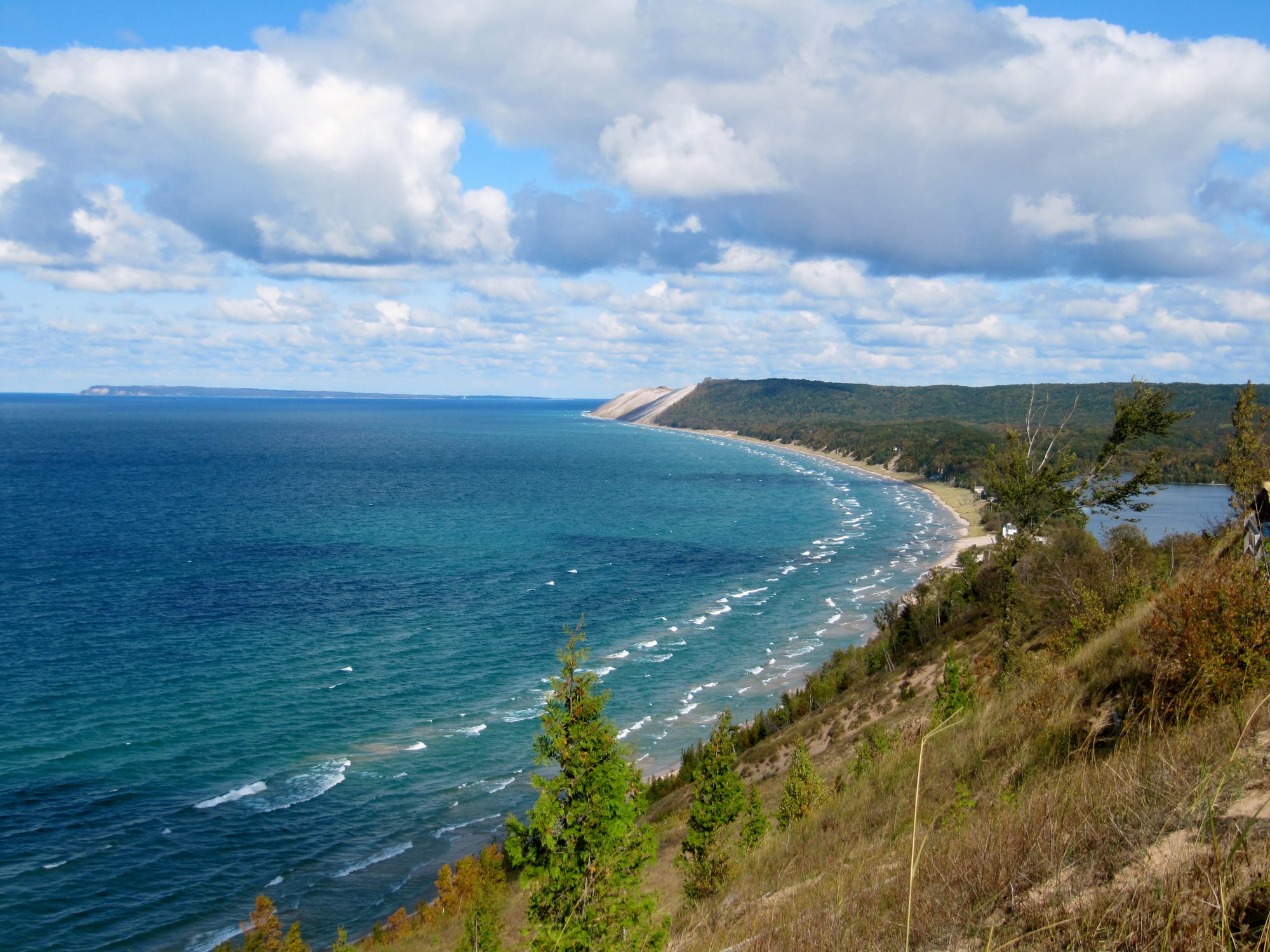
A long curving beach and high sand bluff beside the blue-green water of Lake Michigan, seen from a grassy hillside

United States

Chicago & the Great Lakes

Lake Michigan and the Sleeping Bear Dunes National Lakeshore from the Empire Bluffs Trail, Michigan. (Rachel Kramer / Wikimedia Commons · CC BY 2.0)

The six states wrapped around the western Great Lakes — Ohio, Indiana, Illinois, Michigan, Wisconsin and Minnesota — once the country's industrial heartland of cars, steel and meatpacking, anchored by Chicago and ringed by freshwater dunes, forested lakeshores, farm country and the canoe wilderness of northern Minnesota.

Explore Chicago & the Great Lakes

History

The Adena and Hopewell peoples raised earthworks across Ohio, and the Mississippian city at Cahokia in Illinois was the largest pre-Columbian settlement north of Mexico. At European contact the region was home to the Anishinaabe peoples — Ojibwe, Odawa and Potawatomi — the Ho-Chunk, Menominee, Dakota, Miami, Shawnee and others. French explorers and fur traders arrived in the 17th century; Jacques Marquette and Louis Jolliet travelled the upper Mississippi in 1673, and Antoine de la Mothe Cadillac founded Detroit in 1701.

Britain took the area in 1763, and after independence it became the Northwest Territory, where the Northwest Ordinance of 1787 banned slavery. Native nations resisted American expansion in a series of wars, including Tecumseh's confederacy in the War of 1812; treaties then stripped them of most of their land, and after the Dakota War of 1862 in Minnesota, 38 Dakota men were hanged at Mankato, the largest mass execution in US history. Ohio was a key route on the Underground Railroad, and Illinois sent Abraham Lincoln from Springfield to the White House.

Canals and railways turned Chicago from a small settlement in the 1830s into a giant of meatpacking, grain and steel; it rebuilt after the Great Fire of 1871 and hosted the World's Columbian Exposition in 1893. Henry Ford's moving assembly line made Detroit the car capital of the world, while Cleveland, Akron, Gary, Milwaukee and Minneapolis grew on oil, tyres, steel, beer and flour. The Great Migration brought Black southerners north. From the 1970s factory closures created the Rust Belt, and Detroit filed for bankruptcy in 2013. In 2020 the murder of George Floyd by a police officer in Minneapolis set off protests across the country and beyond.

Culture & Customs

The Midwest is known for a friendly, understated manner — "Minnesota nice" is the best-known label — and for humour aimed at its own weather. German, Scandinavian, Polish, Irish and Dutch settlement shaped towns and churches, and more recent communities stand out: Arab Americans in Dearborn, Hmong and Somali residents in the Twin Cities, and large Mexican American neighbourhoods in Chicago.

Music runs deep. The electric Chicago blues of Muddy Waters and Chess Records came out of the Great Migration, house music was born in Chicago clubs in the 1980s, Detroit gave the world Motown and techno, and Prince made Minneapolis a music city. Chicago's architecture tradition — the early skyscraper, the Prairie School of Frank Lloyd Wright — is a point of civic pride.

Sport is a regional religion: the Ohio State–Michigan football rivalry, the community-owned Green Bay Packers and their "cheesehead" fans, the Chicago Cubs at Wrigley Field and the Indianapolis 500 on Memorial Day weekend. State fairs are huge social events, Wisconsin keeps its supper clubs and Friday fish fries, and "going up north" to a lake cabin is a summer ritual. Several of these states are closely divided at elections, and their votes are often watched nationally.

Daily Life

About 53 million people live in these six states. Chicago has about 2.7 million residents and a metropolitan area of over nine million, the third largest in the country. Columbus and Indianapolis each have close to 900,000, Detroit about 630,000, well down from its 1950s peak, Milwaukee around 570,000, and Minneapolis and St. Paul together about 740,000; Cleveland, Cincinnati and Madison are other major cities.

Manufacturing is still more important here than in most of the country, above all cars and parts around Detroit and in Ohio and Indiana. Chicago is a centre of finance, commodity trading, law and logistics; Minneapolis is home to Target and other large companies; and the region has major medical centres, including the Mayo Clinic in Rochester, Minnesota, and the Cleveland Clinic. Corn and soybeans cover Illinois, Indiana and Ohio, and Wisconsin calls itself "America's Dairyland".

Winter shapes the year, with snow shovelling, heated garages and long indoor months, followed by an outdoor summer on the lakes. Shrinking populations in older industrial cities, ageing water systems — laid bare by the Flint water crisis of 2014 — and the shift of the car industry to electric vehicles are current concerns.

Food

Chicago has three signature dishes: deep-dish pizza, baked in a high-sided pan with cheese under the tomato sauce; the Chicago hot dog, dressed with mustard, onion, bright green relish, tomato, a pickle spear, hot sport peppers and celery salt, but no ketchup; and the Italian beef sandwich, thin-sliced roast beef soaked in its juices. Detroit contributes square, crisp-edged Detroit-style pizza and the coney dog, a hot dog under meat chilli, and Cincinnati its chilli, a cinnamon-spiced meat sauce served over spaghetti.

Wisconsin is cheese country, from cheddar to squeaky fresh cheese curds, often battered and fried, and eats bratwurst grilled in beer, butter burgers and Racine's kringle, a flat oval of Danish pastry; the brandy old fashioned is its cocktail. Minnesota's comfort food is the hotdish, a casserole topped with tater tots, and the Juicy Lucy, a burger with molten cheese inside; walleye and wild rice come from its lakes, and lutefisk, lye-cured dried cod, appears at Scandinavian church suppers.

Michigan's Upper Peninsula keeps the pasty, a meat-and-vegetable pastry brought by Cornish miners, and the Traverse City area grows tart cherries and wine grapes. Indiana is known for its breaded pork tenderloin sandwich and sugar cream pie. Smoked whitefish from the Great Lakes, Polish paczki doughnuts before Lent and Milwaukee's brewing tradition complete the table.

Attractions & Natural Wonders

Chicago offers the Chicago River architecture cruises, Willis Tower, the Art Institute of Chicago, Millennium Park and its mirrored Cloud Gate, the lakefront beaches and trail, Wrigley Field, and Frank Lloyd Wright's homes in Oak Park. Downstate, Springfield holds Lincoln's home and tomb, and Cahokia Mounds is a UNESCO World Heritage Site.

Michigan's shores are the region's great landscape: Sleeping Bear Dunes above Lake Michigan, Traverse City, Mackinac Island with its horse carriages and no cars, the Mackinac Bridge, the coloured cliffs of Pictured Rocks on Lake Superior, and remote Isle Royale National Park. Across the lake, Wisconsin has Door County's orchards and harbours, the Apostle Islands' sea caves, Milwaukee's lakefront art museum and Frank Lloyd Wright's Taliesin. Indiana Dunes National Park lines Lake Michigan's southern tip.

Detroit has the Motown Museum, the Detroit Institute of Arts and, in Dearborn, The Henry Ford museum. Cleveland has the Rock and Roll Hall of Fame and the Cleveland Museum of Art, with Cuyahoga Valley National Park nearby, the Cedar Point roller coasters at Sandusky and the Lake Erie islands to the west. Southern Ohio adds the Hocking Hills and the ancient Serpent Mound, and Indianapolis has the Indianapolis Motor Speedway and its museum.

Minneapolis mixes the Walker Art Center and its sculpture garden, the Chain of Lakes and the Mill City Museum by the Mississippi, with the Mall of America in suburban Bloomington. The North Shore of Lake Superior runs from Duluth past Split Rock Lighthouse towards the Boundary Waters Canoe Area Wilderness, over a thousand lakes linked by portages, beside Voyageurs National Park; the Mississippi's headwaters lie in Itasca State Park.

Cities in Chicago & the Great Lakes

Planning basics

Budget

The region is moderately priced by US standards. Chicago is the exception, with big-city hotel rates and taxes, especially during conventions and summer weekends, and summer resorts such as Mackinac Island and Door County are also dear. Detroit, Cleveland, Indianapolis, Milwaukee and the small lakeside towns are cheaper, and camping is inexpensive.

Daily Budget Midrange
USD 220–420 (mid-range hotel, restaurant dinners with tax and tip, museum tickets, rental car for the lakeshores)
Daily Budget Shoestring
USD 90–160 (hostel or motel, diners, pizza and fish fries, public transport in Chicago, campsites up north)

Stay outside central Chicago near an L station to save on hotels, and book Mackinac Island and Boundary Waters permits early for summer.

Safety

Tourist areas are generally safe. Violent crime in Chicago, Detroit and some other cities is concentrated in particular neighbourhoods away from the main sights. The bigger risks are winter driving and extreme cold, strong rip currents on Lake Michigan beaches, cold water in Lake Superior, and remoteness in the Boundary Waters.

Heed beach warning flags on Lake Michigan, dress for serious cold in winter, and carry maps and a permit for wilderness canoeing. Check current official travel advice before travelling.

Climate

Humid continental, with warm, humid summers and long, cold winters that grow harsher to the north and west. The Great Lakes moderate the shores but drop heavy lake-effect snow on their downwind sides, and Minnesota and northern Wisconsin regularly see temperatures far below freezing. Severe thunderstorms and tornadoes affect the southern states in spring and early summer.

Summer
warm to hot and humid, 77–88°F; cooler along Lake Superior
Winter
cold and snowy, around 10 to 32°F, often colder in Minnesota and the Upper Peninsula

Transportation

Chicago's O'Hare is one of the country's largest hubs, with Detroit and Minneapolis–St. Paul also major airports, and Chicago is the centre of the Amtrak network, with trains to Milwaukee, Detroit and beyond. Chicago's L trains and buses make a car unnecessary in the city. Elsewhere, and above all for the lakeshores and the north woods, a car is needed. Ferries reach Mackinac Island from Mackinaw City and St. Ignace.

Chicago to Detroit or to Minneapolis is a long day's drive; the northern parks and the Upper Peninsula need several days on their own.

Best Time to Visit

June to September is the season for the lakes, the dunes, the islands and canoeing in the Boundary Waters, and Chicago's parks and beaches are at their liveliest. Late September and October bring autumn colour to Michigan, Wisconsin and Minnesota. Winter suits ice fishing, skiing and snowmobiling in the north but is bitter in the cities; spring is changeable.