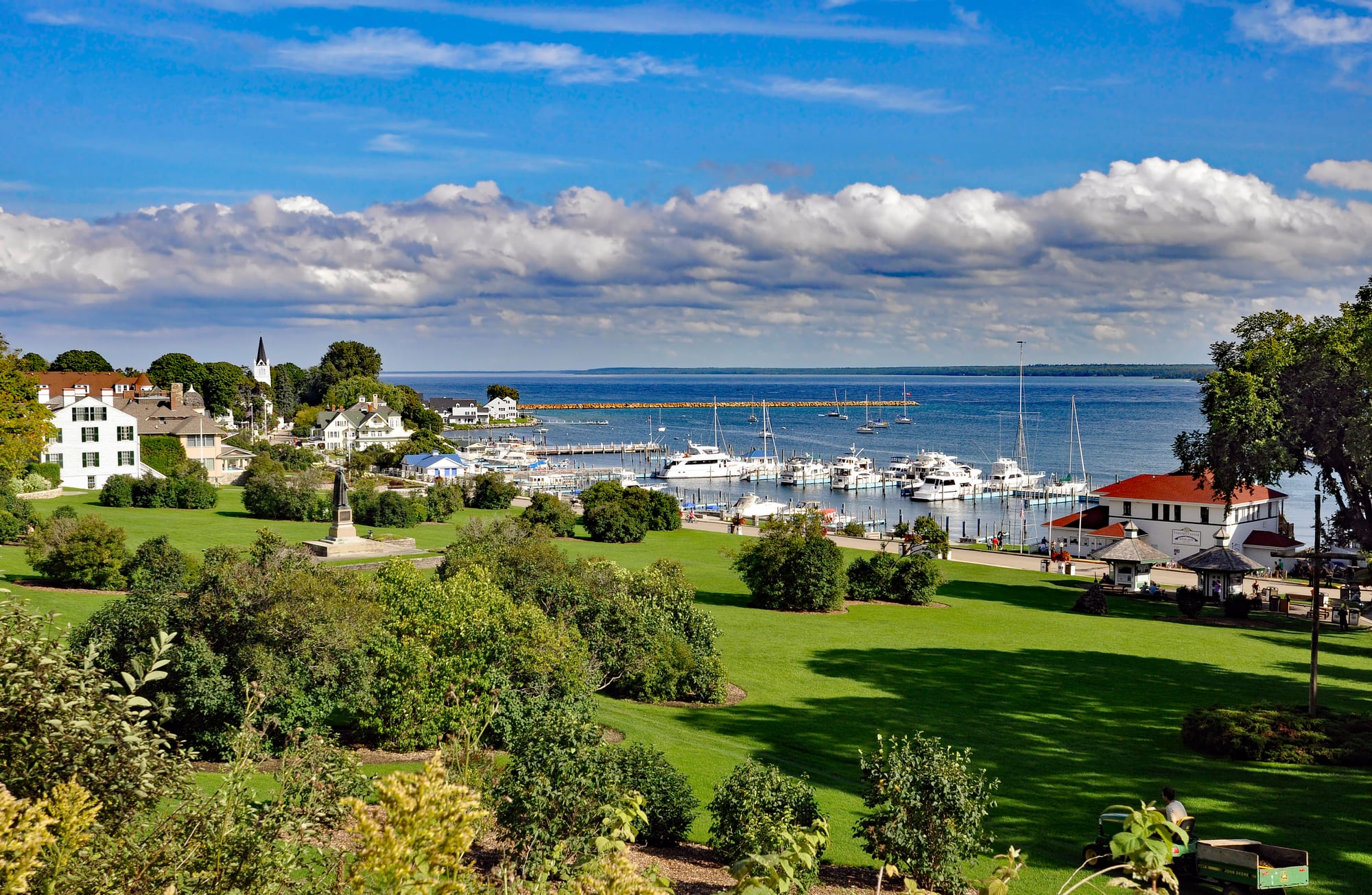
Green lawns and trees sloping down to a harbour full of white boats, with clapboard houses on the left and the blue Straits beyond

Chicago & the Great Lakes, United States

Mackinac Island

The harbour of Mackinac Island on the Straits of Mackinac. (P. Hughes / Wikimedia Commons · CC BY 4.0)

A small limestone island in Lake Huron at the eastern end of the Straits of Mackinac, between Michigan's two peninsulas. A sacred place to the Anishinaabe, then a fur-trade post and a fortress fought over in the War of 1812, it became a Victorian summer resort. Motor vehicles have been banned for over a century, most of the island is a state park, and the whole island is a National Historic Landmark.

Neighbourhoods

  • Downtown: Main Street and Market Street
    • First-time visitors
    • Shopping
    • Historic district

    The village by the ferry docks is essentially two streets. Main Street has false-front commercial buildings of the late 1800s, full of fudge shops, restaurants and bicycle rentals; Market Street, one block back, has even older buildings from the fur-trade years, including the Biddle House. Fort Mackinac stands on the bluff above.

    Open in Maps
  • The bluffs
    • Architecture
    • Quiet and residential
    • Views

    The high ground on either side of the harbour, lined with the large Victorian summer 'cottages' that wealthy families built from the 1880s, along with the Michigan governor's summer residence of 1902. The views over the harbour and the Straits are the reward for the climb.

    Open in Maps
  • The state park interior
    • Nature
    • Cycling
    • Walks

    About 80 per cent of the island is state park — forest, fields, bogs and limestone formations crossed by roads, bridle paths and footpaths. Arch Rock, Fort Holmes and Skull Cave are here, and the quiet is broken mainly by horses' hooves and bicycle bells.

    Open in Maps

Things to do

Forts and history

  • Fort Mackinacmuseum

    The fort the British built on the bluff in 1780 to control the Straits and the fur trade, captured in the first battle of the War of 1812 and garrisoned by the US Army until 1895; it is now a museum in the state park.

    Open in Maps
  • Fort Holmesviewpoint

    An earthen redoubt on the island's highest point, built by the British in 1814 as Fort George and reconstructed in 2015.

    Open in Maps
  • Biddle Housemuseum

    One of the oldest buildings on the island, a house and fur-trade shop on Market Street interpreted as the home of the Métis Biddle family in the 1820s.

    Open in Maps
  • Sainte Anne Churchlandmark

    The Catholic parish church begun in 1874, successor to a mission founded on the island in 1670, whose parish records go back to 1695.

    Open in Maps

Nature and the shore road

  • Arch Rockviewpoint

    A natural limestone arch on the Lake Huron shoreline, standing 146 feet above the water, and a major reason for the creation of Mackinac National Park in 1875.

    Open in Maps
  • Skull Caveattraction

    A small, shallow cave in the island's interior, believed to have been a Native American burial site, where the fur trader Alexander Henry hid in 1763.

    Open in Maps
  • M-185 round-the-island roadtrail

    The eight-mile road around the island's shore, the only state highway in the country without motor vehicles, a flat circuit for cycling and walking.

    Open in Maps
  • Wawashkamo Golf Clubattraction

    A nine-hole links course laid out in 1898 by a Scot from Carnoustie on the site of the 1814 Battle of Mackinac Island, the oldest continuously played course in Michigan.

    Open in Maps

Short trips across the Straits

  • Mackinac Bridgelandmark

    The five-mile suspension bridge opened in 1957 between Mackinaw City and St. Ignace, linking Michigan's two peninsulas and a symbol of the state.

    Open in Maps
  • Fort Michilimackinacmuseum

    In Mackinaw City, the reconstructed French and later British fort and trading post of around 1715, now an open-air museum and National Historic Landmark.

    Open in Maps
  • Old Mackinac Point Lightmuseum

    A lighthouse of 1892 at the northern tip of the Lower Peninsula, deactivated in 1957 when the Mackinac Bridge was completed, and now a museum.

    Open in Maps

Seasonal events

  • Lilac FestivalJune

    A ten-day festival of the island's lilacs held since 1949, ending with a parade of horse-drawn vehicles recognised by the Library of Congress as a local legacy.

  • Sailing races to MackinacJuly

    Two long-running yacht races finish at the island each July, one from Port Huron and one from Chicago, each drawing hundreds of sailboats.

  • Mackinac Island Fudge FestivalAugust

    A festival celebrating the island's most famous product.

Eat and drink

Long-standing places and food districts in Mackinac Island. Hours, ratings and directions come from your maps app, always current.

Mackinac classics

  • Main Street fudge shopsneighborhood

    Five fudge makers sell on the island, much of it made the traditional way — cooked, then worked by hand on a slab as it cools into a loaf.

    Open in Maps
  • Murdick's Fudgerestaurant

    The island family credited with opening its first real candy store in the 1800s, who kept going through the lean years of sugar rationing by using fans to blow the smell of fudge into the street.

    Open in Maps

Food districts

  • Downtown Mackinac Islandneighborhood

    Restaurants, pubs and bars along Main Street and the harbour, busiest from June to Labor Day.

    Open in Maps
  • St. Ignace and the Upper Peninsulaneighborhood

    Across the Straits at the ferry port of St. Ignace, the Upper Peninsula's pasty — a meat-and-vegetable pastry brought by Cornish miners — and Great Lakes whitefish.

    Open in Maps

Experience Mackinac Island

History

The Anishinaabe likened the island's shape to a turtle and called it Mitchimakinak, the Great Turtle. Fishing camps show people here by around AD 900, and the island was sacred — the home of Gitche Manitou, the Great Spirit, a gathering place for offerings and a burial place of chiefs. The French explorer Jean Nicolet probably saw it in 1634; the Jesuit Claude Dablon founded a mission in 1670, and the Straits quickly became a centre of the French fur trade, with a French fort at present-day Mackinaw City from about 1715.

Britain took control after the French and Indian War, and in 1780 Major Patrick Sinclair moved the garrison to the island's limestone bluffs, building Fort Mackinac. The Straits passed to the United States in 1783, though British troops stayed until after 1794. In 1812 the British captured the fort in the first battle of the war, and in 1814 they beat off an American attack on the north side of the island; the Treaty of Ghent returned it in 1815. John Jacob Astor's American Fur Company then made the island its centre, shipping beaver pelts for 30 years, and as late as 1829 the Métis were dominant in the region's economy.

By the mid-19th century fishing for whitefish and lake trout had replaced the fur trade, and after the Civil War visitors arrived by train and lake steamer from the Great Lakes cities. In 1875 much of the federal land on the island became the country's second national park, after Yellowstone; boat and railway companies built hotels, and wealthy families built summer cottages on the bluffs. When the army left in 1895 the park passed to Michigan as its first state park. Cars were banned from 1898, and in 1960 the whole island was listed as a National Historic Landmark.

Culture & Customs

The island's identity rests on preservation. Leaseholders in the state park must keep up its Victorian architecture, and buildings span three centuries: at least two survive from the original French settlement, the island has the only example of northern French rustic architecture in the United States, and the Federal, Greek Revival and Victorian styles of the resort years — Gothic Revival, Italianate, Second Empire and Queen Anne — line the streets and bluffs. The Mission Church of 1829 is the oldest surviving church building in Michigan, and a former Indian Dormitory of the 1830s now houses an art museum.

Horses define daily life. With no cars, carriages, saddle horses and bicycles fill the streets, and one of the island's carriage companies is described as the largest horse and buggy livery in the world. The Lilac Festival, held each June since 1949, ends with a parade of horse-drawn vehicles recognised by the Library of Congress as a local legacy event.

The island also draws the state's political and business world for the Mackinac Policy Conference, and sailors finish two of the Great Lakes' best-known yacht races here each July, from Port Huron and from Chicago, a tradition that has continued through wars and depressions. Anishinaabe heritage remains part of the story told at the island's sites, and the island has its own weekly summer newspaper, the Town Crier.

Daily Life

Only 583 people lived on Mackinac Island year-round at the 2020 census, on an island about eight miles round and under four square miles in area. Between May and October the population swells with tens of thousands of visitors and the hundreds of seasonal workers hired by hotels, restaurants, bars and shops, many of them from Jamaica.

Tourism is the entire economy: fudge, bicycle and carriage hire, the forts and museums run by the state park, golf, galleries and the hotels. Commercial fishing, once the island's main industry, has ceased, though the old fish docks are still in use.

Winter is a different life. The shops and the fort close, the ferries stop once ice fills the Straits, and the small year-round community depends on the airport, with daily charter flights to the mainland, and on snowmobiles, which are allowed in winter and can cross an ice bridge to St. Ignace when the ice is thick enough. The island newspaper switches from weekly to monthly, and the island belongs to its few hundred residents until the boats return in spring.

Food

Fudge is the island's signature. Mackinac candymakers have sold it to visitors since the 1880s, and although fudge was not invented here, the island became so closely linked with it that visitors are nicknamed "fudgies". The Murdick family is credited with the first real candy store, and during the sugar rationing of the Depression and the wars the family used fans to send the smell of its fudge out into the street to draw customers. Much of it is still made the traditional way, cooked and then worked by hand on a slab until it cools into a loaf.

The sweet tradition reaches back further: Native Americans collected maple sugar here long before the fudge shops. The lakes supplied the other staple. Whitefish and lake trout were fished commercially from the mid-19th century, and smoked whitefish from the Great Lakes is still a regional speciality.

Across the Straits in St. Ignace begins the Upper Peninsula, home of the pasty, a pastry filled with meat and vegetables brought by Cornish miners. The Traverse City area, nicknamed the Cherry Capital of the World, grows tart cherries. On the island itself, restaurants, pubs and bars along Main Street and the harbour serve the summer crowds.

Planning tools

Budget

The island is one of the region's more expensive summer resorts. Rooms on the island, in hotels and bed and breakfasts, are costly in July and August, and the ferry, bicycle hire and carriage rides add up. Staying in Mackinaw City or St. Ignace and visiting for the day is the cheaper option.

Daily Budget Midrange
USD 250–450 (island inn or bed and breakfast, ferry, carriage tour and fort admission, restaurant dinner with tax and tip)
Daily Budget Shoestring
USD 110–180 (mainland motel, ferry ticket, bicycle hire, picnic lunch and fudge)

Book island rooms early for summer weekends and the Lilac Festival, or stay on the mainland and take an early ferry; walking and cycling the shore road cost nothing once there.

Best Time to Visit

The season runs from May to October, and most visitors come between the Lilac Festival in June and Labor Day in early September. June and September are quieter than the peak of July and August. In winter the shops and the fort close, ferry service ends once ice forms, and the island is reached by small plane or, when the ice is thick, by snowmobile.

Suggested Number of Days

Many visitors come for a single day, but a night or two on the island shows it after the day-trippers leave. Allow three or four days to add the mainland forts, lighthouses and the bridge on both sides of the Straits.

First Visit
1–2 days
With Surroundings
3–4 days

Transportation

Motorised vehicles have been banned in the city since 1898 and on the whole island since 1901, apart from emergency and service vehicles and snowmobiles in winter. People get around on foot, by bicycle, on horseback or by horse-drawn carriage; bicycles, saddle horses and carriages can be hired, and horse-drawn taxis run around the clock. Most sights are within a mile of the ferry docks.

Horses always have the right of way. Bicycles can be brought on the ferries for an extra fare, and roller skates are not allowed downtown.

Airport & Station Connections

Ferries run from Mackinaw City on the Lower Peninsula and St. Ignace on the Upper Peninsula, frequently from May to October; after 1 November one line keeps sailing until the ice closes the Straits, usually in January. The island airport, about a nautical mile from downtown, takes charter flights from the mainland. Pellston Regional Airport, the main commercial airport for the northern tip of the Lower Peninsula, has airline service.

Walkability

Downtown is compact and entirely free of cars, and Fort Mackinac is a short climb above Main Street. The shore road is eight flat miles, and the interior is hilly but laced with paths. In summer the streets are crowded with rented bicycles and carriages, so walkers need to keep alert.

Safety

For most visitors the US is safe, with the main risks being petty theft and car break-ins in tourist areas of some cities, road accidents over long distances, extreme weather, and the hazards of the outdoors. The island is a safe place for families to walk and cycle; the everyday risks are collisions between inexperienced cyclists, horses and pedestrians, cold lake water and fast-changing weather on the Straits.

Give horses plenty of room — they always have the right of way — and dress for cold wind on the ferry even in summer. Check current official travel advice before travelling.

Climate

The climate has large seasonal differences. Summers are warm; winters are long, cold and snowy, and in hard winters an ice bridge forms across to the mainland.

Summer
warm and sometimes humid — highs across the region typically 77–88°F
Winter
cold and snowy — around 10 to 32°F across the region and often colder in the north, with the Straits freezing in hard winters

Local Customs

Tipping of 18–22 per cent is expected in restaurants; sales tax is added at the till. Visitors are nicknamed 'fudgies' for the fudge they buy. The island's name is pronounced 'MAK-in-aw', like the mainland's Mackinaw City, whatever the spelling.

Identification is asked for when buying alcohol (the legal age is 21). Camping is not allowed anywhere on the island.

Common Payment Methods

The currency is the US dollar. Cards and contactless payment are widely accepted, and a little cash is useful for tips.