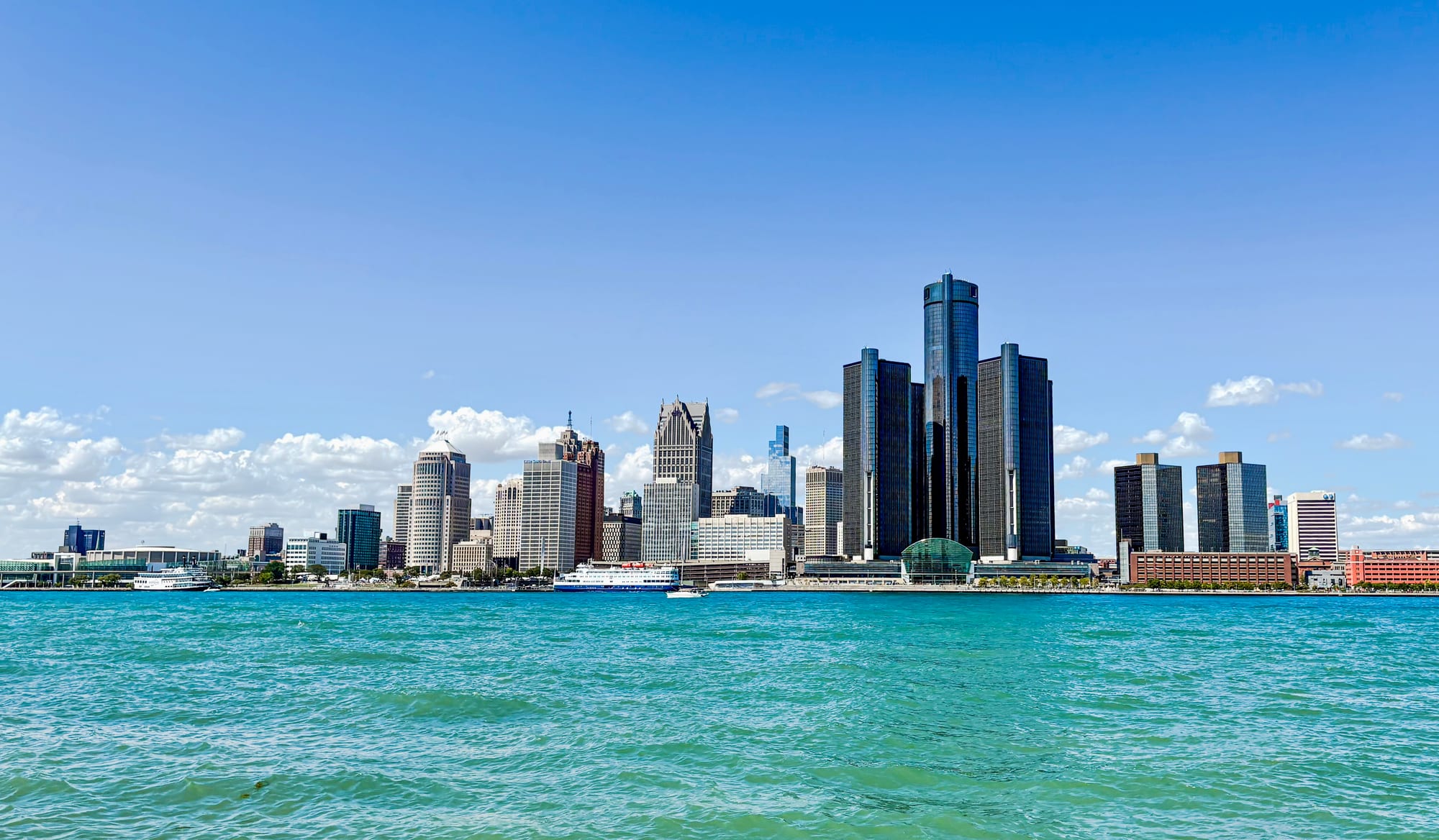
Detroit's downtown skyline across the blue-green Detroit River, with the dark glass towers of the Renaissance Center on the right under a bright sky

Chicago & the Great Lakes, United States

Detroit

Downtown Detroit seen across the Detroit River from Windsor, Ontario. (TheWxResearcher / Wikimedia Commons · CC0)

Michigan's largest city, on the Detroit River facing Windsor, Ontario — the place that built the American car industry and gave the world Motown and techno. Decades of decline ended in a municipal bankruptcy in 2013; since then a compact downtown of Art Deco towers, a major art museum and a long riverfront walk have revived, while many outer neighbourhoods still show the losses.

Neighbourhoods

  • Downtown
    • First-time visitors
    • Sport and theatre
    • Close to public transport

    The business district inside the freeway ring, laid out on a wheel-and-spoke plan around Campus Martius. Art Deco towers, the theatre district around the Fox, a ballpark and a football stadium, Greektown and the RiverWalk are all within walking distance, many of the city's hotels are here, and the elevated People Mover loops around it.

    Open in Maps
  • Midtown and the Cultural Center
    • Arts and culture
    • Museums
    • Students and nightlife

    About two miles up Woodward Avenue from downtown. Wayne State University, the Detroit Institute of Arts, the Detroit Historical Museum, the Charles H. Wright Museum and the main public library stand within a few blocks of each other, among the restaurants, bars and shops of the old Cass Corridor. The QLine streetcar links it to downtown.

    Open in Maps
  • Corktown
    • Historic district
    • Best for food
    • Bars

    Detroit's oldest surviving neighbourhood, settled by Irish immigrants in the 19th century and named after County Cork, with streets of small 19th-century workers' houses just west of downtown. Michigan Avenue's restaurants and bars lead to the restored Michigan Central Station.

    Open in Maps
  • Eastern Market
    • Best for food
    • Street art
    • Saturday mornings

    A working food-wholesale district north-east of downtown, built around public market sheds. Saturday is the big market day all year, and the surrounding blocks hold butchers, spice and cheese shops, restaurants, breweries and dozens of large murals.

    Open in Maps
  • New Center
    • Architecture
    • Close to public transport

    Three miles north of downtown, built in the 1920s as a second business centre around General Motors' former headquarters and the Fisher Building, with its three-storey marble lobby. The Amtrak station and the northern end of the QLine are here, and the Motown Museum is a short ride west along Grand Boulevard.

    Open in Maps
  • Mexicantown and Southwest Detroit
    • Best for food
    • Local life

    The centre of the city's Mexican and wider Latino community, around Bagley Street and Vernor Highway near the Ambassador Bridge — taquerías, bakeries, tortilla makers and murals in a busy residential part of the south-west.

    Open in Maps
  • West Village and Indian Village
    • Quiet and residential
    • Historic homes

    Two adjoining historic districts on the east side, about three miles from downtown. Indian Village's streets of large early 20th-century houses were built for the city's business elite; the smaller-scale West Village beside it has a cluster of cafés and restaurants, a short way from the bridge to Belle Isle.

    Open in Maps

Things to do

Famous landmarks

  • Guardian Buildinglandmark

    A 1929 Art Deco skyscraper whose three-storey vaulted lobby is covered in Pewabic and Rookwood tile.

    Open in Maps
  • Fisher Buildinglandmark

    Albert Kahn's 1928 Art Deco tower in New Center, with a three-storey barrel-vaulted lobby finished in forty kinds of marble, and home to the Fisher Theatre.

    Open in Maps
  • Michigan Central Stationlandmark

    The Beaux-Arts railway station that opened in 1913 and closed in 1988, for decades the city's best-known ruin, reopened in June 2024 after a restoration by Ford.

    Open in Maps
  • Renaissance Centerlandmark

    The cluster of dark glass towers on the riverfront, opened in 1977; the central hotel tower is the tallest building in Michigan.

    Open in Maps
  • Campus Martius Parkpark

    The downtown square that marks the point of origin of the city's street system, with performance stages, sculptures and a winter ice rink.

    Open in Maps
  • Fox Theatrelandmark

    A 1928 movie palace with just over 5,000 seats and a lavish interior mixing Burmese, Chinese, Indian and Persian motifs, now a stage for touring shows and concerts.

    Open in Maps

Museums

  • Detroit Institute of Artsmuseum

    One of the major art museums of the United States, known above all for Diego Rivera's Detroit Industry murals, painted in 1932–33 around a central court.

    Open in Maps
  • Motown Museummuseum

    Hitsville U.S.A., the house on West Grand Boulevard where Berry Gordy ran Motown from 1959, with Studio A, where the label's 1960s hits were recorded.

    Open in Maps
  • Charles H. Wright Museum of African American Historymuseum

    One of the world's oldest and largest independent African American museums, founded in 1965, whose core exhibition, And Still We Rise, runs from Africa to present-day Detroit.

    Open in Maps
  • Detroit Historical Museummuseum

    The city's own story, with long-running exhibitions on the car industry and on Detroit's part in the Underground Railroad.

    Open in Maps
  • Ford Piquette Avenue Plantmuseum

    The brick factory of 1904 where the first Model T cars were built in 1908, now a museum of early motoring.

    Open in Maps
  • Pewabic Potteryattraction

    A working pottery founded in 1903, whose iridescent tiles decorate buildings across the city, with a gallery and shop at its historic studio.

    Open in Maps
  • The Heidelberg Projectattraction

    An outdoor art environment begun by Tyree Guyton in 1986, covering houses and empty lots on an east-side street with painted dots and salvaged objects.

    Open in Maps

Parks and the riverfront

  • Belle Isle Parkpark

    An island park in the Detroit River reached by bridge, with a glass-domed conservatory and an aquarium, both opened in 1904, a Great Lakes museum, a beach and views of two countries' skylines.

    Open in Maps
  • Detroit RiverWalktrail

    A riverside promenade running for several miles past parks, plazas and the Renaissance Center, with Canada in view across the water.

    Open in Maps
  • Dequindre Cuttrail

    A walking and cycling path below street level on a former railway line, lined with graffiti and murals, linking the riverfront with Eastern Market.

    Open in Maps

Markets

  • Eastern Marketmarket

    The largest historic public market district in the United States, with farmers, flowers and food stalls under open sheds every Saturday and smaller markets on other days in season.

    Open in Maps

Music, sport and nights out

  • Comerica Park and Ford Fieldattraction

    The Tigers' baseball park and the Lions' football stadium stand side by side at the edge of the theatre district.

    Open in Maps
  • Little Caesars Arenaattraction

    The arena shared by the Red Wings ice hockey team and the Pistons basketball team, opened in 2017 in Midtown, just north of downtown.

    Open in Maps
  • Orchestra Hallattraction

    The 1919 concert hall of the Detroit Symphony Orchestra in Midtown, known for its acoustics.

    Open in Maps
  • Baker's Keyboard Loungeattraction

    A small jazz club on Livernois Avenue, the oldest in continuous operation in the city, with a piano-shaped bar painted as a keyboard.

    Open in Maps
  • Cliff Bell'sattraction

    A jazz club downtown that first opened in 1935, named after the 1930s entrepreneur John Clifford Bell.

    Open in Maps

Short trips from the city

  • The Henry Fordmuseum

    In Dearborn, a very large museum of American innovation holding the bus on which Rosa Parks refused to give up her seat, beside Greenfield Village, an open-air museum of relocated historic buildings, and tours of Ford's Rouge factory.

    Open in Maps
  • Arab American National Museummuseum

    In Dearborn, home to one of the country's largest Arab American communities — the first museum in the United States devoted to Arab American history and culture, opened in 2005.

    Open in Maps
  • Hamtramckattraction

    A small separate city almost entirely surrounded by Detroit, historically Polish and now also strongly Bangladeshi and Yemeni, known for its bakeries, bars and the Fat Tuesday queues for pączki.

    Open in Maps
  • Windsorattraction

    The Canadian city directly across the river, reached by tunnel or bridge with a passport, whose riverside parks give the classic view of the Detroit skyline.

    Open in Maps

Seasonal events

  • MovementMemorial Day weekend, late May

    An electronic music festival in Hart Plaza on the riverfront, in the city where techno was created.

  • Detroit Grand Prixlate May or early June

    An IndyCar street race, run on downtown streets since 2023 after many years on Belle Isle.

  • Ford Fireworkslate June

    One of the largest fireworks displays in North America, set off over the river between Detroit and Windsor.

  • Detroit Jazz FestivalLabor Day weekend, early September

    A free four-day jazz festival on downtown stages.

  • America's Thanksgiving ParadeThanksgiving morning, late November

    A parade of floats and balloons down Woodward Avenue, held since 1924.

  • Detroit Auto ShowJanuary

    The car industry's home-town show at the Huntington Place convention centre.

Eat and drink

Long-standing places and food districts in Detroit. Hours, ratings and directions come from your maps app, always current.

Detroit classics

  • American and Lafayette Coney Islandrestaurant

    Two rival diners standing side by side on Lafayette Boulevard downtown, both serving the Detroit coney — a natural-casing frankfurter in a steamed bun with a meaty chili sauce, yellow mustard and chopped onion. American was founded in 1917 by the Greek immigrant Gust Keros.

    Open in Maps
  • Buddy's Pizzarestaurant

    The east-side bar where Detroit-style pizza was first made in 1946 — a thick rectangular pie baked in a steel pan, with a crisp cheese edge and the sauce on top.

    Open in Maps
  • The Whitneyrestaurant

    A restaurant inside the 1890s stone mansion of lumber baron David Whitney Jr. on Woodward Avenue in Midtown.

    Open in Maps

Food districts

  • Greektownneighborhood

    A stretch of Monroe Avenue downtown where Greek restaurants and bakeries survive beside a casino — the remains of a Greek quarter dating from the early 20th century.

    Open in Maps
  • Dearborn's Middle Eastern restaurantsneighborhood

    Lebanese, Iraqi and Yemeni bakeries, grills and sweet shops line Warren Avenue and Michigan Avenue in the suburb just west of the city.

    Open in Maps
  • Hamtramck's Polish kitchensneighborhood

    Pierogi, dill pickle soup, stuffed cabbage and pączki in a small city that also has Bangladeshi and Yemeni restaurants on the same streets.

    Open in Maps

Experience Detroit

History

Detroit began on 24 July 1701, when the French officer Antoine de la Mothe Cadillac founded Fort Pontchartrain du Détroit — "of the strait" — on the narrow river between Lakes St Clair and Erie. The British took it in 1760 and held it until 1796, well after American independence. A fire in 1805 destroyed the wooden town; Judge Augustus Woodward rebuilt it on a plan of avenues radiating like spokes, which still shapes downtown, and the disaster gave the city its motto, "We hope for better things; it will rise from the ashes." Before the Civil War it was a key stop on the Underground Railroad, with freedom in Canada a short boat ride away.

Shipping and manufacturing made it an industrial city — by the 1890s it was known as the stove capital of the world — and then Henry Ford, the Dodge brothers and their rivals made it the centre of the world's car industry: the Model T was first built at the Piquette Avenue plant in 1908, and Ford's moving assembly line followed in 1913. Migrants arrived from Europe, the Middle East and the American South, and the population reached 1.85 million in 1950, when Detroit was one of the five largest cities in the country.

Then factories and white residents left for the suburbs. Freeways and clearance schemes destroyed Black Bottom and Paradise Valley, the heart of Black Detroit, and racial tension broke into violence in 1943 and again in July 1967, when 43 people died. Berry Gordy's Motown Records, founded in 1959, left for Los Angeles in 1972. In 1973 Coleman Young was elected the city's first Black mayor. In July 2013 Detroit became the largest American city ever to file for bankruptcy. It emerged late in 2014; since then downtown and Midtown have been rebuilt, Michigan Central Station has reopened, and the population has begun to grow for the first time since 1950.

Culture & Customs

Few cities of its size have shaped popular music as much. Motown put the Supremes, the Temptations, Marvin Gaye and Stevie Wonder on radios around the world from a house on West Grand Boulevard; Aretha Franklin grew up singing in her father's church here; and in the 1980s Juan Atkins, Derrick May and Kevin Saunderson created techno, which the city celebrates every May at the Movement festival. Gospel, jazz, garage rock and hip hop all have deep local roots as well.

Detroit is a majority-Black city, and African American history and culture are central to its identity, from the Charles H. Wright Museum to the churches that anchor many neighbourhoods. It is also a city of immigrants: Polish Hamtramck, the Mexican south-west, and in neighbouring Dearborn one of the largest Arab American communities in the United States. In 2015 UNESCO named Detroit a City of Design, the first in the United States, in recognition of a tradition that runs from car styling studios to Pewabic tiles and the Cranbrook school.

Sport is followed with devotion through good years and bad — the Tigers, Lions, Red Wings and Pistons all play in or beside downtown — and the car is part of the culture, celebrated each August when classic cars parade along Woodward Avenue in the northern suburbs. Detroiters are direct, loyal to their city and quick to notice condescension about it, and the revival of downtown is discussed alongside a sharp awareness of how unevenly it has reached the neighbourhoods.

Daily Life

About 650,000 people live in the city and more than four million in the wider metropolitan area, which spreads across Wayne, Oakland and Macomb counties. The city's population is only a third of what it was in 1950, and the consequences are visible: whole blocks of the east and west sides have returned to grass, tens of thousands of derelict houses have been demolished, and urban farms and community gardens have taken over some of the empty land. At the same time downtown, Midtown and Corktown have filled with new flats, offices and restaurants, and house prices in the strongest neighbourhoods have risen sharply.

The car industry still dominates the regional economy — General Motors and Stellantis build vehicles inside the city limits, and Ford's headquarters are in Dearborn — alongside hospitals, Wayne State University, the mortgage lender Rocket and a growing technology and mobility sector around Michigan Central. Poverty remains high, public transport is thin, and many households depend on a car for work.

Daily life is suburban in rhythm even inside the city: detached houses with porches and yards, shopping by car, and church on Sunday for many. Summer is spent outdoors — at Belle Isle, along the river, at block parties and ball games — and many families head "up north" to Michigan's lakes at weekends. In 2025 the city elected Mary Sheffield as its first woman mayor.

Food

The Detroit coney is the city's signature: a beef frankfurter with a natural casing in a steamed bun, covered with a loose, meaty chili sauce, yellow mustard and chopped raw onion. It was developed by Greek and Macedonian immigrants in the early 20th century, and two rival diners, American and Lafayette, still stand next door to each other downtown. Detroit-style pizza, first made at Buddy's in 1946, is rectangular, thick and airy, baked in steel pans of a kind once used in car plants to hold small parts, with brick cheese spread to the edges so that it caramelises into a crisp border, and stripes of tomato sauce on top.

Immigrant kitchens define much of the rest. Hamtramck's Polish restaurants serve pierogi, stuffed cabbage and dill pickle soup, and the whole region queues for pączki, rich filled doughnuts, on the day before Lent. South-west Detroit has taquerías, bakeries and tamales; Dearborn is known well beyond Michigan for its Lebanese, Iraqi and Yemeni food, from shawarma and fresh pita to honey-soaked pastries; and Greektown keeps its saganaki, served flaming at the table. Eastern Market supplies many of the city's restaurants and draws large crowds on Saturdays.

Local products are a point of pride: Vernors, a strongly flavoured ginger ale first sold by a Detroit pharmacist in 1866; Faygo fruit-flavoured pop; Better Made potato chips; and Sanders hot fudge, poured over ice cream. A Boston cooler — Vernors blended with vanilla ice cream — is a Detroit drink despite its name. The city also has a long brewing history and a growing number of craft breweries.

Planning tools

Budget

Detroit is cheaper than Chicago, New York or the West Coast, above all for food and drink. Hotel prices downtown are the main cost and rise sharply for big events — the auto show, Lions home games, Movement and major concerts. A car, or regular ride-hailing, adds to the bill for anyone staying outside the downtown–Midtown corridor.

Daily Budget Midrange
USD 220–380 (downtown hotel, sit-down dinners, museum tickets, ride-hailing or a hire car)
Daily Budget Shoestring
USD 90–150 (hostel bed or budget motel, coney dogs, tacos and market lunches, buses and the streetcar)

Book rooms early for event weekends; many of the best things — the RiverWalk, Eastern Market, Belle Isle on foot or by bike, the Guardian Building lobby — are free.

Best Time to Visit

May to October. Summer brings the festivals, baseball, patios and long evenings on the riverfront; September and October are mild, with autumn colour on Belle Isle. Winters are cold, grey and snowy, but hotel prices fall, the museums are quiet, there is ice hockey and basketball, and the Campus Martius rink is open.

Suggested Number of Days

Most first visits to the city take two to three days. Allow four or five to include the suburbs and the Canadian side of the river as well. Detroit's sights are spread out, so a visit without a car needs a little more time.

First Visit
2–3 days
With Surroundings
4–5 days

Transportation

This is a city built for the car, spread over about 139 square miles, and most visitors use a hire car or ride-hailing for anything beyond the centre. Without a car, the Woodward corridor works well: the QLine streetcar runs 3.3 miles from downtown through Midtown to New Center, and the elevated People Mover makes a one-way loop around downtown. City (DDOT) and suburban (SMART) buses cover the rest, slowly. There is a bike share scheme, and the RiverWalk and Dequindre Cut are good cycling routes.

On Michigan's wide divided roads a left turn is often made by driving past the junction and making a U-turn — the 'Michigan left'.

Airport & Station Connections

Detroit Metropolitan Airport, a major Delta hub, is in Romulus, about 18 miles south-west of downtown — roughly half an hour by taxi or ride-hailing, longer by bus. Amtrak's Wolverine trains run to Chicago in about five and a half hours from a small station in New Center. Windsor, Ontario, is reached by the Detroit–Windsor Tunnel, the Ambassador Bridge or, since July 2026, the Gordie Howe International Bridge downstream; a passport is needed to cross.

Walkability

Downtown is compact and easy on foot — Campus Martius to the river is about ten minutes — and Midtown's museums sit close together. The districts are separated by freeways, wide roads and stretches of empty land, so walks between them can feel long and bleak even when the distance is short; downtown to Corktown or to Eastern Market is a little over a mile. The RiverWalk and the Dequindre Cut are the pleasant ways to cover ground. Pavements can be icy from December to March.

Safety

Detroit's violent crime rate remains among the highest of large American cities. Crime has fallen significantly in and around downtown but stays high in much of the rest of the city. Very little of it touches visitors: downtown, Midtown, Corktown, Eastern Market by day and the riverfront are busy and well patrolled. The practical risks are theft from parked cars and walking through empty blocks late at night.

Leave nothing visible in a parked car, use ride-hailing between districts after dark, and stay out of abandoned buildings, which are dangerous and illegal to enter. Check current official travel advice before travelling.

Climate

A continental climate moderated a little by the Great Lakes. Summers are warm and humid, with thunderstorms; winters are cold, cloudy and snowy; spring comes late and autumn is often the most settled season.

Summer
warm and humid — July days are typically in the low 80s °F, and the temperature passes 90°F on about a dozen days a year
Winter
cold and grey — January averages around 26°F, about 44 days a year stay below freezing, and snow is regular

Local Customs

Tipping is expected: roughly 18–22 per cent in restaurants, about a dollar a drink at a bar. Prices are shown without Michigan's 6 per cent sales tax, which is added at the till. Soft drinks are 'pop'. Detroiters divide the city into east side and west side along Woodward Avenue and measure distance north by the mile roads — 8 Mile Road is the city limit. People are proud of the city and tired of seeing it photographed as a ruin: ask before photographing residents or their streets.

Identification is asked for when buying alcohol (the legal age is 21). Cannabis is legal for adults in Michigan but may not be taken across the border to Canada.

Common Payment Methods

The currency is the US dollar. Cards and contactless payment are accepted almost everywhere, and some venues no longer take cash at all. A few long-established diners, bars and market stalls still prefer cash, so a small amount is useful. Canadian dollars are not generally accepted.