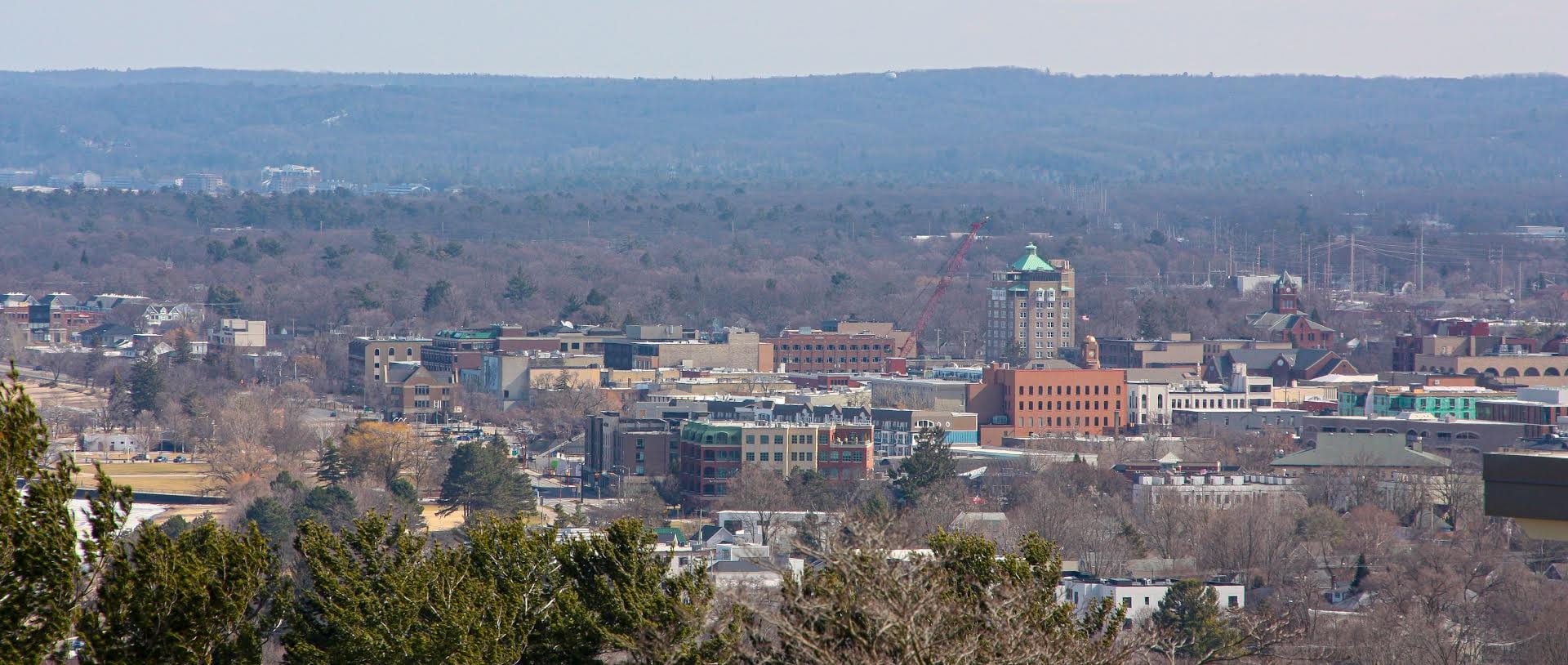
Downtown Traverse City's low brick buildings and green-roofed tower seen from a wooded hill, with forested ridges beyond

Chicago & the Great Lakes, United States

Traverse City

Downtown Traverse City seen from Wayne Hill in early spring. (Phoenix-Five / Wikimedia Commons · CC0)

A small city in northern Michigan at the foot of Grand Traverse Bay, an arm of Lake Michigan. Built on lumber in the 19th century and on tart cherries in the 20th, it is now the hub of a summer holiday region of beaches, vineyards on the Old Mission and Leelanau peninsulas, and the Sleeping Bear Dunes to the west.

Neighbourhoods

  • Downtown and Front Street
    • First-time visitors
    • Best for food
    • Nightlife

    The compact centre between the Boardman River and West Grand Traverse Bay, with Front Street's 19th-century brick blocks, the City Opera House, the State Theatre, shops, restaurants and brewpubs. The bayfront parks and beaches are a few minutes' walk north.

    Open in Maps
  • Old Town
    • Quiet and residential
    • Cafés

    A small district just south of downtown across the river, with older houses, cafés and a few independent shops, quieter than Front Street but within walking distance of it.

    Open in Maps
  • Grand Traverse Commons
    • Architecture
    • Best for food

    The vast Victorian buildings of the former Northern Michigan Asylum on the west side, now converted into homes, shops, restaurants and offices, surrounded by grounds with hiking trails.

    Open in Maps
  • East Bay
    • Beaches
    • Families

    The shoreline of East Grand Traverse Bay along the highway east of downtown, lined with lakefront motels and resorts and sandy beaches; the East Arm is the deeper of the bay's two arms.

    Open in Maps
  • Old Mission Peninsula
    • Wineries
    • Scenic drives

    The narrow peninsula running north from the city between the two arms of the bay, covered in cherry orchards and vineyards, with winery tasting rooms, farm stands and a lighthouse at its tip.

    Open in Maps

Things to do

In town

  • City Opera Houselandmark

    A 19th-century opera house on the upper floors of a three-storey red-brick building, restored and used again for plays, films and performances.

    Open in Maps
  • Dennos Museum Centermuseum

    The art museum of Northwestern Michigan College, known for one of the first public collections of Inuit art in the United States.

    Open in Maps
  • Grand Traverse Commonslandmark

    The former state psychiatric hospital, opened in 1885 and closed in 1989, whose buildings and grounds have been redeveloped since 2000 as shops, restaurants, offices and homes.

    Open in Maps
  • TART Trailstrail

    A network of paved and unpaved trails for walking and cycling that runs through town along the bay and out into the surrounding countryside.

    Open in Maps

The bay

  • Grand Traverse Bayviewpoint

    The two-armed bay of Lake Michigan on which the city sits, with public beaches and parks along the downtown shore, sailing, kayaking and paddleboarding in summer.

    Open in Maps

Short trips from the city

  • Mission Point Lightlandmark

    A small white wooden lighthouse of 1870 at the tip of the Old Mission Peninsula, beside a beach and woodland trails.

    Open in Maps
  • Sleeping Bear Dunes National Lakeshorepark

    A national lakeshore west of the city with huge sand dunes rising above Lake Michigan, the Dune Climb, beaches, islands and forest trails.

    Open in Maps
  • Pierce Stocking Scenic Driveviewpoint

    A loop road through the Sleeping Bear dunes with overlooks high above Lake Michigan and Glen Lake.

    Open in Maps
  • Lelandattraction

    A village on the Leelanau Peninsula whose Fishtown, a cluster of weathered fishing shanties by the harbour, is still home to a working fishery.

    Open in Maps
  • Interlochen Center for the Artsattraction

    An arts boarding school and summer camp about 10 miles south-west of the city, whose summer concerts and performances are open to the public.

    Open in Maps

Seasonal events

  • National Cherry Festivalearly July

    A week-long festival around the Fourth of July on the downtown waterfront, with parades, an air show over West Bay, concerts and a pie-eating contest, rooted in the Blessing of the Blossoms festival of 1925.

  • Interlochen summer performancesJune to August

    Concerts, recitals and plays by the students of Interlochen's summer arts camp, alongside visiting performers.

Eat and drink

Long-standing places and food districts in Traverse City. Hours, ratings and directions come from your maps app, always current.

Traverse City classics

  • Cherry pies and cherry productscafe

    Tart Montmorency cherries from the surrounding orchards end up in pies, jams, salsas, dried cherries and juice, sold in bakeries, farm stands and shops all over town.

    Open in Maps
  • Smoked whitefish in Fishtownmarket

    Lake Michigan whitefish, smoked and sold whole, as fillets or in a spread, in Leland's historic fishing district.

    Open in Maps

Wineries and breweries

  • Old Mission Peninsula wineriesneighborhood

    Tasting rooms among the orchards of the peninsula, best known for Riesling and other cool-climate white wines grown near the lake.

    Open in Maps
  • Leelanau Peninsula wineriesneighborhood

    A larger wine area west of the bay, with tasting rooms spread among the hills and villages of the peninsula.

    Open in Maps
  • Downtown breweries and barsneighborhood

    Craft breweries, cideries and bars on and around Front Street, many of them using local hops, apples and cherries.

    Open in Maps

Experience Traverse City

History

The Anishinaabe — Odawa (Ottawa) and Ojibwe (Chippewa) — have lived around Grand Traverse Bay for centuries. The name comes from French fur traders and voyageurs, who called the open-water crossing at the bay's mouth la grande traverse, "the long crossing". In 1839 the Presbyterian missionary Peter Dougherty set up a mission on the peninsula that still carries the name Old Mission.

The town itself began in the late 1840s as a sawmill on the Boardman River. In 1851 the Chicago firm of Hannah, Lay & Co. bought it, and Perry Hannah, often called the father of Traverse City, built it into a lumber town. The railway arrived in the 1870s, and in 1885 the Northern Michigan Asylum opened on the west side, becoming one of the town's largest employers for a century.

As the forests were cut out, farmers planted fruit, and by the 1920s the area had become a centre of tart cherry growing, celebrated from 1925 with blossom festivals that grew into the National Cherry Festival. Tourism grew alongside it as roads improved and summer visitors came from Detroit and Chicago. The asylum closed in 1989, and its buildings were later restored as the Grand Traverse Commons. Since the 1970s wineries have spread across the peninsulas, and the town has become a year-round regional centre.

Culture & Customs

Traverse City's identity is bound up with cherries, the bay and the outdoors. The National Cherry Festival in July is the town's great event, and the cherry appears on everything from pies to beer. Summer life centres on the water — sailing, kayaking and swimming off the downtown beaches — and winter on cross-country skiing, snowshoeing and the trails.

The town has a lively arts scene for its size. The restored City Opera House and the State Theatre on Front Street host films, concerts and talks; the Dennos Museum Center is known for its Inuit art; and the Interlochen Center for the Arts, an arts boarding school and summer camp nearby, brings young musicians and performers to the area. Film has a special place: the downtown State Theatre is run by the Traverse City Film Festival, with a year-round programme of films and live performances.

The Grand Traverse Band of Ottawa and Chippewa Indians is a federally recognised tribe based on the Leelanau Peninsula, and Anishinaabe culture is part of the region's identity. People here are friendly and informal, and the town's character changes sharply between the busy summer months and the quieter rest of the year.

Daily Life

About 16,000 people live in the city itself and more than 150,000 in the wider area of surrounding counties. Traverse City is the main service centre for northern Lower Michigan, with the region's largest hospital, Munson Medical Center, Northwestern Michigan College, government offices and shopping.

Tourism, healthcare, agriculture and wine are central to the economy, and a growing number of remote workers and retirees have moved to the area. That popularity has a cost: housing is scarce and expensive, and many service workers struggle to find somewhere affordable to live. Summer traffic on the main roads along the bay is a regular complaint.

Life follows the seasons. Summer is crowded and busy, with festivals, boats and visitors; autumn brings the harvest and wine-tasting crowds; winter is quiet, snowy and focused on locals, with skiing and indoor life in the cafés and breweries. Many residents work seasonal jobs and juggle more than one income.

Food

Cherries are everywhere. The area's orchards are known for tart cherries such as the Montmorency, used mainly for pies, jams and preserves; sweet cherries are grown too. Cherry pie, cherry salsa and dried cherries are sold in shops and farm stands, and in July many roadside stands sell fresh fruit straight from the orchard.

Lake Michigan whitefish is the classic local fish, served grilled, broiled or fried, and smoked whitefish spread is a common snack. Leland's Fishtown sells smoked fish from historic fishing shanties. Pasties — pastry turnovers filled with meat and vegetables, brought to Michigan by Cornish miners — are found in northern Michigan too, though they are more strongly linked to the Upper Peninsula.

The Old Mission and Leelanau peninsulas produce cool-climate wines, especially Riesling, Chardonnay and Pinot Gris, and their tasting rooms are a major draw. Craft breweries and cider makers have spread through downtown and the countryside, using local hops, apples and cherries. Farm-to-table restaurants make use of the region's fruit, vegetables and fish, and the downtown farmers' market is busy through the growing season.

Planning tools

Budget

Traverse City is a seasonal resort town, and prices follow the calendar: rooms are expensive from late June to August, and the Cherry Festival week is the most expensive of all. Autumn and winter are much cheaper. Restaurants and wine tastings add up, and a car is needed for the peninsulas and the dunes.

Daily Budget Midrange
USD 220–400 (mid-range hotel or bayfront motel, restaurant dinners with tax and tip, wine tastings, a hire car)
Daily Budget Shoestring
USD 100–160 (campground or budget motel, sandwiches and food from farm stands, cycling on the trails)

Book summer rooms months ahead, especially for the Cherry Festival, and consider September for warm days, harvest and lower prices.

Best Time to Visit

Summer, from late June to August, is the main season for beaches, boats and the festival. Late May brings the cherry blossom; September and October bring the harvest and autumn colour with fewer crowds. Winters are long and snowy, suited to cross-country skiing and quiet visits, and many seasonal businesses close.

Suggested Number of Days

Two or three days suit the town and its bay. Four to six days allow time for the peninsulas, the dunes and the villages further out. A visit without a car takes longer, and a beach holiday tends to stretch the stay.

First Visit
2–3 days
With Surroundings
4–6 days

Transportation

A car is the practical choice for exploring the region. Downtown is easy on foot, and the BATA bus network covers the town and some surrounding areas. The TART Trails make cycling a good way to get around the waterfront, and bikes can be hired in town.

Parking downtown is mostly paid and fills up in summer; leave the car and walk or cycle along the bay where possible.

Airport & Station Connections

Cherry Capital Airport is a few miles south-east of downtown, with flights from major hubs including Chicago, Detroit and Minneapolis, busier in summer. By road, Detroit and Chicago are each several hours away; intercity buses also serve the town.

Walkability

Downtown, the bayfront and Old Town are compact and pleasant to walk, with paths along the water and the river. The Commons is a longer walk to the west. Beyond that, the town spreads along highways, and the peninsulas need a car or a bike.

Safety

Traverse City is a low-crime town and generally safe for visitors. The main risks are on the water — rip currents and sudden waves on Lake Michigan's open beaches, cold water early in summer — and on winter roads during lake-effect snow.

Check beach warning flags, swim near others, and keep to marked roads in winter storms. Check current official travel advice before travelling.

Climate

A humid continental climate tempered by Lake Michigan, which keeps summers from getting very hot and helps the orchards and vineyards by delaying spring frosts. Winters are long, with heavy lake-effect snow.

Summer
warm and mild — the warmest month averages just under 72°F across day and night
Winter
severe — the coldest months average below freezing (32°F), and about 80 inches of snow falls a year, much of it lake-effect

Local Customs

Northern Michigan is informal and outdoorsy; "up north" is how people from the rest of the state describe the region. Tipping follows US custom — about 18–20 per cent in restaurants. Michigan adds 6 per cent sales tax at the till. The Grand Traverse Band of Ottawa and Chippewa Indians has its lands and headquarters on the Leelanau Peninsula.

The legal age for alcohol is 21, and identification is asked for at bars and wineries. Cannabis is legal for adults in Michigan, but not in public.

Common Payment Methods

The currency is the US dollar. Cards and contactless payment are accepted almost everywhere. Some farm stands along country roads take cash or use an honour box, so a little cash is useful.