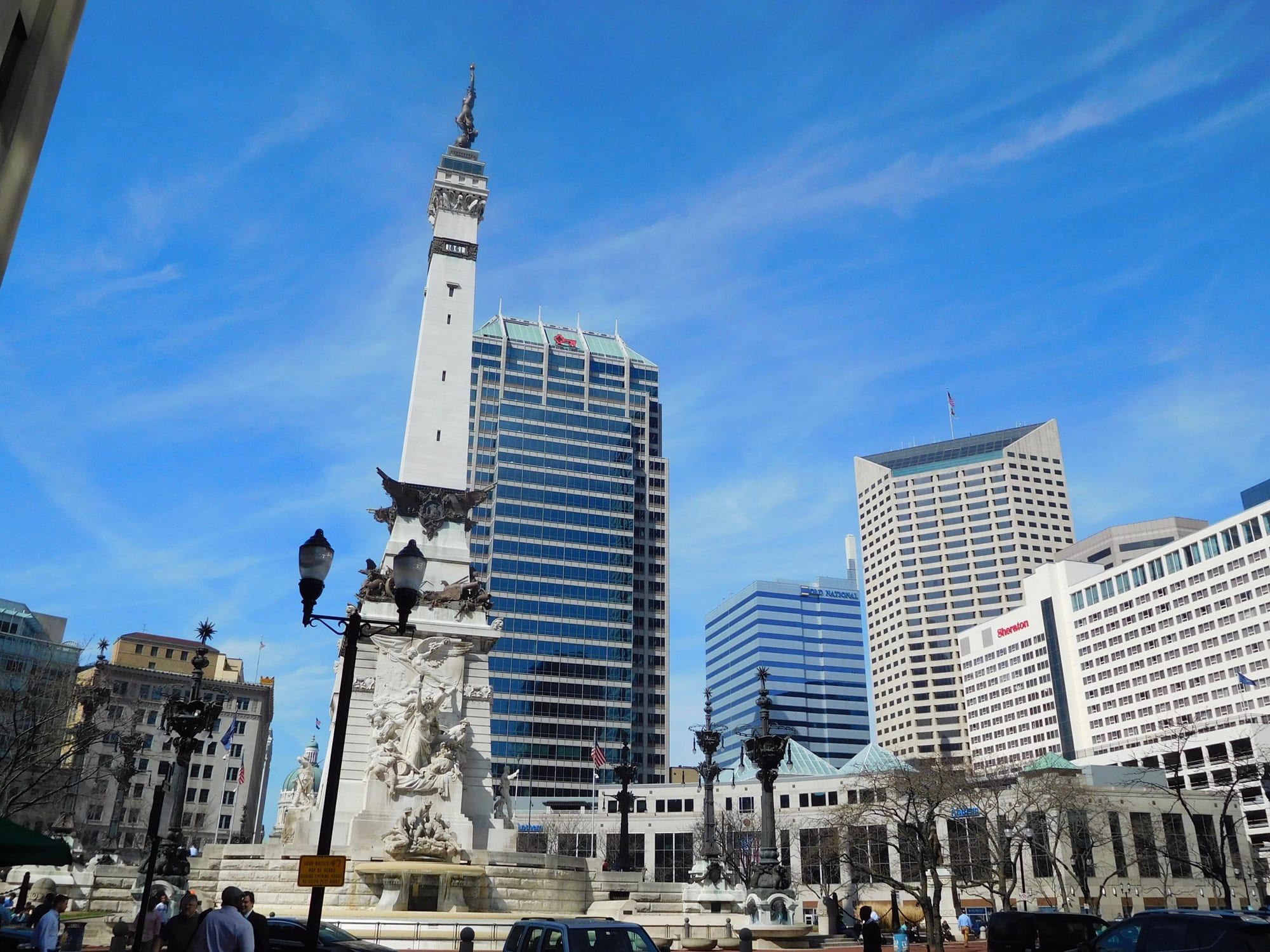
The white stone Soldiers' and Sailors' Monument rising above Monument Circle among downtown office towers under a blue sky

Chicago & the Great Lakes, United States

Indianapolis

The Soldiers' and Sailors' Monument on Monument Circle in downtown Indianapolis. (Deb Nystrom / Wikimedia Commons · CC BY 2.0)

Indiana's capital, planned in 1821 on a one-square-mile grid beside the White River and grown into the 'Crossroads of America' through roads and railways. Known worldwide for the Indianapolis 500, it is also a city of war memorials, a downtown canal and cultural trail, the world's largest children's museum and big sporting events.

Neighbourhoods

  • Downtown
    • First-time visitors
    • Sport and conventions
    • Museums

    The original 1821 Mile Square and its surroundings, between the interstates and the White River. Monument Circle, the Statehouse, the war memorials, the stadium, the arena, the convention centre and most of the museums are here, along with nearly 8,000 hotel rooms.

    Open in Maps
  • Mass Ave
    • Theatre
    • Best for food
    • Nightlife

    A diagonal avenue running north-east from downtown, revived since the 1990s, lined with locally owned shops, bars and restaurants and home to the Athenaeum, Old National Centre and the IndyFringe theatres.

    Open in Maps
  • Lockerbie Square
    • Historic district
    • Quiet and residential

    A small historic district beside Mass Ave, with Federal, Italianate and Queen Anne houses, a short walk from downtown.

    Open in Maps
  • Fountain Square
    • Live music
    • Bars
    • Local life

    About a mile and a half south-east of downtown, a commercial district built by German Americans since the 1870s, cut off by the interstates in the 1960s and revived since the late 1990s, now known for music venues, galleries and bars.

    Open in Maps
  • Broad Ripple Village
    • Nightlife
    • Students
    • Canal and trails

    A former town about six miles north of downtown, annexed in 1922, near Butler University, with bars, live music, the Indianapolis Art Center, the Central Canal towpath and the Monon Trail.

    Open in Maps
  • Irvington
    • Quiet and residential
    • Historic homes

    An east-side streetcar suburb named after Washington Irving, whose large historic district of houses and winding streets holds a well-known Halloween festival each October.

    Open in Maps

Things to do

Famous landmarks

  • Soldiers' and Sailors' Monumentlandmark

    The 284-foot limestone monument at the centre of Monument Circle, dedicated in 1902 and the city's unofficial symbol, surrounded by pools and fountains.

    Open in Maps
  • Indiana World War Memorial Plazalandmark

    Five downtown blocks of memorials, a cenotaph and the national headquarters of the American Legion, conceived in 1919 and now part of the largest war memorial project in the United States.

    Open in Maps
  • Indiana Statehouselandmark

    The state capitol of 1888, the fourth building to house Indiana's government.

    Open in Maps
  • Crown Hill Cemeterylandmark

    A rural cemetery founded in 1863 on a high point overlooking the city, where President Benjamin Harrison is buried.

    Open in Maps

Museums

  • The Children's Museum of Indianapolismuseum

    The world's largest children's museum, founded in 1925, with five floors of exhibits and more than a million visits a year.

    Open in Maps
  • Indianapolis Museum of Art at Newfieldsmuseum

    An encyclopedic art museum of more than 54,000 works on a 152-acre campus of gardens and an art and nature park, about four miles north of downtown.

    Open in Maps
  • Eiteljorg Museummuseum

    A downtown museum of art by Indigenous peoples of the Americas and of paintings and sculpture of the American West.

    Open in Maps
  • Indiana State Museummuseum

    The science, art, culture and history of Indiana from prehistoric times to the present, in White River State Park.

    Open in Maps
  • Madam Walker Legacy Centerattraction

    The 1927 building on Indiana Avenue named for the African American hair-care entrepreneur Madam C. J. Walker, whose theatre anchored the avenue's jazz scene for decades.

    Open in Maps

Parks, the canal and trails

  • White River State Parkpark

    A 267-acre downtown park on both banks of the White River, holding museums, the zoo, gardens and an outdoor amphitheatre.

    Open in Maps
  • Canal Walktrail

    About a mile and a half of the 1830s Central Canal, rebuilt downtown from 1985 and now a walkway and linear park.

    Open in Maps
  • Indianapolis Cultural Trailtrail

    An 8.1-mile walking and cycling path and linear park linking the downtown cultural districts, opened in 2013.

    Open in Maps

Markets

  • Indianapolis City Marketmarket

    The public market founded in 1821, in a brick and limestone hall of 1886, now a food hall.

    Open in Maps

Motor racing and sport

  • Indianapolis Motor Speedwayattraction

    The 2.5-mile oval built in 1909 in the enclave of Speedway, about four and a half miles from downtown, home of the Indianapolis 500 and the largest sports venue in the world by capacity.

    Open in Maps
  • Indianapolis Motor Speedway Museummuseum

    The racing museum in the Speedway's infield, which reopened in April 2025 after a renovation, with winning cars and the track's Hall of Fame.

    Open in Maps
  • Lucas Oil Stadiumattraction

    The retractable-roof downtown stadium of the Indianapolis Colts, opened in 2008.

    Open in Maps
  • Gainbridge Fieldhouseattraction

    The downtown arena of the Indiana Pacers and the Indiana Fever basketball teams, opened in 1999.

    Open in Maps

Short trips from the city

  • Conner Prairiemuseum

    A living history museum built around the William Conner home, recreating 19th-century life along the White River.

    Open in Maps

Seasonal events

  • Indianapolis 500Memorial Day weekend, usually the last weekend of May

    The open-wheel race run at the Speedway since 1911, the climax of the 'Month of May' and the 500 Festival's parade and events.

  • Brickyard 400July

    NASCAR's race at the Indianapolis Motor Speedway.

  • Historic Irvington Halloween FestivalOctober

    A neighbourhood Halloween festival in the historic east-side district of Irvington.

Eat and drink

Long-standing places and food districts in Indianapolis. Hours, ratings and directions come from your maps app, always current.

Indianapolis classics

  • St. Elmo Steak Houserestaurant

    The city's oldest steakhouse, founded in 1902 in the Wholesale District, famous for its shrimp cocktail.

    Open in Maps
  • Pork tenderloin sandwichrestaurant

    A breaded, fried pork cutlet in a bun, one of Indiana's best-known dishes.

    Open in Maps
  • Sugar cream pierestaurant

    A pie with a filling based on sugar and cream, closely associated with Indiana.

    Open in Maps

Food districts and markets

  • Indianapolis City Marketmarket

    The historic public market, now a food hall of local vendors.

    Open in Maps
  • Mass Aveneighborhood

    Restaurants and bars along the arts district's diagonal avenue.

    Open in Maps
  • Fountain Squareneighborhood

    Bars, restaurants and music venues in the old German commercial district south-east of downtown.

    Open in Maps

Experience Indianapolis

History

The Lenape and Miami nations gave up their claims to central Indiana under the Treaty of St. Mary's of 1818. In 1820 the state legislature set up a committee to choose a site near where Fall Creek meets the White River for a new capital, and on 6 January 1821 it adopted the name Indianapolis. Alexander Ralston and Elias Pym Fordham laid it out on a one-square-mile grid with diagonal avenues — the Mile Square that is still downtown — and the state government moved here from Corydon in 1825.

Water transport failed: work on the Indiana Central Canal stopped after the Panic of 1837, leaving a short stretch through the city. The railway, arriving in 1847, made the city's fortune. By 1880 it was the world's third-largest pork packer and by 1888 the second-largest railway centre in the country, and companies such as Eli Lilly, founded in 1876, and Madam C. J. Walker's beauty business grew here. Some 100,000 people filed past Lincoln's coffin at the Statehouse in 1865. The Soldiers' and Sailors' Monument was dedicated in 1902, and Ray Harroun won the first Indianapolis 500 in 1911.

In 1970 the city merged with Marion County under Unigov, adding more than 300 square miles and about 250,000 people. Revival of downtown followed: the Colts arrived from Baltimore in 1984, the city hosted the Pan American Games in 1987, and the canal, White River State Park, new arenas, the Cultural Trail and, in 2008, a new airport terminal and Lucas Oil Stadium reshaped the centre.

Culture & Customs

The Indianapolis 500 defines the city's image. The 'Month of May' brings the 500 Festival's programmes and parade, and the race itself, held over Memorial Day weekend, fills the Speedway, whose permanent seating makes it the largest sports venue in the world. Indianapolis is a centre of motor racing, with the INDYCAR and United States Auto Club sanctioning bodies and hundreds of motorsport companies.

The city has made sport a civic strategy. The NCAA and the national federation of high school sports have their headquarters here, the Final Four and the Big Ten football championship are regular visitors, and the Colts, the Pacers — who reached the NBA Finals in 2025 — and the Fever, WNBA champions in 2012, draw large crowds downtown.

Music has deep roots on Indiana Avenue, the centre of Black Indianapolis, where the Madam Walker theatre anchored a jazz scene from the 1920s to the 1960s and the guitarist Wes Montgomery shaped the 'Naptown Sound'. Today Broad Ripple and Fountain Square are the live-music districts, Mass Ave is the theatre district and home to IndyFringe, and the city's festivals include Indy Jazz Fest, Indy Pride, the Indiana Black Expo Summer Celebration and the Circle of Lights on Monument Circle in the holiday season. People from Indiana call themselves Hoosiers.

Daily Life

Indianapolis had an estimated 881,000 residents in 2022, making it the third-largest city in the Midwest, and its metropolitan area has about 2.1 million. Because of Unigov the city covers almost all of Marion County, so its limits take in suburban neighbourhoods and farmland as well as the centre.

Eli Lilly is the largest private employer, with about 11,000 workers, and the insurer Elevance Health and the agricultural company Corteva are also Fortune 500 companies based here. FedEx runs its national hub at the airport, Allison Transmission builds transmissions in the city, and conventions, hotels and sporting events are a large business downtown.

The city has one of the largest communities of Chin people from Myanmar anywhere outside that country, with an estimated 17,000 to 24,000. Some 500 neighbourhood associations are registered with the city, and historic districts such as Lockerbie Square, Irvington and Fountain Square sit alongside the post-war suburbs.

Food

The city's distinctive local dishes are the breaded pork tenderloin sandwich, a fried cutlet similar to Wiener schnitzel, said to have originated at a restaurant in Huntington, Indiana; sugar cream pie, or Hoosier pie, a custard pie of cream, sugar and cornstarch made in Indiana since statehood and probably brought by Quaker settlers from North Carolina; and the beef Manhattan. The last was named by workers at the city's naval ordnance plant who had eaten an open-faced beef sandwich while training in Manhattan during the Second World War, and was first served under that name in an Indianapolis deli in the late 1940s.

St. Elmo Steak House, founded in 1902 in the Wholesale District, is the oldest steakhouse in the city and its shrimp cocktail is known well beyond Indiana. The Indianapolis City Market, founded in 1821 and in its present hall since 1886, was home to meat and vegetable vendors before the Second World War and is now a food hall.

Mass Ave, Fountain Square and Broad Ripple hold many of the city's independent restaurants and bars.

Planning tools

Budget

Indianapolis is moderately priced for a large American city. Hotel rates rise steeply for the Indianapolis 500, big conventions and major sporting events such as basketball's Final Four, and the city is busiest in May. Many of the monuments, memorials, the canal and the Cultural Trail cost nothing.

Daily Budget Midrange
USD 200–380 (downtown hotel, sit-down dinners with tax and tip, museum tickets, ride-hailing)
Daily Budget Shoestring
USD 90–150 (budget motel or hostel bed, tenderloins and food-hall lunches, buses and bike share)

Book rooms months ahead for race weekend in late May and for major conventions; outside those dates downtown hotels are plentiful.

Best Time to Visit

May is the city's signature month, with the 500 Festival and the race, but also its busiest and most expensive. Late spring and September to October are mild and good for walking the canal and trails. Summers are hot and humid; winters are cold, with occasional snow, but the museums, basketball and indoor sport carry on.

Suggested Number of Days

Two or three days are enough for a first visit. Add a day for the suburbs and the countryside around the city. Race weekend or a major sporting event usually fills a visit of its own.

First Visit
2–3 days
With Surroundings
3–4 days

Transportation

Indianapolis is spread over a large consolidated city and county, and most residents drive. IndyGo runs the city's buses, including bus rapid transit lines, and Indiana Pacers Bikeshare has around 50 stations along the Cultural Trail and beyond. Downtown and the neighbouring districts are easily covered on foot or by bike; the Speedway, Broad Ripple and Newfields are easiest by car or ride-hailing.

Allow plenty of extra time for travel to the Speedway on race weekend, when the crowds are enormous.

Airport & Station Connections

Indianapolis International Airport, with its terminal of 2008, is about seven miles south-west of downtown, a short drive away, and is also served by city buses. Amtrak's Cardinal runs between New York and Chicago through the city three times a week. Interstates converge on the city from every direction.

Walkability

Downtown is compact and flat, and the Cultural Trail, the Canal Walk and White River State Park make it pleasant to walk between Monument Circle, the museums, Mass Ave and Fountain Square. Beyond the centre the city is built around the car.

Safety

For most visitors the US is safe, with the main risks being petty theft and car break-ins in tourist areas of some cities, road accidents over long distances, extreme weather, and the hazards of the outdoors. Downtown and the main visitor districts are busy, especially during events.

Leave nothing visible in parked cars, use ride-hailing between districts late at night, and take shelter during severe spring thunderstorms. Check current official travel advice before travelling.

Climate

A hot-summer humid continental climate, close to humid subtropical. Spring weather swings sharply — a warm day can be followed by snow — and the wettest months are May to July.

Summer
hot and humid — July averages about 75°F, and highs reach 90°F or more on about 18 days a year
Winter
cold — January averages about 28°F, with moderate snowfall

Local Customs

Tipping is expected: roughly 18–22 per cent in restaurants. Sales tax is added at the till. People from Indiana call themselves Hoosiers, and the race and basketball are shared passions.

Identification is asked for when buying alcohol (the legal age is 21).

Common Payment Methods

The currency is the US dollar. Cards and contactless payment are accepted almost everywhere, and some venues no longer take cash. A little cash is useful at the Speedway on race day and at older bars.