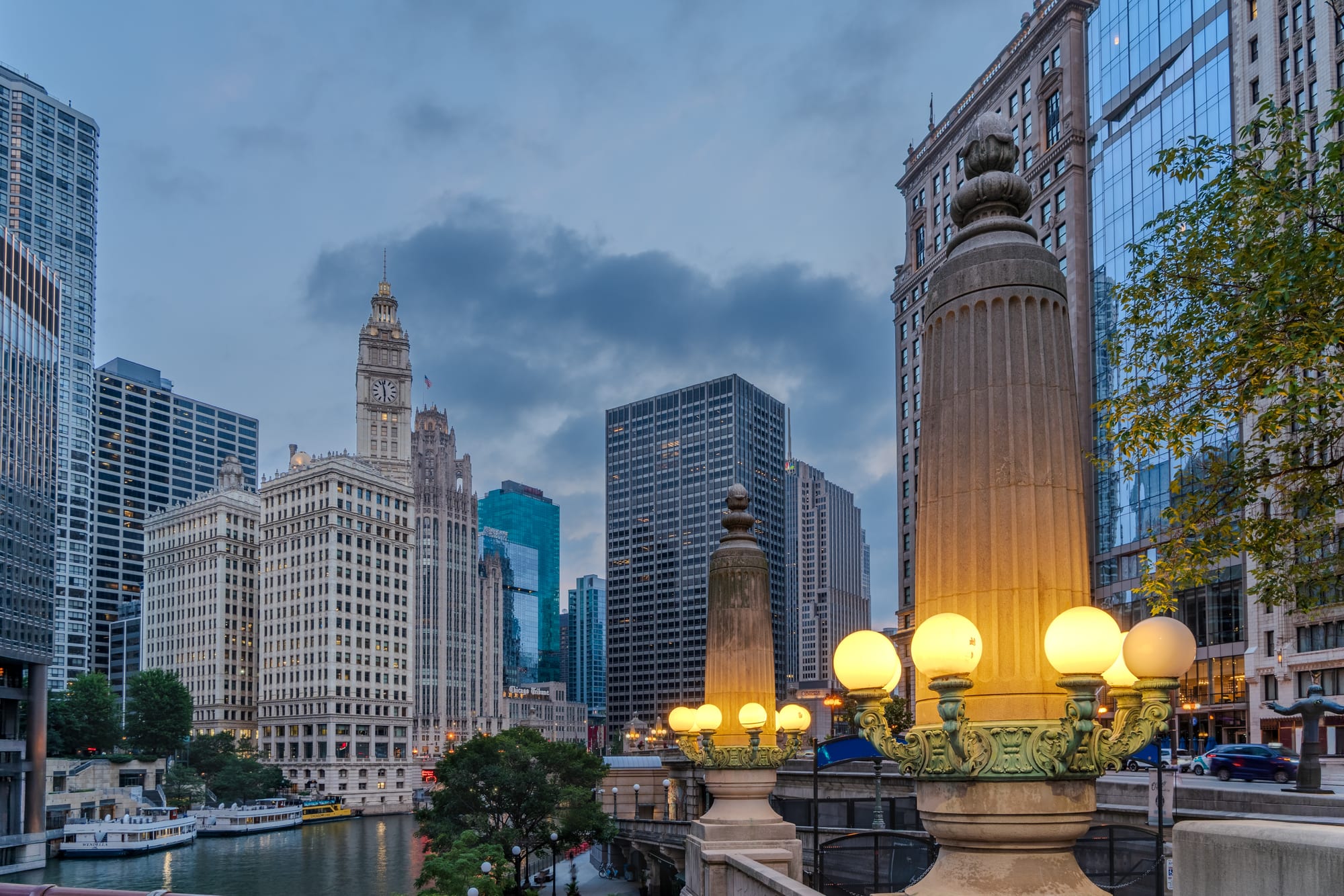
Globe lamps glowing on a bridge beside the Chicago River at dusk, with the white clock tower of the Wrigley Building and downtown towers behind

Chicago & the Great Lakes, United States

Chicago

The main branch of the Chicago River at blue hour, with the Wrigley Building's clock tower on the north bank. (NorbertNagel / Wikimedia Commons · CC BY-SA 4.0)

The largest city of the Midwest, on the western shore of Lake Michigan, built at the portage between the Great Lakes and the Mississippi. Railways and industry made it for decades the world's fastest-growing city; rebuilt after the fire of 1871, it gave the world the skyscraper. Today it is a city of finance and trade, lakefront parks, major museums, the blues and deep-dish pizza.

Neighbourhoods

  • The Loop
    • First-time visitors
    • Architecture
    • Close to public transport

    The central business district, bounded by the Chicago River and Lake Michigan and named after the ring of elevated tracks that circles its core. Historic towers, Willis Tower, the theatres, Millennium Park and the Art Institute are all here, and almost every L line passes through.

    Open in Maps
  • River North and the Magnificent Mile
    • Nightlife
    • Shopping
    • Best for food

    North of the river and west of Michigan Avenue's shopping corridor, a district of high-rises, restaurants, bars and clubs around Hubbard Street. It once had the largest concentration of art galleries in the country outside Manhattan, and a handful remain beside the furniture showrooms north of the Merchandise Mart.

    Open in Maps
  • Lincoln Park and Lakeview
    • Parks and beaches
    • Families
    • Baseball

    Residential North Side districts along the city's largest park, which runs seven miles up the lakefront with beaches, a free zoo, a conservatory and museums. Further north, Wrigley Field stands among the houses and bars of Lakeview.

    Open in Maps
  • Wicker Park and Logan Square
    • Nightlife
    • Best for food
    • Shopping

    Neighbourhoods on the north-west side along the Blue Line, known for bars, restaurants and boutiques. Logan Square, with its historic boulevards, was first settled by Norwegian, Danish, Polish and Jewish immigrants, and the 606 trail runs along its southern edge.

    Open in Maps
  • Pilsen
    • Best for food
    • Murals and art
    • Local life

    A Lower West Side neighbourhood named after the Czech city of Plzeň, one of the few whose buildings survived the fire of 1871. Settled by Eastern Europeans, it became the heart of Mexican Chicago along 18th Street, home to the National Museum of Mexican Art.

    Open in Maps
  • Chinatown
    • Best for food
    • Close to public transport

    A South Side neighbourhood along Wentworth Avenue between Cermak Road and 26th Street, where over a third of the city's Chinese population lives, with restaurants and bakeries and the riverside Ping Tom Memorial Park.

    Open in Maps
  • Hyde Park
    • Museums
    • Architecture
    • Quiet and residential

    A lakeside South Side neighbourhood seven miles south of the Loop, home to the University of Chicago, Frank Lloyd Wright's Robie House and, in Jackson Park, the Museum of Science and Industry.

    Open in Maps

Things to do

Famous landmarks

  • Millennium Parkpark

    A park of about 25 acres on former rail yards beside the Loop, opened in 2004 and seen by many as the city's most important project since the 1893 world's fair, with outdoor concerts, gardens and public art.

    Open in Maps
  • Cloud Gatelandmark

    Anish Kapoor's polished stainless-steel sculpture in Millennium Park, nicknamed 'The Bean', whose surface reflects and distorts the skyline; visitors walk around and under its arch.

    Open in Maps
  • Willis Towerviewpoint

    The 110-storey, 1,451-foot tower that opened in 1973 as the world's tallest building, still called the Sears Tower by many locals, the tallest building in the city.

    Open in Maps
  • Buckingham Fountainlandmark

    A tiered fountain in the rococo wedding-cake style at the centre of Grant Park, dedicated in 1927 and one of the largest in the world.

    Open in Maps
  • Chicago Cultural Centerlandmark

    The city's former main library of 1897, turned in 1978 into the country's first free municipal cultural centre, now one of the city's most popular attractions.

    Open in Maps
  • Navy Pierattraction

    A pier more than 3,000 feet long reaching into Lake Michigan from Streeterville, with over 50 acres of shops, restaurants, theatres and family attractions.

    Open in Maps

Architecture and the river

  • Chicago Riverwalktrail

    A promenade along the south bank of the main branch of the Chicago River from the lake to Lake Street, with restaurants, bars and cafés below the downtown towers.

    Open in Maps
  • Architecture river cruisesattraction

    Boat tours along the branches of the Chicago River, one of the most popular ways to see the city's architecture, past landmarks from the early skyscraper era to the present.

    Open in Maps
  • Robie Houselandmark

    Frank Lloyd Wright's Prairie-style house of 1910 on the University of Chicago campus, with long horizontal lines of Roman brick and art-glass windows, now a house museum.

    Open in Maps
  • Frank Lloyd Wright Home and Studiomuseum

    In suburban Oak Park, the house Wright built in 1889 and the studio he added in 1898, where he and his associates designed dozens of buildings.

    Open in Maps

Museums

  • Art Institute of Chicagomuseum

    One of the oldest and largest art museums in the country, founded in 1879 in Grant Park, whose collection includes Seurat's A Sunday on La Grande Jatte; Renzo Piano's Modern Wing opened in 2009.

    Open in Maps
  • Field Museummuseum

    One of the world's largest natural history museums, on the lakefront Museum Campus, with collections of over 24 million specimens and objects.

    Open in Maps
  • Shedd Aquariummuseum

    An aquarium opened in 1930 on the Museum Campus, holding about 32,000 animals, and the first inland aquarium with a permanent saltwater fish collection.

    Open in Maps
  • Griffin Museum of Science and Industrymuseum

    A science museum in the Palace of Fine Arts from the 1893 world's fair in Jackson Park, with a captured German U-boat, a Boeing 727 and the Apollo 8 command module.

    Open in Maps
  • National Museum of Mexican Artmuseum

    A free museum of Mexican and Chicano art and culture in Pilsen's Harrison Park, founded in 1982.

    Open in Maps

Parks and the lakefront

  • Lincoln Parkpark

    The city's largest public park, stretching seven miles along Lake Michigan with beaches, harbours, gardens, a conservatory, the Chicago History Museum and nature reserves.

    Open in Maps
  • Lincoln Park Zooattraction

    A free zoo founded in 1868, one of the oldest in the country, with about 1,100 animals of some 200 species.

    Open in Maps
  • Lakefront Trailtrail

    An 18.5-mile path for walking, running and cycling along the lake, linking the city's four major lakefront parks.

    Open in Maps
  • Garfield Park Conservatorypark

    One of the largest greenhouse conservatories in the United States, on the West Side, often called 'landscape art under glass'.

    Open in Maps

Music, sport and nights out

  • Wrigley Fieldattraction

    The Chicago Cubs' ballpark, opened in 1914, known for its ivy-covered outfield wall, red marquee and hand-turned scoreboard, set among residential streets.

    Open in Maps
  • Green Millattraction

    A jazz bar on Broadway in Uptown with roots in the 1890s and in the same building since 1921, known for its jazz and its connections to the city's mob history.

    Open in Maps
  • Buddy Guy's Legendsattraction

    A blues club opened in 1989 by the blues musician Buddy Guy, one of the few blues clubs left in the city.

    Open in Maps

Short trips from the city

  • Indiana Dunes National Parkpark

    Beaches and dunes along the southern tip of Lake Michigan in north-west Indiana, a national lakeshore from 1966 that became a national park in 2019.

    Open in Maps

Seasonal events

  • Chicago Blues FestivalJune

    Three days of performances by established and new blues musicians, hosted by the city.

  • Chicago Pride Paradelast Sunday in June

    One of the largest Pride parades in the world, with over a million people attending.

  • Taste of ChicagoJuly

    Billed as the world's largest food festival, in Grant Park, with live music on several stages.

  • Lollapaloozasummer

    A four-day music festival in Grant Park, a touring event from 1991 that settled permanently in Chicago in 2005.

  • Chicago Air & Water ShowAugust

    A free air show held over the lakefront since 1959, the largest free show of its kind in the country.

  • Chicago MarathonOctober

    One of the World Marathon Majors and among the largest marathons by number of finishers, with around 50,000 runners.

Eat and drink

Long-standing places and food districts in Chicago. Hours, ratings and directions come from your maps app, always current.

Chicago classics

  • Pizzeria Unorestaurant

    The restaurant where Chicago's deep-dish pizza is said to have originated — baked in a high-sided pan with the cheese under the tomato sauce.

    Open in Maps
  • Superdawgrestaurant

    A drive-in hot dog stand with carhop service in Norwood Park, one of the few original drive-in restaurants left in the United States.

    Open in Maps
  • Lou Mitchell'srestaurant

    A diner near Union Station and the start of Route 66, long popular with commuters and road-trippers.

    Open in Maps

Food districts

  • Pilsen and 18th Streetneighborhood

    Taquerías, bakeries and Mexican restaurants along the main street of Mexican Chicago.

    Open in Maps
  • Chinatownneighborhood

    Restaurants and bakeries along Wentworth Avenue and Cermak Road in one of the largest Chinese American neighbourhoods in the country.

    Open in Maps
  • Greektownneighborhood

    Greek restaurants along South Halsted Street on the Near West Side.

    Open in Maps
  • Maxwell Streetneighborhood

    The old Near West Side market street that gave its name to the Maxwell Street Polish, a grilled kielbasa with grilled onions, mustard and sport peppers.

    Open in Maps

Experience Chicago

History

The Potawatomi held this flat, marshy land where the Chicago River meets Lake Michigan, at a short portage between the Great Lakes and the Mississippi basin. The first known permanent settler was Jean Baptiste Point du Sable, a trader of African descent, perhaps from Saint-Domingue, in the 1780s. The army built Fort Dearborn in 1803; it was destroyed in the War of 1812 and rebuilt. After the 1833 Treaty of Chicago the Potawatomi were forcibly removed west of the Mississippi. The town was organised in 1833 with about 200 people and incorporated as a city in 1837, and for decades it was the fastest-growing city in the world. The Illinois and Michigan Canal and the first railway opened in 1848, and in 1860 Abraham Lincoln was nominated for president here.

The Great Chicago Fire of October 1871 burned an area about four miles long, killed at least 300 people and left over 100,000 homeless. The rebuilding was the largest building boom in the nation's history, and in 1885 the Home Insurance Building became the first steel-framed high-rise. The Haymarket affair of 1886 and the Pullman Strike of 1894 marked bitter labour conflicts, and the World's Columbian Exposition of 1893 drew 27.5 million visitors. By 1900 most residents were immigrants or their children, and from 1910 the Great Migration brought Black southerners north.

The Prohibition years made the city's gangsters notorious. During the Second World War Chicago produced more steel than Britain. After 1950, when the population peaked at 3.6 million, suburbs drew residents away and steel jobs collapsed. Harold Washington became the first Black mayor in 1983. In the 2020s underfunded pensions pushed the city into a fiscal crisis, with a budget deficit near $1 billion in 2025.

Culture & Customs

Chicago's culture has left a mark far beyond the city. The Great Migration had an immense cultural impact, and blues, jazz, soul and gospel all have deep roots here; house music was born in Chicago clubs, and the city also gave birth to industrial music and has an influential hip-hop scene. Its theatre community created modern improvisational comedy, with The Second City, founded in 1959, launching generations of comedians. The Chicago Symphony Orchestra and the Lyric Opera of Chicago lead the classical scene, and the Art Institute is both a museum and an influential art school.

Architecture is a civic religion. The city gave its name to the Chicago School and was home to Frank Lloyd Wright's Prairie School, and its skyline runs from Louis Sullivan and Daniel Burnham to Mies van der Rohe's lakeshore apartment towers; public art by Picasso, Chagall, Miró and Calder stands in the Loop's plazas.

Neighbourhood identity is strong: Mexican Pilsen and La Villita, Puerto Rican Paseo Boricua in Humboldt Park, Greektown, Chinatown and a large Polish community with its own theatre and newspapers. The Pride Parade in June is one of the world's largest. Sport divides and unites the city — two baseball teams, the Cubs and White Sox, as well as teams in every other major league — and the Chicago accent, famous from The Blues Brothers, is a point of humour and pride.

Daily Life

Chicago had 2.74 million residents at the 2020 census, making it the third most populous city in the country, and its metropolitan area, often called Chicagoland, had about 9.62 million. The city is divided into 77 community areas and more than 200 informally defined neighbourhoods; the Loop is the business centre, and the North Side is the most densely populated residential section. Away from the lake, much of the city is built of brick bungalows from the early 20th century.

The economy is diverse, with no single industry employing more than 14 per cent of the workforce. Chicago has the world's largest and most diverse market in financial derivatives, and is a hub for commerce, technology, logistics and the nation's railways; O'Hare is one of the world's busiest airports. Tourism is large too — nearly 57 million people visited in 2025.

Daily life is shaped by the lake and the weather: crowded beaches, the Lakefront Trail and street festivals all summer, and long indoor months in winter. The city's finances and pension debts, and violent crime concentrated in particular neighbourhoods, are long-running issues. The current mayor is Brandon Johnson.

Food

Chicago has a handful of dishes all its own. Deep-dish pizza, said to have originated at Pizzeria Uno, is baked in a high-sided pan with the cheese under the tomato sauce. The Chicago-style hot dog is usually all-beef, on a poppy-seed bun, loaded with yellow mustard, bright pickle relish, onion, tomato wedges, a dill pickle spear and pickled sport peppers, and finished with celery salt — ketchup is frowned upon. The Italian beef sandwich is thinly sliced beef simmered in its juices and served on an Italian roll with sweet peppers or spicy giardiniera, a pickled vegetable relish; with a sausage added, it becomes a "combo".

Other local inventions come from the city's communities. The Maxwell Street Polish is a grilled or deep-fried kielbasa with grilled onions, mustard and sport peppers; the Puerto Rican-influenced jibarito uses flattened, fried green plantains in place of bread; and the "mother-in-law" is a tamale topped with chilli in a hot dog bun.

Beyond these, Chicago eats like the immigrant city it is: Mexican food in Pilsen and Little Village, Greek on Halsted Street, Chinese along Wentworth Avenue, Polish food for the city's large Polish community, and many restaurants of national reputation. The Taste of Chicago festival each summer and the Chicago Food Truck Festival showcase the city's signature dishes.

Planning tools

Budget

Chicago is the most expensive city in the region. Hotel rates and taxes in the Loop and River North are high, above all during big conventions and on summer weekends, but food is good value away from the tourist strips, many parks, the Cultural Center, the zoo and some museums are free, and public transport makes a car unnecessary.

Daily Budget Midrange
USD 250–450 (mid-range hotel, restaurant dinners with tax and tip, museum tickets, L and ride-hailing)
Daily Budget Shoestring
USD 100–170 (hostel bed, hot dogs, Italian beef and neighbourhood taquerías, L passes)

Stay outside the centre near an L station to save on rooms, check convention dates before booking, and use the free lakefront, Millennium Park and Lincoln Park Zoo.

Best Time to Visit

Late May to September is the season for the lakefront, beaches, outdoor festivals and baseball, though July and August can be hot and busy. September and October are often the most comfortable months, with the marathon in October. Winters are long, grey and cold, with snow possible into April, but hotel prices fall and the museums are quieter.

Suggested Number of Days

Three or four days give a first look at the centre, the lakefront and a few neighbourhoods. Allow five to seven to explore more of the neighbourhoods, the suburbs and the Indiana shore. Winter weather and big events can slow things down.

First Visit
3–4 days
With Surroundings
5–7 days

Transportation

The Chicago 'L', run by the Chicago Transit Authority, is one of the few metro systems in the world with 24-hour service on some lines — the Red and Blue lines — and with buses it makes a car unnecessary in the city. Metra commuter trains run to the suburbs from four downtown terminals. The street grid is easy to follow, and the Divvy bike-share scheme, launched in 2013, and the Lakefront Trail suit cycling.

Tickets for the L, buses and Metra can be bought on the Ventra app; driving and parking downtown are slow and expensive.

Airport & Station Connections

O'Hare International Airport, one of the world's busiest, is on the North-West Side about 17 miles from downtown; the Blue Line runs from the terminal to the Loop around the clock. Midway International Airport, about 12 miles from the Loop, is linked by the Orange Line in roughly 25 minutes. Amtrak's long-distance and intercity trains all use Chicago Union Station.

Walkability

The Loop, the Riverwalk, Millennium Park, Grant Park and the Museum Campus are close together and good on foot, and the flat grid makes navigation simple. Distances to the outer neighbourhoods are long, so most visitors combine walking with the L. Wind off the lake and winter ice make walking hard from December to March.

Safety

For most visitors the US is safe, with the main risks being petty theft and car break-ins in tourist areas of some cities, road accidents over long distances, extreme weather, and the hazards of the outdoors. In Chicago violent crime is concentrated in particular neighbourhoods away from the main sights; the centre, the lakefront and the North Side neighbourhoods are busy with visitors.

Keep valuables out of sight, leave nothing visible in parked cars, use ride-hailing late at night, heed beach warning flags on Lake Michigan and dress for serious cold in winter. Check current official travel advice before travelling.

Climate

A hot-summer humid continental climate with four distinct seasons. The lake keeps waterfront neighbourhoods slightly warmer in winter and cooler in summer. Thunderstorms bring most of the rain, and severe storms with hail and occasional tornadoes are possible in spring and summer.

Summer
warm to hot and humid — temperatures reach 90°F on about 17 days in a normal summer, cooler by the lake
Winter
cold and grey — normal highs from December to March are about 36°F, and snow can fall into April

Local Customs

Tipping of 18–22 per cent is expected in restaurants; sales tax is added at the till. Chicagoans divide the city into the North, South and West Sides, take their two baseball teams seriously, and have firm views on food: ketchup on a Chicago hot dog is frowned upon.

Identification is asked for when buying alcohol (the legal age is 21). Give way to cyclists and runners on the Lakefront Trail.

Common Payment Methods

The currency is the US dollar. Cards and contactless payment are accepted almost everywhere, and some places no longer take cash.