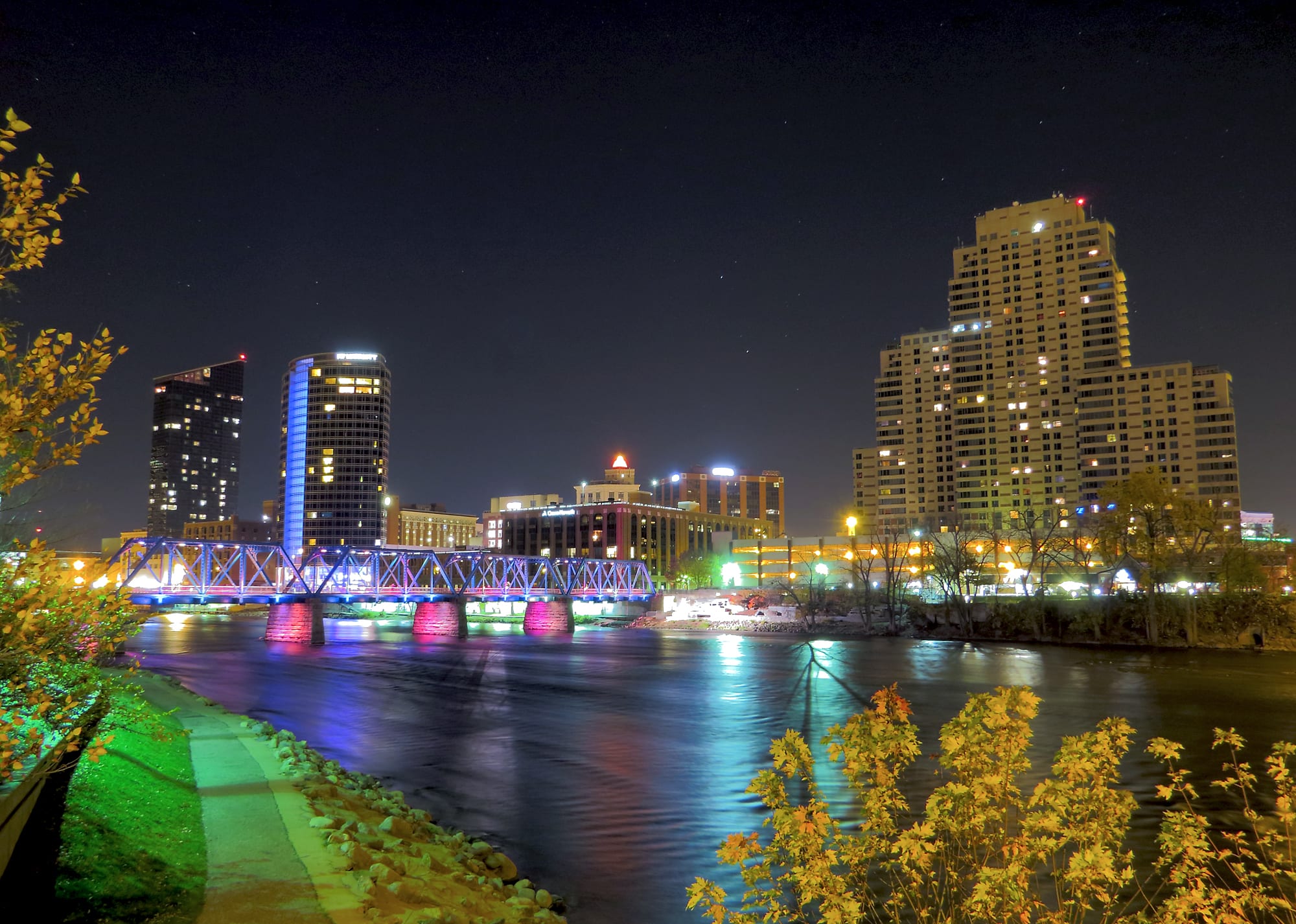
The lit Blue Bridge and downtown towers of Grand Rapids reflected in the Grand River at night, with autumn shrubs on the bank

Chicago & the Great Lakes, United States

Grand Rapids

Downtown Grand Rapids and the Blue Bridge over the Grand River at night. (Russell Sekeet / Wikimedia Commons · CC BY 2.0)

Michigan's second-largest city, on the Grand River about 25 miles inland from Lake Michigan. Lumber and then fine furniture made it famous as Furniture City; today it is a tidy, prosperous place of office-furniture makers, hospitals and craft breweries, with the Gerald R. Ford Museum, a Calder sculpture and a large sculpture garden.

Neighbourhoods

  • Downtown
    • First-time visitors
    • Museums
    • Nightlife

    Both banks of the Grand River, with the arena, the convention centre, the art and public museums, Calder Plaza and the Ford Museum within a few blocks. Most of the city's hotels, bars and restaurants are here, and the Blue Bridge, lit at night, links the two sides on foot.

    Open in Maps
  • Heritage Hill
    • Historic district
    • Architecture
    • Quiet and residential

    A hillside of more than a thousand 19th- and early 20th-century houses just east of downtown, built for the city's lumber and furniture barons in a long run of styles. Frank Lloyd Wright's Meyer May House is here.

    Open in Maps
  • West Side
    • Bars
    • Local life

    The historically Polish and working-class side of the river, where Bridge Street now has a brewpub, restaurants and bars a short walk from downtown.

    Open in Maps
  • Eastown
    • Cafés
    • Students
    • Independent shops

    A walkable district of older shopfronts around Wealthy Street and Lake Drive, with cafés, bars and small restaurants near Aquinas College.

    Open in Maps
  • East Hills and Wealthy Street
    • Best for food
    • Breweries

    Restored commercial blocks along Wealthy Street and Cherry Street between Heritage Hill and Eastown, with restaurants, bakeries and a Belgian-style brewery in an old chapel.

    Open in Maps

Things to do

Famous landmarks

  • La Grande Vitesselandmark

    Alexander Calder's huge red steel sculpture of 1969 on Calder Plaza, the first public artwork funded by the National Endowment for the Arts' Art in Public Places programme and now part of the city's logo.

    Open in Maps
  • Meyer May Houselandmark

    A Prairie School house of 1908–09 by Frank Lloyd Wright in Heritage Hill, restored by Steelcase and one of the most completely restored of Wright's Prairie houses.

    Open in Maps

Museums

  • Gerald R. Ford Presidential Museummuseum

    The museum of the 38th president, who grew up in Grand Rapids, on the west bank of the river; Ford and his wife Betty are buried in its grounds.

    Open in Maps
  • Grand Rapids Art Museummuseum

    The city's art museum, in a LEED Gold-certified modern building downtown, with collections ranging from the Renaissance to modern art.

    Open in Maps
  • Grand Rapids Public Museummuseum

    A history and science museum on the riverbank, with a recreated 1890s street, a planetarium and a 1928 carousel in a pavilion over the river.

    Open in Maps

Parks and gardens

  • Frederik Meijer Gardens and Sculpture Parkpark

    Botanical gardens and a large sculpture park on the north-east edge of the city, with works by Henry Moore, Louise Bourgeois and others, a tropical conservatory, a Japanese garden and summer concerts in its amphitheatre.

    Open in Maps
  • John Ball Zooattraction

    A zoo on a wooded hillside on the West Side, in a park left to the city by a 19th-century pioneer.

    Open in Maps
  • Rosa Parks Circlepark

    A downtown plaza designed by Maya Lin, used for concerts and dances in the warmer months and as an ice rink in winter.

    Open in Maps

Markets

  • Fulton Street Farmers Marketmarket

    A farmers' market running since 1922 east of downtown, roofed over in 2012.

    Open in Maps

Music, sport and nights out

  • Van Andel Arenaattraction

    The downtown arena for concerts and the Grand Rapids Griffins ice hockey team.

    Open in Maps
  • DeVos Performance Hallattraction

    The concert hall in the riverside convention centre, home stage of the Grand Rapids Symphony and touring shows.

    Open in Maps

Short trips from the city

  • Hollandattraction

    A town about 25 miles west founded by Dutch settlers in 1847, with De Zwaan, a Dutch windmill brought from the Netherlands, tulip fields in spring and Lake Michigan beaches nearby.

    Open in Maps
  • Grand Havenattraction

    A Lake Michigan beach town at the mouth of the Grand River, with a long boardwalk, a pier and red lighthouses.

    Open in Maps
  • Saugatuckattraction

    A small harbour town and long-standing artists' colony on the Kalamazoo River near Lake Michigan, with galleries and high sand dunes.

    Open in Maps

Seasonal events

  • Tulip Time Festivalearly May

    Holland's spring festival of tulips, parades and Dutch dancing, a short drive west of the city.

  • Christmas at Meijer Gardenswinter

    Meijer Gardens' Christmas and Holiday Traditions exhibition, held every winter since the gardens opened in 1995.

Eat and drink

Long-standing places and food districts in Grand Rapids. Hours, ratings and directions come from your maps app, always current.

Breweries and bars

  • Founders Brewing Companyrestaurant

    The city's best-known brewery, founded in the mid-1990s and now one of the largest in the United States, known for strong stouts such as its bourbon-barrel-aged KBS, with a taproom on the edge of downtown.

    Open in Maps

Food districts and markets

  • Fulton Street Farmers Marketmarket

    Farm stands selling Michigan fruit and vegetables through the growing season.

    Open in Maps
  • Wealthy Streetneighborhood

    The east-side street with the densest run of independent restaurants, bakeries and cafés in the city.

    Open in Maps

Experience Grand Rapids

History

The Ottawa (Odawa) people lived along the Grand River, whose rapids gave the city its name, long before Europeans arrived. In 1826 the Detroit-born fur trader Louis Campau set up a trading post here, and he later bought the 72 acres that became the heart of downtown. Settlers from New England and New York followed, and Grand Rapids became a city in 1850, using the river's power for sawmills fed by the forests of western Michigan.

Lumber gave rise to furniture. After its makers won attention at the Centennial Exhibition in Philadelphia in 1876, Grand Rapids became the best-known furniture city in the United States, hosting national home-furnishing markets that drew buyers from across the country for about 75 years. Dutch immigrants arrived in great numbers in the later 19th century, joined by Poles and others who worked in the factories; the Dutch gave the city and its region a lasting religious and cultural stamp. In 1945 Grand Rapids became the first city in the world to add fluoride to its drinking water.

Household furniture production moved south, largely to North Carolina, in the 20th century, but office furniture — led by Steelcase — kept the trade alive. Gerald Ford, who grew up in the city and represented it in Congress for nearly 25 years, became president in 1974, and his presidential museum opened here in 1981. Downtown declined in the post-war decades, then was rebuilt from the 1980s onwards, much of it with money from local families such as the DeVoses, founders of Amway, and the Van Andels and Meijers. The city has grown steadily since.

Culture & Customs

Grand Rapids is a city of philanthropy and civic pride. Its museums, arena, gardens and medical campus carry the names of local families, and Calder's La Grande Vitesse, installed in 1969, is treated as a civic symbol. The city has a symphony, a ballet and an opera, Frank Lloyd Wright's Meyer May House, and a long run of 19th-century houses in Heritage Hill. The volunteer-run Festival of the Arts filled downtown each June from 1970 until its organisers closed it in 2025.

The Dutch Reformed heritage remains strong: Calvin University and many churches belong to that tradition, and in the countryside to the west the Dutch identity is celebrated in Holland's spring Tulip Time. The city has also become more diverse, with large Latino and African American communities and newer arrivals, among them thousands of Vietnamese refugees who came after 1975.

Beer is now a large part of its identity. Grand Rapids called itself Beer City USA after sharing the title in an online poll in 2012 and winning it outright in 2013, and its breweries draw visitors from across the Midwest. Locals are polite, practical and quietly proud of a city that outsiders often overlook.

Daily Life

About 200,000 people live in the city and around 1.2 million in its wider metropolitan area. Health care is the largest employer: Corewell Health, based in the city, is West Michigan's biggest, and its hospitals sit beside research institutes and medical schools on the Medical Mile along Michigan Street; furniture and design firms, Meijer supermarkets, Amway in nearby Ada, and manufacturers such as Bissell fill out a broad economy.

Most people live in neighbourhoods of detached wooden houses with porches and yards or in fast-growing suburbs, and almost everyone drives. Downtown has filled with new flats and students from Grand Valley State University's city campus.

The year turns on the weather. Winters are long and snowy — the city averages about 75 inches of snow a year, much of it from sudden lake-effect storms — and life moves indoors to restaurants, church and school sports; in summer families head to the Lake Michigan beaches at weekends, and downtown fills with concerts and patios.

Food

Grand Rapids eats much like the rest of the Midwest, but its local pride lies in beer and in the farm produce of western Michigan. Michigan is a leading grower of blueberries, tart cherries, apples and peaches, and farmers' markets fill with asparagus in spring and sweetcorn in late summer. The Fulton Street Farmers Market has sold local produce since 1922.

The city's breweries are its best-known product. Founders, opened in the mid-1990s, became one of the largest breweries in the country, and dozens of smaller breweries and taprooms are spread across downtown, the West Side and the east-side neighbourhoods. Many serve substantial food, and cider and spirits have joined them.

Immigrant communities add their own cooking: taquerías and Mexican bakeries, Vietnamese and other Asian restaurants, and Polish dishes such as pierogi and kielbasa on the West Side. In the Dutch towns to the west, bakeries sell banket, a pastry filled with almond paste, and windmill cookies, and Dutch-style shops stock licorice and cheeses.

Planning tools

Budget

Grand Rapids costs less than Chicago or Detroit's downtown for rooms and food. Hotel prices downtown rise for conventions and big concerts. A car is useful for the gardens, the beaches and the Dutch towns to the west, and adds rental and fuel to the bill.

Daily Budget Midrange
USD 200–340 (downtown hotel, restaurant dinners with tax and tip, museum and garden tickets, a hire car)
Daily Budget Shoestring
USD 90–140 (budget motel, food halls, taprooms and tacos, buses)

The riverwalk, the Blue Bridge, Calder Plaza and the Heritage Hill streets cost nothing; the gardens and museums charge admission.

Best Time to Visit

Late May to early October. Summer brings outdoor concerts, beer gardens and easy trips to the Lake Michigan beaches; late September and October add autumn colour and salmon in the river. Winters are long, cold and snowy, though Meijer Gardens' Christmas displays and the museums keep the city busy.

Suggested Number of Days

One or two days suit the city itself. Three or four allow time for the lakeshore towns to the west, which most visitors combine with Grand Rapids, and more is needed in summer when the beaches are the main draw.

First Visit
1–2 days
With Surroundings
3–4 days

Transportation

Most people drive, and the city is ringed by freeways that make it easy to reach the suburbs and the lakeshore. The Rapid runs the city's buses, including the Silver Line and Laker Line bus rapid transit routes and a free downtown circulator, DASH. Ride-hailing is common.

Lake-effect snow can make driving slow from December to March; allow extra time on the roads to the lakeshore.

Airport & Station Connections

Gerald R. Ford International Airport is about 13 miles south-east of downtown, with direct flights to major US hubs. Amtrak's Pere Marquette runs daily to Chicago in around four hours. Most visitors drive, on I-196 from the Chicago area or I-96 from Detroit.

Walkability

Downtown is compact and easy on foot, with a riverwalk along the Grand River. Heritage Hill is a short climb east, and the West Side's Bridge Street is a walk across the river. Eastown and the gardens are farther out and need a bus or a car.

Safety

Grand Rapids is generally safe for visitors. Downtown and the main neighbourhoods are busy and well kept, and crime is concentrated in some residential areas away from them. The practical risks are car break-ins and icy pavements in winter.

Leave nothing visible in a parked car and take care on snowy roads. Check current official travel advice before travelling.

Climate

A humid continental climate with four distinct seasons, shaped by Lake Michigan to the west, which brings heavy lake-effect snow in winter and keeps summer evenings mild.

Summer
warm and fairly humid — July afternoons are usually in the low 80s °F, with thunderstorms
Winter
cold and snowy — January averages in the mid-20s °F, with frequent lake-effect snow

Local Customs

Tipping is expected: roughly 18–22 per cent in restaurants and about a dollar a drink at a bar. Prices are shown without Michigan's 6 per cent sales tax. West Michigan is more religious and conservative than the state's big cities, with a strong Dutch Reformed tradition, and Sunday is quieter than in Detroit or Chicago, though the bars and restaurants are open.

Identification is asked for when buying alcohol (the legal age is 21). Cannabis is legal for adults in Michigan but not in public places.

Common Payment Methods

The currency is the US dollar. Cards and contactless payment are accepted almost everywhere, including at most market stalls. ATMs are easy to find, and a little cash helps at farmers' markets.