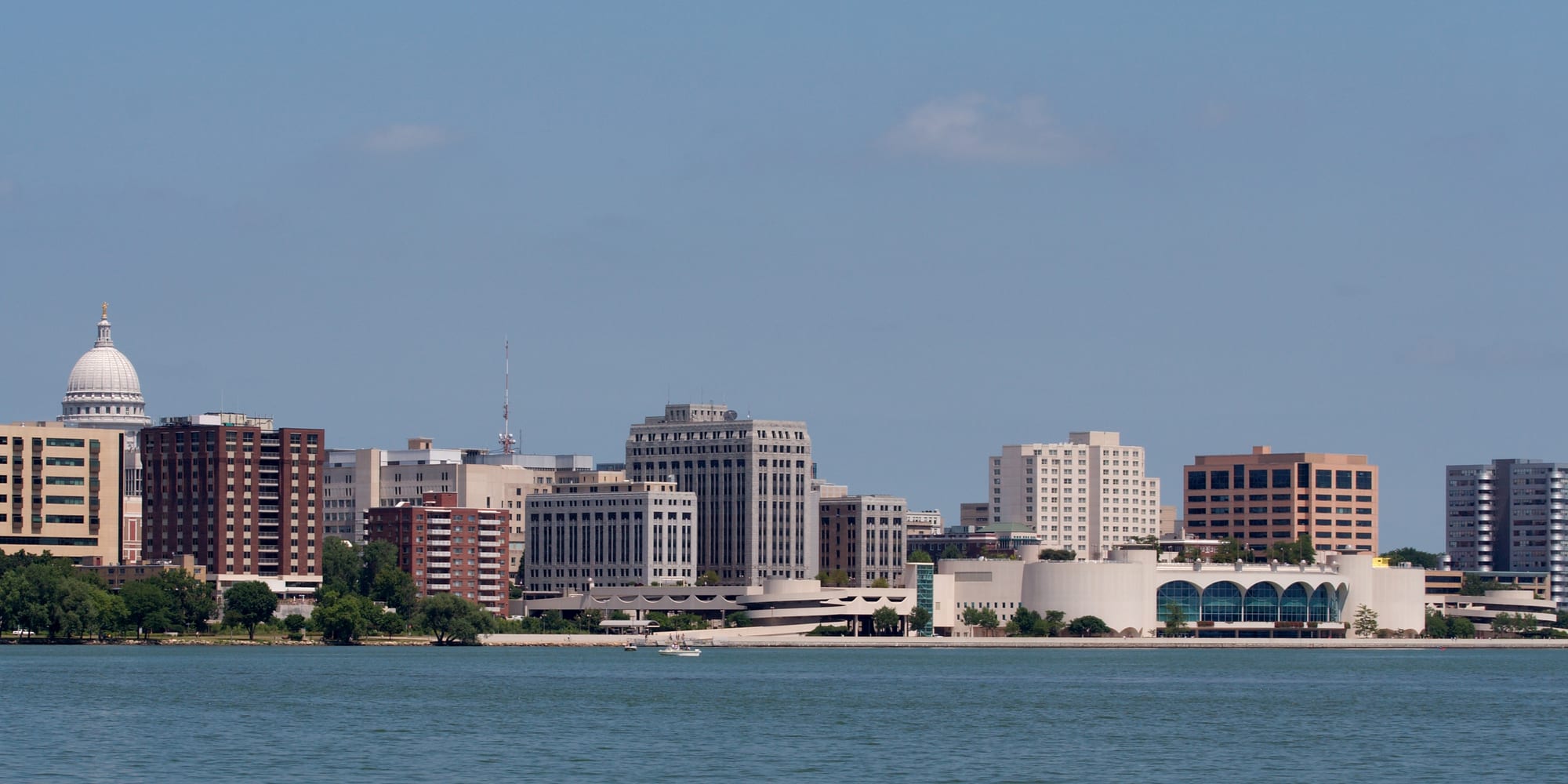
Downtown Madison seen across Lake Monona, with the white capitol dome on the left and the curved Monona Terrace by the water

Chicago & the Great Lakes, United States

Madison

The downtown skyline of Madison seen from Lake Monona. (Dori / Wikimedia Commons · CC BY 2.5)

Wisconsin's capital, built on a narrow isthmus between Lakes Mendota and Monona, with the domed State Capitol at its centre and the University of Wisconsin campus along the shore. Founded as a planned capital in the 1830s, it has grown into a university and government city known for its lakes, bike paths, politics and Saturday farmers' market.

Neighbourhoods

  • Capitol Square and downtown
    • First-time visitors
    • Close to public transport
    • Markets

    The centre of the isthmus around the State Capitol, with offices, restaurants, the Overture Center for the Arts and Monona Terrace on the lakeshore. On summer Saturdays the farmers' market rings the square.

    Open in Maps
  • State Street and the university
    • Students and nightlife
    • Best for food
    • Museums

    A pedestrian street of shops, bars and cafés that runs from the capitol to the University of Wisconsin campus, whose libraries, museums and the lakeside Memorial Union terrace line the shore of Lake Mendota.

    Open in Maps
  • Williamson Street and the near east side
    • Local life
    • Bars and cafés
    • Quiet and residential

    The older east side of the isthmus, where Williamson Street — known as Willy Street — has co-op grocers, music venues, bars and restaurants among wooden houses, and parks lead down to both lakes.

    Open in Maps
  • Monroe Street and the near west side
    • Quiet and residential
    • Cafés

    A tree-lined residential area south-west of campus, with independent shops and restaurants along Monroe Street and the University Arboretum and Camp Randall Stadium close by.

    Open in Maps
  • Atwood and Schenk's Corners
    • Local life
    • Best for food

    A neighbourhood further east on the isthmus, beside Lake Monona's northern end, with a small commercial strip of restaurants, bars and a theatre, and easy access to the lakeshore paths.

    Open in Maps

Things to do

Landmarks

  • Wisconsin State Capitollandmark

    The granite capitol of 1917 at the centre of the isthmus, with a large dome, a richly decorated interior open for guided tours, and an observation deck in summer.

    Open in Maps
  • Monona Terracelandmark

    A convention and community centre on Lake Monona built in the 1990s to a design by Frank Lloyd Wright, with a rooftop garden looking over the water.

    Open in Maps
  • Overture Center for the Artsattraction

    The city's main performing arts centre, home to the Madison Symphony Orchestra and touring shows, and also housing the Madison Museum of Contemporary Art.

    Open in Maps

Museums

  • Chazen Museum of Artmuseum

    The University of Wisconsin's art museum, with a collection of more than 25,000 objects ranging from Japanese woodblock prints to American and contemporary art.

    Open in Maps
  • Madison Museum of Contemporary Artmuseum

    A museum of modern and contemporary art downtown, with a rooftop sculpture garden.

    Open in Maps

Parks, lakes and gardens

  • Memorial Unionattraction

    The university's student union of 1928 on Lake Mendota, whose lakeside terrace is one of the city's favourite summer gathering places.

    Open in Maps
  • University of Wisconsin–Madison Arboretumpark

    A large university arboretum on Lake Wingra, known for pioneering the restoration of prairie and other native landscapes, with walking trails.

    Open in Maps
  • Olbrich Botanical Gardenspark

    Gardens on the east side by Lake Monona, with a tropical conservatory and an outdoor Thai pavilion given by the government of Thailand and the university's Thai alumni.

    Open in Maps
  • Henry Vilas Zoopark

    A free zoo in Vilas Park, owned by Dane County.

    Open in Maps

Sport

  • Camp Randall Stadiumattraction

    The University of Wisconsin's football stadium, built on a former Civil War training camp, where the crowd's 'Jump Around' between quarters is a famous tradition.

    Open in Maps

Short trips from the city

  • Taliesinlandmark

    Frank Lloyd Wright's home, studio and estate near Spring Green, west of Madison, part of the UNESCO World Heritage Site of his 20th-century architecture.

    Open in Maps
  • House on the Rockattraction

    An eccentric complex near Spring Green built on top of a rock column, filled with collections of automata, carousels and curiosities.

    Open in Maps
  • Devil's Lake State Parkpark

    Wisconsin's most visited state park, a lake beneath quartzite bluffs north of the city, with hiking, climbing and swimming.

    Open in Maps
  • New Glarusattraction

    A village founded by Swiss immigrants south-west of Madison, known for its Swiss-style buildings and its brewery.

    Open in Maps

Seasonal events

  • Dane County Farmers' MarketSaturdays, April to November

    A producer-only farmers' market of cheese, vegetables, meat and baked goods around Capitol Square, one of the largest of its kind in the country.

  • Great Taste of the MidwestAugust

    A long-running beer festival in Olin Park on Lake Monona, with breweries from across the Midwest.

  • Badgers footballSeptember to November

    University football home games at Camp Randall Stadium, which fill the city on Saturdays with tailgates and crowds in red.

Eat and drink

Long-standing places and food districts in Madison. Hours, ratings and directions come from your maps app, always current.

Madison classics

  • Dane County Farmers' Marketmarket

    The big Saturday market on Capitol Square, where Wisconsin cheese, cheese curds, breads and seasonal produce are sold directly by the farmers.

    Open in Maps
  • Memorial Union Terracecafe

    The lakeside terrace of the student union, known for beer, bratwurst and university-made ice cream by Lake Mendota.

    Open in Maps

Food districts

  • State Streetneighborhood

    A long run of restaurants, cafés and bars with food from around the world, busy with students and visitors.

    Open in Maps
  • Williamson Streetneighborhood

    The east side's food and drink street, with co-op grocers, bakeries, international restaurants and bars.

    Open in Maps

Experience Madison

History

The isthmus between Lakes Mendota and Monona was home to the Ho-Chunk people, whose name for the area, Teejop, means "land of the four lakes", and effigy mounds built by earlier peoples still survive around the lakes. European-American settlement began in the 1830s.

In 1836 the land speculator and judge James Duane Doty persuaded the territorial legislature to make the still-empty isthmus the capital of the new Wisconsin Territory, naming the town after the late president James Madison. The cornerstone of the first capitol was laid in 1837, and the University of Wisconsin was founded in 1848, the year of statehood. The city grew as a centre of government and learning rather than heavy industry, and the present capitol was completed in 1917.

In the early 20th century the university became associated with the Wisconsin Idea — that its research should serve the whole state — and with the progressive politics of Robert La Follette. Madison was a major centre of student protest against the Vietnam War, culminating in the bombing of the university's Sterling Hall in 1970, which killed a researcher. In 2011 tens of thousands of people occupied and surrounded the capitol in protests over public-sector union rights. As of 2024 it was the fastest-growing city in the state.

Culture & Customs

The university shapes much of Madison's culture. Tens of thousands of students fill the campus and State Street, and Badgers football, basketball and hockey bring the city together; at Camp Randall Stadium the crowd jumps to the song "Jump Around" between the third and fourth quarters. The Memorial Union terrace by Lake Mendota is a shared summer living room for students and residents alike.

Madison is regarded as the most politically liberal city in Wisconsin, and its politics, co-operatives and activism are part of local identity. The city has a strong music and theatre scene for its size, with the Overture Center, small venues on the east side and summer concerts on the Capitol Square. Frank Lloyd Wright, who spent much of his childhood in Madison, left his mark on the city's architecture.

The lakes are central to daily life: sailing, swimming and paddling in summer, ice fishing, skating and cross-country skiing in winter. People are friendly and informal, and the rhythm of the city follows the academic calendar.

Daily Life

About 270,000 people live in Madison, and about 700,000 in the surrounding metropolitan area. The state government and the University of Wisconsin are the largest employers, alongside healthcare, insurance and a large technology and biotech sector; the medical software company Epic Systems is based in nearby Verona.

The isthmus holds the government offices and a dense core of apartments and older houses, while newer suburbs spread outwards. Many residents cycle or take the bus, and the city's lakes and parks give it a green, outdoor character. Housing costs have risen sharply as the population has grown, and affordability is one of the main local issues.

Daily life changes with the seasons and the academic year: busy, outdoor summers with the market and lakes, autumn football weekends, and long, snowy winters when the lakes freeze and people move indoors to cafés, bars and sports. The turnover of student leases each August fills the streets around campus with moving vans and furniture left on the kerb.

Food

Wisconsin is America's Dairyland, and cheese is the heart of the city's food. Cheese curds — fresh, springy pieces of cheddar that squeak when bitten — are eaten fresh or fried in batter. The Dane County Farmers' Market is the best place to try local cheeses, along with breads, honey, meat and vegetables from the farms around the city.

Bratwurst, a German sausage, is a staple at games, festivals and the Memorial Union terrace, and the university's dairy plant makes ice cream that is served on campus. Supper clubs on the edge of the city serve steaks, relish trays and the brandy old fashioned, while the Friday fish fry is a weekly ritual in taverns and restaurants.

Madison also has a varied restaurant scene shaped by the university and immigration, with a large Hmong community making it a national centre of Hmong and Laotian cooking. Craft beer is popular, celebrated each August at the Great Taste of the Midwest, and farm-to-table restaurants make use of the region's produce and cheese.

Planning tools

Budget

Madison is moderately priced by American standards. Hotel rates rise sharply on football weekends, graduation and big events, and downtown rooms cost more than those on the outskirts. Food is good value, and many of the city's pleasures — the lakes, the market, the capitol and the arboretum — are free.

Daily Budget Midrange
USD 200–380 (downtown hotel, restaurant dinners with tax and tip, museum and garden visits, occasional ride-hailing)
Daily Budget Shoestring
USD 90–150 (budget motel on the edge of town, market food and cheap eats on State Street, buses and cycling)

Check the football schedule before booking an autumn weekend, and use the free sights to keep costs down.

Best Time to Visit

Late spring to early autumn is the best time, when the market is running, the lakes are busy and the Memorial Union terrace is open. September and October add football and autumn colour. Winters are cold and snowy but bring skating and ice fishing on the frozen lakes.

Suggested Number of Days

Two to three days suit a first visit to the city. Allowing four or five days leaves time for the countryside and small towns around it. A Saturday in the warmer months adds the market, and football weekends need planning ahead.

First Visit
2–3 days
With Surroundings
4–5 days

Transportation

Madison is one of the best American cities for cycling, with a large network of paths around the lakes and across town and bike lanes on most streets. Metro Transit buses, including a bus rapid transit line, cover the city. A car is useful for the outer areas and the countryside.

In winter many bike paths are cleared of snow, but use proper gear and lights on short, dark days.

Airport & Station Connections

Dane County Regional Airport serves the city, with flights to major hubs. Milwaukee is about an hour and a half by road and Chicago about two and a half to three hours; intercity buses run to both, including to Chicago's airports.

Walkability

The isthmus is compact and very walkable: the capitol, State Street, the campus and the lakeshores are all within a short walk of each other. The outer neighbourhoods are spread out, but lakeside paths and bike lanes make them easy to reach.

Safety

Madison is generally safe for visitors, with crime lower than in many American cities. Bike theft is common, and student nights in the bars around State Street can be loud. Lake ice is unpredictable in winter.

Lock bikes securely, stay off lake ice unless it is clearly safe, and take care on icy pavements. Check current official travel advice before travelling.

Climate

A humid continental climate with four distinct seasons. Summers are warm and humid with thunderstorms; winters are cold and snowy, and the lakes freeze over.

Summer
warm and humid — July days are usually in the low 80s °F
Winter
cold and snowy — January days are usually below freezing, and nights fall to 0 °F or below on some mornings

Local Customs

Madison is a famously progressive university and government town, and politics is part of everyday conversation. Tipping follows US custom — about 18–20 per cent in restaurants. Sales tax is added at the till. Football Saturdays are a citywide event, and the Green Bay Packers have strong local loyalty.

The legal age for alcohol is 21, and identification is checked closely in student bars. Capitol tours run through the day, and security rules apply.

Common Payment Methods

The currency is the US dollar. Cards and contactless payment are accepted almost everywhere, and ATMs are easy to find. Many market stalls take cards, but a little cash is useful there.