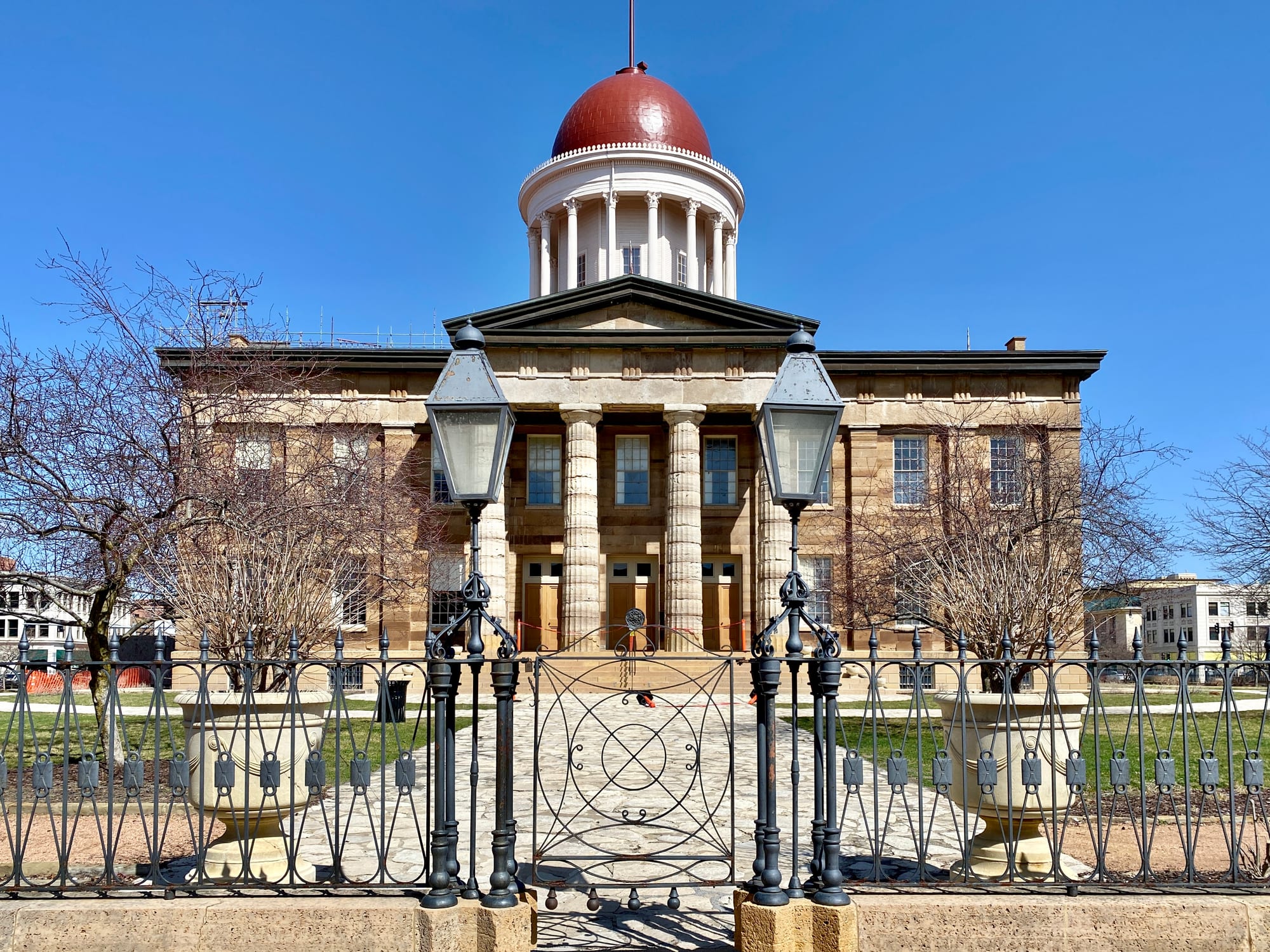
The domed limestone Old State Capitol in Springfield behind an iron gate and lamps under a clear blue sky

Chicago & the Great Lakes, United States

Springfield

The Old State Capitol in downtown Springfield, where Lincoln served as a legislator and gave his House Divided speech. (w_lemay / Wikimedia Commons · CC BY-SA 2.0)

The capital of Illinois, a mid-sized government city in the farmland of the state's centre. Abraham Lincoln lived and practised law here for almost 25 years before leaving for the White House, and he is buried here; his house, law office, the Old State Capitol and a large presidential museum make it the main place to learn his story.

Neighbourhoods

  • Downtown
    • First-time visitors
    • Historic district
    • Lincoln sites

    A small grid around the Old State Capitol's square, with the Lincoln museum and library, the law office, the railway depot where Lincoln said farewell, and the present Capitol a few blocks west. Restaurants and bars cluster on the streets round the square; evenings and weekends are quiet.

    Open in Maps
  • Lincoln Home district
    • Historic district
    • Walking

    Four blocks of restored 19th-century houses around Lincoln's own home, a few minutes east of downtown, with a visitor centre run by park rangers.

    Open in Maps
  • Near north side
    • Lincoln sites
    • Quiet and residential

    Older residential streets running north from downtown towards Oak Ridge Cemetery, where Lincoln's tomb stands, with Route 66 landmarks along the old highway.

    Open in Maps
  • West side and Washington Park
    • Quiet and residential
    • Parks

    Tree-lined streets of large early 20th-century houses around Washington Park, with its botanical garden and carillon, south-west of the centre.

    Open in Maps
  • Lake Springfield
    • Outdoors
    • Families

    A reservoir on the south-east edge of the city, ringed with city parks, used for boating and fishing, with an outdoor theatre that stages musicals in summer.

    Open in Maps

Things to do

Lincoln sites

  • Lincoln Home National Historic Sitelandmark

    The only home Lincoln ever owned, where he lived with his family from 1844 until 1861, restored and shown by park rangers.

    Open in Maps
  • Abraham Lincoln Presidential Library and Museummuseum

    A large museum opened in 2005 that tells Lincoln's life and the Civil War through recreated rooms, theatre shows and original documents.

    Open in Maps
  • Lincoln Tomblandmark

    The granite obelisk and tomb at Oak Ridge Cemetery where Lincoln, his wife Mary and three of their four sons are buried; a bronze cast of Gutzon Borglum's head of Lincoln stands before the entrance.

    Open in Maps
  • Old State Capitollandmark

    The Greek Revival capitol of 1840, rebuilt stone by stone in the 1960s, where Lincoln served in the legislature and gave his House Divided speech in 1858.

    Open in Maps
  • Lincoln-Herndon Law Officesmuseum

    The brick building of 1841 where Lincoln and his partner William Herndon practised law from 1844 until about 1852, across the street from the Old State Capitol.

    Open in Maps
  • Lincoln Depotlandmark

    The railway station where Lincoln gave his farewell speech to Springfield in February 1861 before leaving for Washington.

    Open in Maps

Landmarks and architecture

  • Illinois State Capitollandmark

    The working capitol, built between 1868 and 1888, whose dome rises higher than that of the US Capitol in Washington.

    Open in Maps
  • Dana–Thomas Houselandmark

    A Prairie School house built for Susan Lawrence Dana in 1902–04, one of the largest early commissions of Frank Lloyd Wright's studio, with about 250 art glass windows.

    Open in Maps
  • Vachel Lindsay Homemuseum

    The birthplace and lifelong home of the poet Vachel Lindsay, near the Executive Mansion.

    Open in Maps

Museums

  • Illinois State Museummuseum

    The state's museum of natural history, archaeology and art, a block south-west of the Capitol, with fossils and dioramas of Native American life.

    Open in Maps

Parks and the outdoors

  • Washington Parkpark

    A landscaped park on the south-west side with a botanical garden, ponds, and the Thomas Rees Memorial Carillon, whose bells are played in recitals.

    Open in Maps
  • Lincoln Memorial Gardenpark

    A garden of native plants and woodland trails beside Lake Springfield, laid out by the landscape architect Jens Jensen.

    Open in Maps

Route 66

  • Cozy Dog Drive Inattraction

    A Route 66 diner that claims to have invented the corn dog on a stick, first sold from a stand here as the Cozy Dog in 1946.

    Open in Maps

Short trips from the city

  • Lincoln's New Salemattraction

    A reconstruction of the log village near Petersburg, about 16 miles north-west, where the young Lincoln worked as a shopkeeper and postmaster in the 1830s.

    Open in Maps

Seasonal events

  • Illinois State FairAugust

    The state's agricultural fair on the fairgrounds north of the centre, with livestock shows, a butter cow sculpture, harness racing, concerts and fair food.

Eat and drink

Long-standing places and food districts in Springfield. Hours, ratings and directions come from your maps app, always current.

Springfield classics

  • Horseshoe sandwichrestaurant

    The city's own dish: an open sandwich of toast topped with meat, such as a hamburger patty or ham, covered in chips and cheese sauce, served in restaurants and bars across town.

    Open in Maps
  • Cozy Dog Drive Inrestaurant

    The Route 66 diner known for its cornmeal-battered hot dogs on a stick, served since the late 1940s.

    Open in Maps
  • Maid-Rite Sandwich Shoprestaurant

    A small 1920s loose-meat sandwich shop on the old Route 66, said to have one of the first drive-through windows in the country.

    Open in Maps

Food districts

  • Downtown around the Old Capitolneighborhood

    The streets around the square hold most of the centre's pubs, cafés and restaurants, busiest at lunch while the legislature sits.

    Open in Maps

Experience Springfield

History

Settlers arrived in the 1820s on the prairie beside Spring Creek, a tributary of the Sangamon River, and the town was named Springfield in 1832. The state legislature chose it to replace Vandalia as capital, a move completed in 1839, helped by the lobbying of nine Sangamon County legislators who included the young Abraham Lincoln. The same year Lincoln moved to Springfield to practise law. Here he married Mary Todd, raised his sons, bought the only house he ever owned, and rose through state and national politics. In 1858 he gave his House Divided speech at the capitol, and in February 1861 he took a train east to become president. He came back in May 1865, after his assassination, to be buried at Oak Ridge Cemetery.

The new Capitol, finished in 1888, confirmed Springfield as a government town, and coal mining and farming supported it into the 20th century. In August 1908 a white mob attacked Black residents and their homes and businesses over three days; at least sixteen people died. The violence, in Lincoln's own city, helped lead to the founding of the National Association for the Advancement of Colored People the next year. Route 66, opened in 1926, ran through the city and brought diners and motels.

In later decades the city came to depend on state government, hospitals and medical education. The Old State Capitol was taken apart and rebuilt in the 1960s, and the presidential library and museum opened in 2005, making tourism a growing part of the city's life.

Culture & Customs

Lincoln is everywhere in Springfield: on street names, statues, shop signs and the tourist trail, and in the rangers' and re-enactors' talks at his home and in the museum. The city takes its role as his home seriously, and historians come to use the library's papers. The state's political life is also part of local culture, with the legislature in session for much of the spring.

Beyond Lincoln, the Dana–Thomas House was one of the largest early commissions of Frank Lloyd Wright's studio, and the poet Vachel Lindsay was born in the city, in the house that remained his home all his life. The State Fair in August is the biggest event of the year, drawing farmers and families from across Illinois. Route 66 nostalgia is strong, celebrated in a Route 66 film festival and in roadside diners that have survived since the highway's heyday.

Springfield has a sizeable African American community, and the 1908 riot is now remembered with markers and a memorial. Daily manners are friendly and unhurried, typical of the small-city Midwest, and local food habits are a point of fierce pride.

Daily Life

About 115,000 people live in the city and around 200,000 in the wider metropolitan area, which spreads across Sangamon and Menard counties. State government is the largest employer; health care comes next, and the hospitals and the Southern Illinois University School of Medicine make the city a regional medical centre. The University of Illinois Springfield and Lincoln Land Community College add students.

Most people live in houses with gardens in neighbourhoods built around the old centre or in newer suburbs to the west and south-west, and nearly everyone drives. Downtown is busy on weekdays when offices and the legislature are working and quiet in the evenings, though restaurants and bars have grown in number around the square. Housing is cheaper than in Chicago, and the region surrounding the city is farmland of corn and soybeans.

Local talk turns to state politics, the cost of the state's pensions, the condition of downtown and the summer heat. Weekends often revolve around high school sport, church, Lake Springfield and, in August, the fair.

Food

Springfield's best-known dish is the horseshoe, first served in the city in the early 20th century. It is an open sandwich: thick toast topped with meat — originally ham, now often a hamburger patty — then a heap of chips and a rich cheese sauce. A smaller version is called a ponyshoe. Almost every diner and bar in town serves one, and locals argue over whose cheese sauce is best.

Route 66 left its mark too. The Cozy Dog Drive In has served corn dogs on a stick since the 1940s, and the Maid-Rite shop on the old route sells loose-meat sandwiches of crumbled seasoned beef from a 1920s building. Springfield also spells its chilli with two Ls, a local quirk that some explain by the city's old chilli parlours.

The rest of the food scene is typically Midwestern: steakhouses, family diners, pork tenderloin sandwiches and sweetcorn in season, with farmers' markets downtown in summer and fair food — corn dogs, lemonade and pork chops — at the State Fair.

Planning tools

Budget

Springfield is an inexpensive city to visit, with lower hotel and food prices than Chicago or St Louis. Rooms fill and prices rise during the State Fair in August and some legislative weeks. Most Lincoln sites are free or cheap; the presidential museum charges admission.

Daily Budget Midrange
USD 180–300 (downtown hotel, restaurant meals with tax and tip, museum tickets, a hire car)
Daily Budget Shoestring
USD 80–130 (budget motel, diners and horseshoes, walking and buses)

Several of the Lincoln sites and the State Capitol cost little or nothing to visit; the presidential museum charges admission.

Best Time to Visit

April to June and September to October bring mild weather for walking between the Lincoln sites. Summer is hot and humid, and August is the State Fair. Winters are cold and grey but quiet, with the indoor museums the main draw.

Suggested Number of Days

One or two days suit a first visit, depending on how much time is given to the museums. Two or three allow for the countryside nearby as well, and without a car everything takes a little longer.

First Visit
1–2 days
With Surroundings
2–3 days

Transportation

Springfield is built for the car, with free or cheap parking almost everywhere. The Sangamon Mass Transit District runs city buses, but services are limited, especially in the evenings and at weekends. Ride-hailing and taxis fill the gaps, and the downtown Lincoln sites are close enough to walk between.

Oak Ridge Cemetery, the fairgrounds, Washington Park and the lake are easiest to reach by car.

Airport & Station Connections

Abraham Lincoln Capital Airport, about 3 miles north-west of downtown, has a small number of flights. Most visitors drive: Interstate 55 links the city with Chicago to the north-east and St Louis to the south-west. Amtrak's Lincoln Service trains between Chicago and St Louis stop several times a day at the downtown station.

Walkability

The downtown Lincoln sites are within a few blocks of each other, and the Lincoln Home district is a short walk east. The rest of the city is spread out along wide roads, and the tomb, the parks and the lake are best reached by car or bus.

Safety

Downtown and the Lincoln sites are generally safe and well patrolled by day, though very quiet after office hours. Crime is concentrated in some residential areas away from the visitor sites. Spring and early summer bring severe thunderstorms and occasional tornadoes; outdoor sirens are tested regularly.

Take shelter indoors if tornado sirens sound and lock cars at night. Check current official travel advice before travelling.

Climate

A humid continental climate typical of the Midwestern prairie, with hot summers, cold winters and changeable springs, when strong storms are common.

Summer
hot and humid — July averages about 76°F across day and night, with hot afternoons and frequent thunderstorms
Winter
cold — January averages in the upper 20s °F, with occasional snow and bitter winds across the flat land

Local Customs

Tipping is expected: roughly 18–22 per cent in restaurants and about a dollar a drink at a bar. Prices are shown without sales tax. Locals are friendly and informal, and politics is a common subject in a city full of state employees and lobbyists. The Lincoln sites are treated with respect.

Photo ID is checked when buying alcohol (the legal age is 21); cannabis is legal for adults in Illinois but not in public places.

Common Payment Methods

The currency is the US dollar. Cards and contactless payment are accepted almost everywhere. A little cash helps at older diners and at the State Fair, and ATMs are easy to find.