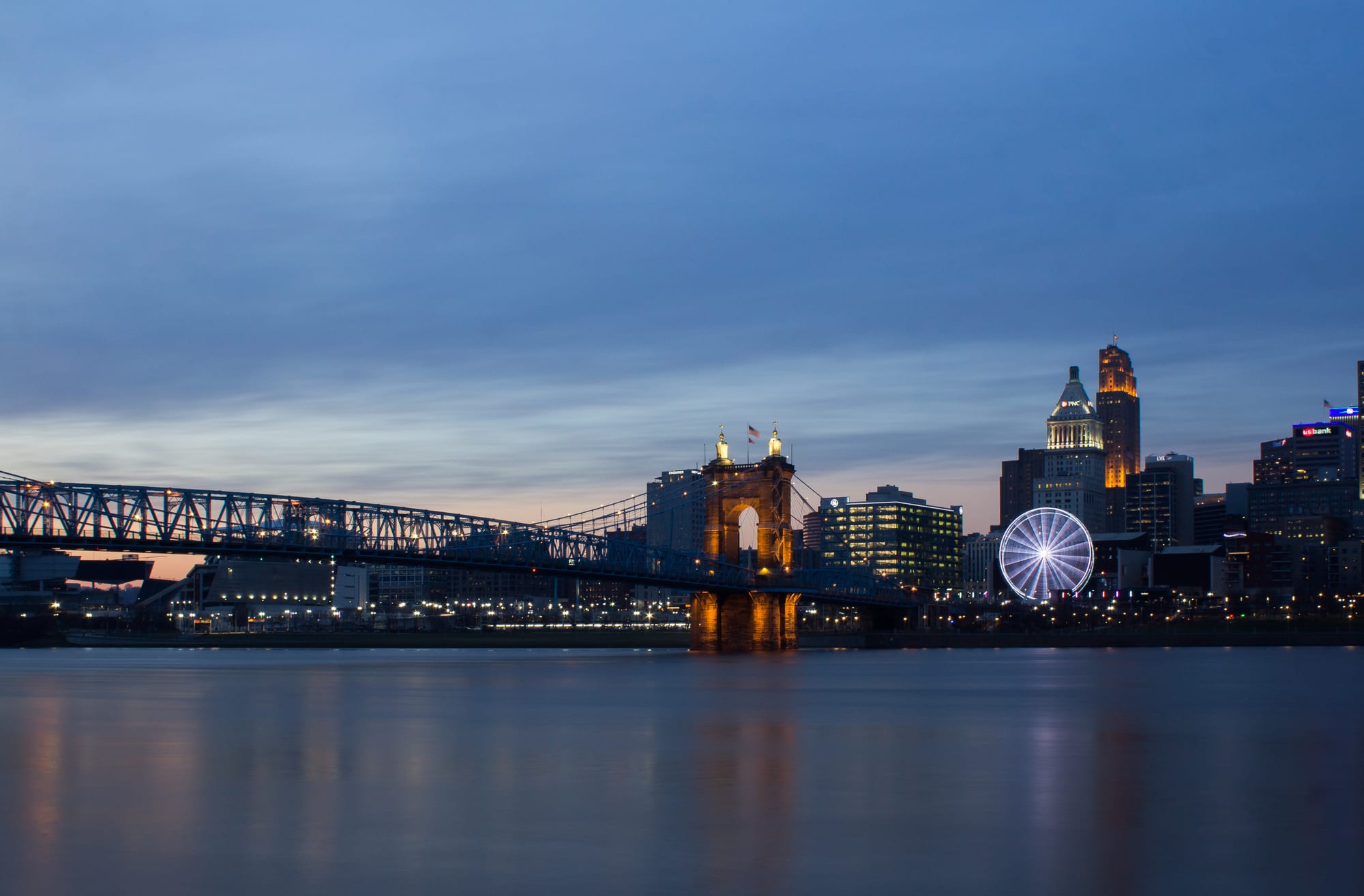
The lit Roebling Suspension Bridge and downtown Cincinnati towers reflected in the calm Ohio River at dusk

Chicago & the Great Lakes, United States

Cincinnati

Downtown Cincinnati and the Roebling Suspension Bridge at blue hour, seen across the Ohio River from Covington, Kentucky. (Jason Zhang / Wikimedia Commons · CC BY-SA 3.0)

A city of steep hills and old brick neighbourhoods on the north bank of the Ohio River, facing Kentucky. River trade, meatpacking and German immigrants built it in the 19th century; today it is home to Procter & Gamble and Kroger, a revived Over-the-Rhine, a rebuilt riverfront between two stadiums and its own style of chili served over spaghetti.

Neighbourhoods

  • Downtown and the Banks
    • First-time visitors
    • Sport
    • Close to public transport

    The grid of streets between the river and Central Parkway, centred on Fountain Square and the Art Deco Carew Tower. Towards the river the Banks fill the land between the baseball park and the football stadium with flats, bars and Smale Riverfront Park, a short walk from the Roebling bridge.

    Open in Maps
  • Over-the-Rhine
    • Historic district
    • Best for food
    • Nightlife

    A dense 19th-century German neighbourhood of Italianate brick tenements just north of downtown, once badly decayed and now full of restaurants, breweries, shops and new flats. Findlay Market, Washington Park and Music Hall are here, and the streetcar loops through it.

    Open in Maps
  • Mount Adams
    • Views
    • Bars
    • Quiet and residential

    A small hilltop neighbourhood of narrow streets and tightly packed houses east of downtown, with bars, views over the river and Eden Park on its doorstep, including the art museum and Krohn Conservatory.

    Open in Maps
  • Clifton and the University
    • Students
    • Cafés
    • Leafy streets

    Hilltop streets near the University of Cincinnati, with the independent shops, restaurants and art-house cinema of the Gaslight District, cheap places to eat around the campus and the zoo a short way to the east.

    Open in Maps
  • Northside
    • Local life
    • Bars
    • Independent shops

    A relaxed, artsy neighbourhood in the valley north of the university, with a main street of bars, music venues, record shops and small restaurants.

    Open in Maps
  • Hyde Park
    • Quiet and residential
    • Shopping

    A prosperous east-side neighbourhood of large houses and tree-lined streets around Hyde Park Square, with its fountain, boutiques and restaurants.

    Open in Maps
  • Covington and Newport
    • Views of the skyline
    • Bars
    • Historic district

    Two separate Kentucky cities directly across the river, linked by the Roebling and Purple People bridges. Covington's MainStrasse Village keeps 19th-century German-built streets of bars and restaurants; Newport has its aquarium and a riverside entertainment complex.

    Open in Maps

Things to do

Famous landmarks

  • John A. Roebling Suspension Bridgelandmark

    First crossed by pedestrians in December 1866 and opened to traffic on 1 January 1867, the bridge to Covington had the longest suspension span in the world when it opened, designed by the engineer who went on to design the Brooklyn Bridge.

    Open in Maps
  • Carew Towerlandmark

    A 49-storey Art Deco skyscraper downtown, the city's tallest building from 1930 until 2011, built as part of a complex that includes the historic Netherland Plaza hotel.

    Open in Maps
  • Fountain Squarelandmark

    The downtown plaza around the bronze Tyler Davidson Fountain of 1871, used for concerts, gatherings and a winter ice rink.

    Open in Maps
  • Music Halllandmark

    A large Venetian Gothic concert hall of 1878 in Over-the-Rhine, built to house the May Festival and now home to the Cincinnati Symphony Orchestra, the opera and the May Festival Chorus.

    Open in Maps
  • Spring Grove Cemeterypark

    At 733 acres the third-largest cemetery in the United States, laid out from 1845 as a landscaped garden with lakes, specimen trees and grand monuments.

    Open in Maps

Museums

  • Cincinnati Museum Center at Union Terminalmuseum

    An Art Deco railway station of 1933 with a vast half-dome rotunda and mosaic murals of the city's industries, now holding history and science museums and still used by Amtrak.

    Open in Maps
  • National Underground Railroad Freedom Centermuseum

    A museum on the riverfront, opened in 2004, telling the story of slavery and of escapes to freedom across the Ohio River, with a log slave pen moved here from Kentucky.

    Open in Maps
  • Cincinnati Art Museummuseum

    One of the oldest art museums in the country, set in Eden Park, with a broad collection and galleries on the city's own Rookwood pottery and painters.

    Open in Maps
  • Taft Museum of Artmuseum

    A collection of European old masters, Chinese porcelain and American paintings, displayed in a house of about 1820 downtown, the oldest domestic wooden structure in the city centre.

    Open in Maps
  • American Sign Museummuseum

    A large hall of restored commercial signs, from painted boards to neon and motel signs, in the Camp Washington neighbourhood.

    Open in Maps
  • Contemporary Arts Centermuseum

    A non-collecting gallery of contemporary art in a downtown building by Zaha Hadid, completed in 2003.

    Open in Maps

Parks and the riverfront

  • Eden Parkpark

    A hilltop park above the river east of downtown, with lookouts, a reflecting pool, the art museum and the Krohn Conservatory.

    Open in Maps
  • Krohn Conservatoryattraction

    An Art Deco glasshouse of 1933 in Eden Park, holding palms, desert plants and orchids, with seasonal flower shows.

    Open in Maps
  • Smale Riverfront Parkpark

    A riverside park between the two stadiums, with fountains, gardens, swings facing the water and a carousel.

    Open in Maps
  • Washington Parkpark

    The green heart of Over-the-Rhine, in front of Music Hall, renovated in 2012 and used for concerts, films and other events.

    Open in Maps
  • Cincinnati Zoo and Botanical Gardenattraction

    Opened in 1875, the second-oldest zoo in the United States, whose 1875 Reptile House is the oldest surviving zoo building in the country.

    Open in Maps

Markets

  • Findlay Marketmarket

    Ohio's oldest continuously operated public market, in an 1850s iron-framed market house in Over-the-Rhine, with butchers, bakers, produce stalls and food vendors.

    Open in Maps

Music, sport and nights out

  • Great American Ball Parkattraction

    The riverfront home of the Reds since 2003, a team named after the 1869 Red Stockings, baseball's first all-professional team.

    Open in Maps
  • Paycor Stadiumattraction

    The Cincinnati Bengals' football stadium on the riverfront, opened in 2000.

    Open in Maps
  • TQL Stadiumattraction

    The football stadium of FC Cincinnati, opened in 2021 in the West End beside Over-the-Rhine.

    Open in Maps

Short trips from the city

  • Newport Aquariumattraction

    A large aquarium in the Newport on the Levee complex, across the river in Newport, Kentucky.

    Open in Maps
  • Kings Islandattraction

    A large amusement park in Mason, north-east of the city, known for its roller coasters.

    Open in Maps

Seasonal events

  • Reds Opening Daylate March or early April

    The Reds always open their season at home, with the Findlay Market Opening Day Parade, and the day is commonly treated as a holiday.

  • May FestivalMay

    A choral festival held since 1873, the oldest continuous choral festival in the Western Hemisphere, performed in Music Hall.

  • RiverfestLabor Day weekend, early September

    A day of crowds on both banks of the Ohio ending in a large fireworks display over the river.

  • Oktoberfest Zinzinnationce a year

    A German-style beer and food festival downtown, first held in 1976 and billed as the largest Oktoberfest in the United States.

Eat and drink

Long-standing places and food districts in Cincinnati. Hours, ratings and directions come from your maps app, always current.

Cincinnati classics

  • Skyline Chilirestaurant

    The best-known of the city's chili parlours, founded in 1949 by a Greek immigrant family, serving thin, spiced meat sauce over spaghetti or small hot dogs under a mound of shredded cheddar.

    Open in Maps
  • Gold Star Chilirestaurant

    The other big local chili chain, founded in 1965 by Jordanian immigrant brothers, with its own take on three-ways and coneys.

    Open in Maps
  • Camp Washington Chilirestaurant

    An independent chili parlour in Camp Washington, open since 1940 and known as a classic of the style.

    Open in Maps
  • Graeter'scafe

    A family ice-cream maker founded in 1870, still making ice cream in small French pots and known for its black raspberry chocolate chip.

    Open in Maps

Food districts and markets

  • Findlay Marketmarket

    The place to find goetta and other local sausages, cheeses and baked goods, with food stalls and busy weekend mornings.

    Open in Maps
  • Vine Street, Over-the-Rhineneighborhood

    The neighbourhood's main restaurant street, where old brick shopfronts hold bars, taprooms and restaurants of every kind.

    Open in Maps
  • MainStrasse Villageneighborhood

    Covington's German-themed quarter across the river, with pubs and restaurants around a small square and clock tower.

    Open in Maps

Experience Cincinnati

History

Settlers from the east founded a village on the north bank of the Ohio River in 1788, opposite the mouth of the Licking River, and called it Losantiville. In 1790 the governor of the Northwest Territory, Arthur St. Clair, renamed it Cincinnati after the Society of the Cincinnati, a club of Revolutionary War officers named in turn after the Roman farmer-statesman Cincinnatus. Fort Washington protected it, and the river made it the gateway to the West.

Steamboats turned Cincinnati into one of the largest cities in the country by the middle of the 19th century. It packed so much pork that it was nicknamed Porkopolis, and from the hogs' fat and the river trade came businesses such as Procter & Gamble, founded in 1837 by a candle-maker and a soap-maker. German immigrants poured in, settling the district north of the Miami and Erie Canal that became known as Over-the-Rhine, with its breweries, churches and beer halls. Across the river lay the slave state of Kentucky, and Cincinnati was a major crossing on the Underground Railroad; Harriet Beecher Stowe lived here for years and drew on stories she heard for Uncle Tom's Cabin. The Roebling bridge opened to traffic in 1867, and in 1869 the Red Stockings became the first all-professional baseball team.

In the 20th century anti-German feeling in the First World War and then Prohibition hit the city's breweries hard. The city's Art Deco era left Union Terminal and the Carew Tower, and Procter & Gamble and Kroger grew into national giants. After the Second World War freeways cut through the West End and residents moved to the suburbs; Over-the-Rhine declined, and unrest followed a police shooting there in 2001. Since the mid-2000s the district has been heavily renovated, the riverfront has been rebuilt, and a streetcar opened in 2016.

Culture & Customs

Cincinnati is a city of old institutions. Its symphony orchestra, May Festival and art museum all date from the 19th century, Music Hall and the Rookwood pottery reflect the city's Gilded Age wealth, and its zoo is the second oldest in the country. German heritage shows in the architecture of Over-the-Rhine, in the beer and sausages, and in Oktoberfest Zinzinnati, billed as the largest in the United States. Bockfest celebrates the neighbourhood's brewing past each year.

African American history runs deep: the Underground Railroad crossings, the Freedom Center on the riverfront, and a strong musical tradition that includes King Records, the Cincinnati label that helped launch the career of James Brown. Sport matters enormously. Reds Opening Day is treated almost as a holiday, with a parade from Findlay Market, and the Bengals and FC Cincinnati draw large crowds.

Locals identify strongly with their neighbourhoods — the city counts over fifty of them, many on separate hills — and with their high schools, many of them Catholic. The city sits on the Kentucky border, and its manners are a blend of Midwestern and Southern: friendly, conservative in some habits and fiercely loyal to local brands, from chili parlours to ice cream.

Daily Life

About 310,000 people live in the city itself and around 2.3 million in the wider metropolitan area, which spreads across south-west Ohio, northern Kentucky and a corner of Indiana. The city lost much of its population after 1950 and has only recently begun to grow again: the 2020 census recorded the first increase since 1950.

The economy rests on large headquarters — Procter & Gamble, Kroger and Fifth Third Bank among them — alongside hospitals, the University of Cincinnati, GE Aerospace in the suburbs and the airport's big cargo hub across the river. Many families live in older inner-ring neighbourhoods of brick houses on steep streets, such as Northside, Clifton or Price Hill, or in the spread-out suburbs, and almost everyone drives. Gentrification in Over-the-Rhine, poverty in parts of the West End and the east, and the future of public transport are common topics of debate.

Life has a strong neighbourhood rhythm: parish festivals through the summer, chili parlour lunches, and evenings at Reds games or on the riverfront. Many people work in Ohio and live in Kentucky, or the other way round, crossing the river daily.

Food

Cincinnati chili is the city's signature. Developed in the 1920s by Macedonian immigrants, it is not a stew but a thin meat sauce spiced with cinnamon, cloves and other flavourings from Greek cooking, served over spaghetti or hot dogs. Order by number: a three-way is spaghetti, chili and a heap of finely shredded cheddar; a four-way adds onions or beans; a five-way has both. A coney is a small hot dog under chili, mustard, onion and cheese. Chili parlours, from big chains to independents, are found across the city.

Goetta is the German contribution: a breakfast sausage of pork, sometimes with beef, mixed with steel-cut oats and spices, sliced and fried until crisp. Bratwurst and other German-style sausages are served at festivals and ball games, and Findlay Market has butchers selling them. Graeter's ice cream, made in small batches since the 19th century, is a local loyalty, and pizza from the regional chain LaRosa's is another.

The city's brewing past is reviving too. Before Prohibition Cincinnati was a national leader in brewing; today taprooms fill old brick buildings in Over-the-Rhine and beyond, and the city's Oktoberfest pours German-style beer by the gallon. Across the river, Covington and Newport add pubs, bourbon bars and riverside restaurants.

Planning tools

Budget

Cincinnati is one of the cheaper large cities in the Midwest to visit, and eating well costs less than in Chicago. Hotels downtown are the main cost and rise for Bengals and Reds weekends, big concerts and Oktoberfest. A car or ride-hailing adds to the bill for trips beyond the downtown and Over-the-Rhine core.

Daily Budget Midrange
USD 200–360 (downtown hotel, sit-down dinners with tax and tip, museum and zoo tickets, ride-hailing or a hire car)
Daily Budget Shoestring
USD 90–150 (budget motel or hostel bed, chili parlours and market lunches, buses and the streetcar)

Fountain Square, Washington Park, the riverfront parks, Eden Park's lookouts and the walk across the Roebling bridge cost nothing.

Best Time to Visit

April to June and September to October. Spring brings baseball, the May Festival and the zoo's flowers; early autumn is warm and settled, with Oktoberfest and Riverfest. July and August are hot and humid. Winters are cold and grey, with occasional snow, but museums are quiet and hotel prices fall.

Suggested Number of Days

Two or three days suit a first visit to the city and the Kentucky side of the river. Four or five allow for the outer neighbourhoods and day trips into the surrounding countryside. Without a car the hills make it slower to move between districts, so allow a little extra time.

First Visit
2–3 days
With Surroundings
4–5 days

Transportation

Cincinnati is a hilly city spread along valleys, and most residents drive. The Connector streetcar runs a loop of about 3.6 miles linking the Banks, downtown and Over-the-Rhine, which covers much of what visitors want. Metro buses reach the university, the zoo and the outer neighbourhoods, and Kentucky buses cross the river. Ride-hailing is widely used.

Parking downtown is mostly in garages and metered streets; the steep hills make cycling hard work away from the riverfront.

Airport & Station Connections

Cincinnati/Northern Kentucky International Airport is across the river near Hebron, in Boone County, Kentucky, reached by taxi, ride-hailing or bus. Most visitors drive in on Interstates 71, 74 and 75. Amtrak's Cardinal stops at Union Terminal three times a week on its route between Chicago and New York.

Walkability

Downtown, the Banks and Over-the-Rhine are close together and easy on foot — Fountain Square to Findlay Market is about a mile — and the walk across the Roebling bridge to Covington takes around ten minutes. Beyond that the city climbs steep hillsides, so reaching Mount Adams, Eden Park or Clifton on foot means long stairways and steep streets.

Safety

Downtown, the Banks, Over-the-Rhine's main streets and the riverfront are busy and well patrolled. Violent crime is concentrated in some neighbourhoods away from the visitor areas. The practical risks are car break-ins and quiet streets late at night.

Leave nothing visible in a parked car and use ride-hailing between districts late at night. Check current official travel advice before travelling.

Climate

A humid climate on the border between continental and subtropical, with four distinct seasons. Summers are hot and sticky with thunderstorms, winters are cold and changeable, and spring and autumn are mild.

Summer
hot and humid — July afternoons are usually in the mid-80s °F and often pass 90°F
Winter
cold and grey — January averages around 30°F, with some snow most winters, though it rarely lasts long

Local Customs

Tipping is expected: roughly 18–22 per cent in restaurants and about a dollar a drink at a bar. Prices are shown without sales tax, which is added at the till. Cincinnatians use 'please?' to mean 'pardon?', a habit often traced to the German 'bitte'. The city is half-Ohioan, half-Southern in manner: polite, unhurried and friendly.

Photo ID is checked when buying alcohol (the legal age is 21).

Common Payment Methods

The currency is the US dollar. Cards and contactless payment are accepted almost everywhere. Some older chili parlours, bars and market stalls prefer cash, so a small amount is useful, and ATMs are easy to find.