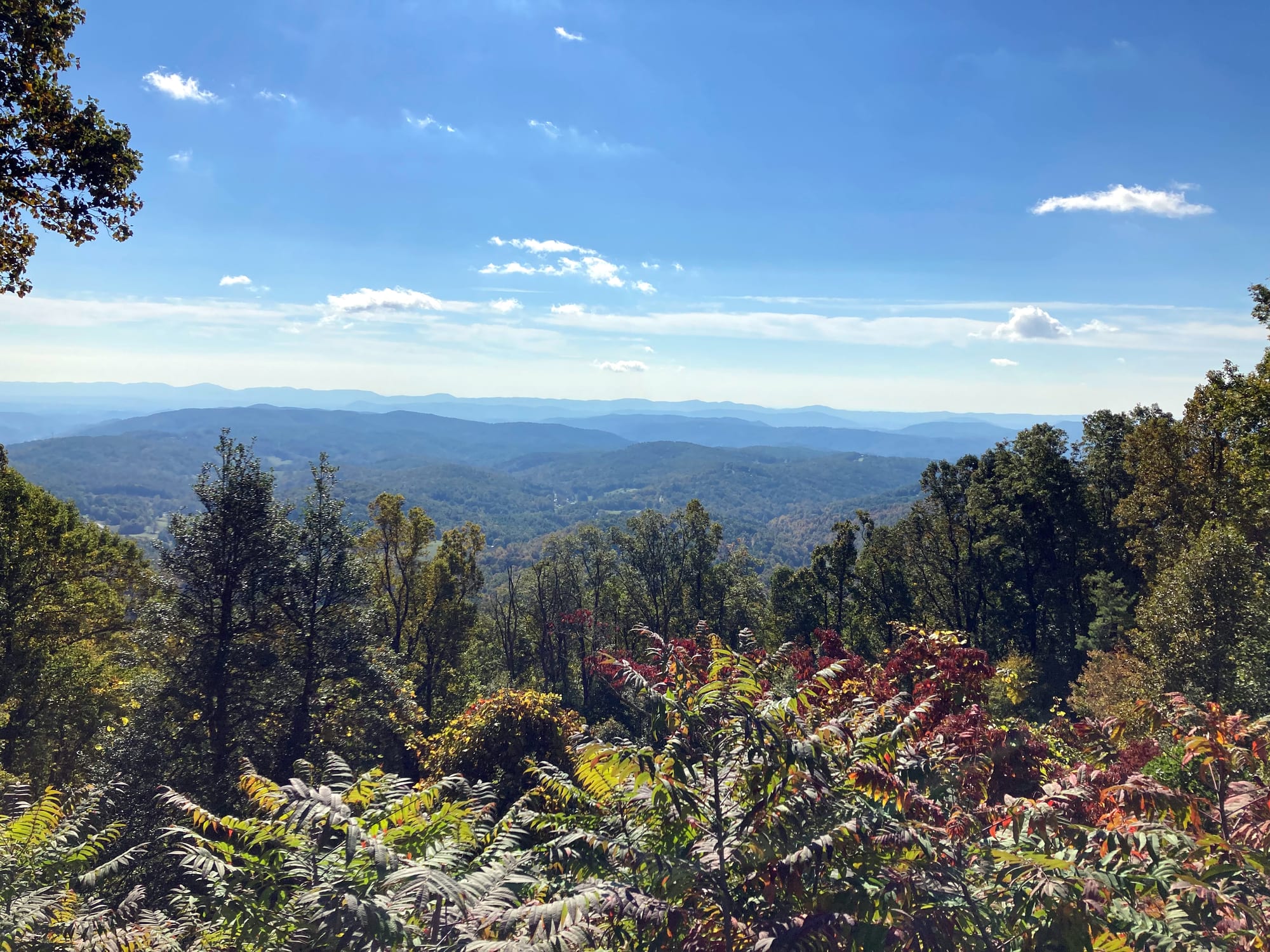
Layers of forested blue ridges under a clear sky, seen over autumn-tinted leaves and ferns from a roadside overlook

United States

The South

The view from Stoney Fork Overlook on the Blue Ridge Parkway near Deep Gap, North Carolina. (Michael Barera / Wikimedia Commons · CC BY-SA 4.0)

Eleven states from Virginia and Kentucky to Louisiana, where English colonisation began at Jamestown and a plantation economy built on slavery led to the Civil War. Today the region is known for the Appalachian mountains, Atlantic and Gulf coasts, the birthplaces of jazz, blues and country music, a strong barbecue tradition, and the landmarks of the Civil Rights Movement.

Explore The South

History

The Mississippian peoples built large earthwork mounds across the region, and Poverty Point in Louisiana is far older still. At European contact the Powhatan, Cherokee, Creek, Choctaw and Chickasaw were among the main nations. England's first permanent colony was founded at Jamestown, Virginia, in 1607, and in 1619 the first recorded enslaved Africans arrived there. Charleston followed in 1670 and Savannah in 1733, while the French founded New Orleans in 1718. Virginia produced four of the first five presidents, and the British surrender at Yorktown in 1781 was the last major land battle of the Revolutionary War.

Tobacco, rice and, above all, cotton made the planter class rich on the labour of millions of enslaved people. Under the Indian Removal Act of 1830 the Cherokee, Creek, Choctaw and Chickasaw were forced west, many dying on the Trail of Tears. The Civil War began with the bombardment of Fort Sumter in Charleston harbour in 1861; Richmond was the Confederate capital, West Virginia broke away from Virginia, and Lee's army surrendered at Appomattox in 1865.

After Reconstruction, Jim Crow laws imposed segregation and stripped Black citizens of the vote, enforced by lynching, and millions left for northern cities in the Great Migration. The Civil Rights Movement was fought largely here: the Montgomery bus boycott of 1955–56, the Little Rock Nine in 1957, the Greensboro sit-ins in 1960, the Birmingham campaign of 1963 and the Selma to Montgomery marches of 1965. Martin Luther King Jr. was born in Atlanta and assassinated in Memphis in 1968. Since then the region has grown quickly as the Sun Belt, while Hurricane Katrina in 2005 devastated New Orleans.

Culture & Customs

Southern manners are real and noticed by visitors: "sir" and "ma'am", "y'all", small talk with strangers and a slower pace. The region is the heart of the Bible Belt, where Southern Baptist and other evangelical churches anchor community life, and Black churches were the organising base of the civil rights struggle.

The South gave the world much of American music. Jazz grew up in New Orleans, the blues in the Mississippi Delta, country music on Nashville's Grand Ole Opry, bluegrass in Kentucky and the Appalachians, and rock and roll and soul in Memphis studios such as Sun and Stax. Mardi Gras parades fill New Orleans before Lent, and the Kentucky Derby is run at Louisville's Churchill Downs on the first Saturday in May.

Distinct communities add depth: the Cajuns of south Louisiana, descended from French-speaking Acadians expelled from Canada, the Creoles of New Orleans, and the Gullah Geechee of the Sea Islands of South Carolina and Georgia, who keep a creole language and crafts such as sweetgrass baskets. Appalachian mountain culture has its own crafts, speech and music. College football, above all in the Southeastern Conference, and NASCAR racing draw huge crowds. How to remember the Confederacy remains contested, and many Confederate monuments have been removed since 2015.

Daily Life

About 65 million people live in these eleven states. Atlanta has around 500,000 residents at the centre of a metropolitan area of more than six million, the region's largest; Charlotte, Nashville, Memphis, Louisville, Virginia Beach and Raleigh are the other big cities, and New Orleans has about 384,000.

Atlanta is a corporate centre, home to Coca-Cola and Delta Air Lines, and Charlotte is a major banking city. Carmakers have built plants across the region, from BMW in South Carolina to Mercedes-Benz in Alabama and Toyota in Kentucky, and North Carolina's Research Triangle around Raleigh and Durham concentrates universities and technology firms. Petrochemicals line the lower Mississippi in Louisiana, while coal mining in West Virginia and eastern Kentucky has long been in decline, leaving poverty and an opioid crisis behind. Mississippi has among the lowest household incomes in the country.

Life often revolves around church on Sunday, Friday-night high-school football, the pick-up truck and air conditioning. Rapid population growth around the big cities, rural decline and exposure to storms and flooding are the issues of the moment.

Food

Barbecue is the regional passion, with fierce local styles: whole hog with vinegar sauce in eastern North Carolina, mustard-based sauce in South Carolina, dry-rubbed pork ribs in Memphis and chicken with mayonnaise-based white sauce in north Alabama. Fried chicken, Nashville hot chicken coated in cayenne, biscuits with gravy, grits (boiled ground corn), collard greens, cornbread and catfish are staples, and Virginia is known for country ham and peanuts.

The Lowcountry of Charleston and Savannah serves shrimp and grits, she-crab soup and the Lowcountry boil of shrimp, sausage, corn and potatoes. Louisiana is a cuisine of its own: gumbo, a dark stew thickened with roux; jambalaya, spiced rice with meat or seafood; crawfish boils; boudin sausage; the po' boy sandwich; New Orleans's muffuletta and red beans and rice; and beignets, fried dough under powdered sugar, with chicory coffee.

Georgia grows peaches, pecans and sweet Vidalia onions, and Coca-Cola was invented in Atlanta in 1886. Sweet iced tea is the everyday drink. Kentucky distils most of the world's bourbon, a corn-based whiskey aged in new charred oak, and Tennessee whiskey is filtered through maple charcoal; New Orleans claims the Sazerac cocktail.

Attractions & Natural Wonders

New Orleans centres on the French Quarter, with Jackson Square, Bourbon Street and Preservation Hall, plus the Garden District and the music clubs of Frenchmen Street; beyond lie the bayous and the Whitney Plantation, a museum of slavery. Nashville has the Grand Ole Opry, the Ryman Auditorium, the Country Music Hall of Fame and the honky-tonks of Broadway; Memphis has Beale Street, Sun Studio, Graceland and the National Civil Rights Museum at the Lorraine Motel. The Mississippi Delta's blues trail runs through Clarksdale.

On the coast, Charleston offers Rainbow Row, the Battery and boat trips to Fort Sumter, and Savannah its grid of garden squares and Forsyth Park. Atlanta has the Martin Luther King Jr. National Historical Park and the Georgia Aquarium. Civil-rights history continues in Alabama at Montgomery's Legacy Museum and National Memorial for Peace and Justice, the Birmingham Civil Rights Institute and Selma's Edmund Pettus Bridge.

The Appalachians hold Great Smoky Mountains National Park, with Cades Cove and Clingmans Dome, and the Blue Ridge Parkway, which runs north from the Smokies past Asheville's Biltmore Estate to Shenandoah National Park in Virginia. West Virginia has the New River Gorge and Harpers Ferry, Kentucky the vast Mammoth Cave and the bourbon distilleries, and Arkansas the Ozarks and Hot Springs. Virginia's colonial triangle links Jamestown, Colonial Williamsburg and Yorktown, with Jefferson's Monticello near Charlottesville. North Carolina's Outer Banks string out into the Atlantic, with Cape Hatteras Lighthouse and the Wright Brothers National Memorial at Kill Devil Hills.

Cities in The South

Planning basics

Budget

The South is one of the cheaper parts of the country, with lower hotel prices and generous portions in small towns and rural areas. Costs rise sharply in New Orleans during Mardi Gras and Jazz Fest, in Nashville at weekends, in Charleston and Savannah in spring, and on the Outer Banks in summer. Northern Virginia, near Washington, prices like a big city.

Daily Budget Midrange
USD 200–400 (mid-range hotel or inn, restaurant dinners with tax and tip, live music, rental car and fuel)
Daily Budget Shoestring
USD 90–150 (motel or hostel, barbecue joints and diners, state-park camping, rental car shared)

Book New Orleans around Mardi Gras and Jazz Fest well ahead; midweek stays in Nashville, Charleston and the mountain towns are much cheaper than weekends.

Safety

Tourist areas are generally safe, but violent-crime rates in parts of cities such as New Orleans, Memphis, Birmingham and Jackson are among the highest in the country, concentrated in particular neighbourhoods. Natural hazards are the bigger everyday risk: summer heat, hurricanes, tornadoes, flash floods, and black bears and steep trails in the mountains.

Stay in well-used areas at night in the larger cities, follow hurricane and tornado warnings, and store food properly in bear country. Check current official travel advice before travelling.

Climate

Mostly humid subtropical: long hot, sticky summers, mild short winters and frequent thunderstorms, especially on the Gulf Coast. The Appalachians are several degrees cooler and see winter snow on the high ridges. Hurricanes threaten the Gulf and Atlantic coasts from June to November, and tornadoes strike across the interior, mainly in spring.

Summer
hot and humid, 86–95°F across the lowlands; milder in the mountains
Winter
mild on the coasts, 41–63°F; colder inland, with snow and ice in the mountains

Transportation

The South is built for driving, and a car is close to essential outside the largest cities. Atlanta's Hartsfield–Jackson, one of the busiest airports in the world, and Charlotte are the main hubs. Long-distance Amtrak trains cross the region but are infrequent. New Orleans has historic streetcars and Atlanta a metro system, but most cities are spread out.

Plan a road trip around clusters — the Carolinas and Georgia coast, the Appalachians, the music cities of Tennessee, the Delta and New Orleans — and allow time for slow mountain roads.

Best Time to Visit

March to May and October to November are the most comfortable, with azaleas and dogwoods in spring and autumn colour along the Blue Ridge Parkway and in the Smokies in October. Mardi Gras falls in February or March and Jazz Fest in late April and early May. Summer is hot everywhere and peak season on the beaches; late summer and early autumn carry the highest hurricane risk on the coast.