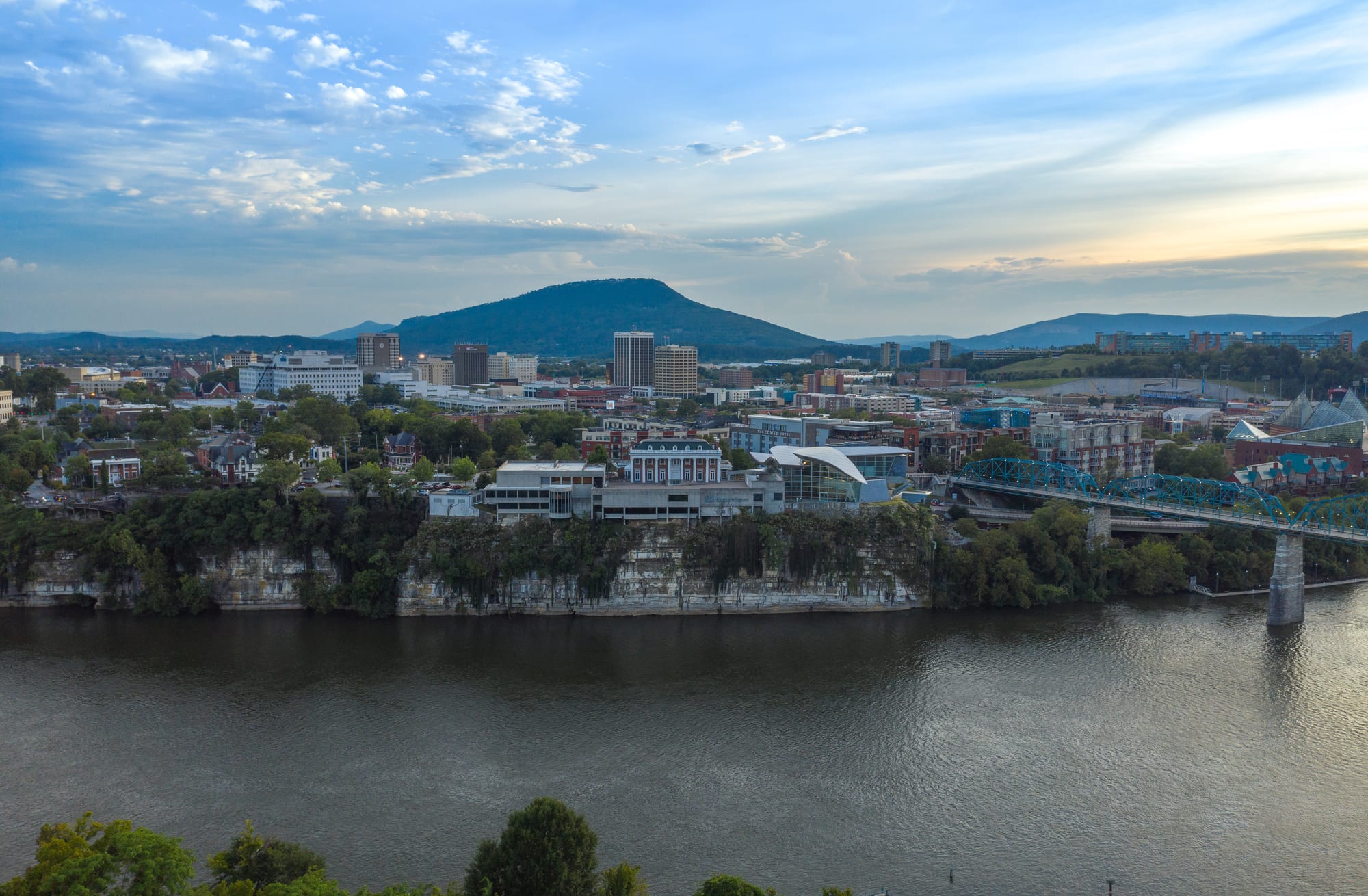
Downtown Chattanooga's towers and the riverside aquarium above a limestone bluff on the Tennessee River, with the blue Walnut Street Bridge and Lookout Mountain behind

The South, United States

Chattanooga

Downtown Chattanooga and the Tennessee River seen from the North Shore, with Lookout Mountain in the distance. (Breethol / Wikimedia Commons · CC BY-SA 4.0)

A mid-sized Tennessee city on a bend of the Tennessee River, hemmed in by Lookout Mountain, Signal Mountain and Missionary Ridge. Railways and iron made it, two Civil War battles were fought on its ridges, and after being declared to have the dirtiest air in the nation in 1969 it rebuilt itself around a cleaned-up riverfront, a large aquarium and a pedestrian bridge.

Neighbourhoods

  • Downtown and the Riverfront
    • First-time visitors
    • Museums
    • Close to public transport

    The compact business district between the river and the railway lines, with the Tennessee Aquarium, the Hunter Museum on its bluff and the Walnut Street Bridge at the river end, and Market and Broad Streets running south past hotels, restaurants and the convention centre. The free electric shuttle runs its length.

    Open in Maps
  • North Shore
    • Best for food
    • Shopping
    • Parks

    Across the river on the north bank, a district of independent shops, cafés and restaurants along Frazier Avenue, with Coolidge Park and its carousel on the river and the best view back to the downtown skyline.

    Open in Maps
  • Southside
    • Nightlife
    • Best for food
    • Historic district

    The old warehouse and railway district around Main Street and the Chattanooga Choo Choo terminal, which has filled with breweries, restaurants, music venues and loft flats since the 2000s. It is the liveliest part of town in the evening.

    Open in Maps
  • St. Elmo and the foot of Lookout Mountain
    • Historic district
    • Quiet and residential
    • Walks and viewpoints

    A late 19th-century suburb at the foot of Lookout Mountain, south of downtown, where the Incline Railway starts its climb. Old houses, a few cafés and easy access to the mountain's trails and sights.

    Open in Maps
  • Lookout Mountain
    • Views
    • Families
    • Quiet and residential

    The mountaintop communities above the city, in Tennessee and Georgia, around Point Park, Rock City and Ruby Falls. Wooded, cool in summer and quiet at night, but a car is needed for almost everything.

    Open in Maps

Things to do

The river and the bridge

  • Tennessee Aquariumattraction

    Two buildings on the riverfront — River Journey, opened in 1992, which follows a raindrop from the Appalachian Mountains to the Gulf of Mexico, and Ocean Journey, opened in 2005. It anchored the city's revival and was the largest freshwater aquarium in the world when it opened.

    Open in Maps
  • Walnut Street Bridgelandmark

    An 1890 truss bridge across the Tennessee River, about 2,376 feet long, closed to motor traffic in 1978 and reopened as a pedestrian bridge in 1993; it was closed again for renovation in March 2025.

    Open in Maps
  • Coolidge Parkpark

    A riverside park on the North Shore with a restored 1890s carousel, a fountain for children and lawns facing the downtown skyline.

    Open in Maps
  • Tennessee Riverwalktrail

    A paved walking and cycling path along the river from downtown past the Hunter Museum and east towards Chickamauga Dam, part of a longer riverpark system.

    Open in Maps
  • Ross's Landingpark

    The riverside park beside the aquarium at the landing John Ross established in 1816, where the city began, with a memorial to the Cherokee removal on the Trail of Tears.

    Open in Maps

Museums and the arts

  • Hunter Museum of American Artmuseum

    An American art collection from the colonial period to today, housed in a 1904 mansion, a 1975 addition and a 2005 wing designed by Randall Stout on a bluff 80 feet above the river.

    Open in Maps
  • Creative Discovery Museummuseum

    A hands-on children's museum downtown, dedicated to science, art and music.

    Open in Maps
  • Chattanooga Choo Choolandmark

    The 1909 Terminal Station on the Southside, with its 82-foot dome, closed to trains in 1970 and reopened in 1973 as a hotel and entertainment complex named after the 1941 Glenn Miller song.

    Open in Maps
  • Tivoli Theatrelandmark

    A 1921 theatre designed by Rapp and Rapp, bought and restored by the city and now home to the Chattanooga Symphony and Opera.

    Open in Maps
  • Bessie Smith Cultural Centermuseum

    A museum honouring the blues singer Bessie Smith, who was born in Chattanooga, and the city's African American history.

    Open in Maps

Lookout Mountain

  • Lookout Mountain Incline Railwayattraction

    A funicular opened in 1895 that climbs from St. Elmo to the top of Lookout Mountain, reaching a gradient of about 73 per cent near the summit.

    Open in Maps
  • Point Park and Lookout Mountain Battlefieldpark

    The summit park on Lookout Mountain, part of the national military park, where the 1863 Battle Above the Clouds was fought, with monuments and views over the river's Moccasin Bend.

    Open in Maps
  • Ruby Fallsattraction

    An underground waterfall deep inside Lookout Mountain, reached by lift and a cave walk, open to visitors since 1930.

    Open in Maps
  • Rock Cityattraction

    A 1930s garden among sandstone formations on Lookout Mountain in Georgia, famous for the barn roofs painted See Rock City across the South and for the Lover's Leap overlook.

    Open in Maps
  • Sunset Rockviewpoint

    A sandstone ledge on the northwest side of Lookout Mountain, once known as Point Lookout, with views over the Tennessee River and Signal Mountain.

    Open in Maps

Walks and viewpoints

  • Stringer's Ridgetrail

    A wooded ridge on the North Shore with hiking and mountain-bike trails and an overlook facing downtown across the river.

    Open in Maps
  • Signal Pointviewpoint

    A point on Signal Mountain once used for fire and smoke signals across the valley and by the Union Army as a signal station, high above the Tennessee River.

    Open in Maps
  • Missionary Ridgeviewpoint

    The long ridge in the east of the city, stormed by Union troops on 25 November 1863 and now part of the national military park.

    Open in Maps

Short trips from the city

  • Chickamauga Battlefieldattraction

    The site of the September 1863 battle, just south in Georgia, part of the first and largest of the national military parks authorised by Congress in 1890, with tour roads through the battlefield.

    Open in Maps
  • Tennessee River Gorgeattraction

    The river's 26-mile canyon through the Cumberland Plateau west of the city, seen from the mountain overlooks, from boats or from Prentice Cooper State Forest on its northern edge.

    Open in Maps
  • Raccoon Mountain Cavernsattraction

    A limestone cave system on Raccoon Mountain west of the city with walking tours and longer wild-cave crawls.

    Open in Maps

Seasonal events

  • Riverbend FestivalJune

    A multi-night music festival on the riverfront, held since 1982 and including the Bessie Smith Strut.

  • Chattanooga MarketSundays, April to December

    The region's largest producer-only market of farm stalls, food and crafts, held at the open-air First Horizon Pavilion.

  • Ironman Chattanoogaonce a year

    A long-distance triathlon that swims the Tennessee River and runs along the riverfront, filling the city for a weekend.

  • Rock City's Enchanted Garden of LightsNovember and December

    Rock City's gardens on Lookout Mountain lit with Christmas lights and displays, with seasonal shows and carolers.

Eat and drink

Long-standing places and food districts in Chattanooga. Hours, ratings and directions come from your maps app, always current.

Chattanooga classics

  • MoonPiemarket

    The coated graham-and-marshmallow sandwich made by the Chattanooga Bakery, a family-owned company in the city, and traditionally paired with an RC Cola.

    Open in Maps
  • Chattanooga Marketmarket

    The Sunday market at the First Horizon Pavilion, with regional farmers, bakers and food trucks, the best place to taste the area's produce in season.

    Open in Maps

Food districts

  • Main Street, Southsideneighborhood

    The city's main dining strip, where restaurants, breweries and bars occupy old warehouses between Market Street and the railway.

    Open in Maps
  • Frazier Avenue, North Shoreneighborhood

    Cafés, ice cream shops and casual restaurants along the North Shore's main street, a short walk over the river from downtown.

    Open in Maps
  • Broad and Market Streets, downtownneighborhood

    The downtown blocks near the aquarium, with Southern, barbecue and brewpub kitchens serving the museum crowds.

    Open in Maps

Experience Chattanooga

History

The Cherokee lived along this stretch of the Tennessee River, and in 1816 John Ross, who later became principal chief of the Cherokee Nation, established the landing that still bears his name. In 1838 the United States Army used Ross's Landing as one of three emigration depots where Cherokee were held before being forced west on the Trail of Tears; the next year the community at the landing was incorporated as the city of Chattanooga. The name is believed to come from a Creek word meaning "rock rising to a point", perhaps a reference to Lookout Mountain.

Railways made the town. The railroad from Atlanta arrived in 1850, other lines followed, and by the Civil War Chattanooga was a junction the Confederacy could not afford to lose. In September 1863 the Union army was beaten at Chickamauga, just south in Georgia, and besieged in the city; in November Ulysses S. Grant's forces broke out, taking Lookout Mountain in the "Battle Above the Clouds" and storming Missionary Ridge, which opened the road to Atlanta. The battlefields became the country's first national military park in 1890.

After the war Chattanooga grew into an iron and manufacturing city — the first Coca-Cola bottling franchise was set up here in 1899 — and in 1941 Glenn Miller's "Chattanooga Choo Choo" made its name known worldwide. In 1969 the federal government declared that it had the dirtiest air in the nation. From the 1980s business and civic leaders planned a new riverfront; the Tennessee Aquarium opened in 1992, the Walnut Street Bridge reopened for walkers in 1993, and the city later built a municipal gigabit internet network, earning the nickname Gig City. Volkswagen opened an assembly plant on the city's east side in 2011.

Culture & Customs

Chattanooga's identity is built on the river and the mountains around it. The Tennessee River Gorge, the sandstone cliffs of the Cumberland Plateau and the ridges inside the city limits make it a centre for rock climbing, trail running, paddling and mountain biking, and outdoor sport is as much a part of local life as college football is elsewhere in Tennessee. The Riverbend Festival has brought music to the waterfront every summer since the early 1980s, and the Ironman triathlon turns the river and the Riverwalk into a race course each year.

The city was the birthplace of the blues singer Bessie Smith, who busked on its streets as a child, and the cultural centre named for her keeps her story alongside that of Black Chattanooga. The Tivoli Theatre and the Chattanooga Symphony and Opera carry the formal arts, and the Hunter Museum's collection covers American art from the colonial period to today. The Choo Choo song, MoonPies and the See Rock City barns are the pieces of popular culture the rest of the country associates with the city, and residents wear them lightly.

Manners are Southern: strangers greet one another, "y'all" is standard, and churches of many denominations fill on Sunday morning. Pride in the turnaround from the polluted city of the 1960s is strong and openly expressed, and the gigabit network and the arrival of Volkswagen are told as parts of the same story. The Civil War is present in the landscape rather than argued over, in the monuments of the national military park on Missionary Ridge and Lookout Mountain.

Daily Life

About 185,000 people live in the city and roughly 560,000 in the metropolitan area, which spills across the state line into Georgia. The economy rests on manufacturing — the Volkswagen plant, which builds electric vehicles alongside its SUVs, and suppliers around it — together with the insurance company Unum, the Tennessee Valley Authority's offices, hospitals, a University of Tennessee campus and a cluster of technology start-ups that the gigabit network helped to attract. Tourism has grown steadily since the aquarium opened.

Most residents live in car-dependent neighbourhoods on the ridges and in the valleys around the centre: the older streets of St. Elmo and Highland Park, the hilltop suburbs on Signal and Lookout Mountains, and the sprawl of Hixson, East Brainerd and Ooltewah beyond. The Southside and North Shore have drawn younger households into flats and renovated houses, and housing costs have risen as people have moved in. About 23 per cent of the city's residents live below the poverty line, and schools and public transport are long-standing political topics.

The day begins early; commuters cross the river on the Market Street and Olgiati bridges, and the lunch hour fills the restaurants of Main Street. Evenings and weekends are spent outdoors in good weather — on the Riverwalk, on Stringer's Ridge, on the climbing walls and paddling routes of the gorge — and in the breweries of the Southside. Summer haze and ozone, flooding on the creeks that drain the ridges and traffic on the interstate bridges are the everyday complaints.

Food

Chattanooga's best-known food is a snack: the MoonPie, two round graham biscuits with marshmallow between them, dipped in a flavoured coating, made by the family-owned Chattanooga Bakery and sold with an RC Cola as the traditional working man's lunch across the South. The city was also the first to bottle Coca-Cola, in 1899, which is why the drink is tied to Chattanooga in local memory even though it was invented in Atlanta.

Otherwise the table is east Tennessee's: slow-smoked pork barbecue with a tomato-based sauce, fried chicken, catfish, biscuits with sausage gravy, grits and sweet tea, with meat-and-three lunch plates — one meat and three vegetable sides, which may include macaroni and cheese — in diners across town. The Southside's restaurants have added Southern cooking with modern touches, wood- fired pizza, Mexican and Asian kitchens, and the city has a dense cluster of craft breweries. The Chattanooga Market on Sundays is the place to find local peaches, tomatoes, honey, cheese and baked goods from the farms of the valley and the plateau.

On the North Shore, Frazier Avenue's cafés and ice cream shops draw families from the riverside parks, and downtown's Market and Broad Streets serve the aquarium crowds with barbecue, burgers and brewpub fare.

Planning tools

Budget

Chattanooga is cheaper than Nashville or Atlanta. Hotel rates downtown rise for the Riverbend Festival, the Ironman weekend and autumn colour on the mountains. The attractions on Lookout Mountain and the aquarium are the main ticketed costs; the riverfront, the bridge and the battlefields are free.

Daily Budget Midrange
USD 200–350 (downtown or Southside hotel, restaurant dinners with tax and tip, aquarium and mountain tickets, a hire car)
Daily Budget Shoestring
USD 90–150 (motel or hostel, barbecue and taco lunches, free riverfront and battlefield walks, the free downtown shuttle)

Book early for the Riverbend Festival and the Ironman weekend.

Best Time to Visit

April to June and September to early November are the most comfortable, with spring blossom in the mountain gardens and autumn colour on the ridges in late October. Summer is hot and humid but busy on the river; winter is mild, quiet and often grey, with the Rock City lights as the main draw.

Suggested Number of Days

Two days are enough for the riverfront and the mountain; three leave room for the battlefields and the Southside. Allow four to reach the river gorge, the caves and the plateau. A car speeds everything up.

First Visit
2–3 days
With Surroundings
3–4 days

Transportation

Downtown and the North Shore are easy without a car, linked by the Market Street Bridge, and the city's CARTA bus system runs a free electric shuttle in the downtown area. Buses cover the rest of the city thinly. Lookout Mountain's sights are spread along the summit, so most visitors drive or take a tour; the Incline Railway reaches the top from St. Elmo. Bike share stations stand around the centre.

Parking downtown is plentiful but mostly paid; the Riverwalk is the pleasant way between the aquarium, the Hunter Museum and the riverside parks.

Airport & Station Connections

Chattanooga Metropolitan Airport, about 5 miles east of downtown, has flights to a handful of hubs; many visitors fly to Atlanta or Nashville instead, each about two hours away by car. Interstates 24 and 75 meet in the city, and I-59 begins about 10 miles to the south-west in Georgia. There is no passenger rail service.

Walkability

The riverfront, downtown and the North Shore make a walkable core of about a mile across, mostly flat apart from the climb to the Hunter Museum's bluff. The Southside is a further mile south along Market Street. Everything on Lookout Mountain and the battlefields needs a car. Summer afternoons are hot for walking.

Safety

Like most American cities, Chattanooga has areas with higher crime, but the riverfront, downtown, North Shore and Southside are well used by day and in the evening. Thefts from parked cars are the usual risk for visitors; summer heat and thunderstorms, and steep edges on the mountain overlooks, are the natural hazards.

Leave nothing visible in a parked car, stay behind railings at the overlooks, and keep off the river during high water. Check current official travel advice before travelling.

Climate

Humid subtropical, in a valley that traps heat and haze in summer. Spring and autumn are long and pleasant; winters are mild with occasional snow on the mountains.

Summer
hot and humid — July highs around 90°F, with frequent afternoon thunderstorms
Winter
mild — cool January days and nights often near 32°F, with variable snowfall, more on the mountains

Local Customs

Tipping of 18–20 per cent is expected in restaurants and a dollar or two a drink at bars. Sales tax is added at the till. People are friendly and chatty in the Southern way, and the city is proud of its turnaround and its outdoor life — climbing, paddling and cycling are part of local identity. Church is central to many residents' weeks.

Identification is asked for when buying alcohol (legal age 21). The battlefields are memorials: stay off the monuments and cannon. Ask before photographing people.

Common Payment Methods

The currency is the US dollar. Cards and contactless payment work almost everywhere, including the mountain attractions (the downtown shuttle is free); a little cash is useful at the Sunday market and a few older diners. ATMs are common downtown.