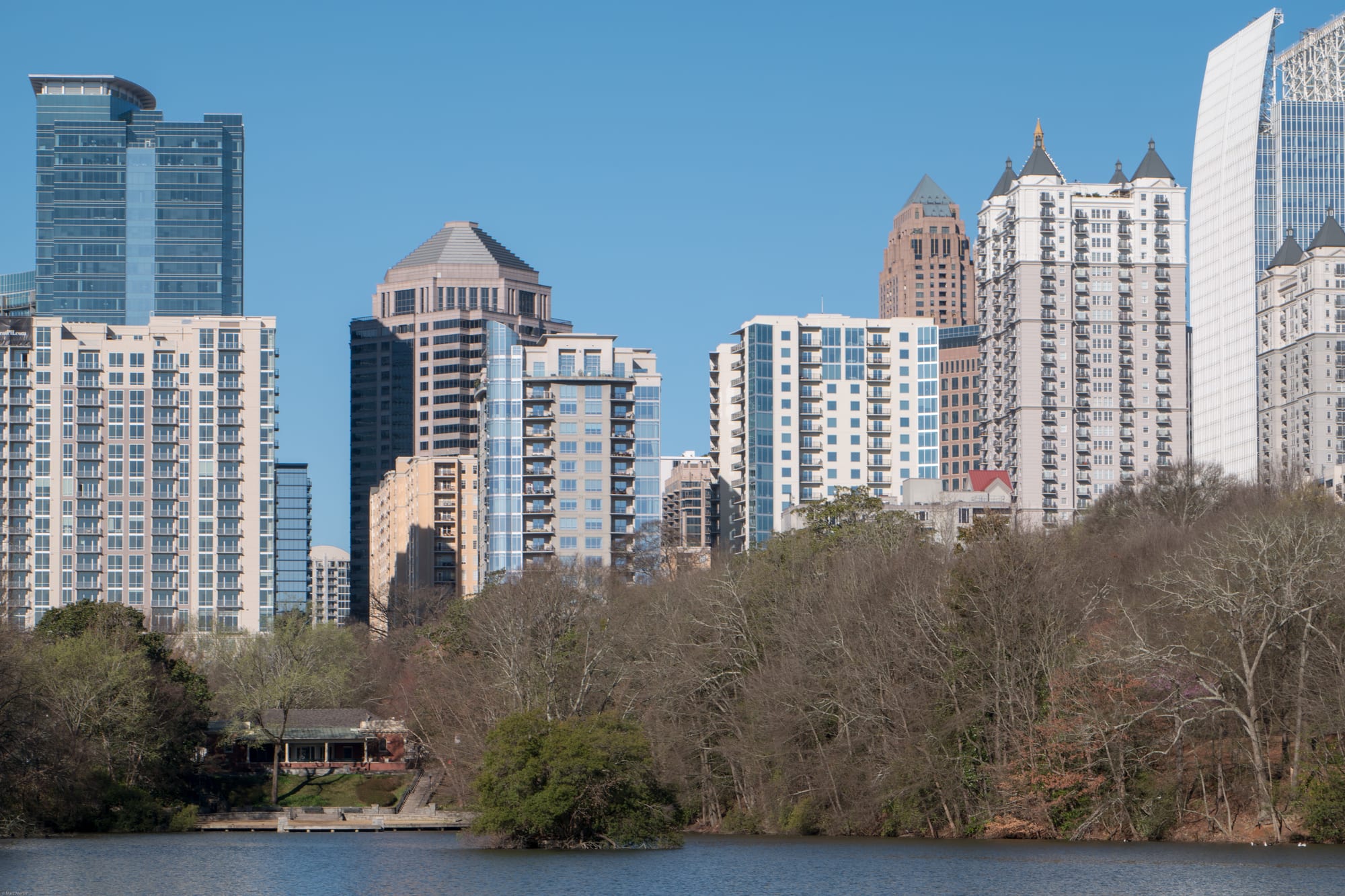
Midtown Atlanta's glass and stone high-rises rising above bare trees on the far shore of a lake under a clear blue sky

The South, United States

Atlanta

The Midtown skyline over Lake Clara Meer in Piedmont Park, Atlanta. (Marc Merlin / Wikimedia Commons · CC BY-SA 4.0)

Georgia's capital, founded in the 1830s as the end of a railway line in the Appalachian foothills and rebuilt after Sherman's army burned it in 1864. The birthplace of Martin Luther King Jr. and a centre of the civil rights movement, it is now a city of glass towers and leafy streets at the heart of a metro area of over six million, with the world's busiest airport.

Neighbourhoods

  • Downtown
    • First-time visitors
    • Sport and attractions
    • Close to public transport

    The central business district, with state and city government, Georgia State University, the stadiums and most of the big attractions — Centennial Olympic Park, the Georgia Aquarium and the World of Coca-Cola. Busy by day and on event nights, quieter after office hours, and well served by MARTA and the streetcar.

    Open in Maps
  • Midtown
    • Arts and culture
    • Parks
    • Nightlife

    The second business district along Peachtree Street, with the highest density of arts institutions in the Southeast: the High Museum, the Woodruff Arts Center, the Fox Theatre. Piedmont Park and the Botanical Garden are on its eastern edge, and its high-rises sit beside older streets of houses.

    Open in Maps
  • Old Fourth Ward and Sweet Auburn
    • Civil rights history
    • Beltline
    • Best for food

    A historic eastside neighbourhood best known for the Martin Luther King Jr. historic site and, along Auburn Avenue, the old centre of Black business. The Beltline's Eastside Trail and Ponce City Market have brought new flats, restaurants and bars.

    Open in Maps
  • Inman Park and Little Five Points
    • Historic district
    • Alternative culture
    • Bars

    Inman Park, Atlanta's first planned suburb, has Victorian houses on shady streets beside the Beltline; its old commercial district, Little Five Points, about two and a half miles east of downtown, is famous for its alternative culture.

    Open in Maps
  • Buckhead
    • Shopping
    • Upmarket dining
    • Quiet and residential

    The uptown district covering roughly the northern fifth of the city, about six miles north of downtown: towers, malls and restaurants around Peachtree and Piedmont roads and Lenox Square, surrounded by wooded streets of large houses. The Atlanta History Center is here.

    Open in Maps

Things to do

Civil rights history

  • Martin Luther King Jr. National Historical Parklandmark

    A National Park Service site of about 35 acres on Auburn Avenue, including King's boyhood home, Ebenezer Baptist Church and a visitor centre and museum.

    Open in Maps
  • Ebenezer Baptist Churchlandmark

    The church where King was baptised and where he and his father were pastors; its historic sanctuary is part of the national historical park.

    Open in Maps
  • National Center for Civil and Human Rightsmuseum

    A museum opened in 2014 beside Centennial Olympic Park, linking the American civil rights movement to human rights struggles around the world.

    Open in Maps
  • Sweet Auburnneighborhood

    The historic African American district along Auburn Avenue, once called the 'richest Negro street in the world', and a National Historic Landmark District since 1976.

    Open in Maps

Downtown attractions

  • Centennial Olympic Parkpark

    A 22-acre park built for the 1996 Olympics, now the centre of the city's tourist district and a venue for concerts and festivals.

    Open in Maps
  • Georgia Aquariumattraction

    The world's largest aquarium from its opening in 2005 until 2012, holding whale sharks, beluga whales and manta rays; its centrepiece is a 6.3-million-gallon whale shark tank.

    Open in Maps
  • World of Coca-Colamuseum

    A museum of the soft drink invented in Atlanta in 1886, opened in 2007, telling the company's history and showing its advertising.

    Open in Maps
  • Mercedes-Benz Stadiumattraction

    The retractable-roof stadium of the Falcons and Atlanta United, opened in 2017, which hosted several matches of the 2026 FIFA World Cup, including a semi-final.

    Open in Maps

Museums and theatre

  • High Museum of Artmuseum

    The largest art museum in the Southeast, on Peachtree Street in Midtown, known for American decorative arts, folk and self-taught art, modern and contemporary art and photography.

    Open in Maps
  • Fox Theatrelandmark

    A Moorish-style movie palace of 1929 with about 4,700 seats, saved from demolition in the 1970s by a grassroots campaign and now a stage for touring shows and the Atlanta Ballet.

    Open in Maps
  • Atlanta History Centermuseum

    A large Buckhead campus of history galleries, gardens and historic houses, including the Swan House; it now displays the Atlanta Cyclorama, a circular painting of the Battle of Atlanta.

    Open in Maps
  • Jimmy Carter Library and Museummuseum

    The presidential library of the Georgia-born president, with his Nobel Peace Prize and a full-scale replica of the Oval Office, on land that was part of Sherman's headquarters in 1864.

    Open in Maps
  • Margaret Mitchell Housemuseum

    The Midtown house where Margaret Mitchell wrote Gone with the Wind, now a museum run by the Atlanta History Center.

    Open in Maps
  • Michael C. Carlos Museummuseum

    Emory University's museum, holding the largest collections of ancient art in the Southeast, from Egypt, Greece and Rome to Africa and the ancient Americas.

    Open in Maps

Parks and trails

  • Piedmont Parkpark

    The city's best-loved green space, about a mile north-east of downtown, laid out for the expositions of 1887 and 1895 and now the setting for many festivals.

    Open in Maps
  • Atlanta Botanical Gardenpark

    Thirty acres of gardens beside Piedmont Park, with a Japanese garden, a conservatory and the Kendeda Canopy Walk, a 600-foot skywalk through the treetops.

    Open in Maps
  • Atlanta Beltlinetrail

    A 22-mile walking and cycling trail on a former railway loop around the city core, lined with public art, parks and new development — and the subject of protests over gentrification and displacement.

    Open in Maps
  • Oakland Cemeterylandmark

    A Victorian garden cemetery founded in 1850, whose original six acres are among the oldest historic ground in a city largely burned in 1864.

    Open in Maps
  • Zoo Atlantaattraction

    The zoo in Grant Park, known for its gorillas and orangutans and, as of 2026, home to two giant pandas.

    Open in Maps
  • Chattahoochee River National Recreation Areapark

    A protected 48-mile stretch of the river on the city's north-western edge, used for walking, fishing, kayaking and tubing.

    Open in Maps

Short trips from the city

  • Stone Mountainpark

    A huge rock dome 15 miles east of the city, the most visited tourist site in Georgia, reached by trail or aerial tram; its north face carries a vast carving of three Confederate leaders, completed in 1972.

    Open in Maps
  • Kennesaw Mountain National Battlefield Parkpark

    A preserved battlefield of the 1864 Atlanta campaign between Marietta and Kennesaw, with trails up Kennesaw Mountain.

    Open in Maps

Seasonal events

  • Atlanta Dogwood Festivalearly April

    An arts and crafts festival in Piedmont Park held since 1933, timed for the flowering of the native dogwood trees.

  • Peachtree Road Race4 July

    The world's largest 10K road race, run down Peachtree Street on Independence Day by some 60,000 runners.

  • Dragon ConLabor Day weekend, late August or early September

    A multi-genre fan convention founded in 1987, drawing tens of thousands of fans to five downtown hotels.

  • Little Five Points Halloween festivalOctober

    A neighbourhood festival in the city's alternative-culture district.

Eat and drink

Long-standing places and food districts in Atlanta. Hours, ratings and directions come from your maps app, always current.

Atlanta classics

  • The Varsityrestaurant

    A long-lived fast food chain whose main branch, on North Avenue, was once the largest drive-in fast food restaurant in the world.

    Open in Maps
  • Mary Mac's Tea Roomrestaurant

    A Midtown institution for traditional Southern cooking on Ponce de Leon Avenue.

    Open in Maps
  • Paschal'srestaurant

    A Southern restaurant business begun as a small sandwich shop in 1947 by the brothers Robert and James Paschal.

    Open in Maps

Food halls and food streets

  • Ponce City Marketmarket

    A food hall, restaurants and shops in the vast former Sears catalogue building where the Beltline crosses Ponce de Leon Avenue.

    Open in Maps
  • Krog Street Marketmarket

    A food hall of vendor stalls and restaurants in Inman Park, opened in 2014 beside the Beltline's Eastside Trail.

    Open in Maps
  • Buford Highwayneighborhood

    The international corridor north-east of the city, celebrated for its diversity and lined with Mexican, Asian and other immigrant restaurants.

    Open in Maps

Experience Atlanta

History

Creek and Cherokee peoples lived in the area for thousands of years; the nearest settlement was Standing Peachtree, a Creek village where Peachtree Creek meets the Chattahoochee River. The Creek were forced out by 1821. In 1836 Georgia voted to build the Western and Atlantic Railroad, and its "zero milepost" was driven into the ground at what is now Five Points. The settlement around it, first called Terminus and then Marthasville, was incorporated as Atlanta in December 1847, a name derived from the railway.

As the junction of several lines, Atlanta became a Confederate supply hub in the Civil War. After the Battle of Atlanta and a four-month siege, the city surrendered to General William T. Sherman in September 1864, and before his March to the Sea he ordered its military assets destroyed; most of the city burned. Rebuilt quickly, it became the state capital in 1868, and the newspaper editor Henry Grady promoted it as the capital of the "New South". The Cotton States and International Exposition of 1895 drew nearly 800,000 visitors. The early 20th century brought growth but also the race riot of 1906, the lynching of Leo Frank in 1915 and the Great Fire of 1917.

In the 1960s Atlanta was a centre of the civil rights movement, led by Martin Luther King Jr., Ralph Abernathy and students from the city's historically Black colleges. By 1970 African Americans were the majority, and in 1973 Maynard Jackson became the first Black mayor. MARTA trains began running in 1979. The 1996 Summer Olympics, marred by the Centennial Olympic Park bombing, transformed the city, and since 2005 the Beltline has remade the inner neighbourhoods. In 2026 Atlanta was one of the host cities of the FIFA World Cup.

Culture & Customs

Since the 1970s Atlanta has been known as a "Black mecca", a centre of African American politics, education, business and culture, anchored by the colleges of the Atlanta University Center and by churches such as Ebenezer Baptist. In the 1960s the mayor called it "the city too busy to hate", and it has a diverse LGBT community, historically centred on Midtown and Cheshire Bridge.

Music has followed the city's growth: country music arrived with Appalachian migrants in the 1920s, the city was a centre of Southern rock in the 1970s, and Outkast and the Dungeon Family brought Atlanta hip hop to prominence; by the 2000s the city had become hip hop's centre of gravity. It is also a leading centre of film and television production, home to Tyler Perry Studios. The Woodruff Arts Center houses the Atlanta Symphony Orchestra and the Tony-winning Alliance Theatre, the city has resident opera and ballet companies, and street art festivals have covered many walls with murals.

Sport is followed passionately. The Braves, the oldest continually operating professional franchise in the country, the Falcons, the Hawks and Atlanta United, MLS champions in 2018, all play here, and the city calls itself the capital of college football. Running is a local passion, crowned by the Peachtree Road Race on the Fourth of July. Festivals run from January to November, from the Dogwood Festival in Piedmont Park to Dragon Con on Labor Day weekend.

Daily Life

About 499,000 people lived in Atlanta at the 2020 census, and an estimated 529,000 in 2025, while the metropolitan area has over 6.4 million. The city is divided into 242 official neighbourhoods: high-rise Downtown, Midtown and Buckhead along Peachtree Street, surrounded by low-density streets of craftsman bungalows under the densest urban tree cover of any major American city, which earns it the name "City in a Forest".

The economy is broad. Coca-Cola, Home Depot, Delta Air Lines, UPS, Chick-fil-A and Norfolk Southern are among the companies with headquarters in the city or region, and Delta is the metro area's largest employer. CNN and other Turner networks were founded here, technology has earned the nickname "Silicon Peach", and film production has boomed on the back of state tax credits. Georgia Tech, Emory and the Atlanta University Center bring tens of thousands of students.

Change is the constant theme. Gentrification, accelerated by the Olympics and the Beltline, has reshaped many intown neighbourhoods, and the Black share of the city's population fell from 67 per cent in 1990 to 47 per cent in 2020. Traffic, commutes and air pollution rank among the worst in the country, yet one household in six has no car.

Food

Atlanta is best known for barbecue, hamburgers, Southern fried chicken and lemon pepper wings. Coca-Cola was invented here in 1886, and Chick-fil-A, the chicken sandwich chain, has its headquarters in the city. The Varsity, on North Avenue, was once the world's largest drive-in, and Mary Mac's Tea Room and Paschal's are long-established names for traditional Southern cooking. Sweet iced tea is the everyday drink, and Georgia is known for its peaches and pecans.

Since the turn of the century Atlanta has become a serious restaurant city. Kitchens in the gentrifying neighbourhoods have drawn national attention, and The New York Times in 2011 described two of them, in West Midtown and Midtown, as reflecting a sophisticated Southern sensibility centred on the farm but experienced in the city. Several restaurants are now recognised by the Michelin Guide, among them the Indian restaurant Chai Pani.

For international food, locals head to Buford Highway, the multi-ethnic corridor north-east of the city, where Mexican and Asian restaurants serve the region's immigrant communities. Food halls in old industrial buildings, above all Ponce City Market and Krog Street Market on the Beltline, have become social hubs.

Planning tools

Budget

Atlanta is cheaper than the big coastal cities but costs have risen with its growth. Hotel prices jump for conventions, big football games and festivals such as Dragon Con. The aquarium and the World of Coca-Cola are the priciest tickets, while the King historic site, Piedmont Park and the Beltline are free. Without a car, MARTA and ride-hailing cover most needs.

Daily Budget Midrange
USD 200–380 (mid-range hotel, restaurant dinners with tax and tip, one paid attraction, MARTA and ride-hailing)
Daily Budget Shoestring
USD 90–150 (hostel or budget motel, food-hall and Buford Highway meals, MARTA and the streetcar)

Check the convention and sports calendar before booking; staying near a MARTA rail station saves on parking and taxis.

Best Time to Visit

Spring and autumn are the best seasons: April brings the dogwoods and azaleas and the Dogwood Festival, and October and November are mild and dry. Summer is hot and humid, with afternoon thunderstorms, though the city's elevation takes a little off the heat. Winters are mild but changeable, with the occasional ice storm that can bring traffic to a halt.

Suggested Number of Days

Most first visits take three to four days, because the city is spread out and its museums and districts are far apart. Five or six days allow for the parks and battlefields outside the city. Traffic and distances decide the number more than the list of sights does.

First Visit
3–4 days
With Surroundings
5–6 days

Transportation

Atlanta is a car city with some of the worst traffic in the country, centred on the Downtown Connector, where I-75 and I-85 merge, and the I-285 'Perimeter' ring. MARTA's rail lines, the eighth-busiest subway system in the country, link the airport, Downtown, Midtown and Buckhead, and buses fill in; a 2.7-mile streetcar loop serves downtown and the King historic site, and the first bus rapid transit line opened in 2026. Ride-hailing and electric scooters are everywhere.

Locals divide the region into 'inside' and 'outside the Perimeter' (ITP and OTP); avoid driving the Connector at rush hour if possible.

Airport & Station Connections

Hartsfield–Jackson Atlanta International Airport, 10 miles south of downtown, has been the world's busiest airport by passenger traffic every year since 1998 except 2020, and is the main hub of Delta Air Lines. MARTA trains run from the domestic terminal to downtown and Midtown. Amtrak's Crescent between New York and New Orleans stops at Peachtree Station, and interstates arrive from every direction.

Walkability

Downtown's attractions around Centennial Olympic Park are within a few minutes' walk of each other, and Midtown is pleasant on foot. Elsewhere the city is hilly and spread out, and the Beltline is the best walking route between eastside neighbourhoods. Summer heat makes long walks tiring.

Safety

For most visitors the US is safe, with the main risks being petty theft and car break-ins in tourist areas of some cities, road accidents over long distances, extreme weather, and the hazards of the outdoors. In Atlanta, as in other large American cities, crime varies sharply from one neighbourhood to the next; the main tourist districts are busy, and the practical risks are theft from cars and quiet streets late at night. Severe thunderstorms and the occasional tornado or ice storm are the weather hazards.

Leave nothing visible in parked cars, use ride-hailing after dark in unfamiliar areas, and follow storm warnings. Check current official travel advice before travelling.

Climate

Humid subtropical, with rain spread through the year — about 50 inches — hot, humid summers tempered slightly by the city's height of more than 1,000 feet, and mild but variable winters. Snow is light and rare; ice storms cause more trouble.

Summer
hot and humid — July averages about 81°F, with highs of 90°F or more on around 47 days a year
Winter
mild but changeable — January averages about 45°F, about 36 nights a year fall to freezing, and snowfall averages about 2 inches

Local Customs

Atlanta mixes Southern courtesy with big-city pace, and many residents come from elsewhere. Tipping of roughly 18–22 per cent is expected in restaurants, and a dollar or two per drink at bars; sales tax is added at the till. Church remains central for many families, and the King sites and Ebenezer Baptist Church are places of worship and remembrance.

Identification is asked for when buying alcohol (the legal age is 21). Dress respectfully when visiting churches during services.

Common Payment Methods

The currency is the US dollar. Cards and contactless payment are accepted almost everywhere, and some venues and stadiums are cashless. A little cash is useful for tips and small vendors.