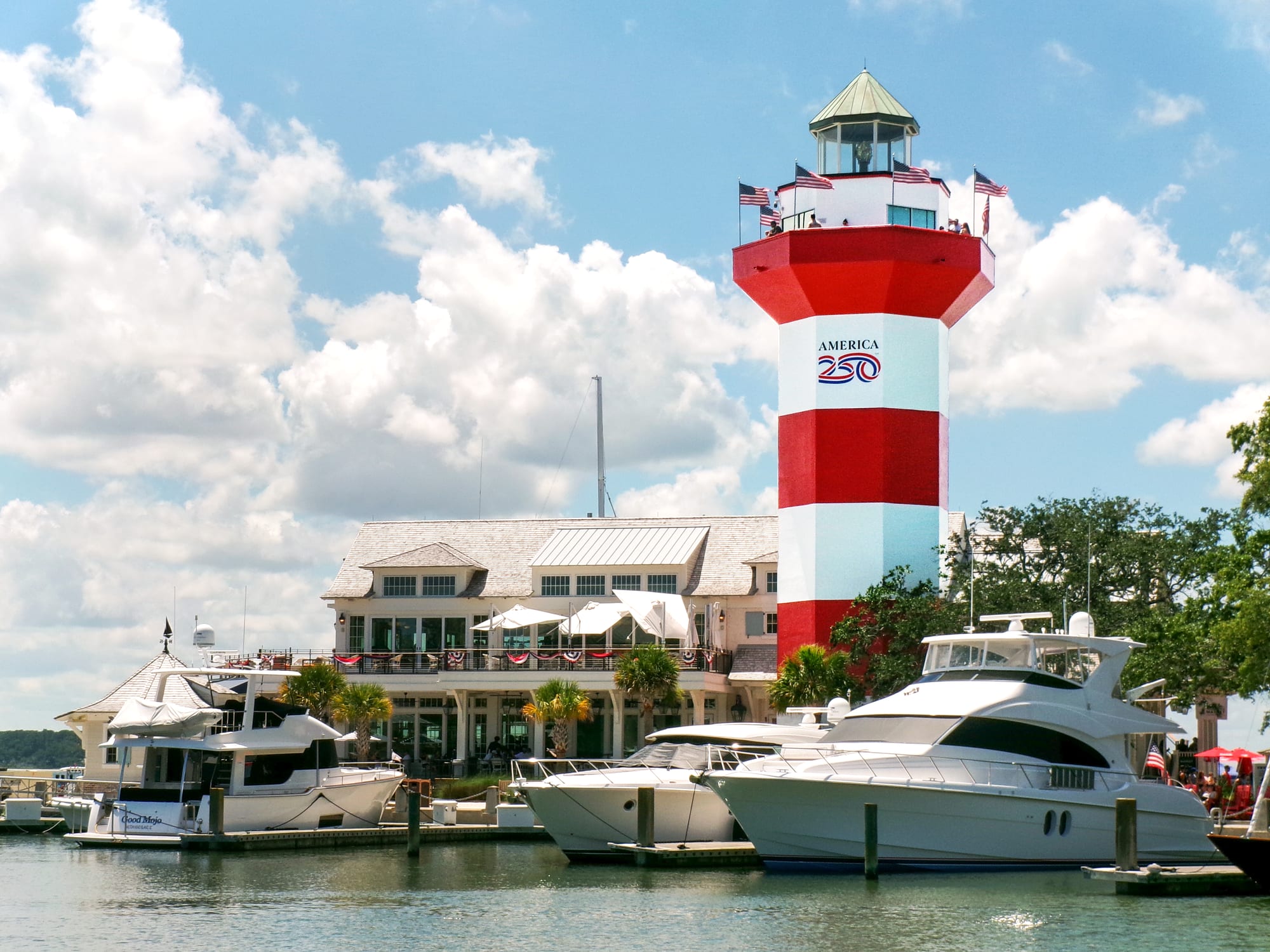
The red-and-white striped Harbour Town Lighthouse above a marina of white motor yachts, with the harbour clubhouse and palms under a blue sky

The South, United States

Hilton Head Island

Harbour Town Lighthouse and marina in Sea Pines, Hilton Head Island, in 2026. (Locust member / Wikimedia Commons · CC BY 4.0)

A shoe-shaped barrier island off the South Carolina Lowcountry, between Savannah and Beaufort, where Sea Island cotton plantations gave way after the Civil War to an early self-governing town of freed people and, from the 1950s, to a planned resort of golf courses, bike paths and gated communities under live oaks. Twelve miles of beach, a famous lighthouse and salt marsh make it a quiet family resort.

Neighbourhoods

  • Sea Pines
    • First-time visitors
    • Golf
    • Cycling

    The original planned resort at the southern toe of the island, a gated 5,000-acre community of villas, houses, golf courses, a forest preserve and the Harbour Town marina with its lighthouse. Day visitors pay a gate fee; inside, the roads are shaded by live oaks and bike paths go everywhere.

    Open in Maps
  • Coligny and Forest Beach
    • Beaches
    • Families
    • Nightlife

    The island's closest thing to a town centre, at the south end just outside Sea Pines — the main public beach park, a plaza of shops, bars and restaurants, and the hotels and condominiums of Forest Beach behind the dunes. Walkable, and the busiest place after dark.

    Open in Maps
  • Palmetto Dunes and Shelter Cove
    • Golf
    • Watersports
    • Quiet and residential

    A mid-island resort community with three golf courses, a lagoon system for kayaking, a tennis centre and oceanfront hotels, facing the Shelter Cove marina and shopping village on the sound side across the main road.

    Open in Maps
  • The north end
    • Quiet and residential
    • Nature
    • Local life

    Hilton Head Plantation, Port Royal and the historic Gullah neighbourhoods around Mitchelville, with marsh views over Port Royal Sound and the quietest beaches. Mostly year-round residents, with the Pinckney Island refuge just across the causeway.

    Open in Maps

Things to do

Beaches and the sea

  • Coligny Beach Parkbeach

    The island's main public beach park, at the south end beside Coligny Plaza, with free parking and a wide stretch of sand.

    Open in Maps
  • Harbour Townlandmark

    The marina village at the heart of Sea Pines, with its 93-foot red-and-white striped lighthouse, privately built in 1969–70, now the island's best-known symbol and open to climb for the view over Calibogue Sound.

    Open in Maps
  • Hilton Head Rear Range Lightlandmark

    A cast-iron skeleton lighthouse of 1879–80 standing in the woods of Palmetto Dunes, a reminder of the island before the resorts.

    Open in Maps
  • Daufuskie Islandattraction

    The bridgeless island across Calibogue Sound, reached by ferry, with Gullah history, a historic district of Gullah houses and dirt roads under live oaks, and beaches.

    Open in Maps

Nature and the marsh

  • Sea Pines Forest Preservepark

    Forest and wetlands within Sea Pines, with trails and, near its east entrance, a prehistoric shell ring about 4,000 years old.

    Open in Maps
  • Pinckney Island National Wildlife Refugepark

    A refuge of salt marsh, ponds and maritime forest on the islands between Hilton Head and the mainland, with 10 miles of trails, herons, egrets, ibises and alligators.

    Open in Maps
  • Coastal Discovery Museummuseum

    A museum of the island's natural and human history, which also runs the beach patrols that protect nesting loggerhead turtles.

    Open in Maps

History

  • Mitchelville Freedom Parklandmark

    The site of Mitchelville, the town laid out in 1862 behind Union lines for formerly enslaved people, with elected officials, churches and a compulsory education law; now Historic Mitchelville Freedom Park.

    Open in Maps
  • Fort Howelllandmark

    The earthwork fort built in 1864 by Union troops, among them the 32nd United States Colored Infantry, to protect Mitchelville, preserved in the woods near the north end.

    Open in Maps
  • Stoney-Baynard Ruinslandmark

    The tabby ruins of a plantation house of around 1800 in Sea Pines, built of oyster-shell concrete, with remains of an overseer's house and a slave house beside it.

    Open in Maps

Short trips from the island

  • Blufftonattraction

    The town across the bridge on the May River, whose Old Town on the bluff has art galleries, the 1850s Church of the Cross and an oyster company working since 1899, about 11 miles away.

    Open in Maps
  • Savannahattraction

    The Georgia city of squares, Spanish moss and Antebellum houses, about 20 miles to the south-west as the crow flies.

    Open in Maps
  • Beaufortattraction

    A waterfront town on Port Royal Island known for its preserved Antebellum architecture, about 18 miles away as the crow flies.

    Open in Maps
  • Hunting Island State Parkpark

    A wild barrier island beyond Beaufort with a climbable 19th-century lighthouse, a dense maritime forest and more than 4 miles of beach.

    Open in Maps

Seasonal events

  • RBC HeritageApril, the week after the Masters

    The PGA Tour golf tournament played at Harbour Town Golf Links since 1969, whose winner wears a tartan jacket, the biggest week of the island's year.

  • Hilton Head Island Gullah CelebrationFebruary

    A festival of art shows, films, books, crafts and food honouring the island's Gullah community and culture.

  • Hilton Head Island Concours d'Elegancelate October or early November

    A motoring festival and classic-car show that begins with a race weekend in Savannah and ends with the concours on the island.

Eat and drink

Long-standing places and food districts in Hilton Head Island. Hours, ratings and directions come from your maps app, always current.

Hilton Head classics

  • Harbour Town and South Beachneighborhood

    Marina-side restaurants and bars under the lighthouse, and more on the waterfront at South Beach, with shrimp, oysters and other local seafood.

    Open in Maps
  • Coligny Plazaneighborhood

    The shopping plaza across from the main beach, the island's densest cluster of casual seafood restaurants, ice cream, bars and breakfast places.

    Open in Maps
  • Shelter Cove and the mid-island marinasneighborhood

    Waterfront restaurants at Shelter Cove and the marinas on the sound side of the island.

    Open in Maps

Lowcountry food districts

  • Bluffton's Old Townneighborhood

    The old town on the May River across the bridge, home to the Bluffton Oyster Company, South Carolina's last full-time oyster-shucking business, and Lowcountry restaurants.

    Open in Maps

Experience Hilton Head Island

History

The island takes its name from William Hilton, an English sea captain who sighted its headland in 1663 while scouting the coast for settlers from Barbados. Spanish and French expeditions had passed earlier, and Native American peoples had lived along its creeks for thousands of years, leaving shell rings such as the one in what is now Sea Pines. From the 1700s planters cleared the island for plantations, from 1790 growing Sea Island cotton, the long-staple variety that made the Lowcountry rich, worked by enslaved Africans whose descendants became the Gullah.

In November 1861 a Union fleet took Port Royal Sound early in the Civil War, and the island became a Union base. Hundreds of enslaved people from across the region came behind Union lines, and in 1862 the army laid out Mitchelville on the north end as a town for them, with elected officials, churches and a compulsory education law, likely the first such law in the South. After the war the island became a place of small Gullah farms and fishing, reached only by boat, and stayed that way into the mid-20th century.

A bridge opened in 1956, the year Charles Fraser, whose father's company held timberland on the island, began developing Sea Pines Plantation at the southern end — a resort planned to keep the trees, hide the buildings and limit signs, a model soon imitated by the other developments on the island. Harbour Town and its lighthouse followed in 1969–70, the Heritage golf tournament the same year, and more gated communities through the 1970s and 1980s. The island incorporated as a town in 1983 to control the growth, and it has since grown into a year-round community of retirees, resort workers and the Gullah families who were here first.

Culture & Customs

Hilton Head's culture is shaped by its plan. Charles Fraser's covenants made the island a place where the live oaks come first, buildings sit back under the canopy in muted colours, and the resort communities are designed for cycling, golf and tennis rather than boardwalk amusement. The result is a quiet, family- and retiree-oriented resort — famous for its golf courses, its tennis centres and the Heritage tournament in April, when the island fills for the week after the Masters and the winner is given a tartan jacket.

The older culture is Gullah. The descendants of the island's enslaved people kept their land, language and foodways through a century of isolation, and families still live in neighbourhoods on the north end that were theirs long before the resorts. The community's story — Mitchelville, the praise houses, the sweetgrass baskets, the February Gullah Celebration — has moved from the margins to the centre of how the island describes itself.

The island also supports a symphony orchestra, an arts centre with a theatre and galleries, and a crowded calendar of charity events run by its retirees. Manners are Southern and relaxed; a wave from a passing cyclist is normal. The year has two rhythms — the summer invasion of families from the Northeast and Midwest, and the quieter, older winter population of golfers and snowbirds — and the people who serve both often live across the bridge in Bluffton and beyond.

Daily Life

About 38,000 people live on the island all year, a number that can swell to 150,000 at the height of summer, and the island's economy is almost entirely tourism, golf, real estate and the retirement industry — health care, home maintenance, landscaping and clubs. The average age is well above the national figure, and many residents live in the gated plantations where community associations handle roads, security and the look of every house.

The island's workers are a different population. Restaurant, hotel, landscaping and construction jobs are held largely by people who commute from Bluffton, Hardeeville and further up the coast, and the cost of housing on the island is a permanent local argument. Traffic over the bridges and along US 278 is the daily consequence, and the widening of the island's main road is a decades-long debate.

The Gullah neighbourhoods on the north end face their own pressures: land held by large families, rising taxes and offers from developers. Hurricanes and erosion are the shared worries — beach erosion is a constant concern, and Hurricane Matthew in 2016 left the island without water, sewer or power for days. Days follow the sun and the tide: an early bike ride or round of golf, the beach, the marsh at low tide, and supper at a marina as the shrimp boats come in.

Food

This is Lowcountry cooking, the coastal food of South Carolina shaped by the Gullah kitchen. Shrimp and grits — local shrimp cooked with bacon or sausage over stone-ground corn grits — is on nearly every menu. Lowcountry boil, also called Frogmore stew after a settlement on nearby St Helena Island, is shrimp, corn, sausage and potatoes boiled together in a seasoned pot and tipped on to a paper-covered table. She-crab soup is a cream soup of blue crab and roe with a dash of sherry, and oysters from the May River and the sounds are eaten raw, fried or steamed in clusters at oyster roasts through the winter.

Gullah dishes are red rice, simmered with tomato and usually bacon; okra gumbo; Hoppin' John of field peas and rice, eaten on New Year's Day; and seafood stews that go back to West African rice cooking. Carolina Gold, the rice that made the Lowcountry rich, has been revived by local growers. Boiled peanuts are sold at roadside stands, pralines and benne wafers — thin sesame biscuits — are the sweets, and sweet tea is the drink.

The island's restaurants cluster at the marinas and Coligny, serving local shrimp, crab and fish, and Bluffton's old town across the bridge has an oyster company on the May River that has shucked oysters since 1899. Seafood shacks, pancake houses and barbecue fill in the everyday meals, and the dining is more casual than the island's prices suggest.

Planning tools

Budget

Hilton Head is a mid-to-upper-priced resort where the cost is mostly lodging and golf. Villas and houses are let by the week in summer and cost most from June to August and during the golf tournament in April; the shoulder months are far cheaper. Beaches are free, bike hire is cheap and Sea Pines charges day visitors a small gate fee.

Daily Budget Midrange
USD 220–400 (resort hotel or villa, restaurant dinners, bike hire or a rental car, a kayak trip or a round of golf every few days)
Daily Budget Shoestring
USD 110–180 (off-season villa share or a motel across the bridge, groceries and seafood-shack lunches, a hired bike, free beaches)

Book summer and April weeks months ahead; May, September and October bring warm water, open courses and much lower rates, and a bike replaces a car for most of a stay in Sea Pines or Palmetto Dunes.

Best Time to Visit

March to May and September to November are the island's best months, warm but not sweltering, with the golf tournament in April and the sea warm enough to swim from May into October. Summer is hot, humid and the peak family season, with afternoon storms and the busiest beaches. Winter is mild — many golfers and retirees come for it — but too cool for the sea, and some restaurants shorten their hours.

Suggested Number of Days

The island is a stay-put beach destination, and most people take a week. Four or five days allow beach time, cycling, the marshes and the lighthouse; a full week adds the historic towns and the Georgia city within an hour's drive.

First Visit
4–5 days
With Surroundings
7 days

Transportation

The island is built for the bicycle: paved paths run beside all the main roads and through the resort communities, and the hard sand at low tide can be ridden for miles. Hire bikes are delivered to villas. A car is useful for the north end, Bluffton and day trips, and traffic on the main road, US 278, backs up on summer Saturdays. The Breeze trolley runs in season.

Sea Pines and several other plantations are gated; Sea Pines charges visitors' cars a day-pass fee, and the speed limits inside are low.

Airport & Station Connections

Savannah/Hilton Head International Airport in Georgia is about an hour's drive away; the island's own small airport has flights from American, Delta and United. By road the island is reached over the bridges on US 278 from Interstate 95, about 40 minutes' drive away; Charleston is roughly two hours and Atlanta about four and a half hours. The nearest Amtrak stations are in Savannah and Yemassee.

Walkability

Within a resort — Harbour Town, Coligny and Forest Beach, Shelter Cove — distances are short and the paths are flat and shaded. Between them the island is 12 miles long and the main road is not meant for walking, so a bike or car is needed. The beach itself is the best walk: wide, firm and uninterrupted for most of the ocean side.

Safety

Crime is low. The risks are natural: rip currents and jellyfish in summer, alligators in the lagoons and ponds, strong sun, and the hurricane season from June to November — Hurricane Matthew in 2016 cut water, sewer and power across the island for several days. Sea turtles nest on the beach from May to October and the island dims its lights for them.

Never feed or approach an alligator and keep dogs and children away from pond edges; swim near lifeguards, follow evacuation orders promptly in a storm, and turn off beach-facing lights at night in turtle season. Check current official travel advice before travelling.

Climate

Humid subtropical, moderated a little by the sea. Spring and autumn are long and pleasant, summer is hot and wet, and winter is mild with occasional cold snaps. Tropical storms are the main weather risk from late summer into autumn.

Summer
Hot and humid, with highs around 90 °F, sea temperatures in the 80s °F and frequent afternoon thunderstorms from June to September.
Winter
Mild, with highs around 60 °F and lows in the 40s °F from December to February; frost is rare and the sea is too cold for most swimmers.

Local Customs

A quiet, orderly resort island where the planned communities keep signs small, buildings low and colours muted by rule, and where golf, tennis and cycling set the tone. The Gullah community, descended from the enslaved people of the island's plantations, is the island's oldest, and its history is increasingly central to how Hilton Head presents itself. The island is a retirement place as much as a holiday one.

Tip 18–20 percent in restaurants and a few dollars to bag handlers and bike deliverers. Dress is casual, with collared shirts expected on most golf courses. South Carolina's drinking age is 21. Keep off the dunes and away from marked turtle nests, and ask before photographing people at Gullah community events.

Common Payment Methods

The US dollar. Cards and contactless payment are accepted almost everywhere, including at the gates and the marinas. ATMs are in banks and supermarkets along US 278 and at the shopping plazas. A little cash helps for tips, farm stands and the ferry to Daufuskie.