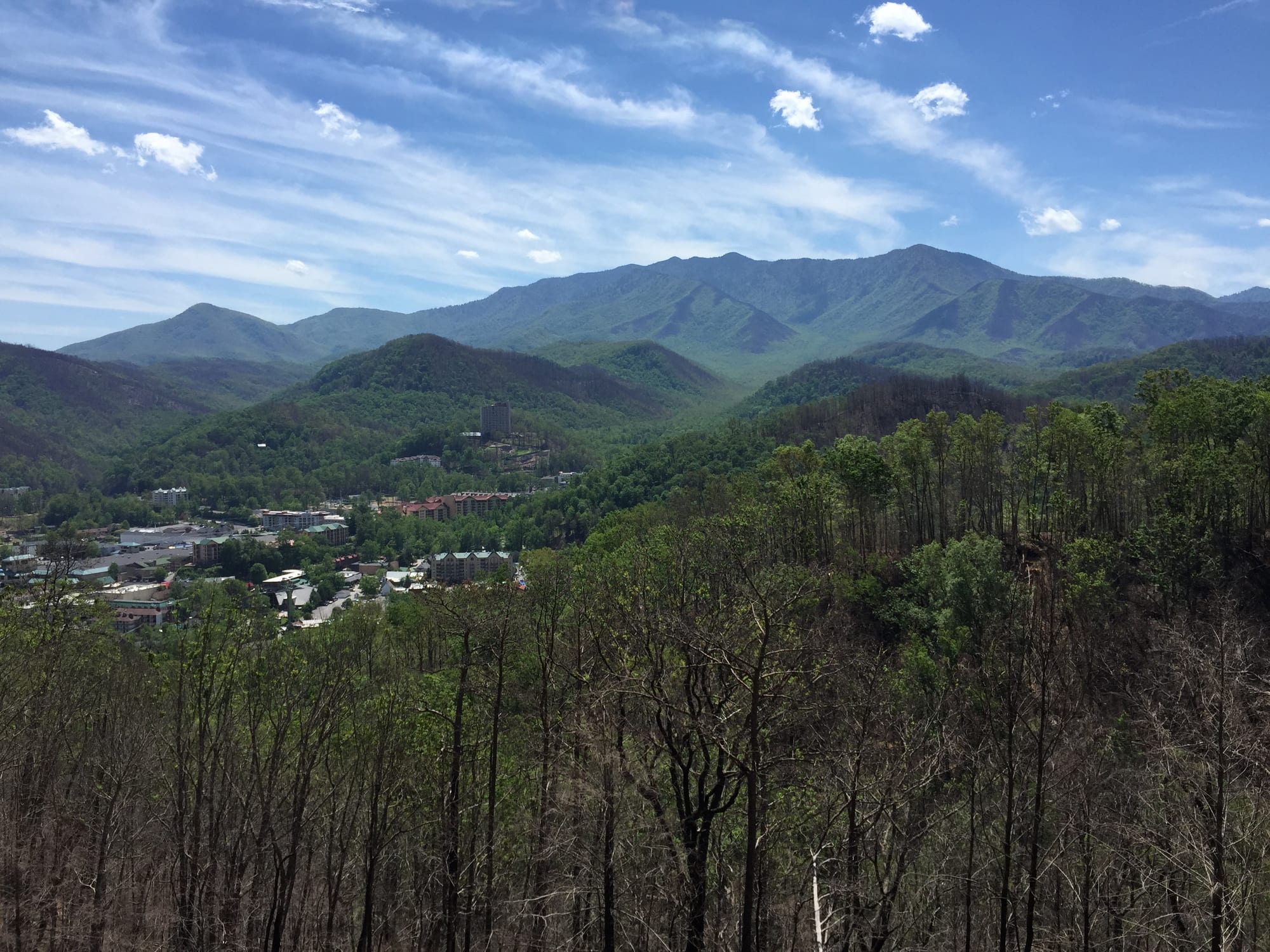
Gatlinburg's buildings in a wooded valley below the long green ridge of Mount Le Conte under a blue sky

The South, United States

Gatlinburg

Western Gatlinburg and Mount Le Conte seen from the Gatlinburg Bypass in Great Smoky Mountains National Park. (Famartin / Wikimedia Commons · CC BY-SA 4.0)

A small mountain resort town in east Tennessee, squeezed into a valley on the edge of Great Smoky Mountains National Park along US 441. A pioneer settlement that grew into a tourist town once the park opened in 1934, it is now a strip of attractions, craft workshops, cabins and chairlifts, rebuilt after the deadly wildfires of 2016.

Neighbourhoods

  • Downtown and the Parkway
    • First-time visitors
    • Close to the national park
    • Family attractions

    The town centre strung along US 441, called the Parkway here, beside the West Fork of the Little Pigeon River. Shops, restaurants, the Space Needle, the aquarium and the tram to Ober Gatlinburg line the street, whose junctions are numbered on traffic lights and maps, and the park entrance is about two miles south.

    Open in Maps
  • Arts and Crafts Community
    • Arts and crafts
    • Quiet and rural

    An 8-mile loop of country roads east of the town centre where artisans work and sell in studios and galleries, in a rural Appalachian setting away from the bustle of the Parkway.

    Open in Maps

Things to do

In town

  • Gatlinburg Space Needleviewpoint

    A 407-foot observation tower of 1969, the tallest structure in town, whose open-air deck gives a 360-degree view of the Smokies.

    Open in Maps
  • Ober Gatlinburgattraction

    Tennessee's only ski area, renamed Ober Mountain by new owners in 2022 and back to Ober Gatlinburg in 2026, reached from downtown by a 2.1-mile aerial tramway, with an indoor ice rink and a wildlife encounter area.

    Open in Maps
  • Arrowmont School of Arts and Craftsattraction

    Tennessee's oldest craft school, grown from the settlement school of 1912, with galleries and the oldest buildings in town; the 2016 fire destroyed two of its dormitories.

    Open in Maps

Great Smoky Mountains National Park

  • Great Smoky Mountains National Parkpark

    A UNESCO World Heritage Site straddling the Tennessee–North Carolina line, with over 11 million visitors in 2025 the most visited national park in the United States; its busiest entrance is at Gatlinburg.

    Open in Maps
  • The Sugarlandspark

    The valley just south of town holding the park headquarters and the Sugarlands Visitor Center, named after the sugar maples the first settlers tapped for syrup.

    Open in Maps
  • Roaring Forktrail

    A mountain stream on the edge of town followed by the Roaring Fork Motor Nature Trail, through the site of a former Appalachian community, now the Roaring Fork Historic District.

    Open in Maps
  • Laurel Falls Trailtrail

    A trail up Cove Mountain past Laurel Falls, one of the most popular waterfalls in the park.

    Open in Maps
  • Mount Le Contetrail

    The 6,593-foot mountain that fills the view south of town, third highest in the park, climbed by the Alum Cave Trail and topped by the highest lodging in the eastern United States.

    Open in Maps
  • Newfound Gapviewpoint

    The 5,048-foot pass on the state line where the Appalachian Trail crosses the road and Franklin D. Roosevelt dedicated the park in 1940.

    Open in Maps

Short trips from the town

  • Dollywoodattraction

    Dolly Parton's theme park in Pigeon Forge, about six miles north, with rides, mountain crafts and music; with nearly four million guests a year it is Tennessee's biggest ticketed attraction.

    Open in Maps
  • Cades Covepark

    An isolated valley of preserved homesteads, churches and meadows full of wildlife, the single most popular destination in the park.

    Open in Maps
  • Kuwohiviewpoint

    Formerly Clingmans Dome, at 6,643 feet the highest point in the park and in Tennessee, with an observation tower reached by a half-mile path.

    Open in Maps

Seasonal events

  • Smoky Mountain WinterfestNovember to February

    The winter season of light displays across downtown, beginning with a kickoff and chili cook-off in early November.

  • Trolley Ride of LightsNovember and December

    Trolley tours of the town's Christmas light displays during Winterfest.

Eat and drink

Long-standing places and food districts in Gatlinburg. Hours, ratings and directions come from your maps app, always current.

Gatlinburg classics

  • Pancake Pantryrestaurant

    A pancake and breakfast restaurant on the Parkway.

    Open in Maps
  • Smoky Mountain Breweryrestaurant

    A brewpub on the Parkway brewing its own beer alongside pub food.

    Open in Maps
  • Moonshine distilleriesneighborhood

    Downtown distilleries where corn whiskey is made in copper stills in view of visitors, with tastings and the story of moonshining in the Smokies.

    Open in Maps

Food streets

  • The Parkwayneighborhood

    Grills, Southern kitchens, pancake houses and sweet shops line the main street from the north end of town to the park entrance.

    Open in Maps

Experience Gatlinburg

History

For centuries Cherokee hunters used the Indian Gap Trail, a footpath following the West Fork of the Little Pigeon River through the site of the town and over the crest of the Smokies; US 441 follows much the same route today. The first permanent settler was meant to be William Ogle of South Carolina, who cut logs for a cabin but died of malaria in 1803. Around 1806 his widow, Martha Huskey Ogle, crossed the mountains with her family and built the cabin, which still stands near the centre of town. The settlement became known as White Oak Flats, and in 1856 a post office opened in Radford Gatlin's store, giving it its name, although Gatlin, a Confederate sympathiser among pro-Union neighbours, was forced out in 1859.

Logging arrived around 1900, and in 1912 the Pi Beta Phi women's fraternity founded a settlement school, the root of today's Arrowmont craft school. At that time Gatlinburg was a hamlet of six houses, a blacksmith, a general store and a Baptist church. The campaign for a national park succeeded, and the park opened in 1934: some 40,000 visitors came through in its first year and 500,000 the next, and land prices later soared.

Tourism brought wealth but also urban sprawl and poorer air. In 1992 a whole downtown block burned down, and in November 2016 a wildfire that began at the Chimney Tops in the park was driven by gusts of up to 87 miles per hour into Gatlinburg, Pigeon Forge and the surrounding hills. About 14,000 people were evacuated, 14 died, and more than 2,400 structures were damaged or destroyed, although the centre of the tourist district escaped heavy damage.

Culture & Customs

Gatlinburg's culture is Appalachian craft and mountain tourism. The settlement school staff of the 1920s found a national market for local weaving and baskets, and Arrowmont still teaches ceramics, woodworking, basket weaving and other crafts, while the studios of the Arts and Crafts Community keep traditional mountain crafts alive along their country loop. The English folklorist Cecil Sharp came to the region after the First World War to collect Appalachian ballads.

Music runs through the area, from Dolly Parton's Smoky Mountain themes at Dollywood in nearby Pigeon Forge to the songwriting couple Felice and Boudleaux Bryant, writers of "Rocky Top", who lived in Gatlinburg from 1978; their house is now a museum.

The town is also known as a wedding destination, because Tennessee marriage licences are easy to obtain, and as a place for family holidays. In winter the Winterfest lights decorate downtown, with trolley tours of the displays. The convention centre hosts the Gatlinburg Regional, a week-long bridge tournament that is the largest outside the national championships in the United States. Locals' pride is bound up with the park, its history and the families — Ogles, Reagans, Ownbys — whose descendants still live in the valley.

Daily Life

Gatlinburg is a very small town: 3,577 people lived there at the 2020 census, with a median age of almost 48. Yet it receives millions of visitors, and nearly everything in the local economy depends on them — attractions, restaurants, shops, cabin rentals and the convention centre. About two-thirds of the town's housing units were counted as vacant at the census. The police department is large for a town of this size because of the number of visitors.

The town lies in a valley surrounded on all sides by high ridges, with Mount Le Conte rising to the south and the river running through the centre. Children attend Pi Beta Phi Elementary and Gatlinburg-Pittman schools in the Sevier County system. Daily rhythms follow the tourist calendar, and the town's roads and services are often pushed to the limit on peak holiday days.

The 2016 fire still shapes local life. After it the town was closed as a crime scene and held under curfew for more than a week; charges against two juveniles accused of starting the fire were dropped in 2017, and residents later sued the federal government over their losses.

Food

Gatlinburg eats like the mountain South, heartily and casually. Pancake houses are a familiar sight on the Parkway, serving breakfasts to people heading into the park. Southern staples — biscuits with gravy, grits (boiled ground corn), cornbread and fried chicken — appear on many menus in the grills and family restaurants downtown, and sweet shops and food stands fill the gaps between the attractions on the Parkway.

Moonshine is a Gatlinburg speciality. Corn whiskey was distilled illegally in the Smoky Mountains for generations; today licensed distilleries downtown run copper stills in full view of visitors and pour samples at the counter. Tennessee is also known for its whiskey, filtered through maple charcoal, and a brewpub on the Parkway makes its own beer.

Sweet tea, as everywhere in the South, is the everyday drink, and coffee comes bottomless with breakfast. The settlers of the Sugarlands, just south of town, once tapped sugar maples for syrup to sweeten their food in the days before cane sugar was easy to buy.

Planning tools

Budget

Gatlinburg's costs follow the seasons: October's autumn colour, summer holidays and the Christmas lights bring the highest rates for cabins and rooms, while midweek stays in winter and early spring are much cheaper. The national park itself charges no entrance fee, but attractions in town, Dollywood tickets and parking add up.

Daily Budget Midrange
USD 200–380 (cabin or mid-range hotel, restaurant dinners with tax and tip, one paid attraction, car and parking)
Daily Budget Shoestring
USD 80–140 (park campground or budget motel, pancakes and diner meals, the trolley and free trails)

Book October and holiday weekends well ahead; the park's trails, viewpoints and visitor centres cost nothing to enter.

Best Time to Visit

Late spring and October are the classic seasons — wildflowers and waterfalls in spring, autumn colour in October, which also brings the heaviest traffic. Summer is warm and humid in town and cooler on the high ridges, with frequent rain. Winter is quieter, with snow on the high ground, skiing at Ober Gatlinburg and the Winterfest lights.

Suggested Number of Days

Two to three days cover the town and a first taste of the national park. Four or five allow for longer hikes and the far valleys of the park, or for Pigeon Forge. Traffic on peak weekends makes everything slower, so busy seasons need more time than quiet ones.

First Visit
2–3 days
With Surroundings
4–5 days

Transportation

Most visitors drive, on US 441 from Pigeon Forge and Sevierville or US 321 from Wears Valley and Cosby, and traffic on the Parkway can crawl on busy days. The Gatlinburg Trolley, a privately funded transit system, runs several routes around town from park-and-ride lots, including free parking at the Gatlinburg Visitor Center; leaving the car there is usually easier than parking downtown.

Inside the park, roads are winding and mountain weather changes quickly; check road status before driving to the high peaks in winter.

Airport & Station Connections

The nearest airport is McGhee Tyson Airport in Alcoa, 12 miles south of Knoxville, served by several major airlines. Gatlinburg is 39 miles south-east of Knoxville by road through Sevierville and Pigeon Forge. There is no passenger railway; almost everyone arrives by car.

Walkability

The town centre is compact and easy on foot along the Parkway, with the tram, the Space Needle and most shops and restaurants within a short walk of each other. The cabins and the Arts and Crafts loop are spread over steep hillsides and need a car or the trolley, and the park's trailheads are mostly reached by road.

Safety

For most visitors the US is safe, with the main risks being petty theft and car break-ins in tourist areas of some cities, road accidents over long distances, extreme weather, and the hazards of the outdoors. Here the outdoors is the main concern: steep trails, slippery rocks by waterfalls, black bears, flash floods and fast weather changes on the ridges. In November 2016 a wildfire from the park, driven by very strong winds and drought, swept into the town; 14 people died and more than 2,400 structures were damaged or destroyed.

Never feed or approach bears, store food properly, stay on marked trails, carry water and rain gear, and follow fire and weather warnings. Check current official travel advice before travelling.

Climate

Humid subtropical in the valley, with hot, humid summers and cool, wet winters. Rain is heavy all year, peaking from May to July, and October is the driest month. The town averages about 8 inches of snow a year, while the high ridges are much colder and snowier: Newfound Gap sees snow on around 19 days a year.

Summer
warm and humid in town, with frequent showers; daytime highs on the peaks run 10–13°F below the valley, and Mount Le Conte has never recorded more than 82°F
Winter
cool and wet in town, much colder and snowier on the high peaks, where Mount Le Conte has recorded a low of −23°F

Local Customs

Gatlinburg is informal and family-oriented, and casual outdoor clothes are worn everywhere. Tipping of roughly 18–22 per cent is expected in restaurants, and sales tax is added at the till. The town is a popular place to marry, because Tennessee marriage licences are easy to obtain, and wedding chapels are a common sight.

Identification is asked for when buying alcohol (the legal age is 21). In the park, leave plants, rocks and historic buildings as they are, and keep well back from wildlife.

Common Payment Methods

The currency is the US dollar. Cards and contactless payment are accepted almost everywhere in town; some parking lots and small craft studios prefer cash, so a little is useful.