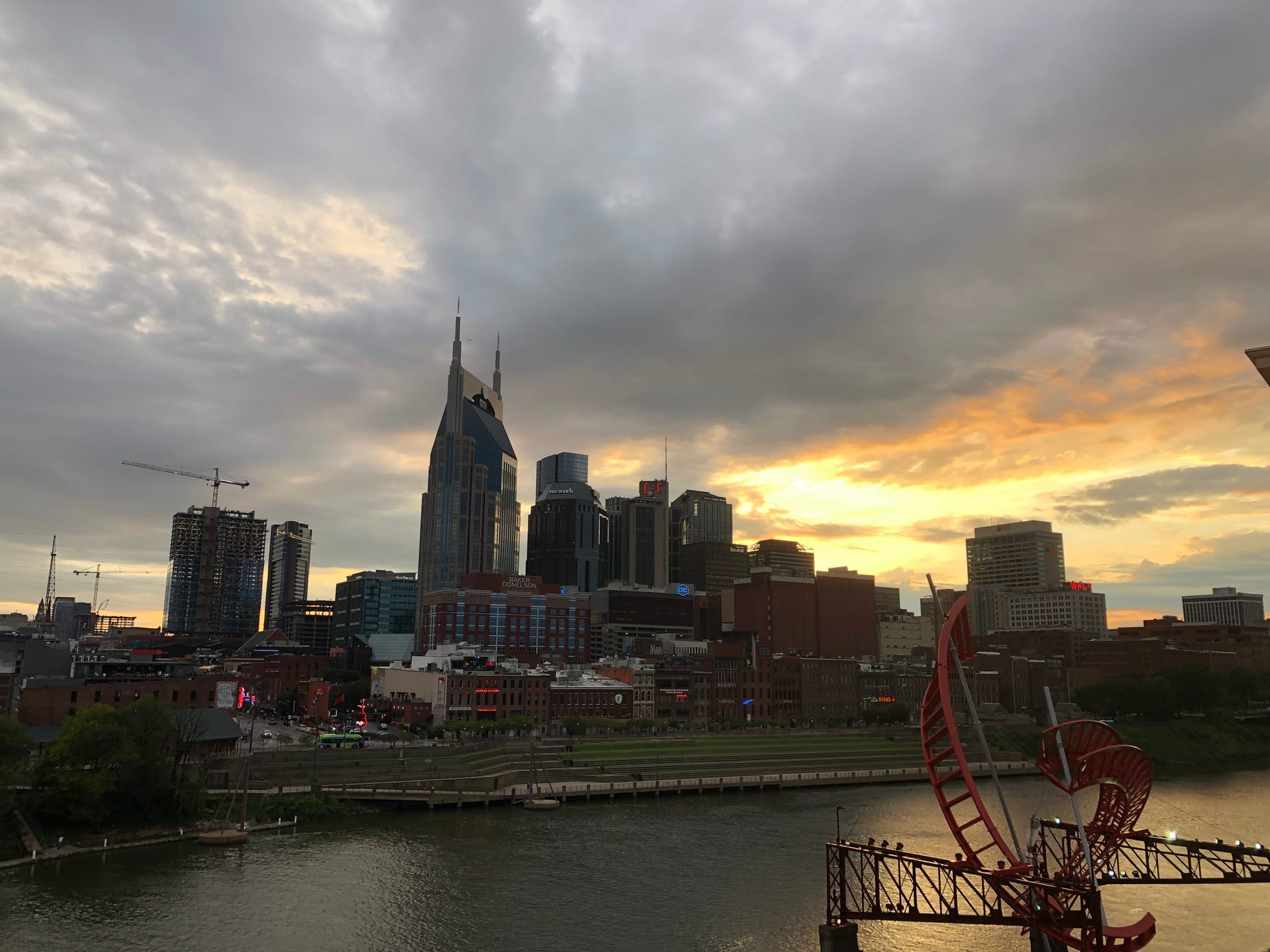
Downtown Nashville towers above the Cumberland River at sunset, with a red steel sculpture in the foreground

The South, United States

Nashville

The Nashville skyline and the Cumberland River at dusk, seen from the east bank. (MusicCityGreek / Wikimedia Commons · CC BY-SA 4.0)

Tennessee's capital and largest city, on the Cumberland River, founded as a frontier fort in 1779. Radio made it Music City: the Grand Ole Opry has broadcast country music since 1925, and the honky-tonks of Lower Broadway play live music all day. Healthcare, universities and fast growth now drive its economy.

Neighbourhoods

  • Downtown and Lower Broadway
    • First-time visitors
    • Nightlife
    • Live music

    The District — Lower Broadway, Second Avenue and Printer's Alley — is the heart of visitor Nashville, with honky-tonks playing live music from morning to late night in old brick buildings. The Ryman, the Country Music Hall of Fame, the arena and the riverfront are all within a few blocks.

    Open in Maps
  • The Gulch
    • Best for food
    • Nightlife

    A neighbourhood on the southern fringe of downtown, near the interstates, which in 2009 became the first in the American South certified as a LEED green neighbourhood, with restaurants and bars.

    Open in Maps
  • Midtown and Music Row
    • Music history
    • Students and nightlife

    South-west of downtown, Music Row's houses and studios are the business heart of country, gospel and Christian music, with RCA Studio B among them. Nearby are Vanderbilt and Belmont universities and, just west of downtown, Centennial Park and its Parthenon.

    Open in Maps
  • East Nashville
    • Local life
    • Best for food
    • Quiet and residential

    A mostly residential area across the Cumberland River from downtown, with restaurants, bars and shops along Gallatin Avenue and its other main roads; it was one of the areas hit by the March 2020 tornado.

    Open in Maps
  • Germantown
    • Best for food
    • Historic district

    A historic north Nashville neighbourhood where German immigrants began building homes in the 1840s, one of the areas hit by the March 2020 tornado, with restaurants and the Nashville Jazz Workshop.

    Open in Maps
  • Music Valley
    • Shows
    • Families

    The area around the Grand Ole Opry House, about nine miles east of downtown, on the site of the former Opryland theme park, with the Opry, a giant shopping mall and a riverboat.

    Open in Maps

Things to do

Country music landmarks

  • Ryman Auditoriumlandmark

    Opened in 1892 as the Union Gospel Tabernacle, home of the Grand Ole Opry until 1974 and still known as the Mother Church of Country Music; a concert hall of about 2,300 seats and a museum.

    Open in Maps
  • Country Music Hall of Fame and Museummuseum

    One of the world's largest museums of a single kind of music, in a downtown building opened in 2001, with the Hatch Show Print letterpress shop inside.

    Open in Maps
  • Grand Ole Opryattraction

    The live country music radio show founded in 1925 and described as the world's longest-running, broadcast several nights a week from the Grand Ole Opry House about nine miles east of downtown.

    Open in Maps
  • Lower Broadwayneighborhood

    The Honky Tonk Highway, a historic district of bars with live country music playing from day into night under neon signs.

    Open in Maps
  • RCA Studio Battraction

    The Music Row recording studio founded in 1957 by Chet Atkins and Steve Sholes for RCA Victor, now run by the Hall of Fame.

    Open in Maps
  • Bluebird Caféattraction

    A 90-seat café in Green Hills famous for acoustic songwriter performances.

    Open in Maps
  • Printer's Alleyneighborhood

    A downtown alley named for the printing houses that stood there in the early 1900s, now a small nightclub district.

    Open in Maps

Museums

  • Johnny Cash Museummuseum

    A downtown museum opened in 2013 with the world's largest collection of Johnny Cash memorabilia.

    Open in Maps
  • National Museum of African American Musicmuseum

    A museum on Broadway devoted to the musical genres created, inspired or influenced by African Americans.

    Open in Maps
  • Frist Art Museummuseum

    An art exhibition hall in the city's historic main post office building, with changing exhibitions.

    Open in Maps
  • Tennessee State Museummuseum

    A large museum of the state's history, opened in its current building in 2018 at the foot of Capitol Hill.

    Open in Maps

History and the capitol

  • Tennessee State Capitollandmark

    The seat of the state legislature and the governor's office, on the hill above downtown.

    Open in Maps
  • Bicentennial Capitol Mall State Parkpark

    A 19-acre linear park below the Capitol, treated as an extension of its grounds.

    Open in Maps
  • Fort Negleylandmark

    The largest inland fort built in the United States during the Civil War, put up by Union troops after they captured the city, about two miles south of the centre.

    Open in Maps

Parks and the river

  • The Parthenon and Centennial Parklandmark

    A full-scale replica of the Parthenon in Athens, built for the Tennessee Centennial Exposition of 1897, in a large park about two miles west of downtown.

    Open in Maps
  • John Seigenthaler Pedestrian Bridgeviewpoint

    A truss bridge of 3,150 feet across the Cumberland River, one of the longest pedestrian bridges in the world, with views of the skyline.

    Open in Maps
  • Cheekwoodpark

    A 55-acre estate on the city's western edge whose Georgian-style mansion opened as a botanical garden and art museum in 1960.

    Open in Maps
  • Radnor Lake State Natural Areapark

    A nature preserve of 1,368 acres inside the city, with about five miles of unpaved trails through the woods around the lake.

    Open in Maps

Short trips from the city

  • The Hermitagemuseum

    Andrew Jackson's plantation and home, a National Historic Landmark and museum about ten miles east of downtown.

    Open in Maps
  • Belle Meade Plantationmuseum

    A historic farm established in 1807 and run by the Harding-Jackson family for nearly a century, now a historic site and winery.

    Open in Maps
  • Franklinattraction

    A historic town about 21 miles south of Nashville, the county seat of Williamson County.

    Open in Maps

Seasonal events

  • CMA FestJune

    A four-day country music festival downtown, begun in 1972 as Fan Fair, with hundreds of artists meeting fans and performing.

  • The Opry at the Rymanwinter

    Each winter the Grand Ole Opry returns for a run of shows to the Ryman Auditorium, its home until 1974.

Eat and drink

Long-standing places and food districts in Nashville. Hours, ratings and directions come from your maps app, always current.

Nashville classics

  • Prince's Hot Chicken Shackrestaurant

    The business started in 1945 by James Thornton Prince and credited with popularising Nashville hot chicken, now in a downtown food hall.

    Open in Maps
  • Arnold's Country Kitchenrestaurant

    A meat-and-three restaurant serving Southern greens, cornbread and chess pie, which won a James Beard America's Classics award in 2009; it announced its closure in 2023, resumed lunch service in January 2024 and planned a second location in North Nashville.

    Open in Maps
  • Loveless Caferestaurant

    A restaurant in south-west Nashville near the northern end of the Natchez Trace Parkway, known for biscuits, fruit preserves, country ham and red-eye gravy.

    Open in Maps

Food districts

  • The Gulch and Germantownneighborhood

    Two neighbourhoods near downtown with many restaurants and bars.

    Open in Maps
  • East Nashvilleneighborhood

    Neighbourhood restaurants, bars and cafés along the main roads across the river from downtown.

    Open in Maps

Experience Nashville

History

Nashville began in 1779, when a party of settlers led by James Robertson and John Donelson reached the salt lick known as French Lick on the Cumberland River and built Fort Nashborough, named after the Revolutionary War general Francis Nash. About a fifth of those first settlers were of African descent, enslaved and free. The town prospered on the iron business, and in 1843 it became the permanent capital of Tennessee.

In February 1862 Nashville became the first Confederate state capital to fall to Union troops, who ringed it with forts such as Fort Negley; the Confederate attempt to retake it at the Battle of Nashville in December 1864 ended in a decisive Union victory. After the war the Fisk Jubilee Singers of Fisk University carried spirituals around the world, and the city's universities earned it the name Athens of the South, celebrated by the replica Parthenon built for the 1897 Centennial Exposition.

The Grand Ole Opry went on air in 1925, studios followed in the late 1940s, and in 1950 a radio announcer coined the name Music City. Students staged the Nashville sit-ins at downtown lunch counters in 1960. Since the 1990s the city has boomed, gaining professional football and ice hockey teams and passing Memphis as Tennessee's largest city. It has also faced the floods of May 2010, a tornado in March 2020, a vehicle bombing on Second Avenue on Christmas Day 2020, and a shooting at the Covenant School in March 2023 that killed three children and three staff.

Culture & Customs

Music defines the city. The Grand Ole Opry, the world's longest-running live radio show, still broadcasts several nights a week, and the Ryman Auditorium, its home for three decades, is known as the Mother Church of Country Music. Music Row holds the offices of many record labels and of the gospel and Contemporary Christian music industries, and songwriters gather at small venues such as the Bluebird Café to play their songs "in the round". Lower Broadway's honky-tonks keep live music going all day.

The music is wider than country. The Fisk Jubilee Singers brought spirituals to world audiences in the 19th century, historically Black Jefferson Street had its own music scene, and the National Museum of African American Music now tells that story; jazz has revived through local radio and the Nashville Jazz Workshop. In the early 20th century Vanderbilt was home to the Fugitives and the Agrarians, two influential groups of Southern writers.

The city is also home to the largest Kurdish community in the United States. Sport draws big crowds: the Tennessee Titans play American football, the Predators ice hockey and Nashville SC football.

Daily Life

Nashville had 689,447 people at the 2020 census, estimated at about 721,000 in 2025, and the metropolitan area has more than two million people. The city and Davidson County share one metropolitan government covering more than 500 square miles, from downtown towers to farmland.

Healthcare is the biggest industry: more than 300 healthcare companies are based here, among them HCA, the world's largest private hospital operator. The music industry is estimated to be worth about $10 billion a year to the area, and banking, publishing, the car industry and technology — including a large new Oracle campus — add to the mix. Vanderbilt, Belmont, Fisk, Tennessee State and other universities make the city a student town as well.

Fast growth has brought pressure. The median home price in North Nashville rose from about $100,000 in 2010 to about $530,000 in 2020, and by 2020 almost all neighbourhoods were unaffordable for Black and Hispanic families on median incomes. Traffic is a constant complaint, and in 2024 voters approved a dedicated transport tax after rejecting an earlier transit plan in 2018.

Food

Hot chicken is Nashville's signature: fried chicken coated in fiery cayenne. Prince's Hot Chicken Shack, started in 1945 by James Thornton Prince, is credited with making it famous, and it is now served across the city. Hot fish is a close cousin.

The meat-and-three is the everyday Southern lunch: a choice of one meat and three vegetable sides from a counter, with cornbread, greens and pie such as chess pie. Arnold's Country Kitchen has been called the most prominent. Barbecue is everywhere, and biscuits with fruit preserves, country ham and red-eye gravy are the speciality of the Loveless Cafe on the road out to the Natchez Trace.

The Goo Goo Cluster, a Southern candy bar, has been made in Nashville since 1912. Alongside the new restaurants, hot chicken, hot fish, barbecue and the meat-and-three remain the most popular kinds of local cooking, served everywhere from roadside shacks to downtown food halls. The Gulch, Germantown and East Nashville have many restaurants and bars.

Planning tools

Budget

Nashville has grown expensive. Downtown hotels are dear, especially at weekends and during big events such as CMA Fest and football games, and many visitors stay out by the airport or in the suburbs. Live music on Lower Broadway is the city's great draw, though drinks and tips for the bands add up.

Daily Budget Midrange
USD 230–450 (downtown or Midtown hotel, dinners with tax and tip, an Opry or Ryman ticket, ride-hailing)
Daily Budget Shoestring
USD 100–170 (hostel bed or motel outside downtown, hot chicken and meat-and-three lunches, buses)

Come midweek for much lower hotel rates, and book Opry and Ryman tickets well before a weekend visit.

Best Time to Visit

Spring and autumn are the most comfortable seasons, though both can bring severe thunderstorms and occasionally tornadoes. Summer is hot and humid, with CMA Fest in June filling the city. Winters are generally cool, with occasional cold snaps, and bring the Opry's annual run at the Ryman.

Suggested Number of Days

Two or three days suit most first visits, with evenings given to live music. Allow four or five to add the plantations, parks and small towns around the city. Weekend crowds and concert dates matter more than distances.

First Visit
2–3 days
With Surroundings
4–5 days

Transportation

Nashville is spread over more than 500 square miles and built for the car. WeGo Public Transit runs the buses and the WeGo Star commuter train east to Lebanon; a transit funding plan approved by voters in 2024 is meant to improve service. Most visitors use ride-hailing, taxis or a hire car beyond downtown, Midtown and East Nashville.

Traffic on the interstates is heavy at rush hours and parking downtown is expensive — stay central and walk or use ride-hailing at night.

Airport & Station Connections

Nashville International Airport, originally Berry Field, is in the south-eastern part of the city, a short drive from downtown by taxi, ride-hailing or bus. Interstates 40, 65 and 24 meet around downtown, and intercity buses serve the city.

Walkability

Downtown, the riverfront, Lower Broadway and the Gulch are walkable, and the pedestrian bridge leads across the river to East Nashville. Beyond them, neighbourhoods are spread out along busy roads with patchy pavements, and summer heat makes long walks tiring.

Safety

For most visitors the US is safe, with the main risks being petty theft and car break-ins in tourist areas of some cities, road accidents over long distances, extreme weather, and the hazards of the outdoors. Nashville's homicides and robberies fell to their lowest levels in years in 2025. Lower Broadway is crowded and lively late into the night, with the usual risks of drunken crowds and bag theft. Severe spring storms, tornadoes and flash floods are the main natural hazards.

Keep an eye on drinks and belongings on Broadway, use ride-hailing late at night, and take tornado warnings seriously. Check current official travel advice before travelling.

Climate

A humid subtropical climate with hot, humid summers and generally cool winters. Spring and autumn bring severe thunderstorms that can produce tornadoes, hail and flash floods. The city centre is noticeably warmer than the countryside on clear nights.

Summer
hot and humid; the record high is 109°F, set in June 2012
Winter
generally cool, with occasional hard freezes; the record low is −17°F, set in January 1985

Local Customs

Tipping of roughly 18–22 per cent in restaurants is expected, and the bands in the honky-tonks play for tips . Southern courtesy — 'sir', 'ma'am' and small talk — is the norm.

Tip the musicians if staying for a set, and keep quiet during songwriter rounds, where the songs are the point.

Common Payment Methods

The currency is the US dollar. Cards and contactless payment are accepted almost everywhere; small bills are useful for tipping bands and bar staff.