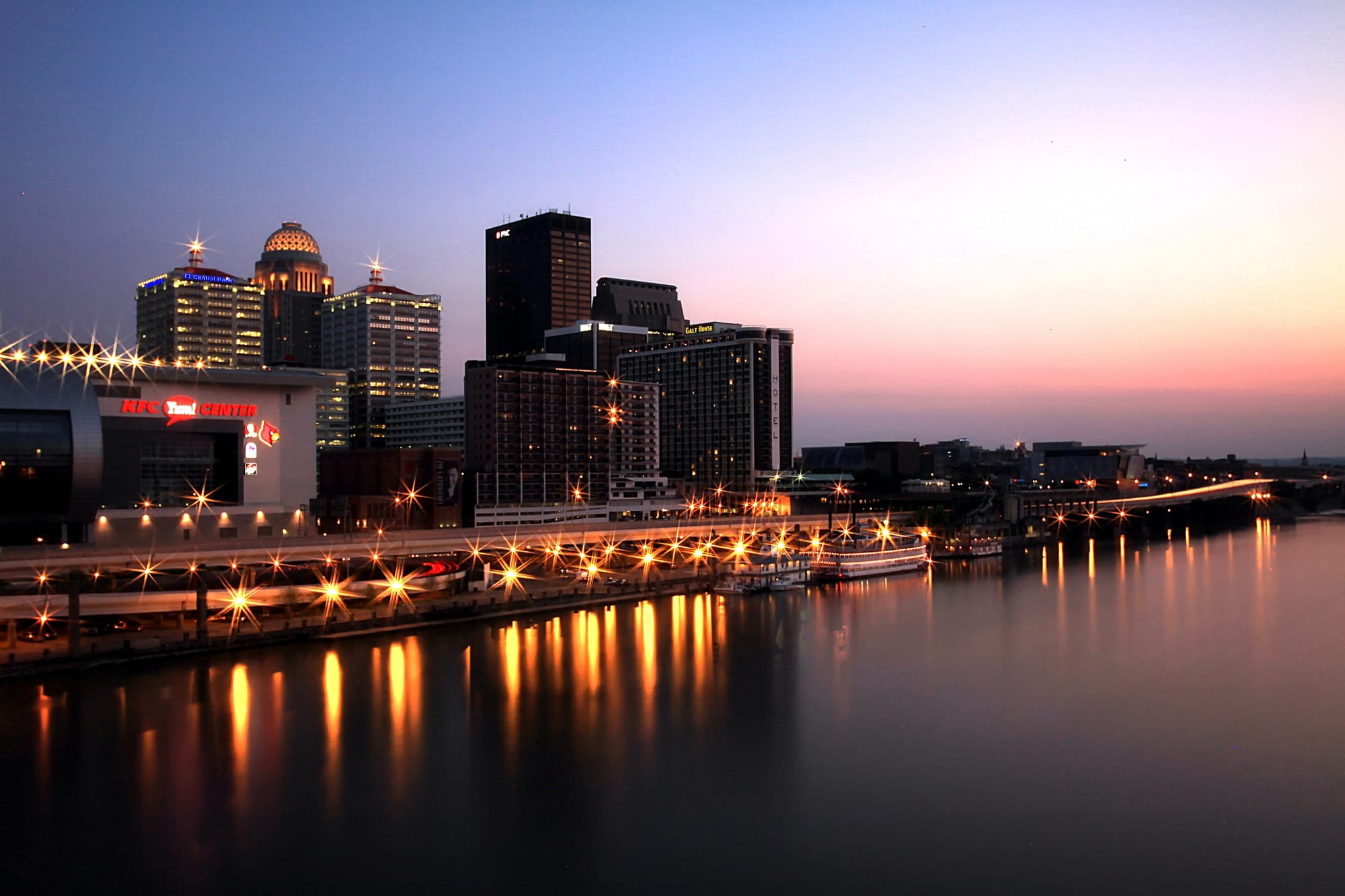
Downtown Louisville's lit towers and the riverside arena reflected in the calm Ohio River at dusk, with a paddle steamer moored at the wharf

The South, United States

Louisville

The downtown Louisville skyline and the Ohio River wharf at dusk. (Scott Oves / Wikimedia Commons · CC BY 2.0)

Kentucky's largest city, founded in 1778 at the Falls of the Ohio and grown rich on river trade and whiskey. It is the home of the Kentucky Derby, the Louisville Slugger bat and Muhammad Ali, and the gateway to bourbon country. Today a merged city-county of about 630,000 people, it mixes a riverfront downtown of cast-iron warehouses and distilleries with Victorian Old Louisville and lively neighbourhoods of bars and restaurants.

Neighbourhoods

  • Downtown and Whiskey Row
    • First-time visitors
    • Bourbon
    • Close to public transport

    The grid between the river and Broadway, with Main Street's cast-iron facades, the Slugger factory, the Ali Center, several urban distilleries and the arena along the waterfront. Fourth Street has the bars and the big hotels, and Waterfront Park and the Big Four Bridge are a short walk.

    Open in Maps
  • NuLu
    • Best for food
    • Shopping
    • Design and galleries

    The East Market district just east of downtown, where old warehouses and shopfronts have become restaurants, cocktail bars, galleries and boutiques. Walkable, busy in the evening and the city's most-talked-about dining strip.

    Open in Maps
  • Old Louisville
    • Historic district
    • Architecture
    • Quiet and residential

    South of Broadway, one of the largest Victorian neighbourhoods in the United States — block after block of brick and stone mansions from the 1880s and 1890s around St James Court and Central Park, with the University of Louisville at its southern end. Residential and leafy, with a few inns and cafés.

    Open in Maps
  • The Highlands
    • Nightlife
    • Best for food
    • Bars

    A long strip of bars, restaurants, record shops and vintage stores along Bardstown Road and Baxter Avenue, east of downtown, with Cherokee Park at the top and Cave Hill Cemetery beside it. Louisville's traditional night-out district, backed by streets of early 20th-century houses.

    Open in Maps
  • Germantown and Schnitzelburg
    • Bars
    • Local life
    • Budget stays

    A working-class district about three miles south-east of downtown, settled by German immigrants from the 1870s, where corner taverns and newer breweries, coffee shops and restaurants share the same blocks, with the city's largest collection of shotgun houses, built in the 1890s.

    Open in Maps
  • Butchertown
    • Best for food
    • Football
    • Close to the river

    The old meat-packing district along Beargrass Creek between downtown and the river, where the Louisville City football stadium, the Thomas Edison House and a cluster of restaurants and distilleries sit among 19th-century cottages. Still partly industrial.

    Open in Maps
  • Crescent Hill and Clifton
    • Cafés
    • Quiet and residential
    • Families

    Frankfort Avenue, running east from downtown along the old railway, is a mile of coffee shops, restaurants, ice cream and small shops between two settled neighbourhoods of bungalows and Victorian houses, with the Crescent Hill reservoir and a view back to the city.

    Open in Maps

Things to do

Famous landmarks

  • Churchill Downslandmark

    The racecourse with the Twin Spires that has run the Kentucky Derby every year since 1875, with spring and autumn meetings and the Kentucky Derby Museum beside the track.

    Open in Maps
  • Louisville Slugger Museum & Factorymuseum

    The working bat factory on Main Street, marked by a 120-foot bat listed by Guinness as the world's largest, with tours that show how the Louisville Slugger has been made since the 1880s.

    Open in Maps
  • Big Four Bridgelandmark

    A 19th-century railway bridge over the Ohio turned into a pedestrian and cycle path in 2013, linking Waterfront Park with Jeffersonville, Indiana.

    Open in Maps
  • Belle of Louisvillelandmark

    A steam-powered paddlewheeler built in 1914 as the Idlewild, owned by the city and running cruises from the downtown wharf, and a contender in the Derby Festival's Great Steamboat Race.

    Open in Maps
  • Cave Hill Cemeterylandmark

    A Victorian garden cemetery and arboretum on the edge of the Highlands, where Muhammad Ali and Colonel Harland Sanders are buried.

    Open in Maps
  • Louisville Palacelandmark

    A Spanish Baroque theatre of 1928 by John Eberson on Fourth Street, now a music venue, with a vaulted ceiling of sculpted faces and an auditorium ceiling painted as a night sky.

    Open in Maps

Museums

  • Muhammad Ali Centermuseum

    A museum and cultural centre on the riverfront devoted to the boxer's life and principles, opened in 2005 in the city where he was born and raised.

    Open in Maps
  • Speed Art Museummuseum

    Kentucky's oldest and largest art museum, beside the University of Louisville campus, with European, American and contemporary collections in a 1927 building and a modern wing added in 2016.

    Open in Maps
  • Frazier History Museummuseum

    A history museum on Main Street that serves as the official starting point of the Kentucky Bourbon Trail, with exhibits on the state and on bourbon.

    Open in Maps
  • Kentucky Science Centermuseum

    A hands-on science museum in an 1878 cast-iron-fronted warehouse on Main Street, with a four-storey digital theatre and a children's area.

    Open in Maps
  • Kentucky Derby Museummuseum

    A museum at Churchill Downs on the race and the horses, with a film of the Derby on a wrap-around screen and tours of the track.

    Open in Maps
  • Locust Grovemuseum

    A Georgian brick house of about 1790 on the east side, the last home of the city's founder George Rogers Clark, shown with its outbuildings and grounds.

    Open in Maps

Distilleries

  • Evan Williams Bourbon Experienceattraction

    A distillery attraction on Main Street's Whiskey Row, part of the Kentucky Bourbon Trail, telling the story of the 18th-century distiller whose name is on the brand.

    Open in Maps
  • Old Forester Distilling Co.attraction

    Brown-Forman's Louisville distillery for Old Forester, described as the first bottled bourbon, from a company that was among the whiskey firms of Main Street's Whiskey Row.

    Open in Maps
  • Stitzel-Weller Distilleryattraction

    A historic distillery in Shively, south-west of downtown, opened on Derby Day 1935 and built by Julian 'Pappy' Van Winkle and partners, closed as a distillery in 1992 and since 2014 a visitor site for the Bulleit brand.

    Open in Maps

Parks and the river

  • Waterfront Parkpark

    An 85-acre park on the Ohio built on former industrial land, with lawns, a playground, the Big Four Bridge ramp and the city's largest outdoor events.

    Open in Maps
  • Cherokee Parkpark

    A Frederick Law Olmsted park of 1891 in the Highlands, with a 2.4-mile scenic loop, woods and meadows along Beargrass Creek.

    Open in Maps
  • Iroquois Parkpark

    Another Olmsted park, on a wooded knob in the south of the city with a summit overlook of the skyline and an outdoor amphitheatre.

    Open in Maps
  • Louisville Mega Cavernattraction

    A former limestone mine beneath the south of the city, classed as Kentucky's largest building, with underground zip lines, a ropes course and tram tours.

    Open in Maps
  • Louisville Zooattraction

    The state zoo of Kentucky, with gorillas, polar bears and a well-known Islands exhibit, in the south-east of the city.

    Open in Maps

Short trips from the city

  • Falls of the Ohio State Parkpark

    Across the river in Clarksville, Indiana, exposed Devonian fossil beds, some 380 to 387 million years old, with an interpretive centre and a view back to the skyline.

    Open in Maps
  • Bernheim Arboretum and Research Forestpark

    A 16,000-acre forest and arboretum at Clermont, about 25 miles south of the city, with more than 40 miles of trails, four lakes and three giant recycled-wood sculptures by Thomas Dambo.

    Open in Maps
  • Jim Beam American Stillhouseattraction

    The Clermont distillery of one of the world's best-selling bourbon brands; production is paused for 2026, but the visitor centre stays open.

    Open in Maps
  • Bardstownattraction

    The trademarked 'Bourbon Capital of the World', about 35 miles south-east, with several distilleries, the Oscar Getz Museum of Whiskey and a historic district.

    Open in Maps

Seasonal events

  • Kentucky Derbyfirst Saturday in May

    The oldest continuously held major sporting event in the United States, two minutes of racing preceded by a fortnight of parties, hats and mint juleps.

  • Kentucky Derby Festivalmid-April to early May

    Two weeks of events across the city leading up to the race, including the Great Balloon Race, a marathon, a steamboat race and the Pegasus Parade.

  • Thunder Over LouisvilleApril

    The festival's opening event — an air show over the Ohio followed by one of the largest annual fireworks displays in North America.

  • Kentucky State FairAugust

    Eleven days of livestock, concerts, rides and fried food at the Kentucky Exposition Center near the airport.

  • Bourbon & BeyondSeptember

    A festival billed as the world's largest bourbon, food and music festival, held at the Highland Festival Grounds at the Kentucky Exposition Center.

  • St. James Court Art Showearly October

    A free outdoor arts and crafts show with more than 700 artisans, held on the Victorian streets of Old Louisville since 1957.

Eat and drink

Long-standing places and food districts in Louisville. Hours, ratings and directions come from your maps app, always current.

Louisville classics

  • Whiskey Row and Main Streetneighborhood

    The downtown blocks of bourbon bars, distillery tasting rooms and restaurants behind the cast-iron facades, where the Old Fashioned, the city's official cocktail, and the mint julep are poured.

    Open in Maps
  • NuLuneighborhood

    East Market Street's run of chef-led restaurants, cocktail bars, a bakery, an ice cream shop and coffee roasters, the centre of the city's newer food scene.

    Open in Maps

Food districts and markets

  • Bardstown Road in the Highlandsneighborhood

    The longest run of independent restaurants, pubs, pizza places, Vietnamese and Mexican kitchens and late-night bars in the city.

    Open in Maps
  • Frankfort Avenueneighborhood

    A gentler mile of neighbourhood restaurants, bakeries, coffee shops and an old-fashioned ice cream parlour through Clifton and Crescent Hill.

    Open in Maps
  • Logan Street Marketmarket

    The city's first year-round indoor market, opened in Shelby Park in 2019, with food vendors, a coffee bar, a brewery and a farmers' market.

    Open in Maps

Experience Louisville

History

Louisville exists because of the Falls of the Ohio, the only major obstruction to river traffic between the upper Ohio and the Gulf of Mexico. Boats had to unload and portage around the rapids, and in 1778 George Rogers Clark landed a party of settlers on Corn Island at the falls as a base for his campaign against the British in the Illinois country. The town that followed was chartered in 1780 and named for Louis XVI of France, America's ally in the revolution; its early residents lived in forts against raids by the region's Native peoples until the late 1780s.

The portage made the town. Warehouses, taverns and shipping agents grew up at the falls, and the opening of the Louisville and Portland Canal in 1830 let steamboats pass while keeping the trade in the city. By the 1850s Louisville was a major river port and the home of a growing German and Irish population. Kentucky stayed in the Union in the Civil War, and the city became a supply base for Union armies, then grew rich afterwards as the gateway between the Northern industry and the defeated South. The Louisville and Nashville Railroad, the whiskey trade on Main Street, the bat factory of Hillerich & Bradsby and the Kentucky Derby, first run in 1875, all date from this boom.

The 20th century brought the great flood of 1937, which put most of the city under water, wartime industry, the birth of Cassius Clay in 1942, suburban flight and a long decline of downtown. In 2003 the city and Jefferson County merged into Louisville Metro, making it at a stroke one of the larger cities in the country. Since then the riverfront, Main Street and the old neighbourhoods have been revived, and bourbon tourism has become a second economy.

Culture & Customs

The Derby defines the city's year. For two weeks before the first Saturday in May the whole of Louisville is in festival: fireworks over the river, a balloon race, a marathon, a steamboat race and a parade, ending with the race itself and its rituals of hats, roses and mint juleps. Churchill Downs races through spring and autumn, and horses, breeding and betting are everyday talk in a city on the edge of the Bluegrass.

Bourbon is the other identity. The state's whiskey industry was run from Louisville's Main Street in the 19th century, and the distilleries' return downtown over the past decade has given the city a tasting room on nearly every block, a cocktail culture built on the Old Fashioned and a steady stream of visiting enthusiasts. Muhammad Ali, born and raised here, is its most famous son, and the Ali Center on the river sets out his six core principles. Louisville also produced the critic Hunter S. Thompson, actress Jennifer Lawrence and a long line of jazz, bluegrass and indie musicians, and its theatres, orchestra and an active gallery scene outlast most cities of its size.

Louisville calls itself a Southern city with a Midwestern accent, and it has a reputation as Kentucky's quirkiest city — "Keep Louisville Weird" is a slogan on bumper stickers — with a large Catholic population from its German and Irish past, a strong Black community whose heart is the West End, and newer Cuban and Somali communities. People are friendly, direct and fond of the city's porches, parks and pubs.

Daily Life

About 630,000 people live in the merged city-county and about 1.4 million in the metropolitan area, which spills across the river into southern Indiana. The economy is diverse: UPS runs its Worldport global air hub at the airport, Ford has two major plants, GE Appliances has its headquarters and a major factory here, and health care, Humana's insurance headquarters, the University of Louisville and the bourbon industry provide much of the rest.

The city is sharply divided by Ninth Street, which separates the prosperous downtown and the eastern neighbourhoods from the largely Black West End, where investment has lagged for decades. The 2020 killing of Breonna Taylor by police and the protests that followed brought that divide to national attention and remain part of civic life. Housing is still affordable by national standards, though rents in the Highlands, NuLu and Germantown have risen.

Daily life runs on the car outside the centre, with TARC buses serving the main corridors. People live in bungalows and shotgun houses in the inner neighbourhoods, in Victorian mansions divided into flats in Old Louisville and in sprawling eastern suburbs around Middletown and the Gene Snyder Freeway. Weekends mean the Olmsted parks, the riverfront, youth football and basketball, church, and the porch. Spring allergies, summer humidity and the long-running debate over how to revive the West End and downtown's empty office space are the local constants.

Food

The Hot Brown is the city's dish: an open-faced sandwich of sliced turkey on toast, covered in a cheesy Mornay sauce, topped with bacon and tomato and grilled until it browns, created in 1926 by the chef Fred K. Schmidt in downtown Louisville. Benedictine, a pale green spread of cucumber and cream cheese created by the caterer Jennie Benedict around 1900, appears in tea sandwiches and dips. Derby pie, a chocolate and walnut pie, is a name trademarked since 1968 by the Kern family's firm; bourbon balls, the Modjeska — a caramel-wrapped marshmallow candy named after a Polish actress — and bourbon-laced cakes fill the confectioners. Burgoo, a thick stew of several meats and vegetables cooked for hours, is the Kentucky dish of fairs and church suppers.

Bourbon is drunk neat, in an Old Fashioned, which legend credits to Louisville's Pendennis Club, and in the mint julep, the Derby's crushed-ice cocktail of bourbon, sugar and mint, traditionally served in a pewter cup. The downtown distilleries, the bars of Whiskey Row and the Urban Bourbon Trail of cocktail bars make it hard to avoid. Fried chicken is Kentucky's export, and the Colonel is buried in the city.

Everyday eating is broad. The Highlands has Vietnamese, Mexican, pizza and pub food; Germantown has corner taverns with fish sandwiches and newer breweries; NuLu has the chef-led restaurants; and the city's Cuban and Somali communities add their own cooking. Farmers' markets run through the warm months, and the public market in Shelby Park gathers food stalls under one roof.

Planning tools

Budget

Louisville is one of the cheaper large cities in the eastern United States for food, drink and hotels — with one enormous exception. During Derby week in late April and early May room rates multiply several times over and sell out far ahead; Thunder Over Louisville and the autumn festivals push prices up too. Distillery tours and museum tickets are the main daily extras.

Daily Budget Midrange
USD 200–380 (downtown or Highlands hotel, restaurant dinners, a distillery tour and a museum, ride-hailing or a rental car)
Daily Budget Shoestring
USD 80–140 (hostel or budget motel, tacos and Hot Browns at the counter, TARC buses, free parks and the Big Four Bridge)

Avoid Derby week unless the race is the reason for the trip; the rest of May and September to October offer the same city at a fraction of the price, and many downtown distilleries can be reached on foot.

Best Time to Visit

April to early June and September to October. Spring brings racing at Churchill Downs, the Derby Festival and dogwood blossom in the parks; autumn has the second race meeting, bourbon-release season, music festivals and colour in Cherokee Park. Summer is hot and humid with the State Fair in August. Winter is grey and occasionally snowy, but cheap, with the distilleries and museums open year-round.

Suggested Number of Days

Two or three days cover the city's main districts, a museum or two and a downtown distillery. Add two more for the distilleries, small towns and countryside of bourbon country to the south and east, which need a car or a tour.

First Visit
2–3 days
With Surroundings
4–5 days

Transportation

TARC buses are the main public transport, with routes along Fourth Street, Bardstown Road and Frankfort Avenue. Downtown, NuLu, Butchertown and Waterfront Park are walkable together, and ride-hailing is cheap and plentiful. A car is useful for the parks, Churchill Downs and anything outside the Watterson Expressway, and essential for the bourbon trail unless a tour company does the driving. The Riverwalk section of the Louisville Loop trail serves the riverfront.

Interstates 64, 65 and 71 meet in a knot of junctions downtown that confuses drivers; allow extra time around Spaghetti Junction and in the afternoon rush.

Airport & Station Connections

Louisville Muhammad Ali International Airport is about seven miles south of downtown, next to the fairgrounds — roughly 15 minutes by taxi or ride-hailing, with direct flights to many US cities. There is no passenger rail service. Intercity buses connect to Cincinnati, Nashville and Indianapolis, each about two to three hours' drive, and Chicago is about five hours by road.

Walkability

Downtown is flat and compact: Main Street, the waterfront, the Slugger factory, the Ali Center and the distilleries are all within about a mile, and NuLu and Butchertown continue the walk east. The Highlands, Germantown and Frankfort Avenue are each walkable along their main street, but the city as a whole is spread out, with wide roads and gaps between its districts, and Old Louisville's long blocks feel empty at night. Summer humidity makes long walks hard work.

Safety

Louisville's violent crime rate is above the national average and concentrated in parts of the west and south of the city that visitors rarely go to. Downtown, the Highlands, NuLu and the parks are busy and generally safe, with the usual big-city care about cars, phones and late-night streets. Spring storms and summer heat are the natural hazards, and the Ohio floods in wet years.

Keep to lit, busy streets late at night, use ride-hailing rather than walking long distances after dark, and keep valuables out of sight in parked cars. Check current official travel advice before travelling.

Climate

Humid subtropical, with hot, sticky summers, mild springs and autumns and changeable winters. The Ohio Valley traps humidity and pollen, and thunderstorms are frequent from spring to early summer.

Summer
Hot and humid, with highs in the upper 80s °F and regular storms from June to August; the heat often lingers into September.
Winter
Cool to cold, with highs in the low 40s °F and lows in the 20s °F from December to February; snow falls several times a winter and ice storms occasionally shut the city.

Local Customs

Louisville sits on the line between the South and the Midwest and shows both — Southern hospitality and bourbon with a Midwestern straightforwardness. The city is proud of Muhammad Ali, the Derby and its own oddities, and locals disagree cheerfully about how to say its name (something close to "LOO-uh-vul"). University of Louisville basketball, Kentucky basketball and Louisville City football stir strong loyalties.

Tip 18–20 percent in restaurants and bars and a dollar or two a drink. Dress is casual except at Derby parties, where hats and suits are the point. Kentucky's drinking age is 21, and bourbon is poured generously; have a plan for getting home. Photography is welcome at the distilleries and the track, and the cemetery asks for quiet around funerals.

Common Payment Methods

The US dollar. Cards and contactless payment are accepted almost everywhere, including at the track. ATMs are in banks, pharmacies and supermarkets. Cash is useful for tips, the farmers' markets and some small bars in Germantown.