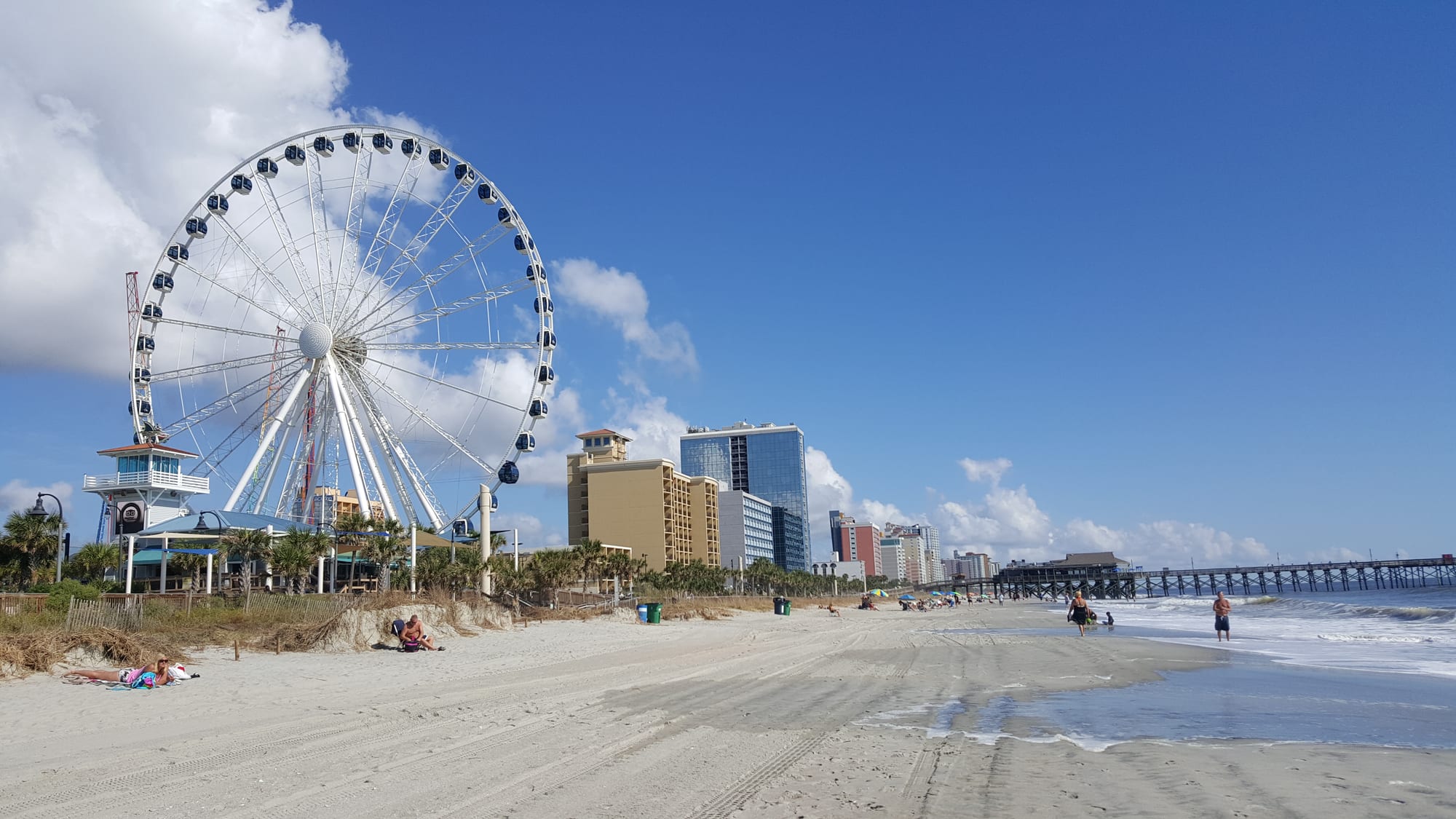
The white SkyWheel observation wheel and hotel towers beside the wide Myrtle Beach sand, with a fishing pier reaching into the sea

The South, United States

Myrtle Beach

The SkyWheel, the Boardwalk hotels and a fishing pier seen from the beach at Myrtle Beach. (The ed17 / Wikimedia Commons · CC BY-SA 4.0)

The centre of South Carolina's Grand Strand, more than 60 miles of beach from Little River to Winyah Bay. Laid out in 1900 by the timber company that owned the land, it grew from a railway resort into one of the East Coast's biggest holiday cities: a boardwalk with an observation wheel, amusement parks, dinner theatres, about ninety golf courses and a high-rise strip of hotels along the sand, with a small year-round city behind it.

Neighbourhoods

  • The Boardwalk and Ocean Boulevard
    • First-time visitors
    • Nightlife
    • Families

    The old heart of the resort, where the Pavilion once stood — a promenade of about a mile along the ocean with the SkyWheel, arcades, bars, souvenir shops and the piers, and Ocean Boulevard's high-rise hotels and motels running north and south from it. Loud, cheerful and walkable.

    Open in Maps
  • Broadway at the Beach and the attractions district
    • Families
    • Theme parks
    • Shopping

    Inland along the bypass, the city's purpose-built entertainment zone around a lake — an aquarium, a wax museum, mini-golf, restaurants, nightclubs and shops — with the baseball park, the convention centre and more amusement parks around it. Needs a car.

    Open in Maps
  • The Market Common
    • Best for food
    • Quiet and residential
    • Shopping

    A planned district of shops, restaurants, houses and flats that opened in 2008 on the former air force base at the south end, with parks and a calmer feel than the beachfront.

    Open in Maps
  • The north end and Kings Highway
    • Golf
    • Quiet and residential
    • Best for food

    North of the Boardwalk the strip continues along Kings Highway past golf communities, resorts and restaurants, with the Carolina Opry near its northern end, before North Myrtle Beach begins.

    Open in Maps
  • The south end and Surfside
    • Beaches
    • Families
    • Budget stays

    Beyond the state park's woods and pier the beach continues through Surfside Beach and Garden City, low-rise family towns of rental houses, campgrounds and fishing piers that are quieter and cheaper than the city itself.

    Open in Maps

Things to do

The beachfront

  • Myrtle Beach Boardwalklandmark

    The oceanfront promenade opened in 2010 between the two downtown piers, with arcades, bars and an open-air stage, and the city's main place for an evening stroll.

    Open in Maps
  • SkyWheellandmark

    A 187-foot observation wheel with 42 enclosed glass gondolas, opened on the Boardwalk in 2011.

    Open in Maps
  • Family Kingdom Amusement Parkattraction

    A seaside amusement park on Ocean Boulevard with the Swamp Fox wooden roller coaster and a Ferris wheel.

    Open in Maps
  • Myrtle Beach State Parkpark

    The first state park in South Carolina, opened in 1936 at the south end of the city, with a mile of beach backed by maritime forest, a fishing pier, campsites and nature trails.

    Open in Maps

Family attractions

  • Ripley's Aquarium of Myrtle Beachattraction

    An aquarium at Broadway at the Beach with sharks, stingrays and a ray touch tank.

    Open in Maps
  • Broadway at the Beachattraction

    A 350-acre complex of shops, restaurants, nightclubs, mini-golf and attractions around a lake, opened in 1995 and the city's busiest evening destination away from the sand.

    Open in Maps
  • Hollywood Wax Museumattraction

    A wax museum of film and television celebrities, one of the attractions of Broadway at the Beach.

    Open in Maps

Shows and sport

  • The Carolina Opryattraction

    A 2,200-seat theatre at the north end staging a country, comedy and variety show that has run since 1986.

    Open in Maps
  • Pelicans Ballparkattraction

    The home of the Myrtle Beach Pelicans, a minor-league affiliate of the Chicago Cubs, with cheap summer evening games beside Broadway at the Beach.

    Open in Maps
  • Myrtle Beach Convention Centerattraction

    The city's convention and sports hall, which hosts concerts, conventions and sporting events.

    Open in Maps

Short trips along the Strand

  • Brookgreen Gardenspark

    A 9,100-acre sculpture garden and nature preserve on four former rice plantations at Murrells Inlet, founded by Archer and Anna Hyatt Huntington, with the world's largest outdoor collection of figurative sculpture by American artists.

    Open in Maps
  • Huntington Beach State Parkpark

    A coastal park with a large, quiet sandy beach, a causeway across the salt marsh where many wild birds can be seen, and Atalaya, the Spanish-style winter home of the Huntingtons, who founded the neighbouring Brookgreen Gardens.

    Open in Maps
  • Murrells Inletattraction

    A former fishing village about 16 miles south, known for its seafood restaurants and its half-mile MarshWalk, a boardwalk overlooking the salt marsh.

    Open in Maps
  • Pawleys Islandbeach

    A narrow old barrier island about 25 miles south, one of the oldest resort areas on the East Coast, a resort since the early 1700s, with cottages and a tidal creek and marsh behind it.

    Open in Maps
  • Barefoot Landingattraction

    A waterfront shopping and entertainment village on the Intracoastal Waterway in North Myrtle Beach, with a concert hall, restaurants and a theatre.

    Open in Maps
  • Conwayattraction

    The Horry County seat about 12 miles inland on the Waccamaw River, with a riverwalk of restaurants and a revitalised downtown of shops.

    Open in Maps
  • Georgetownattraction

    The state's third-oldest city, about 35 miles south, with a historic district on its original grid and a rice museum from its days as the centre of a rice-growing area.

    Open in Maps

Seasonal events

  • Carolina Country Music FestJune

    A large open-air country music festival on the beachfront at the former Pavilion site, held since 2015.

  • Myrtle Beach Bike WeekMay

    A spring motorcycle rally that fills the Grand Strand's roads and bars with riders, followed on Memorial Day weekend by the Atlantic Beach Bikefest.

  • Society of Stranders shag eventsSpring

    Dancers of the Carolina shag, South Carolina's official state dance, gather in the Ocean Drive section of North Myrtle Beach for the Society of Stranders' gathering, which grew from a small yearly meeting into a major spring event.

  • Myrtle Beach Marathonlate winter

    A flat, fast marathon and half marathon along the coast that draws runners in the cool off-season.

  • Sun Fun and summer fireworksJune to August

    Weekly summer fireworks over the Boardwalk and at Broadway at the Beach, with live music on the oceanfront stage.

Eat and drink

Long-standing places and food districts in Myrtle Beach. Hours, ratings and directions come from your maps app, always current.

Myrtle Beach classics

  • Calabash-style seafood housesneighborhood

    The Strand's signature meal is Calabash-style fried seafood, named after the North Carolina town about 25 miles away that has been known for its style of fried fish since the 1930s, and often served from a buffet.

    Open in Maps
  • Murrells Inlet MarshWalkneighborhood

    A half-mile boardwalk overlooking the salt marsh in Murrells Inlet, about 16 miles south, a former fishing village known for its seafood restaurants.

    Open in Maps

Food districts

  • Broadway at the Beachneighborhood

    More than 20 restaurants, bars and nightclubs around the lake, the easiest place to feed a family in the evening.

    Open in Maps

Experience Myrtle Beach

History

There was no town here until 1900. The land behind the beach belonged to the Burroughs & Collins timber company of Conway, which built a railway to the coast to carry timber, opened in 1900; the end of the line was nicknamed New Town. In a naming contest Franklin Burroughs's widow suggested Myrtle Beach, after the southern wax myrtle that grows locally, and in 1901 his sons opened the Seaside Inn, the first inn.

Growth was slow until the roads came. Kings Highway was paved in 1940, and a succession of pavilions became the places where crowds danced through summer nights. The town was incorporated in 1938, and an air force base south of town, opened for the Second World War, brought a permanent population. Hurricane Hazel, the worst in the city's history, struck in 1954, and the beachfront was rebuilt as the Grand Strand grew into a mass-market resort. The Carolina shag was danced to rhythm and blues in the beach clubs along the way.

Myrtle Beach became a city in 1957. The decades since have brought the golf boom, the dinner theatres and amusement parks of the 1980s and 1990s, Hurricane Hugo in 1989, the closure of the air base in 1993 and its rebuilding as the Market Common, the closure of the old Pavilion in 2006 after 58 years, and the opening of the Boardwalk in 2010 and the SkyWheel in 2011. The region is now one of the fastest-growing in the country.

Culture & Customs

Myrtle Beach is a people's resort, closer in spirit to Blackpool or the Jersey Shore than to the quiet gated islands further down the coast. Its culture is the summer culture of the Boardwalk and Ocean Boulevard — arcades, airbrushed T-shirts, beach-music bars, pancake breakfasts — and the family entertainment industry built around it: dinner theatres with pirate shows, a country-music variety show that has run for about forty years, wax museums, mini-golf courses by the dozen and a minor-league ball club.

The one art form it can claim as its own is the Carolina shag, the smooth partner dance whose name is thought to have originated at Cherry Grove Beach in the 1940s, danced in the bars and pavilions of the Carolina beaches to the rhythm and blues that became known as beach music. It is the official state dance of South Carolina, and each spring dancers gather in the Ocean Drive section of North Myrtle Beach for the Society of Stranders' gathering. Golf is the other religion: the Grand Strand has about ninety courses and has been called the golf capital of the world, and golfers from the North and from Canada fill the hotels in the shoulder seasons.

The city's visitors have always been working- and middle-class families from the Carolinas, Virginia, Ohio, Pennsylvania and Ontario, and motorcyclists in May. Manners are friendly and informal, and the city's year-round residents — many of them retirees from the North — take some pride in living in a place the rest of the country thinks of as a holiday.

Daily Life

About 35,000 people live inside the city limits, but the wider Myrtle Beach–Conway area had an estimated 479,000 people in 2024 and is among the fastest-growing in the United States, with more than 104,000 people moving in over eight years. The economy is tourism, with more than 20 million visitors a year, plus golf, real estate and the construction that serves them. Coastal Carolina University in Conway adds a student population, and the airport, the hospitals and Horry County government supply the steadier jobs.

Work is seasonal for many. Hotels, restaurants and attractions hire in spring and lay off in autumn; wages are low and housing near the beach is expensive, so many workers live inland and commute along crowded main roads. The residents live in neighbourhoods behind the strip — the Market Common's new streets, the older bungalows around the city centre, and the golf-course subdivisions to the north and west.

Daily rhythm is the visitors' rhythm: breakfast queues at the pancake houses, beach by mid-morning, attractions in the afternoon heat, buffets and shows at night. Winter is the locals' season, when the beach is empty, the golf courses are full of Canadians and the city catches its breath. The long-running local issues are traffic, the behaviour of late-night crowds on Ocean Boulevard, erosion and the regular renourishment of the beach, and the question of how much more the Strand can build.

Food

The dish that defines the Grand Strand is fried seafood in the Calabash style, named after the town of Calabash, about 25 miles away in North Carolina, which has been known for its style of fried fish since the 1930s. Calabash-style buffets are common in the coastal towns of the eastern Carolinas, and Myrtle Beach has a large number of these restaurants, where fried fish and shellfish are served in generous portions.

The local inland dish is chicken bog, Horry County's one-pot meal of chicken, smoked sausage, rice and onion cooked together until the rice is soft — a pilaf that is most popular in Horry County and has its own festival, the Loris Bog-Off. Lowcountry food reaches up the coast from Charleston: shrimp and grits, she-crab soup, oyster roasts in the cooler months and Lowcountry boil. Murrells Inlet, a former fishing village about 16 miles south, is known for its seafood restaurants and its half-mile boardwalk over the salt marsh.

Breakfast is a genre of its own, with pancake and waffle houses serving stacks with country ham, sausage gravy and grits to the holiday crowds. Barbecue comes in the South Carolina mustard-sauce style as well as the vinegar style of the eastern Carolinas, and peaches, boiled peanuts and watermelon are sold at stands along the inland roads in summer.

Planning tools

Budget

Myrtle Beach is one of the cheaper beach resorts on the East Coast, with a huge supply of hotels, motels and condominiums that keeps prices down outside the peak weeks. Rates are highest from mid-June to early August, on holiday weekends and during Bike Week; golf packages make the off-season cheap for golfers. Attractions, shows and amusement parks are the costs that add up for a family.

Daily Budget Midrange
USD 190–360 (oceanfront hotel or condo, seafood dinners, a show or attraction ticket, rental car and fuel)
Daily Budget Shoestring
USD 80–140 (motel or campsite, pancake-house breakfasts and buffet dinners, free beach and Boardwalk, a city bus)

Visit in May or September for summer weather at spring prices; buy attraction tickets in combination packages, and expect resort fees and parking charges on top of advertised room rates downtown.

Best Time to Visit

May to early June and September to October offer warm sea, open attractions and smaller crowds, with golf at its best in spring and autumn. Summer is the full resort season — hot, humid, crowded and busiest in July. Winter is mild and very quiet; many attractions keep shorter hours, but golfers and long-stay retirees fill the hotels at low rates. Hurricane season runs from June to November.

Suggested Number of Days

A long weekend covers the beach, the Boardwalk and a show or an amusement park. Families and golfers usually take a week, which allows beach days alongside the gardens, state parks and fishing villages further down the Strand.

First Visit
3–4 days
With Surroundings
7 days

Transportation

Most visitors drive. The city runs along two parallel roads — Ocean Boulevard on the beachfront and Kings Highway (US 17) a few blocks inland — with the US 17 Bypass further in, and summer traffic on all three is slow. Coast RTA buses serve the area, though service hours are limited, and ride-hailing is plentiful. Bikes and golf carts are common on the quieter south-end streets, and the beach itself is the shortcut between oceanfront hotels.

Parking is metered along the Boardwalk and oceanfront streets from spring to autumn; hotels charge for it too, so choose a base within walking distance of what matters and leave the car parked.

Airport & Station Connections

Myrtle Beach International Airport is about three miles south-west of the city centre, with regular flights to cities such as Atlanta, Charlotte, Boston, Detroit, New York and Washington. By road the city is 67 miles from Florence on Interstate 95, 94 miles from Charleston and 74 miles from Wilmington. There is no passenger rail service; the nearest station is at Florence.

Walkability

The Boardwalk and the blocks of Ocean Boulevard around it are made for walking, and the beach is a flat, firm path running the whole length of the city. Away from the oceanfront the city is strung out along busy highways, and most attractions sit in car parks of their own, so a car or bus is needed to reach Broadway at the Beach, the theatres or the Market Common. Summer heat makes midday walks short.

Safety

As in any busy resort, petty crime and late-night trouble occur, mostly around the bars and the oceanfront at night. Daytime beach areas are busy and well patrolled. Rip currents are the main physical danger; lightning, heat and hurricanes follow. Bike Week and the Memorial Day rally bring heavy traffic.

Swim near lifeguards and out of the water when the red flags fly, keep valuables out of hotel rooms' sight and parked cars, and take a taxi rather than walk Ocean Boulevard late at night. Check current official travel advice before travelling.

Climate

Humid subtropical, with hot summers, long warm springs and autumns and short mild winters. The sea is warm from late spring to autumn. Tropical storms and hurricanes are a risk from June to November, with September the peak month.

Summer
Hot and humid, though the sea breeze keeps highs of 90 °F to about 21 days a year; the sea reaches 80 °F or more, and thunderstorms are common from June to September.
Winter
Mild, with highs in the upper 50s °F and lows in the upper 30s °F from December to February; snow is rare, and cold snaps are short.

Local Customs

A big, informal, working-class holiday city where the visitors come from the Carolinas, the Northeast, the Midwest and Canada, and the locals work the hotels, restaurants and golf courses. Southern manners meet beach-town ease; the Carolina shag — the swing dance born on the Strand's pavilions to rhythm and blues — is the local pride, and the beach-music clubs of Ocean Drive still dance it.

Tip 18–20 percent in restaurants, including at buffets where a server brings drinks. Dress is as casual as it gets, but shirts and shoes are required in shops and restaurants. South Carolina's drinking age is 21. Photography is unrestricted on the beach and Boardwalk; the sea turtle nests marked off in summer should not be disturbed.

Common Payment Methods

The US dollar. Cards and contactless payment are accepted everywhere, from parking machines to piers and buffets. ATMs are in banks, pharmacies, supermarkets and on the Boardwalk, where fees are higher. Cash is useful for tips, the beach-chair hire on the sand and roadside produce stands.