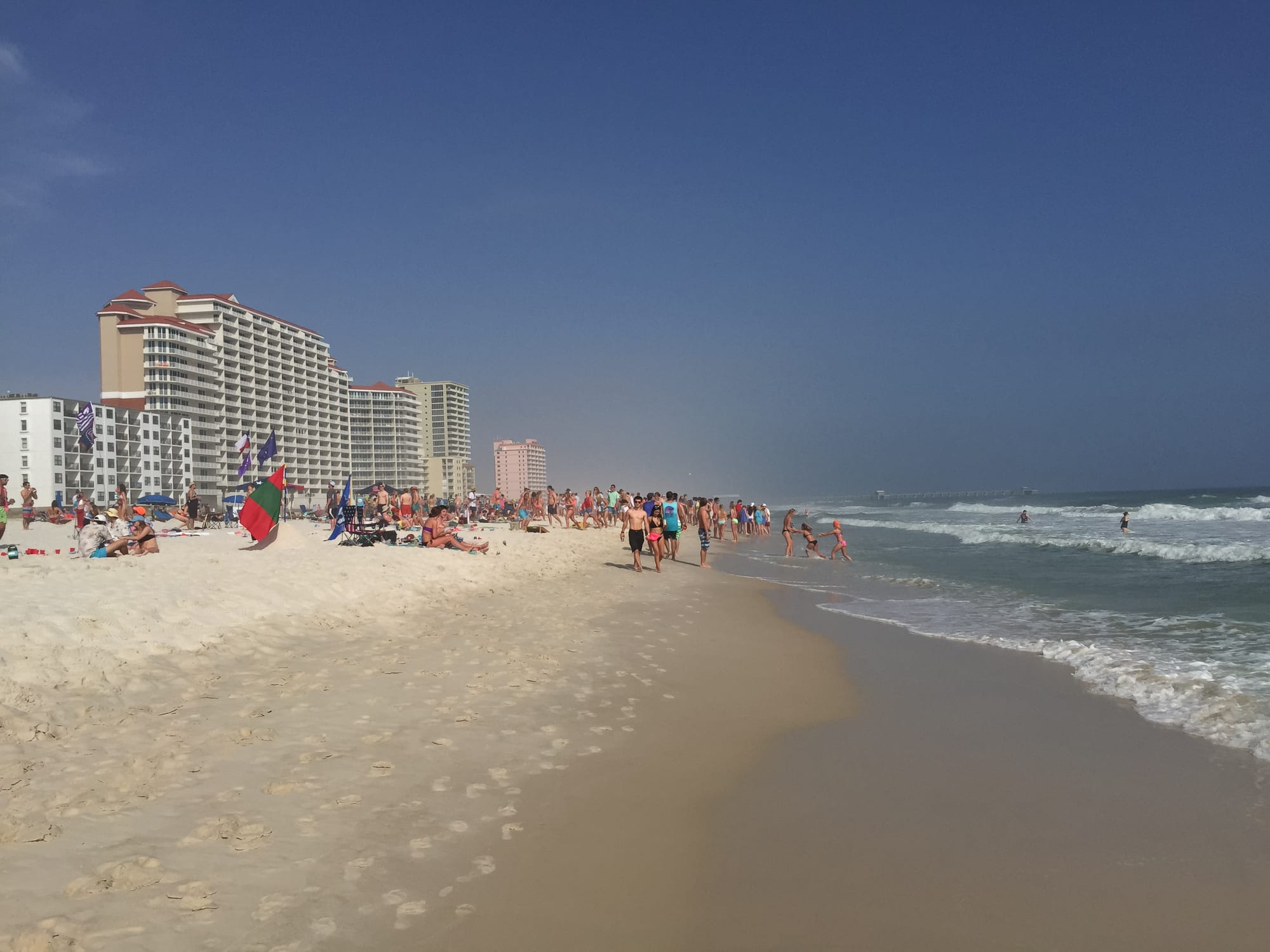
Crowds on a wide white-sand beach at Gulf Shores with pastel condominium towers behind and green Gulf surf rolling in under a hazy blue sky

The South, United States

Gulf Shores

The main beach at Gulf Shores, Alabama, in spring, with the town's condominium towers behind. (DiscoverWithDima / Wikimedia Commons · CC BY-SA 4.0)

Alabama's main beach town, on a barrier strip of white quartz sand between the Gulf of Mexico and the bays behind it, at the southern end of Baldwin County. Fishing camps and a canal gave way to condominium towers after the 1970s, and the town now lives on summer families, spring breakers and winter snowbirds, with Gulf State Park and the Fort Morgan peninsula on either side.

Neighbourhoods

  • The Beach and Gulf Shores Parkway
    • Beaches
    • First-time visitors
    • Families

    The strip where Highway 59 meets the Gulf — the public beach, the Hangout, souvenir shops, seafood restaurants and a wall of condominium towers along West and East Beach Boulevard. Everything a first-time visitor expects of the town is within a mile of this junction.

    Open in Maps
  • West Beach and Little Lagoon
    • Quiet and residential
    • Beaches

    The narrow spit running west between the Gulf and Little Lagoon, lined with beach houses and smaller rental blocks, quieter the further west it goes, with lagoon fishing and kayaking behind the dunes.

    Open in Maps
  • Gulf State Park and the eastern beaches
    • Nature
    • Cycling
    • Beaches

    East of the centre the shore passes into the state park — a lodge, campground, cottages, freshwater lakes, nature trails and a long fishing pier — before reaching the neighbouring town of Orange Beach.

    Open in Maps
  • The Fort Morgan peninsula
    • Quiet and residential
    • Nature
    • History

    The long peninsula west of town between the Gulf and Mobile Bay, with scattered beach houses, the Bon Secour wildlife refuge and the brick fort at the tip, where a ferry crosses to Dauphin Island.

    Open in Maps

Things to do

Beaches and the water

  • Gulf Shores Public Beachbeach

    The town's main beach at the foot of Highway 59, with wide white sand, lifeguards in season and the Hangout's stages and restaurants just behind it.

    Open in Maps
  • Gulf State Parkpark

    Some 6,000 acres of beach, marsh, pine forest and spring-fed freshwater lakes across the eastern part of the town, with nature trails, a nature centre, a campground and a lodge rebuilt after Hurricane Ivan.

    Open in Maps
  • Gulf State Park Pierlandmark

    A 1,540-foot fishing pier reaching into the Gulf, built after Hurricane Ivan in 2004, damaged by Hurricane Sally in 2020 and reopened in 2024; a popular place to walk and watch anglers.

    Open in Maps
  • Little Lagoonattraction

    The shallow lagoon behind West Beach, fed by a pass to the Gulf, used for boating, kayaking, crabbing and fishing for red drum and spotted seatrout.

    Open in Maps

History and nature

  • Fort Morganlandmark

    A five-sided masonry fort completed in 1834 at the mouth of Mobile Bay, about 18 miles west of town, which guarded the channel where Admiral Farragut's fleet ran past in the 1864 Battle of Mobile Bay.

    Open in Maps
  • Bon Secour National Wildlife Refugepark

    About 7,000 acres of dunes, maritime forest and lagoon on the Fort Morgan peninsula, with trails to an undeveloped beach and nesting sea turtles and the endangered Alabama beach mouse.

    Open in Maps
  • Alabama Gulf Coast Zooattraction

    A zoo that moved to a new site farther inland in 2020 after repeated hurricane evacuations, home to more than 300 animals, among them lemurs, kangaroos, tigers and giraffes.

    Open in Maps

Short trips from the town

  • Orange Beachattraction

    The neighbouring resort town east along the shore, with the Wharf's shops, restaurants and Ferris wheel beside the Intracoastal Waterway.

    Open in Maps
  • Dauphin Islandattraction

    The barrier island across the mouth of Mobile Bay, reached by car ferry from Fort Morgan, with Fort Gaines, the Alabama Aquarium and the Audubon Bird Sanctuary.

    Open in Maps
  • Foleyattraction

    The inland town ten miles north on Highway 59, with the OWA resort and amusement park, a city museum in the restored railway depot and the farm country of south Baldwin County.

    Open in Maps

Seasonal events

  • Hangout Music FestivalMay

    A three-day pop, rock and electronic festival on the public beach, first held in 2010.

  • National Shrimp FestivalOctober

    An outdoor festival of shrimp and seafood, fine art, arts and crafts and music, with hundreds of vendors, held each October.

  • Spring breakMarch

    College students from across the South fill the beach and the condominiums for several weeks each spring.

  • Snowbird seasonJanuary to March

    Retirees from the Midwest and Canada take the condominiums by the month in winter, when the beach is empty and prices lowest.

Eat and drink

Long-standing places and food districts in Gulf Shores. Hours, ratings and directions come from your maps app, always current.

Gulf Shores classics

  • The Hangoutrestaurant

    The beachfront restaurant and bar on East Beach Boulevard that gives the music festival its name, run by the festival's founders.

    Open in Maps

Food districts

  • Gulf Shores Parkway and Beach Boulevardneighborhood

    The main strip of seafood houses, oyster bars, pancake restaurants and ice cream shops along Highway 59 and the beach road.

    Open in Maps
  • Bon Secour fishing villageneighborhood

    The fishing village north of town, founded by French settlers in the 1700s, which has long lived from shrimping and fishing on the bay.

    Open in Maps

Experience Gulf Shores

History

The barrier strip that holds Gulf Shores was little more than sand, scrub and a few fishing camps for most of its history. The Spanish and French charted the mouth of Mobile Bay to the west, and the United States built Fort Morgan on its tip in the 1830s to control the channel; in August 1864 Admiral Farragut's fleet forced its way past the fort's guns in the Battle of Mobile Bay, the action remembered for his perhaps apocryphal order to damn the torpedoes. The beach itself stayed almost empty into the 20th century.

The Gulf Intracoastal Waterway, cut behind the shore, turned the beach into an island reached by bridge. Gulf State Park, its cabins built by the Civilian Conservation Corps, opened in 1939, and for a generation Gulf Shores was a quiet place of beach houses, a fishing pier and a small summer trade from Alabama and the states to the north.

Hurricane Frederic in 1979 levelled most of that town; FEMA bought damaged oceanfront lots and turned them into a public beach, and the rebuilding that followed produced the condominium resort of today. Hurricane Ivan in 2004 devastated the state park and destroyed its lodge, and the Deepwater Horizon oil spill of 2010 brought oil ashore on nearby beaches and a year of lost tourism; the first Hangout Music Festival opened on the beach that May, just after the spill began. Since then the town has grown quickly, gained a new pier and park lodge, and come to depend on tourism above all.

Culture & Customs

Gulf Shores is a beach town first. Life runs on the tides and the seasons: families in summer, students in March, retirees in winter and anglers all year. Sport fishing is close to a religion along this coast — charter boats run out from the passes and the bays for red snapper, grouper and king mackerel, and the pier at the state park fills with rod-holders at dawn. The National Shrimp Festival each October celebrates the boats that still work out of Bon Secour and Bayou La Batre.

The Hangout Music Festival, first held on the public beach in May 2010, brought a younger crowd and national attention, and spring break remains a rite of passage for students across Alabama, Georgia and Tennessee. For the rest of the year the town is family-minded and conservative, part of a county that votes and worships like the rest of south Alabama; churches are full on Sunday, high-school football matters, and the University of Alabama and Auburn rivalry divides households.

Loggerhead, green and Kemp's ridley sea turtles nest on the beaches, and the endangered Alabama beach mouse lives among the dunes and sea oats, which are protected; visitors are expected to use the boardwalks. Manners are Southern and informal — strangers say hello, "y'all" is standard, and nobody minds sand on the floor.

Daily Life

About 15,000 people lived in Gulf Shores at the 2020 census, a number that swells many times over in summer, when tens of thousands of visitors fill the condominiums and rental houses. Together with neighbouring Orange Beach the town is the economic engine of Baldwin County's coast, and tourism — rentals, restaurants, charter fishing, construction and the trades that serve them — is the overwhelming employer. Since 2000 the county as a whole has grown faster than almost any other in Alabama.

Permanent residents mostly live away from the beachfront: in subdivisions north of the Intracoastal Waterway, along the canals and the bays, and in Foley and the farm country beyond. Retirees make up a large share, with about a quarter of residents aged 65 or over. Workers in the tourist trade often commute from Foley and the towns inland, where housing is cheaper, and the cost of homes and insurance along the shore is a constant worry.

The rhythm is seasonal rather than daily. Summer Saturdays bring the change-over traffic on Highway 59; autumn is quieter and favoured by locals; winter belongs to the snowbirds and their pot-luck suppers; spring brings the students. Hurricane preparation is part of life from June to November, and beach renourishment, dune protection and the balance between new towers and the character of the town are the issues at council meetings.

Food

The food is Gulf seafood, as fresh as anywhere on the coast. Gulf shrimp are the local pride, served fried, boiled, grilled or in po' boys. Oysters from Mobile Bay and the nearby Gulf are served raw, chargrilled or fried; crab claws are fried as a bar snack; and the catch of charter boats — red snapper, grouper, triggerfish, mahi-mahi — turns up blackened, grilled or in tacos at restaurants that will cook what a customer has caught.

Seafood houses line Highway 59 and the beach road, many of them large, family-oriented places with outdoor decks and live music. The fishing village of Bon Secour to the north, founded by French settlers in the 1700s, has long lived from shrimping, and the National Shrimp Festival in October brings the whole catch to the beach. Away from the water, the cooking is south Alabama's: fried chicken, barbecue, biscuits, grits and sweet tea, with produce from the farms of Baldwin County.

Mornings belong to the pancake houses and doughnut shops that serve the rental crowd; evenings to the open-air bars with frozen drinks and the Hangout's beachfront stages.

Planning tools

Budget

Gulf Shores is priced by the week and the season. Beachfront condominiums and houses cost most in June and July and over spring break, fall in autumn and are cheapest in the snowbird months of January and February. Food is reasonably priced by resort standards, and the beach, the state park trails and the refuge are free or nearly so.

Daily Budget Midrange
USD 200–400 (beachfront condominium or hotel in season, seafood dinners with tax and tip, fishing or boat trips, rental car and fuel)
Daily Budget Shoestring
USD 90–150 (state-park campsite or inland motel, seafood shacks and self-catering, public beach, shared car)

Rentals in summer are let by the week, usually Saturday to Saturday; book months ahead for June, July and the Hangout Festival, and expect bargains in winter.

Best Time to Visit

April to early June and September to October are the sweet spots: warm water, smaller crowds and lower prices than high summer. June to August is hot, busy and the family season. March is spring break. Hurricane season runs from June to November, peaking in August and September, and winter is mild but too cool for most people to swim.

Suggested Number of Days

Most people come for a beach week. Three or four days are enough for the beach, the state park and the fort; a week allows fishing, the neighbouring islands and lazy days. Families and snowbirds often stay far longer.

First Visit
3–4 days
With Surroundings
5–7 days

Transportation

A car is needed. The town stretches along two long shore roads, and the fort, the refuge and the neighbouring towns are miles apart. Bicycles suit the state park's trails, and the county's BRATS service offers dial-a-ride transport. Ferries cross from Fort Morgan to Dauphin Island.

Traffic on Highway 59 at the beach is slow on summer Saturdays, when rentals change over; the Foley Beach Express, toll-free since 2024, is the quicker route in.

Airport & Station Connections

The nearest commercial airports are Pensacola International, across the Florida line to the east, and Mobile's, to the north-west; Jack Edwards National Airport in the town serves private planes only. Most visitors drive, from Birmingham, Atlanta, Nashville and the Midwest, down Interstate 65 and Highway 59. There is no passenger train to the beach.

Walkability

Only the central beach strip is walkable — the public beach, the Hangout and the shops along the first few blocks of Highway 59 and Beach Boulevard. Beyond that the town is a long thin strip of towers and houses along fast roads with few crossings. The state park's trails are the pleasant exception, flat and easy. Summer heat makes midday walking hard.

Safety

Crime is low and the main risks are natural. Rip currents drown swimmers every year on this coast; the beaches fly a flag system, and a double red flag closes the water. Hurricanes are a real threat in late summer, lightning comes with the afternoon storms, and the sun is strong. In October 2026 Hurricane Isaias made landfall near Destin, Florida, to the east, and left more than 300,000 customers in Alabama without power.

Swim near lifeguards, obey the beach flags, keep out of the lakes and bayous, follow evacuation orders in hurricane season, and leave nothing visible in a parked car. Check current official travel advice before travelling.

Climate

Humid subtropical, moderated by the Gulf. Summers are hot, humid and stormy, winters short and mild, and the sea is warm enough for swimming from about May to October. Rain is plentiful, much of it in summer thunderstorms.

Summer
hot and humid — highs around 90°F from June to August, with Gulf water in the low 80s °F
Winter
mild — January highs around 60°F and occasional frosts, with cool water and quiet beaches

Local Customs

Tipping of 18–20 per cent is expected at restaurants and for charter and tour crews. Alabama's sales and lodging taxes are added to prices. Dress is beach-casual almost everywhere, though shirts and shoes are expected in shops and restaurants. The town is in the Bible Belt and families set the tone outside spring break.

Identification is checked for alcohol (legal age 21). Keep off the dunes and sea-oat plantings, fill in holes dug in the sand, and turn off beachfront lights at night in turtle nesting season.

Common Payment Methods

The currency is the US dollar. Cards and contactless payment are taken almost everywhere, including beach-chair hire and charter boats; some seafood markets and small stands prefer cash. ATMs are easy to find along Highway 59.