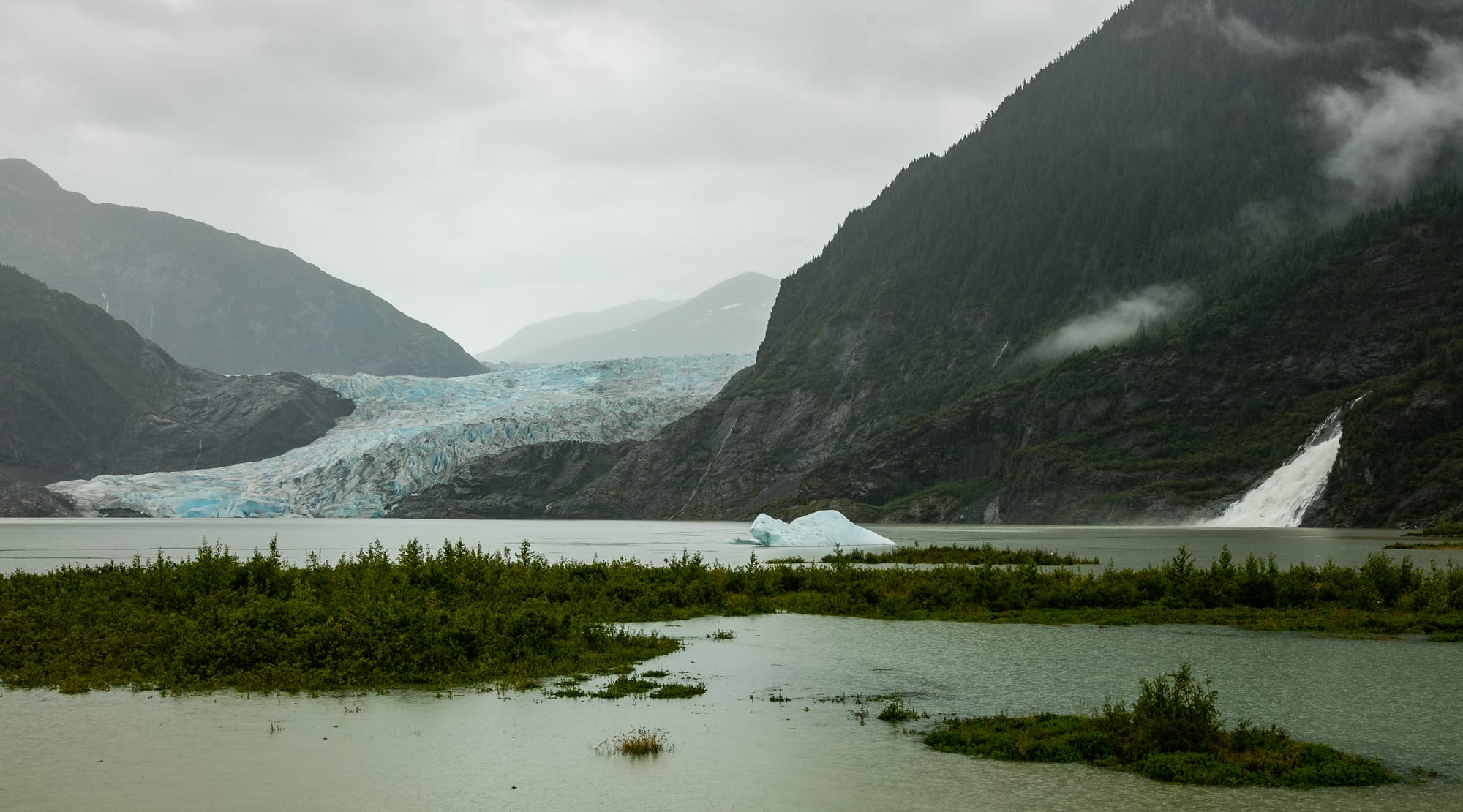
A blue-white glacier flowing into a grey lake between forested mountains, with a waterfall on the right and low cloud

United States

Alaska

Mendenhall Glacier and Nugget Falls outside Juneau, Alaska's capital, on the Inside Passage. (Diego Delso / Wikimedia Commons · CC BY-SA 4.0)

The largest and most thinly populated US state, separated from the lower 48 by Canada — a land of glaciers, tundra and North America's highest mountain, bought from Russia in 1867, home to many Alaska Native peoples, and reached by visitors mainly through Anchorage, Fairbanks and the cruise ports of the Inside Passage.

Explore Alaska

History

People crossed into Alaska from Asia over the Bering land bridge thousands of years ago, and by the time Europeans arrived the land was home to many distinct peoples: the Iñupiat of the Arctic coast, the Yup'ik of the south-western river deltas, the Unangax (Aleut) of the Aleutian Islands, the Alutiiq of Kodiak and the southern coast, the Athabascan peoples of the interior, and the Tlingit, Haida and Tsimshian of the south-eastern rainforest, famous for their clan houses and totem poles.

Vitus Bering's Russian expedition reached the coast in 1741, and Russian fur traders followed, forcing Unangax and Alutiiq hunters to hunt sea otters for them. Russian America's capital moved from Kodiak to Sitka, which the Russians took from the Tlingit in 1804, and Russian Orthodox missionaries left churches that still serve Native congregations. In 1867 the United States bought Alaska for 7.2 million dollars, a deal promoted by Secretary of State William Seward and mocked at the time as "Seward's Folly". The Klondike gold rush of the late 1890s sent thousands through Skagway towards Canada's Yukon, and gold strikes at Nome and Fairbanks followed.

In 1942 Japan occupied Attu and Kiska in the Aleutians, and US forces retook Attu in 1943; the Unangax were evacuated to camps in south-east Alaska, where many died. The Alaska Highway was built through Canada during the war. Alaska became the 49th state in 1959. In 1964 the Good Friday earthquake, of magnitude 9.2, the most powerful recorded in North America, devastated Anchorage and coastal towns. Oil discovered at Prudhoe Bay in 1968 led to the Alaska Native Claims Settlement Act of 1971, which created Native-owned corporations, and to the Trans-Alaska Pipeline, completed in 1977. The Exxon Valdez spill fouled Prince William Sound in 1989.

Culture & Customs

Alaska has the highest proportion of Native residents of any US state, with far higher shares in rural areas, where many villages are mostly Native. Twenty Native languages are officially recognised by the state, and efforts to revive them run alongside the Alaska Native Heritage Center in Anchorage, the World Eskimo-Indian Olympics of traditional games held in Fairbanks each July, and Juneau's Celebration, a festival of south-eastern Native dance. Hunting, fishing and gathering for food, known as subsistence, remains central to rural life and is protected by law.

Alaskans call the lower 48 "Outside" and take pride in self-reliance, and the state has a strong libertarian streak. There is no state income tax, and every resident receives an annual dividend from the Permanent Fund, the savings account built from oil revenue. The tallest peak is itself a matter of identity: the federal government renamed Mount McKinley as Denali in 2015 and restored the old name in 2025, but the State of Alaska, which adopted the name in 1975, calls it Denali.

Winter brings the state's signature events. Anchorage's Fur Rendezvous winter carnival in February is followed in early March by the ceremonial start of the Iditarod, a long-distance sled dog race to Nome. Dog mushing, snow machines, as snowmobiles are called here, and ice fishing fill the long winter.

Daily Life

About 740,000 people live in Alaska, and around 40 per cent of them live in Anchorage, a city of about 290,000. Fairbanks has around 30,000 in a borough of nearly 100,000, and Juneau, the capital, about 32,000. Much of the rest of the population lives in small towns and villages scattered along the coast and rivers, most of them off the road network and supplied by plane and barge.

Oil has long paid for most of the state government, and the decline of North Slope production has brought years of budget arguments. Commercial fishing is a major industry, led by Bristol Bay's sockeye salmon run, the largest in the world, and by the seafood ports of Dutch Harbor and Kodiak. Tourism, largely by cruise ship, and military bases near Anchorage and Fairbanks are the other pillars.

Daily rhythm follows the light. In summer people fish, garden and hike late into bright evenings, and many fill freezers with salmon for the year; in winter the short days are for work, skiing and watching the aurora. Current issues include the high cost of living in rural areas and climate change, which is thawing permafrost and eroding coastal villages such as Shishmaref and Kivalina.

Food

Alaskan food begins with wild fish and game. Salmon — king, sockeye, silver and others — is eaten fresh, smoked, canned, or dried in strips, and halibut from Homer and king crab from the Bering Sea are prized. Moose and caribou fill winter freezers, and reindeer sausage is a local favourite.

Alaska Native foods remain central in villages and appear at gatherings statewide. Akutaq, sometimes called Eskimo ice cream, is whipped fat, traditionally from animals and now often vegetable shortening, mixed with berries and sometimes fish. Muktuk, whale skin with its layer of blubber, is shared after Iñupiat and Yup'ik whale hunts, and seal oil is used as a dip and seasoning. Wild berries — blueberries, salmonberries, lowbush cranberries and crowberries — are picked across the state in late summer and turned into jams and pies, and fireweed flowers are made into jelly.

Old-timers are called sourdoughs, after the starter that prospectors carried for bread and pancakes. The Matanuska Valley near Palmer grows giant cabbages and other vegetables in the long summer daylight, shown off at the Alaska State Fair. Birch syrup is made in the interior, and Juneau's Alaskan Brewing Company has been making beer since 1986, part of a large craft-brewing scene.

Attractions & Natural Wonders

Denali National Park lies about halfway between Anchorage and Fairbanks. A single park road leads into the wilderness, travelled by park buses from which grizzly bears, caribou, moose and Dall sheep are regularly seen, though a landslide has blocked the road partway along since 2021; the summit itself is often in cloud, and flightseeing trips from Talkeetna circle it. Fairbanks, to the north, is the base for the northern lights, with Chena Hot Springs, the University of Alaska's Museum of the North, and the Dalton Highway leading to the Arctic.

Anchorage has the Alaska Native Heritage Center, the Tony Knowles Coastal Trail and Chugach State Park on its edge. The Seward Highway follows Turnagain Arm south to the Kenai Peninsula, passing Portage Glacier and the road to Whittier on Prince William Sound. At its end, Seward has the Alaska SeaLife Center and boat tours into Kenai Fjords National Park, whose tidewater glaciers flow from the Harding Icefield, with Exit Glacier reachable on foot. Homer, on the peninsula's southern tip, is a centre for halibut fishing.

The Inside Passage in the south-east is a chain of islands, fjords and rainforest. Ketchikan has Creek Street, the totem parks of Saxman and Totem Bight and floatplane trips to Misty Fjords. Juneau offers Mendenhall Glacier, the Mount Roberts Tramway and whale watching, while Sitka keeps its Russian heritage, and Skagway is the start of the White Pass and Yukon Route railway. Glacier Bay National Park, visited by many cruise ships, lies west of Juneau. Beyond the main routes are Wrangell–St Elias, the largest national park in the country, with the old Kennecott copper mine, and Katmai, where brown bears catch salmon at Brooks Falls.

Cities in Alaska

Planning basics

Budget

Alaska is expensive: almost everything is shipped or flown in, the summer season is short, and hotels in Denali, Seward and Juneau charge high rates from June to August. Getting around adds up quickly, whether by rental car, the Alaska Railroad, ferries, or small planes to places off the road system. There is no state sales tax, though many towns add their own, and prices in remote villages are far higher than in Anchorage.

Daily Budget Midrange
USD 300–600 (lodges and hotels, restaurant meals, rental car or train, a glacier cruise or flightseeing trip)
Daily Budget Shoestring
USD 120–200 (hostels or camping, supermarket food, buses and ferries, one paid excursion now and then)

Book Denali and Kenai Fjords accommodation and day cruises well ahead; late May and early September are noticeably cheaper than high summer.

Safety

Street crime is low for visitors, though Anchorage has more crime than its size suggests. Nature is the main risk: brown bears and moose, cold water that can kill in minutes, fast-changing weather, glacier crevasses, avalanches, and remoteness that means help can be hours or days away. Small-plane accidents are more common than elsewhere in the country, and winter in the interior brings dangerous cold and icy roads.

Carry bear spray and make noise on trails, give moose a wide berth, leave a trip plan with someone before heading into the backcountry, and dress for cold even in summer. Check current official travel advice before travelling.

Climate

Alaska spans several climates. The Inside Passage has a mild, very wet temperate-rainforest climate, and Ketchikan is one of the wettest towns in the country. Anchorage and the Kenai Peninsula are cool and moderated by the sea. The interior around Fairbanks is continental, with warm summers and extremely cold winters, and the Arctic north is tundra with permafrost. Daylight is the other extreme: near-continuous light around the June solstice, and only a few hours of daylight in the south in December, while the sun does not rise for about two months in the far north.

Summer
54–64°F and frequent rain in Juneau and Ketchikan; 59–72°F in Anchorage; 68–82°F at times in Fairbanks
Winter
32 to 41°F and wet in the Inside Passage; 5 to 23°F in Anchorage; -4 to -22°F and colder in Fairbanks

Transportation

Most visitors arrive at Anchorage or on a cruise ship. A limited road network links Anchorage with Seward, Homer, Denali and Fairbanks, and the Alaska Railroad runs the same route in summer. Juneau, Ketchikan and Sitka are not connected by road to the rest of the state and are reached by air, cruise ship or the Alaska Marine Highway ferries. Much of the state, including most Native villages, can be reached only by small plane or boat. Inside Denali National Park, private cars are restricted and visitors ride park buses.

Allow plenty of time: Anchorage to Denali takes around four to five hours by car or seven to eight by train, and weather often delays small planes.

Best Time to Visit

Mid-June to mid-August is the main season, with long days, open park roads, cruise ships in the Inside Passage and salmon runs in the rivers. Late May and early September are quieter and cheaper, with autumn colour on the tundra in late August and September. For the northern lights, go to Fairbanks from about late August to April, when nights are dark; February and March combine aurora with longer days and the Iditarod sled dog race.