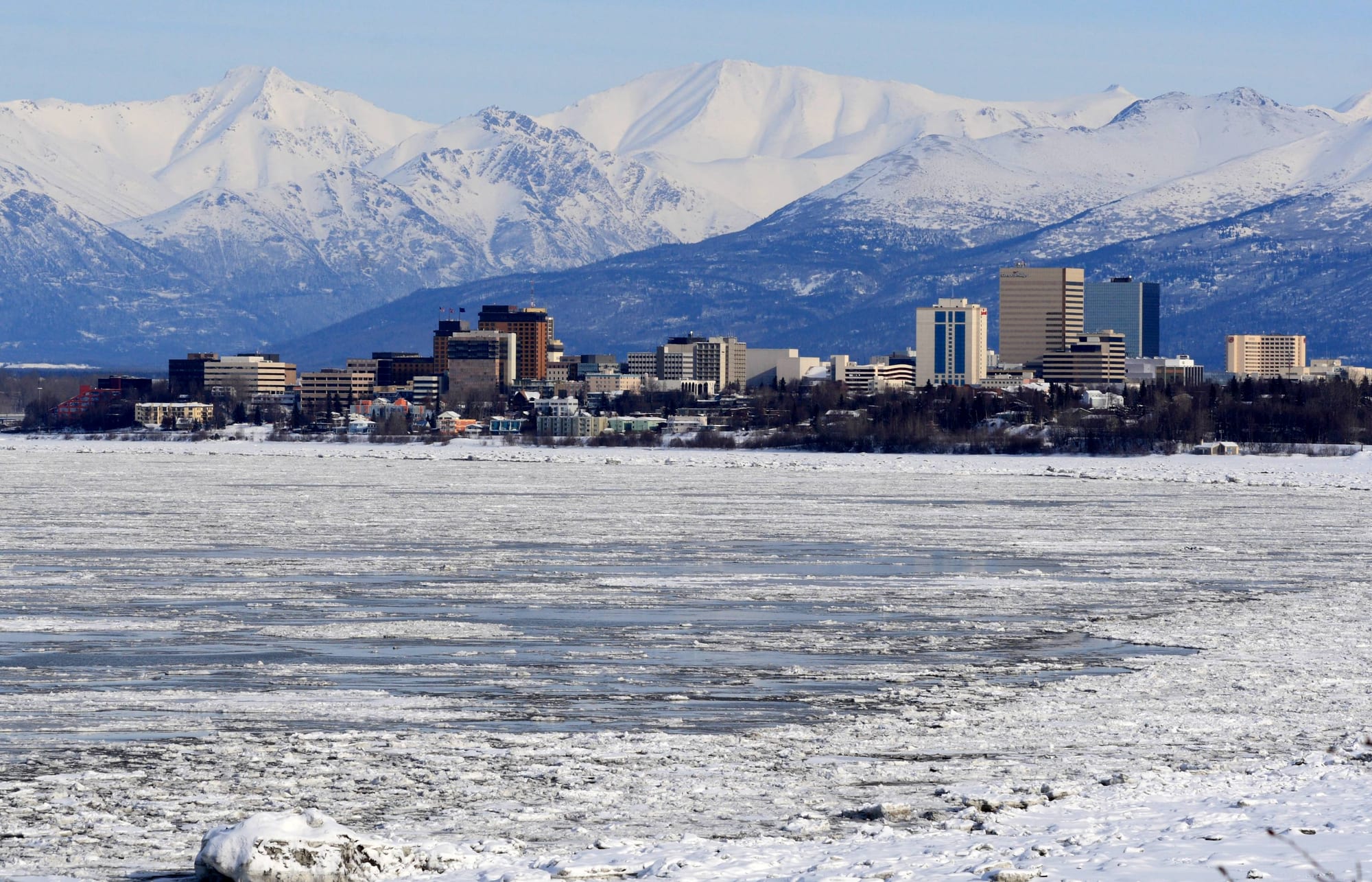
Downtown Anchorage's towers with the Chugach Mountains rising behind

Alaska, United States

Anchorage

Downtown Anchorage with the Chugach Mountains behind. (Frank K. from Anchorage, Alaska, USA / Wikimedia Commons · CC BY 2.0)

Alaska's largest city, at the head of Cook Inlet between the Knik and Turnagain arms with the Chugach Mountains behind it. It began in 1915 as a railway construction camp at the mouth of Ship Creek, grew on military bases and oil, and is now the state's air hub — a spread-out city where moose wander the suburbs and a state park lies inside the city limits.

Neighbourhoods

  • Downtown
    • First-time visitors
    • Museums
    • Close to public transport

    The site of the 1915 land auction that gave the city its grid of streets, at the north-western tip of the city above Ship Creek. The state's tallest buildings, the Anchorage Museum, the performing arts centre, most restaurants and bars, the railway depot and the bus centre are all here, and it is the one part of Anchorage that is easy on foot.

    Open in Maps
  • Bootleggers Cove
    • Quiet and residential
    • Coastal walks

    A residential area just west of downtown on the bluffs above Knik Arm, with Elderberry Park, the Oscar Anderson House and access to the Coastal Trail. Its quiet streets lead down to Westchester Lagoon.

    Open in Maps
  • Spenard
    • Best for food
    • Nightlife
    • Local life

    Once a separate town with a racy reputation, now a mixed neighbourhood along Spenard Road between downtown and the airport. It has some of the city's more interesting small restaurants and bars, and Lake Hood's floatplanes are on its south-western edge.

    Open in Maps
  • Midtown
    • Shopping
    • Practical base

    The largely commercial area south of downtown, between about 15th Avenue and Tudor Road — malls, offices, chain hotels and restaurants along wide roads. Convenient for drivers, with little to see on foot.

    Open in Maps
  • Hillside
    • Hiking access
    • Quiet and residential

    The wooded foothills of the Chugach Mountains in South Anchorage, where large houses look over the city and moose are common in the streets. The roads up the Hillside lead to the Glen Alps trailhead and Chugach State Park.

    Open in Maps
  • Eagle River
    • Mountain setting
    • Quiet and residential

    A suburban community within the municipality, north of the military base and squeezed against Chugach State Park. Many residents commute to the city, and its valley gives access to the northern side of the park.

    Open in Maps

Things to do

Museums and culture

  • Anchorage Museummuseum

    A large museum downtown, covering the art, history, peoples and science of Alaska and the North, with Alaska Native collections shared with the Smithsonian's Arctic Studies Center.

    Open in Maps
  • Alaska Native Heritage Centermuseum

    Opened in 1999 on wooded land about 6 miles from downtown, it presents Alaska's eleven major Native cultural groups through dance, games, storytelling, crafts and full-size village sites around a lake.

    Open in Maps
  • Oscar Anderson House Museummuseum

    The first wood-frame house in Anchorage, built in 1915 by an early settler and restored to its original look, in Elderberry Park beside the Coastal Trail.

    Open in Maps
  • Alaska Aviation Museummuseum

    Vintage aircraft and the story of bush flying, in hangars on the shore of the Lake Hood seaplane base.

    Open in Maps

Parks, trails and the coast

  • Tony Knowles Coastal Trailtrail

    An 11-mile paved path along the shore from downtown to Kincaid Park, with views across Knik Arm; walkers and cyclists use it in summer and cross-country skiers in winter.

    Open in Maps
  • Kincaid Parkpark

    A large forested park on the city's western tip between the airport and the water, known for its Nordic ski trails and frequent moose.

    Open in Maps
  • Chugach State Parkpark

    One of the largest state parks in the United States, covering the mountains immediately east of the city, with trailheads a short drive from town.

    Open in Maps
  • Flattop Mountaintrail

    The most climbed mountain in Alaska, reached by a short, steep trail from the Glen Alps trailhead, with views over the city and, on clear days, as far as Denali.

    Open in Maps
  • Lake Hood Seaplane Baseattraction

    One of the busiest seaplane bases in the world, beside the international airport, where floatplanes take off and land all day in summer.

    Open in Maps
  • Alaska Zooattraction

    A zoo on 25 acres of the Hillside with about 50 species of birds and mammals, many of the animals found orphaned or injured.

    Open in Maps

Short trips from the city

  • Turnagain Armviewpoint

    The fjord south of the city, with some of the largest tides in the world, followed by the Seward Highway; beluga whales are sometimes seen from the road.

    Open in Maps
  • Girdwoodneighborhood

    A former gold-rush supply town near the end of Turnagain Arm, still within the municipality, now a ski town in a valley ringed by glaciers.

    Open in Maps
  • Alaska Wildlife Conservation Centerattraction

    A sanctuary for orphaned and injured animals at the head of Turnagain Arm, with large enclosures for bears, moose and wood bison.

    Open in Maps

Seasonal events

  • Fur Rendezvouslate February

    Fur Rondy, the city's winter festival, marking the approach of the end of winter, with sled dog sprint races and an ice carving competition.

  • Iditarod ceremonial startfirst Saturday of March

    Mushers and their dog teams leave from Fourth Avenue downtown at the ceremonial start of the long-distance race to Nome.

Eat and drink

Long-standing places and food districts in Anchorage. Hours, ratings and directions come from your maps app, always current.

Anchorage classics

  • Anchorage Market and Festivalmarket

    A large open-air weekend market downtown in summer, with several hundred stalls selling produce, local seafood, cooked food, crafts and souvenirs.

    Open in Maps
  • Downtown seafood and brewpubsneighborhood

    Downtown's restaurants serve Alaskan salmon, halibut and crab, and several brew their own beer.

    Open in Maps

Food districts

  • Spenardneighborhood

    A neighbourhood of small, informal places along Spenard Road, including Himalayan and Indian kitchens, diners and bars.

    Open in Maps
  • Midtownneighborhood

    The commercial area south of downtown, with restaurants of many kinds along its main roads.

    Open in Maps

Experience Anchorage

History

The Cook Inlet shore was home to Alutiiq people for thousands of years before the Dena'ina Athabascans arrived around 500 AD, fishing the streams in summer and hunting moose and Dall sheep in autumn. In 1778 James Cook's expedition anchored near a creek it called Ship Creek, in a vain search for the Northwest Passage, and in a bad mood named the southern arm River Turnagain. Gold found along Turnagain Arm in 1888 brought prospectors and small settlements such as Girdwood and Spenard.

The city itself began in 1915, when the mouth of Ship Creek was chosen as the construction port for the Alaska Railroad and a tent city grew up there. A land auction that year laid out the downtown grid, and Anchorage was incorporated in November 1920. The railroad, finished in 1923, carried the economy through the 1920s and 1930s, until Elmendorf air base and Fort Richardson were built in the 1940s and the military became the main employer.

On Good Friday, 27 March 1964, a magnitude 9.2 earthquake struck. The city stood on glacial silt that liquefied in the shaking; roads cracked, large areas of land collapsed, and in the Turnagain neighbourhood dozens of homes on the bluff dropped to sea level. The discovery of oil at Prudhoe Bay in 1968 then made Anchorage the business centre of the oil industry. In 1975 the city merged with the surrounding borough, which brought Eagle River, Girdwood and the mountains into a single municipality covering nearly 2,000 square miles.

Culture & Customs

Anchorage is Alaska's meeting place. Five Alaska Native regional corporations have their headquarters here, the Alaska Native Medical Center serves people from all over the state, and the Alaska Native Heritage Center presents the dance, games and building traditions of eleven cultural groups. The city's Dena'ina name is Dgheyay Kaq'. Alaska Native residents live alongside Filipino, Samoan, Korean, Hmong and Latin American communities, and in 2010 Spanish and Tagalog were the most common home languages after English.

Winter has its own calendar. Fur Rendezvous, known as Fur Rondy, is a late-February festival of sled dog sprint races and ice carving, and on the first Saturday of March the Iditarod's ceremonial start brings dog teams down Fourth Avenue. In summer the Alaska Baseball League's Anchorage Bucs and Glacier Pilots play at Mulcahy Stadium under the evening light.

Outdoor life shapes the city's identity. Residents fish for salmon in Ship Creek beside downtown, ski the trails of Kincaid Park and camp out on Flattop at the solstices. Wildlife is part of everyday life: a few hundred moose live in the Anchorage Bowl in summer and many more in winter.

Daily Life

The 2020 census counted 291,247 people in the municipality, nearly 40 per cent of the state's population, and the wider metropolitan area, including the Matanuska-Susitna Borough to the north, had about 398,000. Most live in the Anchorage Bowl between the inlet and the mountains, in suburban houses, with Eagle River and Chugiak to the north and smaller communities along Turnagain Arm to the south.

The economy rests on government, the military and transport. Joint Base Elmendorf-Richardson employs about 8,500 civilian and military personnel. The airport is one of the busiest cargo airports in the world and a regular stop for freighters crossing the Pacific. Oil companies, the Native corporations and hospitals are other large employers.

Daily life is organised around the car, the season and the light. Summer evenings are spent on the trails and rivers; winter brings ice-covered roads, short days and skiing on lit trails. The high cost of living is a common local concern.

Food

Anchorage eats like the rest of Alaska, only with more choice. Wild salmon and halibut appear on many menus, grilled, smoked or fried in a sandwich, and king crab is the expensive treat. Halibut sandwiches and halibut burgers are served at some of the city's casual burger stands, and in summer anglers carry salmon home from Ship Creek beside downtown. Reindeer sausage turns up at breakfast, sometimes beside sourdough pancakes; in Alaskan slang a 'sourdough' is a long-time resident.

Summer weekends bring the downtown Anchorage Market and Festival, an open-air market with local seafood, produce, cooked food and crafts. In autumn wild blueberries cover Flattop Mountain, and berry picking is a popular pastime.

The city's mix of residents shows in its food: Spenard has Himalayan and Indian cooking among its diners and bars, and the many immigrant communities run restaurants of their own. Several brewpubs downtown brew their own beer, and the city has many microbreweries.

Planning tools

Budget

Anchorage is expensive by national standards, because almost everything is shipped or flown in, and summer hotel prices are high. Its supermarkets and outdoor shops make it a practical place to stock up before heading to the parks. A hire car is the largest extra cost, and rates are highest in the summer peak season.

Daily Budget Midrange
USD 300–550 (mid-range hotel, restaurant meals, hire car, museum tickets)
Daily Budget Shoestring
USD 120–200 (hostel bed or campground, supermarket food and market stalls, city buses)

Book summer rooms and cars early; the Coastal Trail, Flattop, Kincaid Park and the downtown market cost nothing.

Best Time to Visit

Mid-June to mid-August is the main season, with very long days, the summer market and the trails clear of snow. Late May and early September are quieter and cheaper. Winter is dark and cold but brings skiing, Fur Rondy in late February and the Iditarod start in early March.

Suggested Number of Days

Two or three days cover the city itself. Most visitors use Anchorage as a base or a stopover, so the number grows with the day trips south of the city and the time given to hiking in the mountains.

First Visit
2–3 days
With Surroundings
4–5 days

Transportation

The developed city is spread out and built for the car, and most visitors hire one. The People Mover bus system has its main hub downtown and covers the city, more slowly. Downtown's street grid is simple, with numbered avenues and lettered streets. The Coastal Trail and the linked creek trails make cycling a practical way to cross the western side.

Watch for moose on the roads, especially at dusk and in winter, when they are hard to see.

Airport & Station Connections

Ted Stevens Anchorage International Airport, the main airport of the state and one of the world's busiest cargo airports, is about 5 miles south-west of downtown, a short taxi or bus ride. The Alaska Railroad depot is downtown, and the Seward, Glenn and Parks highways link the city with the Kenai Peninsula, the Canadian border and Fairbanks. One large cruise line calls regularly; most cruise passengers arrive by bus or train from Seward or Whittier.

Walkability

Downtown is compact and pleasant on foot in summer, with the museum, the market, restaurants and the Coastal Trail within a few blocks. Beyond it, distances are long and roads wide, and walking is mostly for trails rather than errands. Pavements are icy for much of the winter.

Safety

For most visitors the US is safe, with the main risks being petty theft and car break-ins in tourist areas of some cities, road accidents over long distances, extreme weather, and the hazards of the outdoors. Anchorage has a higher crime rate than the US as a whole. Moose are common inside the city and can be dangerous, and bears use the trails and greenbelts.

Give moose a wide berth, carry bear spray on trails, and do not walk onto the mudflats of Knik and Turnagain arms, where the incoming tide is dangerous. Check current official travel advice before travelling.

Climate

A subarctic climate with a strong maritime influence, far milder than interior Alaska. Summers are cool with very long days; winters are cold and snowy, with short days around December.

Summer
cool — July averages range from about 52°F at night to 66°F by day
Winter
cold and snowy — January averages about 11°F to 23°F, and snowfall averages about 75 inches a winter

Local Customs

Tipping of roughly 18–22 per cent in restaurants is expected, as across the country. Dress is casual and practical, in layers and waterproofs, even in good restaurants. Alaskans call the rest of the country 'Outside'. Alaska Native cultures are central to the city's identity; ask before photographing people at dances and cultural events.

Identification is asked for when buying alcohol (the legal age is 21).

Common Payment Methods

The currency is the US dollar. Cards and contactless payment are accepted almost everywhere, and ATMs are easy to find. A little cash helps at market stalls.