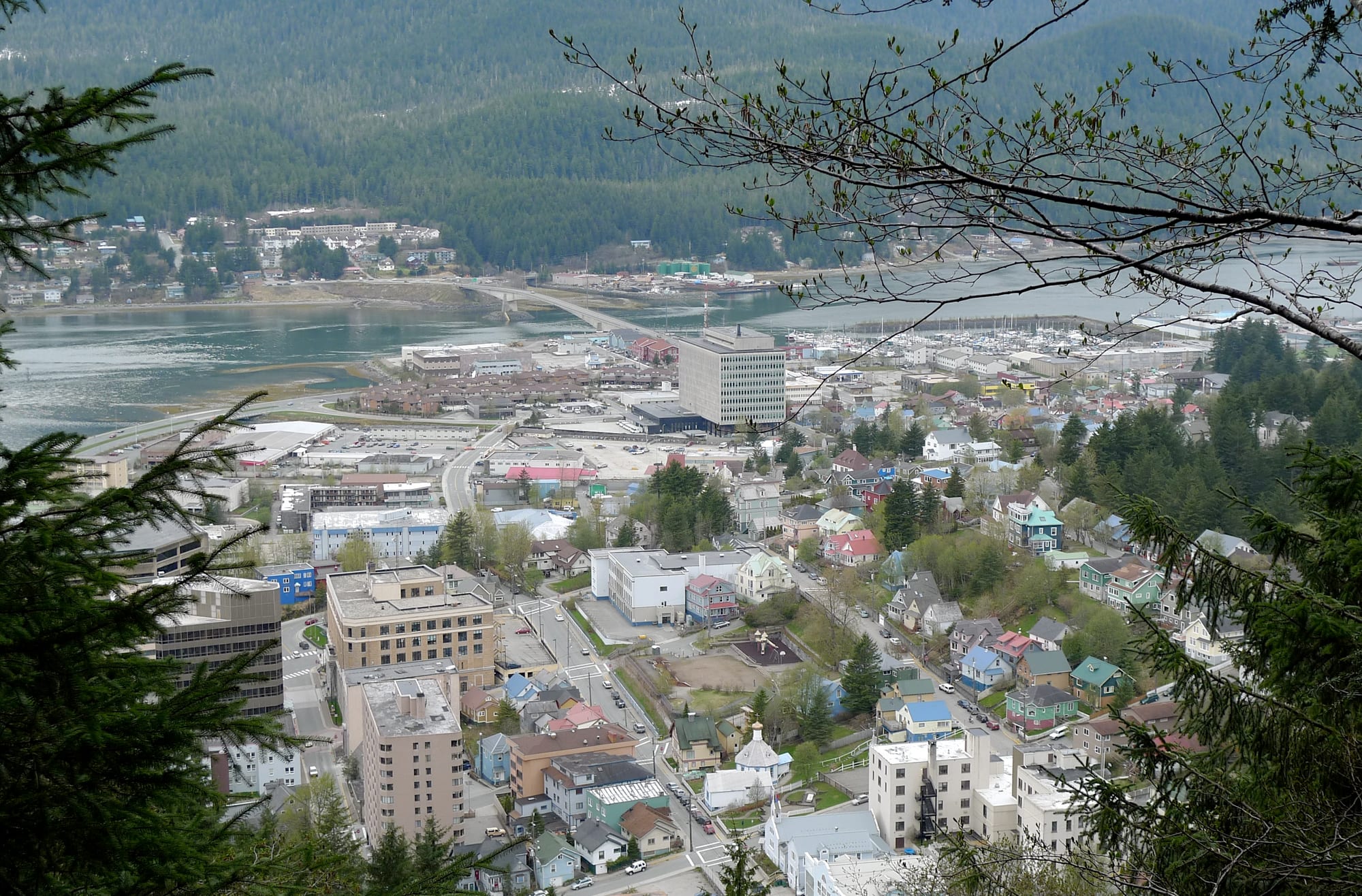
Downtown Juneau seen from above, with the Gastineau Channel and Douglas Island beyond

Alaska, United States

Juneau

Downtown Juneau and the Gastineau Channel from the slopes of Mount Roberts, with Douglas Island beyond. (Joseph from Cabin On The Road, USA / Wikimedia Commons · CC BY-SA 2.0)

Alaska's capital, squeezed between the Gastineau Channel and steep mountains in the Inside Passage, with no road to the rest of the state. Founded as a gold camp in 1880 and capital since 1906, it is a small city of government offices, Tlingit heritage and wooden houses on the hillside, filled in summer by cruise passengers heading for the Mendenhall Glacier.

Neighbourhoods

  • Downtown
    • First-time visitors
    • Historic district
    • Museums

    The old town at the foot of Mount Juneau, where the cruise ships dock beside South Franklin Street. The Capitol, the State Museum, St Nicholas Church and most restaurants and bars are here, and steep streets and public stairways climb to the residential hill above.

    Open in Maps
  • Douglas
    • Quiet and residential
    • Mining history

    A small community on Douglas Island directly across the channel, reached by bridge. The ruins of the Treadwell gold mine lie along its shore, and the road continues to the city's ski area.

    Open in Maps
  • Mendenhall Valley
    • Glacier access
    • Local life

    The valley carved by the Mendenhall Glacier, beginning about ten miles from downtown, the borough's largest populated area, with suburban neighbourhoods near the airport, the shops and the glacier itself.

    Open in Maps
  • Auke Bay
    • Harbour
    • Whale watching

    A harbour neighbourhood north of the valley, home to the University of Alaska Southeast and Auke Lake, with views of the Mendenhall Glacier. Whale-watching boats leave from here, and the state ferry terminal is further out the road.

    Open in Maps

Things to do

Landmarks

  • Alaska State Capitollandmark

    Opened in 1931 as the Federal and Territorial Building, home to the legislature and the governor's offices since statehood in 1959.

    Open in Maps
  • St. Nicholas Russian Orthodox Churchlandmark

    A small onion-domed church built in the 1890s for Tlingit converts to Orthodoxy, still in use.

    Open in Maps

Museums

  • Alaska State Museummuseum

    The state's museum of human and natural history, founded in 1900 and reopened in a new building in 2016.

    Open in Maps
  • Juneau-Douglas City Museummuseum

    The city's own history in a former library opposite the Capitol, with a Tlingit totem pole outside.

    Open in Maps
  • Last Chance Mining Museummuseum

    A former gold mining camp on Gold Creek, about a mile from town, whose main building now holds mining machinery and history.

    Open in Maps

Glaciers, mountains and the coast

  • Mendenhall Glacierpark

    A glacier about 13 miles long flowing from the Juneau Icefield into Mendenhall Lake, about 12 miles from downtown, with trails and viewing platforms; it has retreated well over a mile since 1929.

    Open in Maps
  • Goldbelt Tramviewpoint

    The aerial tramway, formerly the Mount Roberts Tramway, that rises in six minutes from the cruise docks to about 1,800 feet on Mount Roberts, with trails and a nature centre at the top.

    Open in Maps
  • Mount Juneautrail

    The steep mountain rising directly behind downtown, climbed by a demanding trail with views over the channel.

    Open in Maps
  • Treadwell gold mineattraction

    Once the largest hard-rock gold mine in the world, worked from 1881 to 1922; little remains but ruins along a woodland trail on Douglas Island.

    Open in Maps
  • National Shrine of St. Thérèselandmark

    A stone chapel and labyrinth on wooded land overlooking the Lynn Canal, north of the city.

    Open in Maps

Seasonal events

  • Alaska Folk FestivalApril

    A week of free concerts, dances and workshops, founded in 1975, with musicians from across Alaska, the Pacific Northwest and the Yukon.

  • Celebrationearly June, every two years

    A Tlingit, Haida and Tsimshian gathering of dance, song and art, first held in 1982 and now the largest cultural event in Alaska.

Eat and drink

Long-standing places and food districts in Juneau. Hours, ratings and directions come from your maps app, always current.

Juneau classics

  • Downtown seafoodneighborhood

    Restaurants and crab shacks around the cruise docks and South Franklin Street serve king crab legs, crab cakes and halibut, from fish and chips to halibut tacos.

    Open in Maps
  • Juneau breweriesneighborhood

    The Alaskan Brewing Company's tasting room in Lemon Creek, founded in 1986, and the city's smaller breweries.

    Open in Maps

Out of the centre

  • Douglasneighborhood

    A quieter choice across the bridge, with a pub and a few local places popular with residents.

    Open in Maps

Experience Juneau

History

The Gastineau Channel was a fishing place of the Auke and Taku Tlingit for thousands of years; the Tlingit name for the town is Dzántik'i Héeni, the 'base of the flounder's river'. In 1880 a Sitka mining engineer, George Pilz, offered a reward to any local Native who could lead him to gold, and sent the prospectors Joe Juneau and Richard Harris to Gold Creek. They found nuggets 'as large as peas and beans', marked out a town site in October 1880, and a mining camp grew up — the first new settlement founded after the United States bought Alaska. After being called Rockwell and Harrisburg, it took the name Juneau in December 1881.

Gold made the city. The Treadwell mine across the channel on Douglas Island became the largest hard-rock gold mine in the world, and the Alaska-Juneau and Alaska-Gastineau mines worked the mountains behind town. In 1890 about 700 Tlingit joined the Russian Orthodox Church, and St Nicholas Church followed. In 1906 the territorial government moved from Sitka to Juneau, and between the wars it was Alaska's largest city. The Federal and Territorial Building, now the Capitol, opened in 1931. During the Second World War more than 50 Japanese residents were sent to internment camps, remembered today by the Empty Chair Memorial.

Statehood in 1959 brought growth in government. In 1970 Juneau merged with Douglas and the surrounding borough, creating one of the largest municipalities in the country by area. Alaskans voted in the 1970s to move the capital closer to Anchorage, but later votes in 1984 and 1996 rejected a move and Juneau remains the capital. Cruise tourism grew from about 230,000 passengers in 1990 to nearly 1.7 million in 2025.

Culture & Customs

Juneau is a social centre for the Tlingit, Haida and Tsimshian of Southeast Alaska. The Tlingit names of places are in common use — Auke Bay is Áak'w, the Mendenhall Glacier Áak'w T'áak Sít' — and Celebration, a gathering of dance and art first held in 1982, fills the city with clan regalia every second June. A totem pole carved by the Tlingit artist Amos Wallace stands outside the city museum.

For a small city, the arts scene is busy. Perseverance Theatre is Alaska's largest professional theatre, an art house cinema shows independent and foreign films, and every April the Alaska Folk Festival gives a week of free concerts in which each act plays a short set. Juneau Jazz & Classics is another annual music festival.

Life is also outdoors and close to the weather. Residents hike the mountains behind town, ski at the city-owned Eaglecrest area on Douglas Island and skate at the Treadwell rink beside the old mine.

Daily Life

The 2020 census counted about 32,000 people in the City and Borough of Juneau, the third most populous city in Alaska and the least densely populated state capital. The Mendenhall Valley, not downtown, is the borough's largest populated area.

Government is the main employer — state, federal and city offices, the hospital, the harbours and the University of Alaska Southeast — followed by tourism, mining and fishing. In summer, 16,000 or more cruise passengers arrive on many days between May and September, and downtown shops, tours and flightseeing companies work at full stretch; in winter many of those businesses close.

Being off the road system shapes routines: cars and trucks arrive by barge or ferry, and leaving town means a flight or a boat. In recent summers the glacial outburst floods from Suicide Basin above the Mendenhall Glacier have become a recurring worry for valley residents. The 2024 flood was declared a disaster, and in 2025 a temporary levee along the Mendenhall River held back record water levels with little damage.

Food

Seafood comes first. King crab legs, crab cakes, halibut and salmon appear on many menus downtown, from crab shacks near the docks to sit-down restaurants, and halibut turns up in tacos and fajitas as well as fish and chips. Charter fishing for salmon and halibut is one of the most popular summer activities.

Beer is a source of local pride. The Alaskan Brewing Company, founded in Juneau in 1986, was the first brewery in Alaska after Prohibition and grew into one of the larger craft breweries in the country; its tasting room is in Lemon Creek, and the city has smaller breweries too.

As across Alaska, wild foods matter: many residents use the salmon season to put part of the household's food by, fishing for subsistence as well as sport. Downtown also has cafés and coffee houses, and the Mendenhall Valley and Auke Bay have the everyday restaurants where most residents eat, from diners to Thai cooking.

Planning tools

Budget

Juneau is expensive: most goods arrive by barge or plane, and summer rooms are in short supply on busy cruise days. Excursions — whale watching, flightseeing and glacier trips — are the largest costs. Hostel beds and city buses keep a basic visit manageable.

Daily Budget Midrange
USD 300–550 (hotel, restaurant meals, a whale-watching or glacier excursion)
Daily Budget Shoestring
USD 120–200 (hostel bed or campground, supermarket food, city buses)

Book rooms and tours early for summer, and plan glacier visits for the hours or days when fewer cruise ships are in port.

Best Time to Visit

May to September is the cruise and whale-watching season, with long days and the most tours running. It rains often in every season. The Folk Festival brings the city to life in April, and winter is the quiet season of the legislature and skiing on Douglas Island.

Suggested Number of Days

Cruise passengers see the city in a single day, but two or three allow for the hiking and the weather. Allow four or five for boat trips and flights further afield; rain and low cloud often cancel flights, so a spare day helps.

First Visit
2–3 days
With Surroundings
4–5 days

Transportation

Capital Transit buses link downtown, Douglas, the Mendenhall Valley and Auke Bay, and in summer shuttle buses run from the cruise docks to the Mendenhall Glacier. A hire car or taxi is useful for the outer trails. The road network is short: the main highway runs about 40 miles from Thane, south of downtown, to Berners Bay in the north.

City buses stop about a mile short of the glacier visitor centre; the summer shuttles go all the way.

Airport & Station Connections

No road connects Juneau with the rest of Alaska or North America, so people arrive by air or by sea. Juneau International Airport is about 8 miles north-west of downtown, with Alaska Airlines flights to Anchorage, Seattle and towns around the region. The Alaska Marine Highway ferries call at the Auke Bay terminal, about 14 miles from downtown, and fast catamarans link Juneau with Haines and Skagway. Most visitors come on cruise ships, which dock downtown.

Walkability

Downtown is compact, with pavements, stairways and steep streets up the hill, and the docks, museums and tram are a few minutes apart on foot. Everything else is spread along the road to the valley and needs a bus or a car. Rain gear is essential.

Safety

For most visitors the US is safe, with the main risks being petty theft and car break-ins in tourist areas of some cities, road accidents over long distances, extreme weather, and the hazards of the outdoors. In Juneau the outdoors is the real risk: bears on the trails, steep and slippery paths, cold water and changeable weather. Summer glacial outburst floods from Suicide Basin above the Mendenhall Glacier affect the Mendenhall Valley; the 2024 flood was declared a disaster, and a temporary levee kept damage low in the record flood of 2025.

Make noise and carry bear spray on trails, keep away from the glacier face and the ice in Mendenhall Lake, and follow city flood warnings in late summer. Check current official travel advice before travelling.

Climate

A mild, very wet maritime climate with temperate rainforest. Rain or snow falls on most days of the year, and the amount varies a great deal across the borough. Winters are mild by Alaskan standards; summers are cool.

Summer
cool and often wet — the Alaska region page gives 54–64°F for Juneau and Ketchikan; days above 75°F are rare
Winter
around freezing — January averages slightly below 32°F, with highs often above it, and snow is common

Local Customs

Tipping of roughly 18–22 per cent in restaurants is expected, as across the country. Dress is casual and waterproof everywhere, including the Capitol. Juneau is a social centre for the Tlingit, Haida and Tsimshian peoples of Southeast Alaska; Tlingit place names are widely used, and totem poles and clan crests deserve respect.

Identification is asked for when buying alcohol (the legal age is 21). Ask before photographing dancers or people at Celebration and other Native events.

Common Payment Methods

The currency is the US dollar. Cards and contactless payment are accepted almost everywhere, and ATMs are found downtown and in the valley.