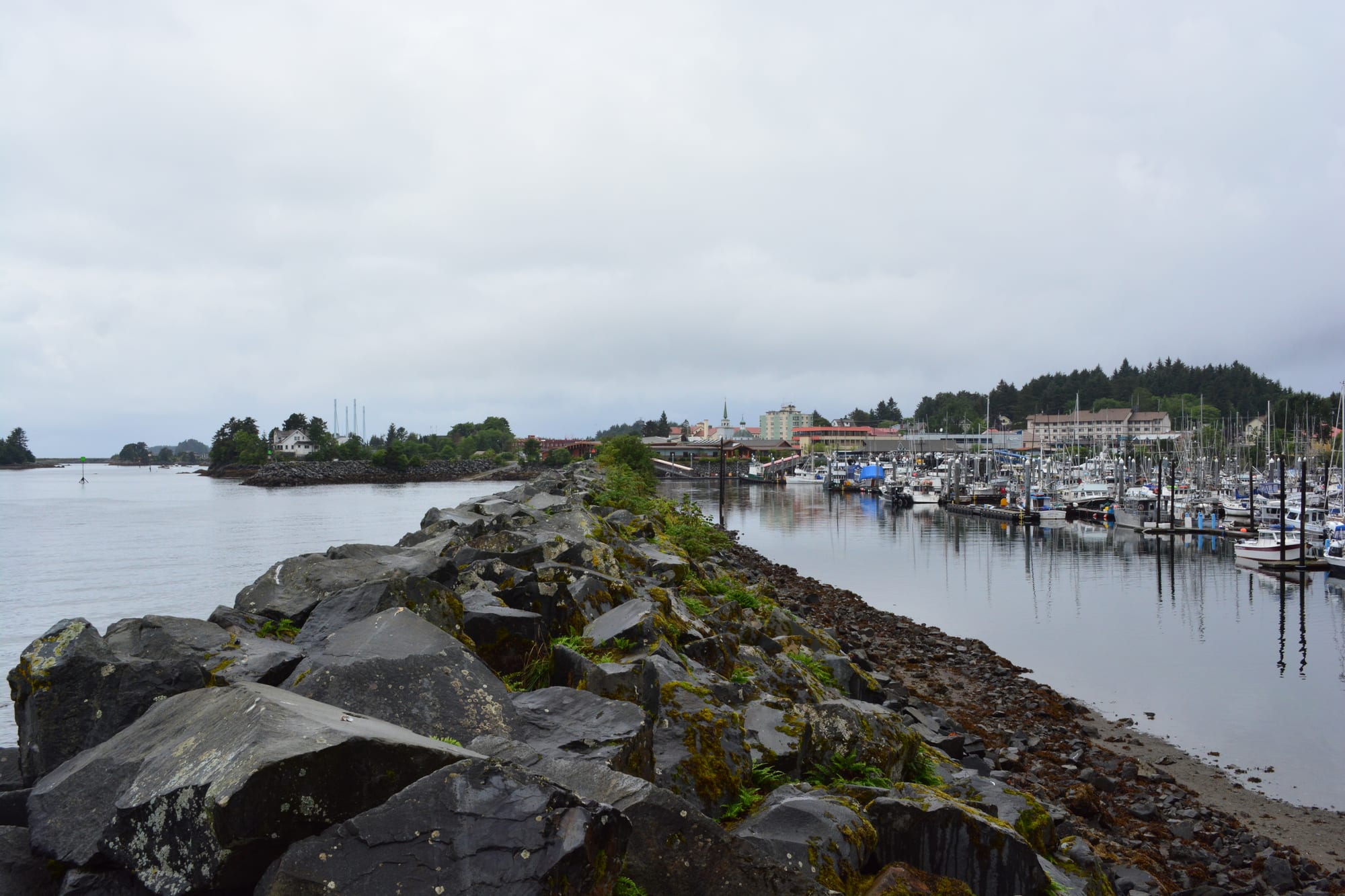
A rocky breakwater beside Crescent Harbor's moored fishing boats, with downtown Sitka and forested hills under grey cloud

Alaska, United States

Sitka

The breakwater and fishing boats of Crescent Harbor, with downtown Sitka behind. (Joe Mabel / Wikimedia Commons · CC BY-SA 4.0)

A fishing town on the outer coast of Baranof Island in Southeast Alaska, Tlingit land long before it became, as New Archangel, the capital of Russian America. The transfer of Alaska to the United States took place here in 1867. Today it is a small, rain-washed harbour town of fishing boats, onion-domed churches, totem poles and wildlife in Sitka Sound.

Neighbourhoods

  • Downtown and Lincoln Street
    • First-time visitors
    • Historic district
    • Shops and cafés

    The old centre between Castle Hill and Crescent Harbor, where Lincoln Street runs past St Michael's Cathedral, the Russian Bishop's House, galleries, cafés and the boat harbours. Most of the town's sights lie along or just off this street, and the totem park is a short walk east along the shore.

    Open in Maps
  • Japonski Island
    • Airport
    • Views of the town

    The island across Sitka Channel, joined to downtown by the O'Connell Bridge, holding the airport, a Coast Guard station and Mount Edgecumbe High School. Its shore gives views back across the channel to the cathedral dome and the mountains.

    Open in Maps
  • Halibut Point Road and the north shore
    • Quiet and residential
    • Forest walks

    The road running north-west from downtown along Sitka Sound, lined with houses, small harbours and beaches facing the islands and the cone of Mount Edgecumbe. It leads towards the ferry terminal, about 7 miles north of downtown.

    Open in Maps

Things to do

Tlingit and Russian heritage

  • Sitka National Historical Parkpark

    The site of the 1804 battle between the Tlingit and the Russians, where a coastal forest trail is lined with totem poles, many of them from Haida villages, and a visitor centre with demonstrations of Alaska Native arts and crafts.

    Open in Maps
  • Russian Bishop's Housemuseum

    A log building completed in 1843 for the Orthodox bishop of Alaska, one of the oldest surviving buildings of Russian America, restored by the National Park Service.

    Open in Maps
  • St. Michael's Cathedrallandmark

    The onion-domed Orthodox cathedral in the middle of Lincoln Street, a faithful rebuilding of the 1840s church that burned in 1966; most of its icons were saved from the fire.

    Open in Maps
  • Castle Hillviewpoint

    The rocky hill above the harbour where Russian governors lived and where Alaska was formally handed to the United States on 18 October 1867, with views over Sitka Sound.

    Open in Maps
  • Sheldon Jackson Museummuseum

    A state museum in an 1890s concrete building holding more than 5,000 objects from Alaska Native peoples, among them Aleut, Athabascan, Eskimo and Tlingit work.

    Open in Maps

Wildlife and the sound

  • Alaska Raptor Centerattraction

    A rehabilitation centre for injured bald eagles, owls and other birds of prey, with birds that cannot be released kept in view of visitors.

    Open in Maps
  • Sitka Soundviewpoint

    The island-dotted sound in front of the town, where boat trips look for sea otters, humpback whales, sea lions and seabirds.

    Open in Maps

Short trips from the town

  • Mount Edgecumbeviewpoint

    The dormant volcano on Kruzof Island whose snow-streaked cone dominates the view west across the sound, reached only by boat and a long hike.

    Open in Maps

Seasonal events

  • Alaska Day Festival18 October

    The annual commemoration of the 1867 transfer, with a parade and a re-enactment of the flag-raising.

  • Sitka Summer Music FestivalJune

    A chamber music festival founded in 1972, with concerts in Harrigan Centennial Hall overlooking the harbour.

Eat and drink

Long-standing places and food districts in Sitka. Hours, ratings and directions come from your maps app, always current.

Sitka classics

  • Seafood on Lincoln Streetneighborhood

    The cafés and restaurants of the old centre serve the local catch — halibut, salmon, black cod, Dungeness crab and spot prawns — in chowders, fish and chips and grilled plates.

    Open in Maps
  • Restaurants near the harboursneighborhood

    Casual places around Crescent Harbor and the waterfront cater to fishermen and visitors alike, with coffee, baked goods and simple seafood.

    Open in Maps

Food to take home

  • Smoked and frozen fishmarket

    Local processors and fish shops sell smoked salmon and frozen fillets packed for travel, a common way to take Sitka's fishing home.

    Open in Maps

Experience Sitka

History

Sitka stands in the homeland of the Sheet'ká Kwáan, the Tlingit people of Baranof Island's outer coast, who fished, traded and built clan houses here long before Europeans arrived. In 1799 Alexander Baranov of the Russian-American Company built a fort a few miles north of the present town; Tlingit warriors destroyed it in 1802. Baranov returned with warships in 1804, and after the Battle of Sitka the Tlingit withdrew from their fort near the Indian River. The Russians built New Archangel on and around Castle Hill, and from 1808 it was the capital of Russian America.

For decades New Archangel was a busy port on the Pacific coast of North America and a base for the fur trade, and from 1848 the seat of the Orthodox cathedral of St Michael. On 18 October 1867 the Russian flag was lowered on Castle Hill and Alaska passed to the United States. Sitka remained the seat of government until 1906, when the capital moved to Juneau. A Presbyterian mission school opened here in 1878 and later took the name of the missionary Sheldon Jackson, and in 1912 the Alaska Native Brotherhood, which campaigned for Native civil rights, was founded in Sitka.

In 1937 the Navy established the first seaplane base in Alaska on Japonski Island, which became a large military installation during the Second World War; in 1947 part of it became the Mount Edgecumbe boarding school for rural Alaska Native students. A pulp mill opened in 1959 and closed in 1993, and since then fishing, health care, education and tourism have carried the town's economy.

Culture & Customs

Sitka's identity is layered. Tlingit culture is the oldest and most visible, in the totem poles of the historical park, the Sheet'ká Kwáan Naa Kahídi community house, and dances, carving and the harvest of herring eggs on hemlock branches each spring. Russian heritage survives in the cathedral, the Bishop's House and the Orthodox congregation.

The American period added the Lutheran and Presbyterian churches, the Pioneer Home for elderly Alaskans on the site of old Russian-built barracks and a strong tradition of education. Every October the Alaska Day Festival re-enacts the 1867 transfer, with a parade through town, and each June the Sitka Summer Music Festival fills Harrigan Centennial Hall with chamber music.

The town also has an unusually strong scientific and artistic community for its size, with marine researchers, writers and craftspeople drawn by the setting. Residents are used to rain, small boats and visitors, and conversation often turns to the fishing season, the weather and the wildlife in the sound.

Daily Life

About 8,500 people live in the City and Borough of Sitka, a municipality that covers a huge area of mountains, forest and islands, though almost everyone lives along the few miles of road around the town. It is the fifth-most populous city in Alaska and, by total area, the largest city in the United States.

Commercial fishing is the backbone: Sitka is one of the most valuable fishing ports in Alaska, landing salmon, halibut, black cod and herring, and processing plants run hard in summer. The regional Native health consortium's hospital, schools, the Coast Guard air station and tourism are the other large employers. Many residents combine jobs, fishing in summer and working on land in winter.

Daily life follows the boats and the seasons: harbours busy before dawn in summer, long dark evenings in winter, and weekends spent hiking, hunting deer or fishing for the freezer. Current issues include the cost of housing, the number of cruise passengers the town wants to receive, and the pressures of climate change and ocean warming on the fisheries.

Food

Sitka eats from the sea. King, coho and sockeye salmon, halibut and black cod, also called sablefish, are caught by the town's fleet and appear on menus as grilled fillets, chowder, fish tacos and fish and chips. Dungeness crab and spot prawns, large sweet shrimp caught in traps, are seasonal treats, and smoked salmon is a staple in many homes.

Tlingit food traditions remain strong. Herring eggs gathered on hemlock branches each spring are eaten fresh or dried, salmon is smoked and dried in strips, and seaweed, berries and Sitka black-tailed deer are harvested through the year. Wild blueberries, salmonberries and huckleberries are picked in late summer and turned into jams and pies.

Because most other food arrives by barge or plane, home cooking leans on the freezer and on what can be caught or picked, and community potlucks and church dinners are common. The cafés, bakeries and restaurants downtown serve coffee to fishermen early in the morning and seafood to visitors through the summer.

Planning tools

Budget

Like the rest of Southeast Alaska, Sitka is expensive: it has no road link to the outside world, and most goods arrive by barge or plane. Rooms are limited and dearest in July and August. Wildlife cruises, fishing charters and flightseeing are the main extra costs; the historical park, the harbours and the trails are free.

Daily Budget Midrange
USD 260–450 (hotel or bed-and-breakfast room, restaurant meals, a wildlife boat trip or museum tickets)
Daily Budget Shoestring
USD 110–180 (hostel bed or campground, self-catering and casual meals, walking)

Book rooms early for summer, and expect the town to be at its busiest when several cruise ships are in port.

Best Time to Visit

May to September, when days are long, boats run and the town is fully open; June to August is the warmest period, though rain is possible at any time. Autumn brings the Alaska Day festival in October. Winter is mild for Alaska but dark, wet and quiet.

Suggested Number of Days

The historic centre and its museums fit comfortably into two or three days. More time is needed for boat trips into the sound, fishing, kayaking or hiking, and for the weather, which can cancel trips and flights.

First Visit
2–3 days
With Surroundings
4–6 days

Transportation

The road network is short, running only a few miles north and south of downtown. The centre is walkable, a small local bus system and taxis cover the rest, and cars and bicycles can be hired. Boats and floatplanes are the only way to reach the outer islands.

Leave slack in any onward plans: fog and storms delay flights and boats in every season.

Airport & Station Connections

Sitka cannot be reached by road. The airport on Japonski Island, a few minutes from downtown across the O'Connell Bridge, has jet flights from Juneau, Anchorage and Seattle. Alaska Marine Highway ferries call at a terminal north of town, and many summer visitors arrive on cruise ships, coming ashore by tender or from a dock outside the centre with shuttles into town.

Walkability

Downtown is compact and easy to walk, and a waterfront path leads from the harbours to the totem park. Pavements are good in the centre, but outside it many roads have narrow verges. Waterproof shoes and a rain jacket are needed in every season.

Safety

Crime is low. The risks are natural: brown bears are common on Baranof Island, trails can be steep and slick, the sea is cold enough to kill quickly, and weather changes fast. Small boats and floatplanes are part of daily life and depend on good conditions.

Carry bear spray and make noise on forest trails, wear a life jacket on small boats, and check the forecast before any trip on the water. Check current official travel advice before travelling.

Climate

An oceanic climate, mild for Alaska and very wet: rain falls on most days of the year, and snow is lighter than in most of the state.

Summer
cool and changeable — the August mean temperature is about 57 °F, and highs reach 70 °F on only about five days a year
Winter
mild for Alaska but wet and dark — the January mean temperature is about 36 °F, with rain more common than snow

Local Customs

Tipping follows American norms, roughly 18–20 per cent in restaurants. Sitka is a working fishing town with a large Tlingit community, and the Sitka Tribe of Alaska is a visible presence. Orthodox services are held at St Michael's Cathedral; visitors are welcome but should dress modestly and keep quiet during worship.

Ask before photographing people, carvers at work or ceremonies; treat totem poles and graves as cultural heritage, not props. Identification is asked for when buying alcohol (the legal age is 21).

Common Payment Methods

The currency is the US dollar. Cards are accepted almost everywhere, there are cash machines downtown, and a little cash is useful for small shops and local buses.