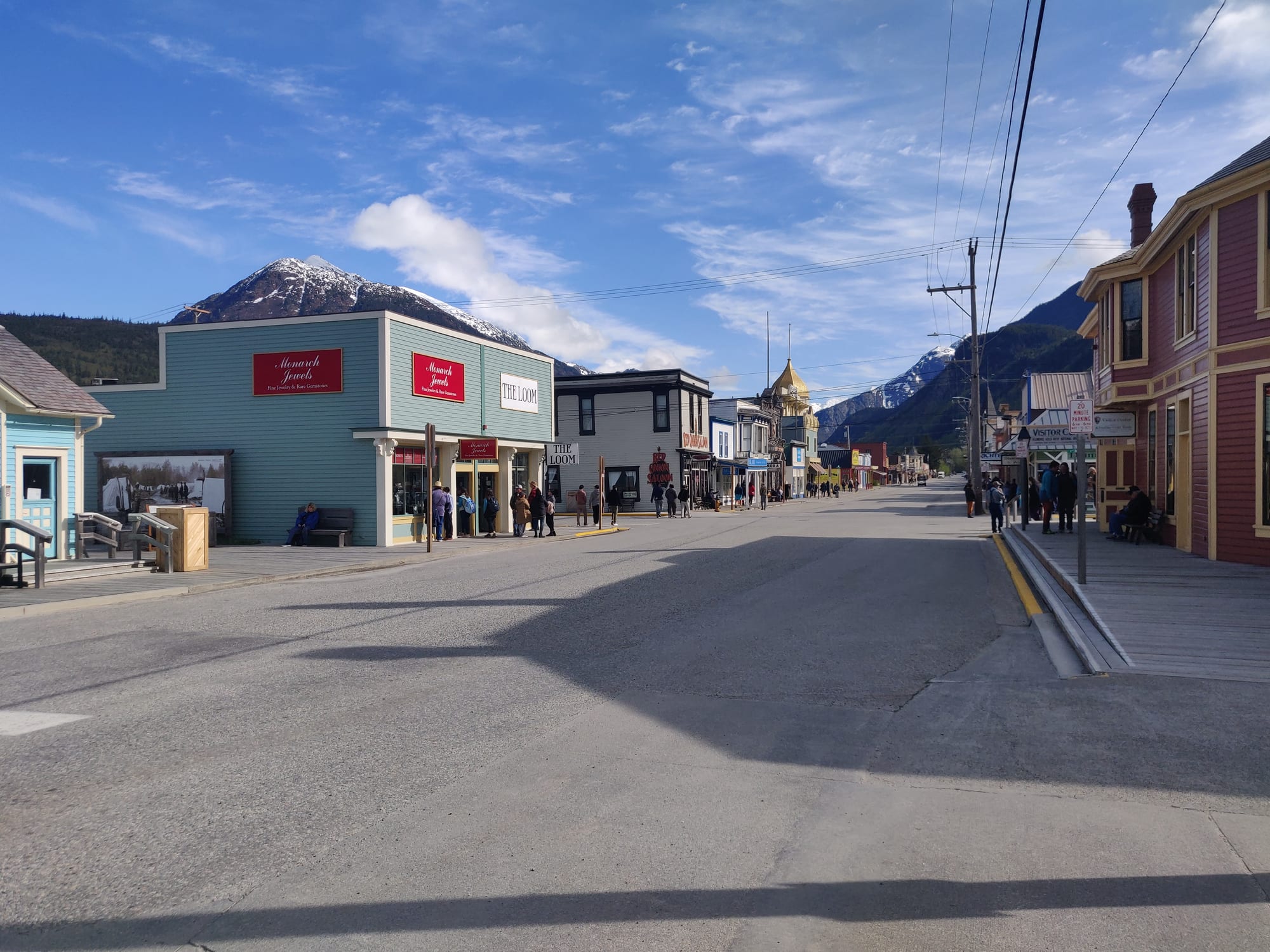
Broadway in Skagway, a wide street of painted wooden shopfronts under a blue sky, with snow-capped mountains beyond

Alaska, United States

Skagway

Broadway, the main street of Skagway's gold-rush historic district. (Pabernosmatao / Wikimedia Commons · CC BY-SA 4.0)

A small town at the head of Taiya Inlet, the northern arm of the Lynn Canal in Southeast Alaska, born in 1897 as the main gateway to the Klondike gold fields. Its false-fronted wooden main street is now a national historical park, the White Pass railway still climbs into the mountains behind it, and in summer cruise passengers far outnumber the year-round residents.

Neighbourhoods

  • Broadway and the historic district
    • First-time visitors
    • Historic district
    • Shops and saloons

    A grid of a few blocks running inland from the docks, with Broadway at its centre: restored gold-rush buildings with false fronts and wooden boardwalks, many of them owned by the National Park Service. Shops, saloons and restaurants fill it in summer, and it empties almost completely in winter.

    Open in Maps
  • The waterfront and the railway depot
    • Close to the docks
    • Train departures

    The south end of town, where cruise ships tie up at the docks and the White Pass and Yukon Route trains leave from the depot beside them. Small boat harbours, the ferry terminal and the start of short trails along the shore are all within a few minutes' walk of Broadway.

    Open in Maps
  • Dyea
    • Hiking
    • Quiet and remote

    The site of Skagway's rival gold-rush town, about 15 minutes from Skagway by road, where the Chilkoot Trail begins. Almost nothing of the town survives beyond cemeteries and scattered foundations in the woods, and the valley is now quiet forest, tidal flats and a campground.

    Open in Maps

Things to do

Gold-rush landmarks

  • Klondike Gold Rush National Historical Parkmuseum

    The national park unit that protects much of downtown, with its visitor centre in the old railway depot and restored buildings telling the story of the stampede of 1897–98.

    Open in Maps
  • Arctic Brotherhood Halllandmark

    A fraternal hall built in 1899 whose facade is covered in driftwood, one of the landmark buildings of the historic district.

    Open in Maps
  • Jeff. Smith's Parlormuseum

    The small saloon the con man Soapy Smith used as the base of his gang in 1898, later a private museum and now part of the national historical park.

    Open in Maps
  • The Days of '98 Showattraction

    A long-running stage show in Skagway that retells the story of Soapy Smith and the stampede of 1898.

    Open in Maps

Railway and trails

  • White Pass and Yukon Routetransit hub

    A narrow-gauge railway built over the mountains to the Yukon between 1898 and 1900, now running excursion trains from the Skagway depot up to the White Pass summit and beyond.

    Open in Maps
  • White Passviewpoint

    The mountain pass at the head of the Skagway River valley, on the border with British Columbia, crossed by both the railway and the Klondike Highway.

    Open in Maps
  • Chilkoot Trailtrail

    The stampeders' route from Dyea over the Chilkoot Pass to Lake Bennett, about 33 miles, now a multi-day hike that needs a permit and crosses into Canada.

    Open in Maps

Short trips from the town

  • Carcrossattraction

    A small Yukon community between Bennett Lake and Nares Lake, reached by the Klondike Highway or by the railway, with the Carcross Desert nearby.

    Open in Maps
  • Hainesattraction

    A fishing town across the water on the Chilkat Peninsula, reached by ferry, known for the bald eagles that gather in the Chilkat Bald Eagle Preserve between October and February.

    Open in Maps

Eat and drink

Long-standing places and food districts in Skagway. Hours, ratings and directions come from your maps app, always current.

Skagway classics

  • Red Onion Saloonrestaurant

    A saloon at the corner of Broadway and Second Avenue, in the heart of the gold-rush historic district.

    Open in Maps
  • Restaurants on Broadwayneighborhood

    Most of the town's places to eat line Broadway and the streets just off it, serving halibut and chips, salmon, crab and burgers through the summer season.

    Open in Maps

Seafood

  • Seafood near the harbourneighborhood

    Dungeness and king crab, halibut and smoked salmon from Southeast Alaska's fisheries are the standard order around the waterfront.

    Open in Maps

Experience Skagway

History

The routes from the head of Taiya Inlet over the coastal mountains were Tlingit trade paths to the interior long before the gold rush. In 1887 Captain William Moore and his son claimed a 160-acre homestead at the mouth of the Skagway River, and the same year Moore investigated the pass behind it, later known as the White Pass. Ten years later, after news of the Klondike strike reached Seattle in July 1897, thousands of stampeders landed on the beach, pushed Moore aside and built a town of tents and saloons almost overnight.

Skagway and its rival Dyea were the two starting points for the trek to the gold fields: the White Pass from Skagway, the Chilkoot Pass from Dyea. For a few months in 1898 the town was largely run by the con man Jefferson Randolph "Soapy" Smith and his gang, until he was shot dead on the Juneau Wharf in July 1898 in a gunfight with Frank Reid, who died of his own wounds days later. The White Pass and Yukon Route railway, finished to Whitehorse in 1900, gave Skagway a lasting role as the rush faded and Dyea was abandoned.

For most of the 20th century Skagway was a railway and port town. The line closed in 1982, when Yukon mining slumped, and reopened in 1988 for tourist trains. The Klondike Gold Rush National Historical Park was created in 1976, and its restoration of the downtown buildings, together with the growth of Inside Passage cruising, turned Skagway into one of the busiest summer stops in Alaska.

Culture & Customs

Skagway's identity rests on the gold rush, and the town tells the story constantly — in park ranger walks, saloon tours and the legend of Soapy Smith, whose death is still marked locally each July. Much of the downtown is owned and restored by the National Park Service, so the look of 1898, with false-fronted buildings and boardwalks, is preserved by law rather than staged.

Behind the tourist face is a tight community of about a thousand people who share the outdoors: hiking the trails above town and taking boats out on the Lynn Canal. Many residents are seasonal workers who come for the summer, and the town's mood changes sharply when the last cruise ship leaves in autumn and the population settles back to its year-round core.

Skagway also looks north as much as south. The road to Whitehorse makes it closer in daily life to the Yukon than to Juneau, which cannot be reached by road, and Canadians drive down for the sea air, the shops and the port. The Tlingit history of the Chilkoot route and the human cost of the gold rush, which disrupted Native trade and land, are part of how the story is told today.

Daily Life

About 1,200 people live in the Municipality and Borough of Skagway, and almost all of them live in the town itself, on a narrow valley floor between steep mountains. The population roughly doubles in summer with seasonal workers who staff shops, tours, the railway and restaurants, and on a busy day the cruise ships bring several times the town's own population ashore.

Tourism is by far the main industry: the railway, the National Park Service, tour operators and the shops on Broadway employ most people. The White Pass railway also carries copper ore from the interior, and the road and ferry links make the town a supply point for travellers heading north. Winter is long and quiet, many businesses close, and those who stay rely on a small school, a clinic, a few shops and each other.

Current debates centre on how many cruise passengers the town can handle and the cost and difficulty of housing seasonal workers in a valley with very little flat land.

Food

Skagway's food is the food of Southeast Alaska: salmon, halibut and crab caught in the surrounding waters, eaten as fish and chips, grilled fillets, chowder or smoked strips. Halibut and chips is the standard order on Broadway in summer, and Dungeness and king crab appear on most menus during the season.

The gold rush left its own traditions. Sourdough bread and pancakes recall the prospectors who carried their starter over the passes, and old-timers in Alaska are still called sourdoughs. The starter was favoured because yeast and baking soda were much less reliable in the conditions the prospectors faced. Wild berries from the hills are turned into jams, pies and syrups.

Because almost everything else comes up by barge or down the highway from Whitehorse, meals in the town are simple and seasonal, and many restaurants close for the winter. The saloons on Broadway keep the atmosphere of 1898, while a few cafés and bakeries cater to the residents and the summer workers.

Planning tools

Budget

Skagway is expensive by mainland American standards: almost everything arrives by barge or truck, and the season for rooms and restaurants is short. The White Pass railway, flightseeing and other excursions are the main extra costs, while the historic district, its museums and the trails around town cost little or nothing.

Daily Budget Midrange
USD 280–500 (hotel or inn room, restaurant meals, a railway excursion or a guided trip)
Daily Budget Shoestring
USD 110–180 (campground or hostel bed, self-catering and casual meals, walking and free park ranger tours)

Rooms are few, so book well ahead for July and August; many businesses close from late September to early May.

Best Time to Visit

May to September, when the railway runs, the shops and restaurants are open and the days are long. June to August is the warmest and busiest time. In winter the town is very quiet, with few services, short days and strong, cold winds down the valley.

Suggested Number of Days

The town itself is small, and many visitors come for a single day from a cruise ship. Staying one or two nights allows a calmer look at the town once the ships leave; hiking the multi-day trail from Dyea or driving into the Yukon adds several more.

First Visit
1–2 days
With Surroundings
3–5 days

Transportation

Downtown is walkable, and most visitors need no vehicle there. Taxis, tour vans and shuttles cover Dyea and the trailheads, cars can be hired for the drive to the Yukon, and bicycles are a common way to reach the edges of town.

Driving north on the Klondike Highway means a Canadian border crossing within a few miles of the summit; carry a passport.

Airport & Station Connections

Most visitors arrive by cruise ship along the Inside Passage. The Alaska Marine Highway ferries connect Skagway with Haines and Juneau, small planes fly from Juneau to the town's airport, and the Klondike Highway links it by road with Whitehorse in the Yukon, about 110 miles away, which has the nearest larger airport.

Walkability

Very walkable. The historic district, the docks, the depot and the small boat harbour are all within about half a mile of each other on flat ground, with trails into the hills starting at the edge of town. Dyea and the White Pass summit are too far to walk.

Safety

Crime is very low. The risks are natural: bears on the trails, steep and slippery mountain paths, cold water and sudden changes in weather. On the Chilkoot Trail, avalanche danger lingers into late May on the pass.

Carry bear spray and make noise on trails, check trail and weather conditions with park rangers before hiking, and carry a passport for any trip into Canada. Check current official travel advice before travelling.

Climate

Skagway lies in the rain shadow of the coastal mountains and is noticeably drier than most of Southeast Alaska, though still cool and changeable. Strong winds funnel down the valley, especially in winter.

Summer
mild — July highs average about 67°F and nights about 51°F, with long hours of daylight
Winter
cold and windy — January highs average about 29°F and nights about 20°F, with strong north winds and snow

Local Customs

Tipping follows American norms, roughly 18–20 per cent in restaurants. The town lives on the summer season, and residents are used to large crowds on cruise-ship days and very quiet streets otherwise. Dyea and the Chilkoot Trail were Tlingit trade routes long before the gold rush, and the Tlingit heritage of the area is part of the park's story.

Identification is asked for when buying alcohol (the legal age is 21). Ask before photographing people, and treat graves and historic remains at Dyea with respect.

Common Payment Methods

The currency is the US dollar. Cards are accepted in most shops, restaurants and on the railway, and there are cash machines in town. Canadian dollars are sometimes accepted but not reliably.