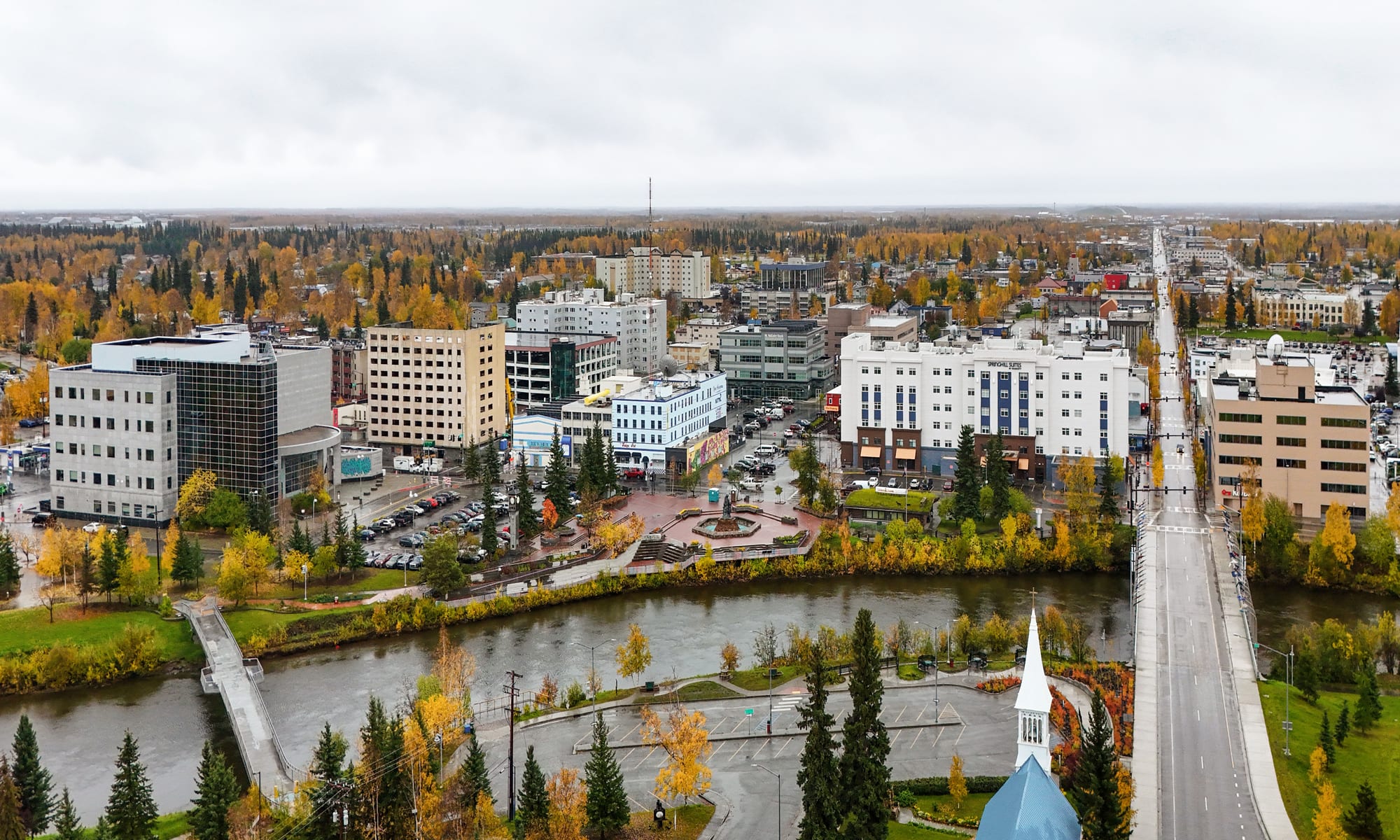
Aerial view of downtown Fairbanks in autumn, with low office blocks, a plaza and a footbridge over the Chena River among yellow birches

Alaska, United States

Fairbanks

Downtown Fairbanks above the Chena River in September 2024. (Quintin Soloviev / Wikimedia Commons · CC BY 4.0)

Interior Alaska's largest city, on the Chena River in the Tanana Valley, founded as a trading post in 1901 and made by a gold rush, military airfields and the Trans-Alaska Pipeline. Today it is a university and army town of long summer days and fiercely cold winters, and one of the best places to watch the northern lights.

Neighbourhoods

  • Downtown
    • First-time visitors
    • Historic district
    • Close to the river

    The original town on the south bank of the Chena River, where Barnette's trading post stood. Low office blocks, bars and restaurants surround Golden Heart Plaza, and the Morris Thompson Cultural and Visitors Center is a short walk from the old bridges.

    Open in Maps
  • College and the university
    • Museums
    • Students
    • Views

    The hilltop campus of the University of Alaska Fairbanks and the residential district around it, beside the city limits. The Museum of the North and the Georgeson Botanical Garden are on campus, and Creamer's Field and the fairgrounds lie along College Road.

    Open in Maps
  • Airport Way and the west side
    • Families
    • Practical base
    • Close to the airport

    The commercial strip between downtown and the airport, lined with chain hotels, shops and restaurants. Pioneer Park sits beside the river here, and the riverboat landings and many visitor services are a short drive away.

    Open in Maps
  • Ester and the hills
    • Quiet and residential
    • Gold rush history

    A former gold-mining camp founded in the early 1900s outside the city, now a small community whose old camp is a historic district.

    Open in Maps

Things to do

Museums and history

  • University of Alaska Museum of the Northmuseum

    The university's museum of natural history, Alaska Native cultures and art on the campus hilltop, the only research and teaching museum in Alaska accredited by the American Alliance of Museums.

    Open in Maps
  • Pioneer Parkpark

    A 44-acre park on the Chena River laid out like a gold rush town, with relocated historic cabins, several small museums, a replica Native village and a salmon bake; entry to the park is free.

    Open in Maps
  • SS Nenanaattraction

    A five-deck sternwheeler launched in 1933 that carried passengers and freight on Alaska's rivers, now dry-docked in Pioneer Park.

    Open in Maps
  • Morris Thompson Cultural and Visitors Centermuseum

    The downtown cultural and visitor centre, dedicated in 2008 and named after the Alaska Native leader Morris Thompson.

    Open in Maps
  • Goldstream Dredge No. 8attraction

    A ladder dredge that worked the gold-bearing gravels north of the city from 1928 to 1959, now a historic site with summer tours and gold panning.

    Open in Maps

Parks and nature

  • Creamer's Field Migratory Waterfowl Refugepark

    A 2,200-acre bird sanctuary around a former dairy farm, partly inside the city, where sandhill cranes, swans, geese and more than 100 other species stop on their spring and autumn migrations.

    Open in Maps
  • Georgeson Botanical Gardenpark

    A five-acre research garden on the university campus, open to the public from May to September, showing what grows in the subarctic summer.

    Open in Maps
  • Golden Heart Plazapark

    The small riverside square downtown, centred on a statue of an Alaska Native family commissioned for the 25th anniversary of statehood, beside the Chena River.

    Open in Maps

Short trips from the city

  • North Poleneighborhood

    A small city south-east of Fairbanks that has turned its name into a year-round Christmas theme, with a post office whose postmark is sought for Christmas cards and letters.

    Open in Maps
  • Chena River State Recreation Areapark

    A large state park along the upper Chena River with campgrounds, hiking, sled dog and snowmachine trails, catch-and-release grayling fishing and outcrops of granite tors.

    Open in Maps
  • Chena Hot Springsattraction

    A hot spring community at the end of the road through the Chena valley, about 56 miles north-east of the city, known for its hot springs, aurora viewing and an ice museum.

    Open in Maps

Seasonal events

  • World Ice Art ChampionshipsFebruary to March

    The largest ice-sculpting contest of its kind in the world, drawing more than 100 sculptors from around 30 countries to a park on College Road.

  • Midnight Sun GameSummer solstice, June

    A baseball game first played in 1906, held late into the night of the summer solstice without artificial light; the Alaska Goldpanners have hosted it since 1960.

  • Golden DaysJuly

    A week-long celebration of Fairbanks history and the 1902 gold discovery, with a parade.

  • World Eskimo-Indian OlympicsJuly

    Four days of traditional Indigenous games and survival skills from across the Circumpolar North, held in Fairbanks.

  • Tanana Valley State FairLate July to early August

    Interior Alaska's big summer fair, on fairgrounds along College Road, with rides, food stands, competitive exhibits and live music.

Eat and drink

Long-standing places and food districts in Fairbanks. Hours, ratings and directions come from your maps app, always current.

Fairbanks classics

  • Alaska Salmon Bakerestaurant

    A salmon bake inside Pioneer Park, popular with tour groups and good value for budget travellers.

    Open in Maps
  • Reindeer and game dishesneighborhood

    Reindeer, bison and other game dishes appear on many Fairbanks menus alongside standard American food.

    Open in Maps

Bars and breweries

  • HooDoo Brewingrestaurant

    A local craft brewery west of downtown and north of Pioneer Park.

    Open in Maps
  • Downtown bars and restaurantsneighborhood

    The streets around Golden Heart Plaza hold the city's oldest bars, cafés and restaurants, a short walk from the river.

    Open in Maps

Experience Fairbanks

History

Athabascan peoples have lived on and travelled through the land around Fairbanks for thousands of years. A camp about 3,500 years old has been excavated on the grounds of the University of Alaska Fairbanks, and sites on nearby Fort Wainwright date back more than 10,000 years; arrowheads from the university site resemble finds in Asia and were among the early evidence that people reached North America over the Bering land bridge.

In August 1901 the trader E. T. Barnette was set down with his supplies on the south bank of the Chena River, some seven miles above its meeting with the Tanana, and built a trading post. Smoke from his steamer caught the attention of the prospector Felix Pedro in the hills to the north, and Pedro's gold discovery set off the Fairbanks gold rush. Residents voted to incorporate the city in November 1903, with Barnette as its first mayor. By the First World War the population had collapsed, but it recovered in the Depression as the price of gold rose and large dredges such as Goldstream Dredge No. 8 worked the creeks.

The building of Ladd Field from the late 1930s, renamed Fort Wainwright in 1960, brought a wartime and Cold War boom. On 14 August 1967 the Chena burst its banks after record rain and flooded almost the whole town overnight; the Moose Creek Dam and a spillway were later built upstream to divert floodwater into the Tanana. After oil was found at Prudhoe Bay in 1968, Fairbanks became a supply point for the oil field and the Trans-Alaska Pipeline, and the Elliott Highway leads north from the city to the start of the Dalton Highway.

Culture & Customs

Fairbanks's culture is shaped by the interior's extremes. Athabascan and other Alaska Native leaders have long been influential here, and the city hosts the World Eskimo-Indian Olympics each July, four days of traditional games and survival skills from across the Circumpolar North. The Morris Thompson Cultural and Visitors Center downtown is named after an Alaska Native leader who headed Doyon, the Native regional corporation for the interior.

The University of Alaska Fairbanks, founded in 1917 and opened in 1922, is the flagship campus of the state university system and a centre of Arctic research, and it gives the west side a student town feel. Its Nanooks ice hockey team plays at the Carlson Center, and the junior Fairbanks Ice Dogs at the Big Dipper Ice Arena. Dog mushing is woven into local life: Fairbanks is a home of the Yukon Quest, a 1,000-mile sled dog race regarded as one of the hardest in the world, and teams train on the trails around town.

The seasons set the calendar. In June the Midnight Sun Game, first played in 1906, runs late into the solstice night without artificial light, and July brings the Golden Days celebration of the gold rush. In late winter the World Ice Art Championships draw sculptors from around the world, and through the dark months the aurora, visible on more than 200 nights a year in the area, is part of ordinary life.

Daily Life

The 2020 census counted 32,515 people in the city of Fairbanks and 95,655 in the Fairbanks North Star Borough, the second largest metropolitan area in Alaska after Anchorage. Many residents live outside the city limits — in College around the university, in North Pole to the south-east and out towards Ester.

The economy rests on the military, the university and government, with tourism and the oil industry's supply routes north adding to it. Fort Wainwright lies within the city, and the university enrolled around 7,500 students in autumn 2024.

Daily life follows the extremes of light and temperature. Summer days are long and busy, with gardening, river trips on the Chena and evening sport in full daylight. In winter the sun shines for only a few hours and in a cold snap the city can disappear under ice fog. Fairbanks is the coldest city of its size in the United States, although its mean annual temperature rose by 3.9°F between 1949 and 2018.

Food

Fairbanks eats much like the rest of Alaska, with wild fish and game at the centre. Salmon is eaten fresh, smoked or dried, and it is served at the salmon bake in Pioneer Park. Many menus offer reindeer or bison alongside more familiar American food.

Sourdough has a special place in the interior: old-timers are still called sourdoughs, after the starter that prospectors carried into Alaska during the Klondike gold rush for baking bread, when yeast and baking soda were unreliable. Wild berries are picked in late summer, and the university's botanical garden researches the cultivation of Alaska's wild blueberries and lingonberries.

The Tanana Valley was an important farming area for Alaska in the early years of settlement, and agriculture continues today, mostly south-east of the city around Salcha and Delta Junction.

The city also has a range of Asian restaurants and a small craft brewing scene, and the Tanana Valley State Fair in late July and early August fills its grounds with food stands.

Planning tools

Budget

Fairbanks is expensive by mainland standards, as most of Alaska is: food and fuel are brought in from far away, and hotel rates are highest in the summer season. Winter rates are often much lower, though aurora tours, hot springs trips and cold-weather gear add to the cost. A hire car is the main extra for anyone travelling beyond the city.

Daily Budget Midrange
USD 260–480 (chain hotel or lodge, restaurant meals, a hire car, museum tickets and an aurora or riverboat tour)
Daily Budget Shoestring
USD 110–180 (hostel bed or budget room, supermarket food and diners, local buses, free museums and parks)

Compare summer and winter rates — the same room can cost far less out of season. Pioneer Park, Creamer's Field, Golden Heart Plaza and the visitor centre are free.

Best Time to Visit

Two seasons draw visitors. June and July bring the midnight sun, when it never gets fully dark, warm days and the summer festivals. For the northern lights, the region's guidance is from about late August to April, when the nights are dark; the aurora cannot be seen in the bright summer months. February and March add longer days and the ice sculpture championships to the aurora season.

Suggested Number of Days

Two or three days cover the city itself. Winter visitors usually stay longer to allow several nights for clear skies, since cloud can hide the aurora for days at a time, and a trip into the hills or out to the hot springs adds a day or more.

First Visit
2–3 days
With Surroundings
4–6 days

Transportation

Fairbanks is spread out along highways and river bends, and a hire car is the practical way to get around. The borough's public buses run infrequently but link much of the urban area, including North Pole. Taxis and tours fill the gaps.

In winter, use a car with an engine block heater and plug it in overnight, carry warm clothing in the vehicle, and drive slowly on ice and in ice fog.

Airport & Station Connections

Fairbanks International Airport is about three miles south-west of downtown, a short taxi ride, with flights from Anchorage and direct flights from several mainland cities. The Alaska Railroad runs daily trains from Anchorage in summer, stopping at Denali National Park, with a reduced service in winter. By road the drive from Anchorage takes around seven to eight hours in summer.

Walkability

Downtown is compact and easy to walk, and the Chena Riverwalk follows the river. Beyond that the city was built for driving, with long distances between the university, the shopping strips and the sights. In winter, extreme cold, ice and darkness make even short walks a challenge.

Safety

For most visitors the US is safe, with the main risks being petty theft and car break-ins in tourist areas of some cities, road accidents over long distances, extreme weather, and the hazards of the outdoors. In Fairbanks the cold is the greatest danger: temperatures reach −40°F on several days in an average winter. The crime rate is higher than the Alaska average, which is itself above the national average.

Dress in layers rated for extreme cold, carry emergency supplies when driving out of town in winter, give moose plenty of room, and leave nothing visible in parked cars. Check current official travel advice before travelling.

Climate

Subarctic, bordering on continental, and far from the sea. Fairbanks is the coldest US city of 10,000 people or more, yet summers are warm and the temperature has passed 50°F in every month of the year. Winter cold often traps exhaust and breath in thick ice fog. Daylight ranges from near-continuous in June to only a few hours in December.

Summer
warm — July averages about 63°F, around 13 days a year pass 80°F, and the record is 99°F
Winter
extremely cold — January averages about −8°F, the temperature falls to −40°F on about seven days a year, and the record low is −66°F

Local Customs

Tipping is expected: roughly 18–22 per cent in restaurants, and about a dollar a drink in bars. Fairbanks has no sales tax. Dress is practical and informal everywhere, and in winter heavy parkas, boots and layers are normal even in restaurants. Fairbanks sits on Athabascan land, and Alaska Native culture is part of daily life in the city.

Identification is asked for when buying alcohol (the legal age is 21). Ask before photographing people, especially at Native cultural events.

Common Payment Methods

The currency is the US dollar. Cards and contactless payment are accepted almost everywhere in the city, and ATMs are easy to find. Carry some cash for rural stops, small vendors and tips if travelling beyond the city.