Sandstone buttes glowing orange in low evening sun above a red desert plain dotted with yucca and dry grass

United States

The Southwest

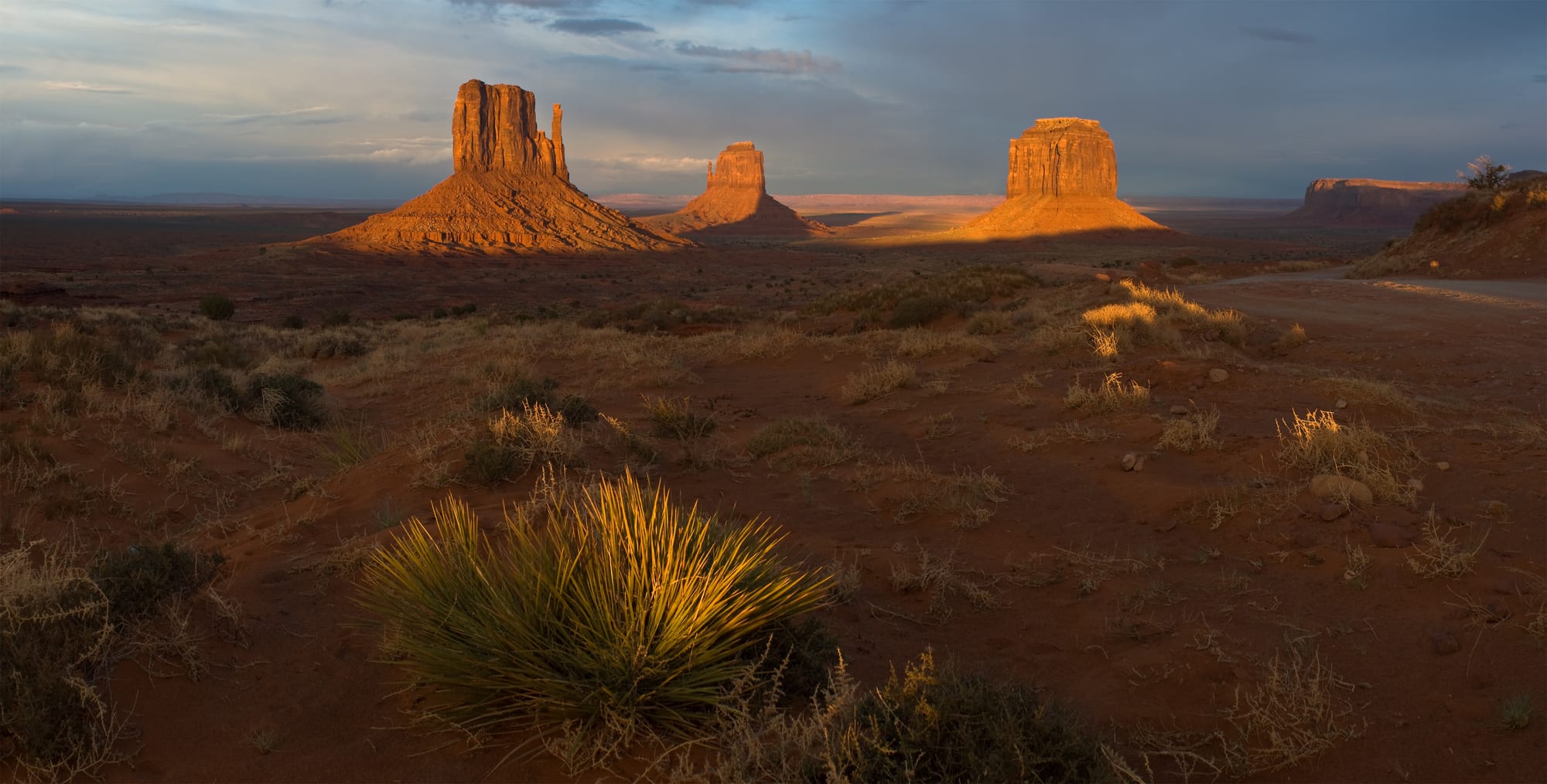
The Mittens and Merrick Butte at sunset in Monument Valley Navajo Tribal Park, Arizona. (Christian Mehlführer / Wikimedia Commons · CC BY 2.5)

The desert states of Arizona, New Mexico and Nevada, a land of canyons, mesas and sprawling Sun Belt cities where Native American, Spanish, Mexican and American histories overlap — home to the Grand Canyon, the Navajo Nation and the pueblos, old Santa Fe, and the casino city of Las Vegas.

Explore The Southwest

History

People have lived in these deserts for more than 12,000 years. The Hohokam dug hundreds of kilometres of irrigation canals in the Salt River valley where Phoenix now stands, and the Ancestral Puebloans built the great houses of Chaco Canyon and the cliff villages of Bandelier before moving towards the Rio Grande, where their descendants still live in New Mexico's pueblos and on the Hopi mesas. The Navajo and Apache arrived later, and the Tohono O'odham and Akimel O'odham farmed the Sonoran Desert.

Spanish expeditions under Coronado came north in 1540 looking for gold, and in 1598 Juan de Oñate founded the colony of New Mexico; Santa Fe, established around 1610, is the oldest state capital in the country. The Pueblo Revolt of 1680 drove the Spanish out for twelve years before reconquest in 1692. The region became part of Mexico in 1821, and the Santa Fe Trail opened trade with Missouri. After the Mexican–American War of 1846–48 the United States took most of the region, and the Gadsden Purchase of 1853 added southern Arizona, including Tucson. Conquest followed: in 1864 thousands of Navajo were forced on the Long Walk to Bosque Redondo, and the Apache wars ended with Geronimo's surrender in 1886.

Nevada became a state in 1864 on the wealth of the Comstock silver lode; Arizona and New Mexico followed only in 1912. The atomic bomb was designed at Los Alamos and first tested at Trinity in southern New Mexico in July 1945, and Japanese Americans were held during the war at Poston and Gila River in Arizona. Hoover Dam and Nevada's legalisation of gambling in 1931 made modern Las Vegas, and air conditioning after the war turned Phoenix into one of the largest cities in the country.

Culture & Customs

The Southwest is where Native, Hispanic and Anglo-American cultures meet most visibly. The Navajo Nation, spreading across north-eastern Arizona and into New Mexico and Utah, is the largest reservation in the country, and the Diné language is still widely spoken there; Navajo Code Talkers used it to pass unbreakable messages in the Second World War. New Mexico has nineteen pueblos, each with its own feast days and dances, and Arizona holds the Hopi mesas, the Tohono O'odham Nation and the Apache reservations.

Northern New Mexico's Hispano families trace their roots to Spanish colonists and keep a distinctive Spanish dialect, adobe churches and religious brotherhoods, while southern Arizona's culture is strongly Mexican-American and flows back and forth across the border. Adobe and Pueblo Revival buildings define Santa Fe, and turquoise and silver jewellery, Navajo weaving and pueblo pottery are living crafts sold directly by their makers.

Artists have gathered in Taos and Santa Fe since the early 20th century, most famously Georgia O'Keeffe. The calendar includes the Santa Fe Indian Market in August, the burning of the giant puppet Zozobra in Santa Fe on Labor Day weekend, the Albuquerque International Balloon Fiesta in October and Tucson's All Souls Procession in November. Nevada's culture is different again: casinos, showbusiness and a libertarian streak, with the Burning Man gathering in the Black Rock Desert each summer.

Daily Life

About 13 million people live in the three states: roughly 7.5 million in Arizona, over 3 million in Nevada and around 2 million in New Mexico. Most live in a few metropolitan areas. Phoenix has about 1.6 million people in a metro area of around 5 million that takes in Scottsdale, Mesa and Tempe; Las Vegas's metro area has over 2 million; Tucson and Albuquerque each have about 550,000. Santa Fe has around 90,000 and Reno about 270,000.

The economy combines tourism and gaming with copper mining in Arizona, oil and gas in the Permian Basin of south-eastern New Mexico, military bases and the national laboratories at Los Alamos and Sandia, and a growing semiconductor industry around Phoenix. Retirees and remote workers keep arriving, and Phoenix has spent years among the fastest-growing big cities in the country.

Life is shaped by the heat. In summer people in Phoenix and Las Vegas run errands at dawn, move from air-conditioned car to air-conditioned building, and spend weekends in the pines of Flagstaff or on the lakes. The big issues are water and heat: the Colorado River and Lake Mead have been shrinking, forcing cuts in supply, and Phoenix set a record in 2023 with a month of days at or above 110°F. Immigration and the border are debated here more directly than in most of the country.

Food

New Mexican cooking revolves around chile. Diners are asked "red or green?" — sauce made from dried red chile or roasted green chile — and answering "Christmas" gets both. Green chile from the Hatch area is roasted at harvest time, from August into October. Classic dishes include flat stacked enchiladas, carne adovada (pork braised in red chile), posole (hominy stew), blue-corn tortillas, sopaipillas (puffy fried bread eaten with honey) and biscochitos, anise-flavoured biscuits that are the state cookie.

Southern Arizona's food is Sonoran: large thin flour tortillas, carne seca (dried beef), chimichangas, which Tucson claims to have invented, and the Sonoran hot dog, wrapped in bacon and piled with beans, onions and salsa. Tucson was named a UNESCO City of Gastronomy for its long agricultural heritage. Across the Navajo Nation and at powwows, fry bread becomes the Navajo taco, topped with beans, meat and cheese. Prickly-pear cactus fruit turns up in sweets, syrups and margaritas.

Las Vegas has become a restaurant capital, with its famous buffets and outposts of celebrity chefs, while northern Nevada keeps a Basque tradition from immigrant shepherds, with family-style dinners and picon punch in Reno and Elko. Wine is made in Arizona's Verde Valley and around Willcox, and New Mexico has made wine since Spanish missionaries planted grapes in the 17th century.

Attractions & Natural Wonders

In northern Arizona the Grand Canyon is the centrepiece: the South Rim's viewpoints from Mather Point to Desert View, the Bright Angel and South Kaibab trails, the quieter North Rim, and Havasu Falls on the Havasupai reservation. Near Page lie Horseshoe Bend, Antelope Canyon and Lake Powell. Monument Valley's buttes, on the Navajo Nation at the Utah border, and the cliff dwellings of Canyon de Chelly lie east, with Petrified Forest National Park further south. Sedona sits among red-rock formations such as Cathedral Rock and Bell Rock at the mouth of Oak Creek Canyon, near the old mining town of Jerome.

Phoenix and Scottsdale offer the Heard Museum of Native art, the Desert Botanical Garden and Frank Lloyd Wright's Taliesin West. Around Tucson are Saguaro National Park's cactus forests, the white mission church of San Xavier del Bac and the Arizona-Sonora Desert Museum, with Tombstone to the south-east.

Nevada's attraction is Las Vegas: the Strip's casino resorts, Fremont Street downtown, and shows every night, with Hoover Dam, Red Rock Canyon and the Valley of Fire within an hour or so. Further north are Great Basin National Park and Reno.

In New Mexico, Santa Fe's plaza, the Palace of the Governors, Canyon Road's galleries and the Georgia O'Keeffe Museum form the heart of the old town. Taos Pueblo, a UNESCO World Heritage Site still inhabited in its multi-storey adobe houses, stands outside Taos, near the Rio Grande Gorge Bridge and Taos Ski Valley. Chaco Canyon and Bandelier preserve Ancestral Puebloan sites, Albuquerque has its Old Town and the Sandia Peak Tramway, and in the south White Sands' gypsum dunes and the huge chambers of Carlsbad Caverns are within a few hours of each other.

Cities in The Southwest

Planning basics

Budget

The Southwest is cheaper than the coasts overall. Albuquerque, Tucson and small-town New Mexico are good value, and Phoenix is mid-priced, but Sedona, Santa Fe and the Grand Canyon's rim lodges are expensive. Las Vegas room rates swing enormously: weekday rooms can be cheap, while weekends, big conventions and events send prices soaring, and resort fees are added to most Strip hotel bills. A rental car is the main fixed cost.

Daily Budget Midrange
USD 200–400 (mid-range hotels or casino resorts, sit-down meals, rental car, park and tribal-park fees)
Daily Budget Shoestring
USD 80–140 (motels or campgrounds, Mexican food and diners, economy rental car)

Stay midweek in Las Vegas and check the resort fee before booking; outside the Grand Canyon's own lodges, Tusayan, Williams and Flagstaff are the usual cheaper bases.

Safety

The main danger is the heat: every summer visitors suffer heat illness or die on desert and canyon trails, and hiking from the Grand Canyon's rim to the river and back in one day is a common cause of rescues. Monsoon flash floods sweep through slot canyons and dry washes. City crime is mostly property crime, with car break-ins at trailheads and in parts of Phoenix, Albuquerque and Las Vegas; Albuquerque's violent-crime rate is high by US standards. Tribal lands have their own laws, including alcohol bans and photography rules in some places.

Carry far more water than seems necessary, hike early in summer, never enter slot canyons when storms threaten, and respect tribal rules on photography and alcohol. Check current official travel advice before travelling.

Climate

Mostly arid and sunny, but altitude makes a huge difference. The low deserts around Phoenix, Tucson and Las Vegas are among the hottest places in the country in summer and mild in winter. The high country — Flagstaff, the Grand Canyon rims, Santa Fe and Taos — sits above 2,000 metres, with warm summers, cold snowy winters and freezing nights. The summer monsoon, roughly July to September, brings afternoon thunderstorms, dust storms and flash floods, especially in Arizona and New Mexico.

Summer
104–113°F in Phoenix and Las Vegas; 77–90°F in Santa Fe, Flagstaff and on the Grand Canyon's South Rim, with afternoon storms
Winter
59–72°F by day in Phoenix, Tucson and Las Vegas; below freezing at night and snow at Santa Fe, Taos, Flagstaff and the Grand Canyon

Transportation

Phoenix Sky Harbor and Las Vegas's Harry Reid airport are the main hubs, with Albuquerque and Tucson for the east and south. A car is essential: the Grand Canyon, Monument Valley, Sedona and Santa Fe lie hours apart on two-lane highways. Amtrak's Southwest Chief crosses northern Arizona and New Mexico with stops at Flagstaff, Albuquerque and Lamy near Santa Fe, and a heritage railway runs from Williams to the Grand Canyon. Phoenix has a light-rail line; Las Vegas has a monorail along the Strip.

Keep the fuel tank topped up on long empty stretches; Arizona outside the Navajo Nation does not observe daylight saving time, so clocks can differ across short distances.

Best Time to Visit

March to May and October to November suit almost everywhere: warm desert days and open high-country roads. Winter is peak season in Phoenix, Scottsdale and Tucson, and ski season at Taos and around Flagstaff. Summer is dangerously hot in the low deserts but fine in the high country, when the Grand Canyon's North Rim is open (roughly mid-May to mid-October). Albuquerque's balloon fiesta fills the city in early October, and Santa Fe's Indian Market in August.