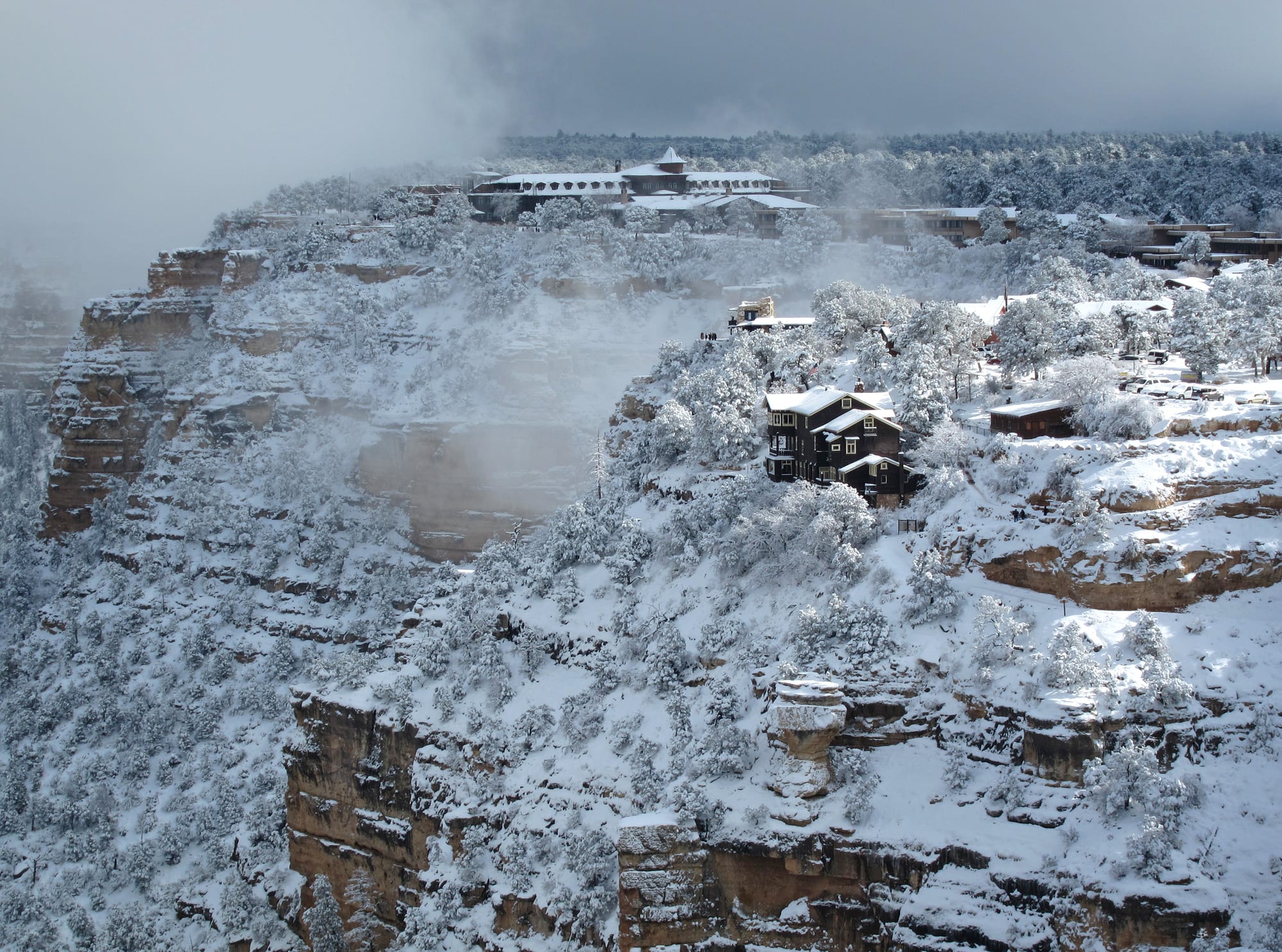
Snow-covered canyon cliffs and pines below the South Rim, with the timber Kolb Studio on the edge and village buildings above in drifting mist

The Southwest, United States

Grand Canyon Village

Grand Canyon Village under fresh snow in December 2011, with Kolb Studio on the rim in the foreground. (Grand Canyon National Park / Wikimedia Commons · CC BY 2.0)

The small settlement on the South Rim of the Grand Canyon in northern Arizona, inside Grand Canyon National Park. It grew around the railway that reached the rim from Williams in 1901, and its historic core of stone and timber buildings is a National Historic Landmark District. Today it exists almost entirely to house, feed and guide the millions who come to see the canyon.

Neighbourhoods

  • The historic rim
    • First-time visitors
    • Historic buildings
    • Canyon views

    The original village along the canyon edge, around the 1910 log railway depot, with the historic hotels and lodges, Hopi House, Kolb Studio, Lookout Studio and the head of the Bright Angel Trail, all linked by the paved Rim Trail.

    Open in Maps
  • Market Plaza and the visitor centre
    • Practical base
    • Campgrounds
    • Shuttle hub

    East of the historic rim, in the woods, the village's practical side: the general store at Market Plaza, more modern lodges, the main campground and, near Mather Point, the visitor centre and transit hub for the free shuttle buses.

    Open in Maps
  • Tusayan
    • Lower prices
    • More restaurants

    A small gateway town just outside the park's south entrance, incorporated in 2010, with motels, restaurants and the Grand Canyon National Park Airport; in summer a park shuttle links it with the village.

    Open in Maps

Things to do

Rim viewpoints

  • Mather Pointviewpoint

    A limestone point about two miles east of the village near the main visitor centre, looking north across Granite Gorge to the buttes called Isis Temple and Cheops Pyramid.

    Open in Maps
  • Hermits Restlandmark

    A stone shelter of 1914 designed by Mary Colter to resemble a hermit's dwelling, at the western end of Hermit Road, reached by the park shuttle in the busy season.

    Open in Maps

Historic buildings

  • Hopi Houselandmark

    Mary Colter's first Grand Canyon building, of 1904, modelled on Hopi dwellings and built as a market for Native American crafts.

    Open in Maps
  • Kolb Studiolandmark

    The rim-edge home and photographic studio of the brothers Ellsworth and Emery Kolb from 1904 to 1976, near the head of the Bright Angel Trail; the brothers were known for their photographs of mule riders.

    Open in Maps
  • Lookout Studioviewpoint

    A rubble-stone building of 1914 by Mary Colter, built on the canyon edge as a rival photography studio, now a shop with telescopes on its terraces.

    Open in Maps
  • Grand Canyon Depottransit hub

    The log railway station of 1909–10, one of only three log depots left in the United States, still the terminus of the heritage train from Williams.

    Open in Maps
  • Buckey O'Neill Cabinlandmark

    Built in 1890, the oldest standing structure on the South Rim, once the office of an early tourist camp.

    Open in Maps

Trails

  • Bright Angel Trailtrail

    The classic trail into the canyon, starting in the village and descending to the Colorado River.

    Open in Maps
  • South Kaibab Trailtrail

    A steeper ridge-top trail east of the village, with open 360-degree views on the way to Skeleton Point and the river.

    Open in Maps

Short trips from the village

  • Desert View Watchtowerlandmark

    Mary Colter's 70-foot stone tower of 1932 on the eastern rim, with long views over the eastern canyon.

    Open in Maps

Seasonal events

  • Grand Canyon Star PartyJune

    Night-sky viewing through astronomers' telescopes at Yavapai Point on the South Rim, held every June.

Eat and drink

Long-standing places and food districts in Grand Canyon Village. Hours, ratings and directions come from your maps app, always current.

Eating on the rim

  • Market Plaza general storemarket

    The village's grocery store, with a deli counter, the place to stock up for picnics and hikes.

    Open in Maps
  • Lodge dining rooms and cafeteriasrestaurant

    The rim's lodges run the village's restaurants, from cafeterias and informal restaurants to a historic dining room in 1910s style with partial canyon views.

    Open in Maps
  • Tusayanneighborhood

    The gateway town just outside the south entrance has a wider choice of restaurants than the village.

    Open in Maps

Experience Grand Canyon Village

History

The canyon's South Rim lies in lands long used by Native peoples — the Havasupai and Hualapai to the west, the Navajo to the east and the Hopi, whose historic presence in the area is commemorated in the village's Hopi House. The village itself is a creation of tourism. In 1890 William "Buckey" O'Neill built a cabin on the rim that served as the office of an early tourist camp, and in 1901 the Santa Fe Railway completed its 64-mile line from Williams to the South Rim, bringing visitors in comfort for the first time.

The railway and its partner, the Fred Harvey Company, built the village around the station. Mary Colter, Harvey's architect, designed Hopi House in 1904 as a market for Native American crafts, then Lookout Studio and Hermits Rest in 1914 and the Desert View Watchtower in 1932, buildings that drew on Native and frontier forms and fitted into the rim. The Kolb brothers ran their studio on the canyon edge from 1904, photographing mule riders on the Bright Angel Trail, and a log depot was built in 1909–10. After the national park was created in 1919, a 1924 master plan by the National Park Service laid out a village square and staff housing, and the historic core became a National Historic Landmark District, recognised for its town design.

Cars replaced trains: passenger service ended in 1968 and freight in 1974, but private investors restored the line and trains returned to the rim in 1989. In 1979 the Grand Canyon became a UNESCO World Heritage Site. In July 2025 the lightning-caused Dragon Bravo Fire burned across the North Rim, destroying 113 structures there including its historic lodge, before it was contained at the end of September.

Culture & Customs

Grand Canyon Village is less a town than a stage for the canyon, and its culture is that of a national park: rangers' talks, people gathering at the rim for sunset and sunrise, hikers in boots at the trailheads, and visitors from all over the world comparing views. Its buildings are part of the experience — Mary Colter's stone and timber designs set out an idea of architecture that belongs to its landscape, and the village is the largest surviving example of National Park Service town planning in the park system.

Native American culture is a continuing presence. Hopi House was built to sell Native crafts, and Hopi artisans once lived and worked there; the park's neighbours include the Havasupai, whose reservation lies within the canyon to the west, the Hualapai, who run their own developments at the western end, and the Navajo Nation on the eastern side. Visitors meet these communities mostly through crafts, guides and the lands they cross on the roads in.

Each June astronomers set up telescopes at Yavapai Point for the Grand Canyon Star Party, taking advantage of the dark skies. Mule rides still carry visitors into the canyon, and the arrival of the heritage train at the old depot each day recalls the railway that created the village.

Daily Life

About 1,800 people lived in Grand Canyon Village at the 2020 census, in a community planned by the National Park Service and largely built by the park's concessioners; its school district includes Grand Canyon High School. The village is wholly focused on its visitors: the park received more than 4.9 million recreational visits in 2024, and the South Rim accounts for about 90 per cent of them.

Life follows the visitors' calendar. Spring, summer and autumn bring full lodges, busy shuttles and long hours for staff, whose housing was laid out in the village plan; winter is quieter and snowier. Residents shop at the general store at Market Plaza, and for anything more drive to Tusayan or Flagstaff.

The canyon's extremes shape daily routines too. Rangers and rescuers deal each year with hundreds of hikers overcome by heat and exhaustion. Water is a constant concern in a village on a dry plateau, and in August 2026 flash floods followed heavy rain; as of mid-September 2026, inner-canyon closures and water restrictions were in place.

Food

Food in Grand Canyon Village is run by the park's concessioners, and the choice reflects a place built for visitors rather than residents. The lodges on the rim offer everything from cafeterias and informal restaurants serving breakfast, lunch and dinner to a historic dining room in 1910s style with partial views of the canyon.

For picnics and trail food, the general store at Market Plaza has groceries and a deli counter, and many visitors eat on the rim or carry lunch down the trails; snack bars at viewpoints such as Hermits Rest serve drinks and simple food. Tusayan, just outside the south entrance, has a wider choice of restaurants, and Williams and Flagstaff further south have more still. Because the village serves millions of visitors and few residents, the emphasis is on reliable, filling meals after a day on the trails rather than on fine dining.

The park's history is part of the table too. The Fred Harvey Company, which built much of the village, ran restaurants and hotels alongside the railroads of the western United States, including the historic dining room on the rim. Visitors staying at the bottom of the canyon eat in a dining hall that can only be reached on foot, by mule or by raft, and meals there must be reserved.

Planning tools

Budget

The village itself is expensive and limited: the historic rim lodges book up far ahead and cost more than motels in Tusayan, Williams or Flagstaff, and food inside the park costs more than outside. The park entrance fee covers seven days, and the shuttle buses, rim walks and viewpoints are free once inside.

Daily Budget Midrange
USD 220–420 (rim lodge or Tusayan motel, cafeteria and restaurant meals, park entry, rental car and fuel)
Daily Budget Shoestring
USD 80–140 (campground, groceries from the general store, free shuttles)

Book rim lodging and campsites well ahead for spring, summer and autumn; outside the park, Tusayan, Williams and Flagstaff are the usual cheaper bases.

Best Time to Visit

The South Rim is open all year. Spring and autumn have the mildest weather on the rim and the most comfortable hiking below it. Summer is the busiest season, cool on the rim but dangerously hot inside the canyon, with afternoon thunderstorms. Winter brings regular snow on the rim, smaller crowds and some of the clearest views.

Suggested Number of Days

One or two days are enough to walk the rim and see the main viewpoints. Allow three or four to hike some way into the canyon or to take in the eastern rim; a night on the rim adds sunset and sunrise.

First Visit
1–2 days
With Surroundings
3–4 days

Transportation

The National Park Service runs free shuttle buses on the South Rim on three interlocking routes linking the visitor centre, the village, the viewpoints and the trailheads; some viewpoints and trailheads have little or no parking and can only be reached by shuttle. In summer a park shuttle also runs from Tusayan. Mule rides into the canyon are also available.

Park once at the visitor centre or in the village and use the shuttles and the Rim Trail; parking near the rim fills early in the busy season.

Airport & Station Connections

Most visitors drive in on Arizona State Route 64 through the south entrance. Flagstaff Pulliam Airport is the nearest commercial airport, with a scheduled shuttle to the village, and Grand Canyon National Park Airport lies just outside the entrance at Tusayan. Many visitors fly into Phoenix, about 230 miles away, or Las Vegas, about 275 miles. The heritage Grand Canyon Railway runs 64 miles from Williams to the village depot.

Walkability

The historic village is compact and walkable, and the paved Rim Trail runs along the canyon edge past the main viewpoints, the lodges and the studios; part of it, the Trail of Time, explains the canyon's rocks. The shuttle buses cover longer stretches. The rim is at high altitude, so walking uphill is tiring, and paths can be icy in winter.

Safety

For most visitors the US is safe, with the main risks being petty theft and car break-ins in tourist areas of some cities, road accidents over long distances, extreme weather, and the hazards of the outdoors. At the Grand Canyon the hazards are the canyon itself: unfenced edges, the heat below the rim and the steep climb out. Each year hundreds of hikers have to be rescued from the inner canyon, mostly for exhaustion and dehydration.

Stay well back from unfenced edges, carry more water than seems necessary on any trail below the rim, remember that the climb back up is the hardest part, and check park alerts for trail closures before setting out. Check current official travel advice before travelling.

Climate

A high-plateau climate on the rim, with cold winters and warm summers, and a desert climate in the depths of the canyon. Temperatures inside the canyon vary widely with height.

Summer
comfortable on the rim, with afternoon thunderstorms, while the canyon floor can exceed 120°F
Winter
cold on the rim, with regular snow and nights well below freezing (32°F)

Local Customs

The village is a national park community, and park rules apply: wildlife must not be fed, and horse and mule riders must follow park rules and need a permit to keep animals in the park overnight. Parts of the wider canyon lie on the Havasupai, Hualapai and Navajo lands, which have their own rules and permits. Tipping of roughly 18–22 per cent is expected in restaurants.

Identification is asked for when buying alcohol (the legal age is 21); treat the Native American crafts and sites in and around the park with respect, and ask before photographing people.

Common Payment Methods

The currency is the US dollar. Cards are accepted at the lodges, restaurants and general store; a little cash is useful for tips.