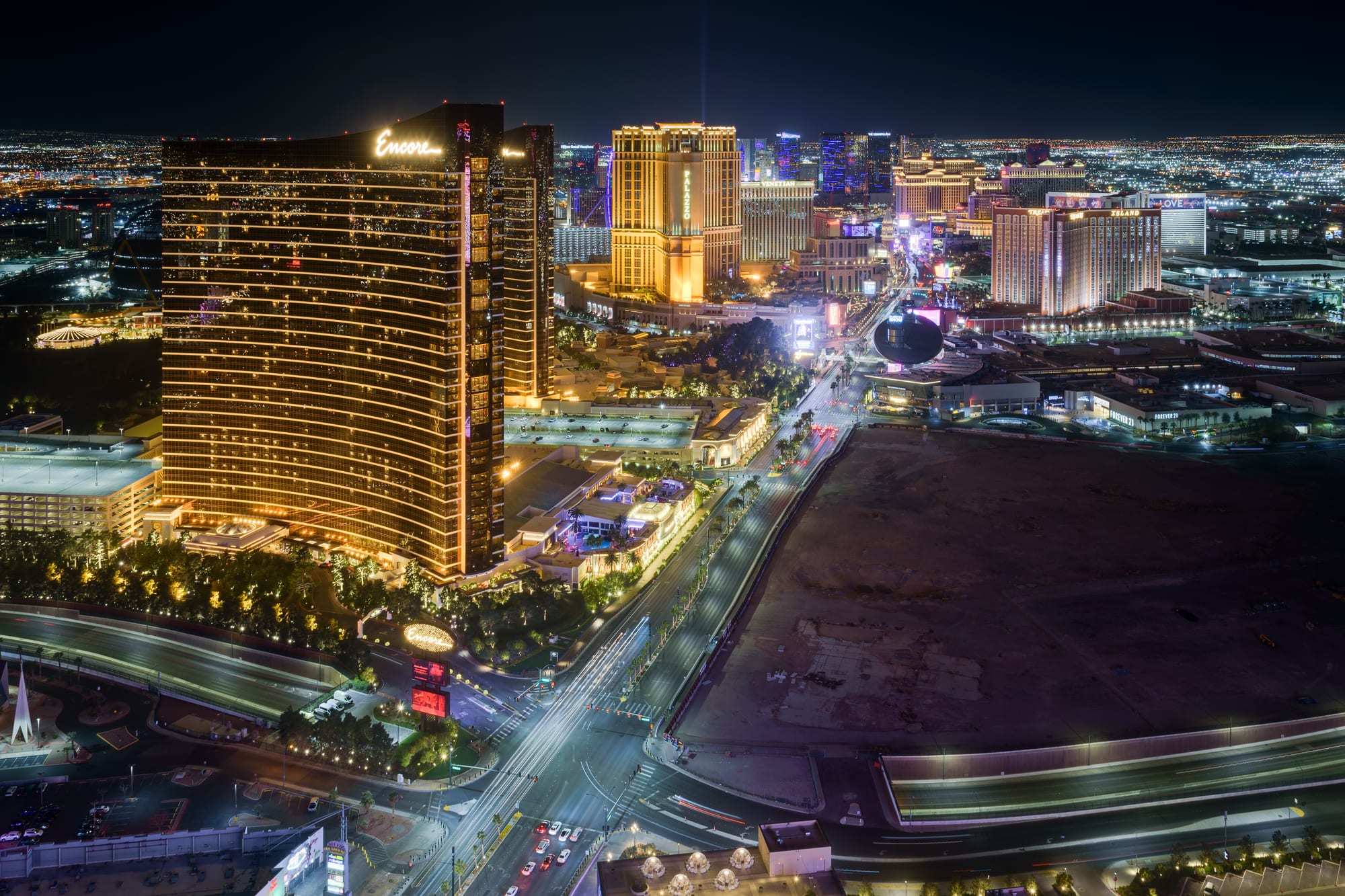
Gold-lit hotel towers beside the glowing lanes of Las Vegas Boulevard at night, with the lights of the valley stretching to the horizon

The Southwest, United States

Las Vegas

The Las Vegas Strip at night, seen from a high-rise in February 2023. (King of Hearts / Wikimedia Commons · CC BY-SA 4.0)

Nevada's largest city, in a Mojave Desert valley ringed by mountains. A railway town founded in 1905 around desert springs, it was made by legal gambling in 1931, the building of Hoover Dam and the postwar casino boom. Today its downtown and the Strip just south of the city limits draw over 40 million visitors a year for casinos, shows, conventions and sport.

Neighbourhoods

  • The Strip
    • First-time visitors
    • Shows and nightlife
    • Big resorts

    About 4.2 miles of Las Vegas Boulevard just south of the city limits, lined with many of the largest casino resorts in the world, arenas, shopping malls and residential towers. Most visitors stay here; the monorail runs behind the resorts on the east side.

    Open in Maps
  • Downtown and Fremont Street
    • Old Vegas
    • Lower prices
    • Bars

    The original townsite and the city's first gambling district, centred on Fremont Street, whose westernmost blocks are covered by a light-show canopy. Fremont East, beyond it, is a district of bars and small venues, and the Mob Museum and the Neon Museum are nearby.

    Open in Maps
  • The Arts District
    • Galleries
    • Best for food
    • Local life

    A district between downtown and the Strip, along East Charleston Boulevard, with art galleries, antique and clothing shops, restaurants, bars and breweries, busiest on First Friday each month.

    Open in Maps
  • Summerlin
    • Quiet and residential
    • Close to Red Rock Canyon

    A large planned community on the western edge of the valley, closest to Red Rock Canyon, with its own shopping centre, the minor-league ballpark and quieter places to stay.

    Open in Maps
  • Henderson
    • Families
    • Local life

    A separate city in the south-east of the valley, mainly residential, on the side of town closest to Lake Mead, Boulder City and Hoover Dam.

    Open in Maps

Things to do

Famous landmarks

  • Las Vegas Striplandmark

    The boulevard of giant themed casino resorts, fountains and light shows that made the city's image; most of it is designated an All-American Road.

    Open in Maps
  • Fremont Street Experienceattraction

    Five pedestrian blocks of the old 'Glitter Gulch' casino district, four of them under a 90-foot-high canopy that shows light and video displays, with free concerts on three stages and zip lines overhead.

    Open in Maps
  • Welcome to Fabulous Las Vegas signlandmark

    The 1959 roadside sign that some consider the southern end of the Strip, one of the city's best-known landmarks.

    Open in Maps
  • Sphereattraction

    An entertainment arena opened in 2023 east of the Strip, with a wraparound high-resolution screen inside and the world's largest LED display covering its exterior.

    Open in Maps
  • Old Las Vegas Mormon Fortlandmark

    The remains of the adobe fort completed in 1855, the first permanent structure in what became Las Vegas, now a state historic park north of downtown.

    Open in Maps

Museums

  • Neon Museummuseum

    More than 200 old signs from casinos and other businesses displayed outdoors in the Neon Boneyard, with a visitor centre in the relocated lobby of a former Strip motel.

    Open in Maps
  • Mob Museummuseum

    The National Museum of Organized Crime and Law Enforcement, opened in 2012 in the former post office and courthouse of 1933, two blocks from Fremont Street.

    Open in Maps
  • Springs Preservemuseum

    A 180-acre site around the original Las Vegas Springs, with desert botanical gardens, museum galleries and trails through wetland habitat, about three miles west of downtown.

    Open in Maps

Shows, sport and nights out

  • The Smith Center for the Performing Artsattraction

    Downtown's Art Deco-style performing arts centre, home of the Las Vegas Philharmonic and Nevada Ballet Theatre, with touring Broadway shows.

    Open in Maps
  • T-Mobile Arenaattraction

    The arena behind the Strip where the Vegas Golden Knights play ice hockey, and a regular venue for boxing, mixed martial arts and concerts.

    Open in Maps
  • Allegiant Stadiumattraction

    The indoor stadium of the Las Vegas Raiders, opened in 2020 west of the southern Strip, which hosted the Super Bowl in 2024.

    Open in Maps

Short trips from the city

  • Red Rock Canyonpark

    Red and cream sandstone walls up to 3,000 feet high, reached by a 13-mile one-way scenic loop road, with hiking trails, rock climbing and a visitor centre.

    Open in Maps
  • Hoover Damlandmark

    The concrete arch-gravity dam built across the Black Canyon of the Colorado River in 1931–36, which cost over 96 lives and draws about 7 million visitors a year.

    Open in Maps
  • Lake Meadpark

    The reservoir behind Hoover Dam, the largest in the country by capacity, used for boating and swimming; its level fell to a record low in August 2026.

    Open in Maps
  • Valley of Fire State Parkpark

    Nevada's oldest state park, whose red Aztec Sandstone formations seem to burn in the sun; a new visitor centre opened in November 2025.

    Open in Maps

Seasonal events

  • CESearly January

    The consumer electronics industry's great annual trade show at the convention centre, one of the many conventions that fill the city's hotels.

  • First Fridaythe first Friday of every month

    A monthly evening of art, music and food in the Arts District, spilling into Fremont East.

  • Las Vegas Grand PrixNovember

    A Formula One night race on a temporary street circuit that includes part of the Strip, held since 2023.

  • National Finals Rodeothe first full week of December

    The championship of professional rodeo at the Thomas & Mack Center on the UNLV campus, with a cowboy gift show alongside.

  • New Year's Eve on Fremont Street31 December

    The city's annual New Year's Eve celebration under the Fremont Street canopy.

Eat and drink

Long-standing places and food districts in Las Vegas. Hours, ratings and directions come from your maps app, always current.

Las Vegas classics

  • Resort buffets and chef restaurantsneighborhood

    The Strip's resorts hold everything from buffets and simple cafés to gourmet restaurants, some of them Michelin-starred, the core of the city's reputation for fine dining.

    Open in Maps

Food districts and markets

  • Chinatownneighborhood

    Strip malls along Spring Mountain Road west of the Strip full of Chinese and other pan-Asian restaurants and shops, begun with Chinatown Plaza in 1995.

    Open in Maps
  • Arts Districtneighborhood

    Restaurants, bars and breweries among the galleries along East Charleston Boulevard, busiest on First Friday.

    Open in Maps
  • Fremont Eastneighborhood

    The blocks east of the canopy, redesigned by the city in the 2000s as a compact entertainment district of bars and clubs.

    Open in Maps

Experience Las Vegas

History

The Las Vegas Valley was the winter home of the Southern Paiute, who moved to the mountains in summer; the springs that fed its meadows gave the place its Spanish name, "the meadows". The Mexican scout Rafael Rivera is credited as the first non-Native person to see the valley, in 1829, and Latter-day Saint missionaries built an adobe fort beside the springs on the road from Salt Lake City to southern California, completed in 1855 and abandoned in 1857. Las Vegas itself was founded in 1905, when 110 acres beside the new Union Pacific railway were auctioned off as building lots, and it was incorporated in 1911.

The year 1931 made the city. Nevada legalised casino gambling and cut the residency requirement for divorce to six weeks, and work began on Hoover Dam nearby. After the Second World War, lavish hotels, casinos and big-name entertainment became synonymous with Las Vegas, first downtown on Fremont Street and then on the highway south of the city limits that became the Strip. From 1951 nuclear weapons were tested at the Nevada Test Site, 65 miles to the north-west, and visitors watched mushroom clouds from the city — the "Atomic City" — until testing moved underground in 1963.

Growth then accelerated: between 1990 and 2000 the city's population rose by 85 per cent. In the 21st century the city has become a major sports town as well, with the Golden Knights from 2017, the Raiders from 2020, Formula One from 2023 and baseball's Athletics due by 2028, while downtown has been revived with museums, an arts centre and a new city hall.

Culture & Customs

Las Vegas calls itself the Entertainment Capital of the World, and its culture is built for visitors: stage shows, circus acts, boxing and mixed martial arts — the UFC is headquartered here — and nightclubs, alongside the casinos; it has the most land-based casinos in the world. Its tolerance of adult entertainment earned it the nickname "Sin City" and has made it a popular setting for films.

There is also a local cultural life the Strip hides. The Smith Center downtown is home to the Las Vegas Philharmonic and Nevada Ballet Theatre; the Arts District holds galleries, antique shops and the monthly First Friday; and the Neon Museum preserves the signs of the city's mid-century heyday. The Las Vegas Paiute Tribe has a small reservation just north of downtown.

The city is diverse. About a third of residents are Hispanic, Filipinos are one of the largest ancestry groups in the valley, and the metropolitan area has the largest Native Hawaiian population outside Hawaii. Sport has become a new source of local pride since the Golden Knights' arrival in 2017, and the Athletics' planned move by 2028 will add Major League Baseball.

Daily Life

About 640,000 people lived in the city of Las Vegas at the 2020 census, in a metropolitan area of an estimated 2.4 million; much of that population, and the Strip itself, lies outside the city limits in unincorporated Clark County. The valley drew over 40 million visitors in 2023, and tourism, gaming, conventions and hospitality dominate the economy; the online retailer Zappos has its headquarters downtown and the airline Allegiant in nearby Summerlin, and the lack of state taxes on individuals and corporations has helped draw business.

Many residents work in the resorts, and the city never fully stops: some bus routes, including the Deuce along the Strip, run 24 hours a day, as do many bars and liquor stores. Most people live in the sprawling suburbs — Summerlin to the west, Henderson to the south-east, North Las Vegas — and drive everywhere.

Water and heat are the defining issues. The valley depends on Lake Mead, which fell to its lowest level since it was first filled in August 2026, and conservation has cut daily use per resident sharply since a drought in 2002, with watering limited to set days. Summers are getting hotter: July 2024 was the hottest month ever recorded in the city.

Food

Las Vegas is known for its fine dining as well as its gambling. The big resorts offer everything from buffets and simple cafés to gourmet and Michelin-starred restaurants. Shows, sports events and conventions keep the dining rooms busy late into the night, and many bars are open around the clock.

The buffet is one of the city's best-known food traditions, but by 2026 only a handful of resorts still ran one, and the most famous charged high prices for a weekend dinner. Lunch and breakfast remain the better value.

Away from the resorts, the most interesting eating is in Chinatown. The strip malls along Spring Mountain Road, west of the Strip, hold Chinese and other pan-Asian restaurants, bakeries and shops; the first, Chinatown Plaza, opened in 1995 and was billed by its Taiwanese American founder as America's first master-planned Chinatown. Downtown's Fremont East and the Arts District have the city's independent bars, breweries and small restaurants, liveliest on First Friday. Drinking is easy almost everywhere, and the dry desert heat makes water as important as anything on the menu.

Planning tools

Budget

Las Vegas can be cheap or very expensive, and the difference is mostly the room and the shows. Room rates swing widely: midweek is usually much cheaper than weekends, and big conventions, fights, the Grand Prix and New Year send prices up sharply. Most resorts add a daily resort fee to the advertised rate, and parking on the Strip is often charged. Downtown is generally cheaper than the Strip.

Daily Budget Midrange
USD 220–420 (Strip resort room with fees, sit-down meals, a show ticket, ride-hailing)
Daily Budget Shoestring
USD 90–160 (downtown or off-Strip room, cheap eats and Chinatown, buses and walking)

Check the resort fee and parking charges before booking, and compare midweek with weekend rates; many of the best sights — the Strip itself, the fountains, Fremont Street's canopy and Red Rock's scenic loop — cost little or nothing.

Best Time to Visit

March to May and October to November are the most comfortable months, with warm days and cool nights. Summer is dangerously hot, with temperatures above 100°F on many days, though resorts and pools stay busy. Winter days are mild and sunny but nights are cold. Conventions and big events matter more than seasons for prices.

Suggested Number of Days

Two or three days are enough for most first visits to the city. Allow four or five with trips into the surrounding desert. Visits around a convention, a fight or a festival follow the event's own dates.

First Visit
2–3 days
With Surroundings
4–5 days

Transportation

The Strip is walkable in parts but much longer than it looks. Frequent city buses run along the Strip and on to downtown, and the 3.9-mile monorail runs behind the resorts on the east side, though its stations are at the back of the casinos. Taxis and ride-hailing are the usual way to get around, and a car is needed for Red Rock Canyon, Hoover Dam and the desert parks.

Distances between resorts are deceptive — the buildings are so large that a walk of 'a couple of hotels' can take half an hour in the heat.

Airport & Station Connections

Harry Reid International Airport, renamed from McCarran in 2021, is about five miles south of downtown, beside the southern end of the Strip; it is one of the few US airports with slot machines in its terminals. Interstate 15 links the city with southern California and Utah across open desert, and intercity buses arrive from Los Angeles, Phoenix and Salt Lake City.

Walkability

The Strip and downtown's Fremont Street are built for pedestrians, with bridges over the main crossings, but the resorts are huge and walking between them takes far longer than expected. In summer the daytime heat makes walking any distance outside dangerous. Away from the Strip and downtown the city is spread out and car-centred, and long walks are not advised.

Safety

For most visitors the US is safe, with the main risks being petty theft and car break-ins in tourist areas of some cities, road accidents over long distances, extreme weather, and the hazards of the outdoors. In Las Vegas the greatest danger for visitors is the heat, made worse by alcohol, which speeds dehydration and heat stroke even after dark.

Drink plenty of water, avoid long walks or hikes in the middle of a summer day, and keep valuables close in crowds and casinos. Check current official travel advice before travelling.

Climate

A hot desert climate. Summers are extremely hot and dry, with warm nights; winters are short, mild by day and cool at night; rain is rare, with February the wettest month.

Summer
extremely hot — July averages a high of about 104.5°F, around 78 days a year reach 100°F, and the record of 120°F was set in July 2024
Winter
mild and sunny — December averages a high of about 57°F, with nights around 40°F; snow in the city is rare

Local Customs

Tipping is a large part of many workers' pay: roughly 18–22 per cent in restaurants, and a small tip per drink for bar and casino drink servers is customary. Dress is casual by day, smarter for nightclubs, some of which have dress codes. Prostitution, legal in some rural Nevada counties, is prohibited in Clark County by state law.

Identification is asked for when buying alcohol (the legal age is 21), and drinks can usually be carried from one bar or gaming area to another inside a casino.

Common Payment Methods

The currency is the US dollar. Cards and mobile payment are accepted almost everywhere; casinos have ATMs and cashiers. Small bills are useful for tipping.