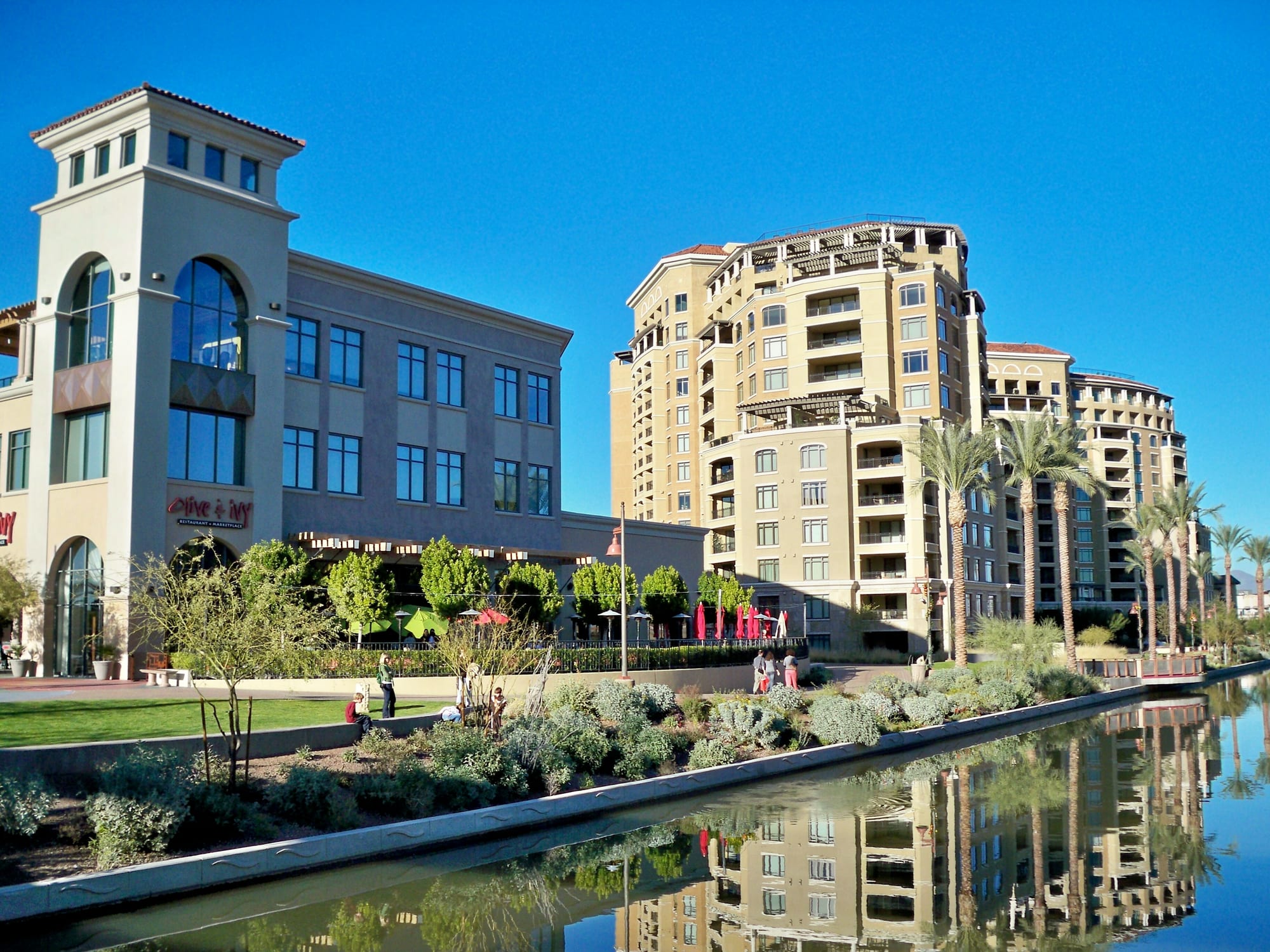
A straight canal reflecting palm trees, desert planting, a shopping building and tall cream apartment towers under a clear sky

The Southwest, United States

Scottsdale

The Arizona Canal at the Scottsdale Waterfront, beside Old Town Scottsdale. (Joseph Plotz / Wikimedia Commons · CC BY 3.0)

A city of about 240,000 people on the north-eastern side of the Phoenix area, named in 1894 after the founder of a small farming settlement on the Arizona Canal. Winter visitors, resorts, artists and Frank Lloyd Wright turned it into a resort town; today it is known for its Western-themed Old Town, galleries, golf, spas, spring-training baseball and a large desert preserve.

Neighbourhoods

  • Old Town
    • First-time visitors
    • Galleries
    • Nightlife

    The original town centre, now a cluster of districts: Western-style storefronts, the galleries of Main Street and Marshall Way, the civic centre's lawns and museums, and a bar-and-club district that fills at weekends. Restaurants and hotels are all within walking distance.

    Open in Maps
  • Scottsdale Waterfront and Fashion Square
    • Shopping
    • Best for food

    Shops, restaurants and apartment towers along the Arizona Canal at the northern edge of Old Town, beside a very large shopping mall. The canal path and Paolo Soleri's pedestrian bridge make it good for an evening walk.

    Open in Maps
  • South Scottsdale
    • Local life
    • Quiet and residential

    The older, long working-class part of the city south of Old Town, with modest houses, strip malls and local restaurants. It is cheaper than the north and close to Tempe and Papago Park.

    Open in Maps
  • McCormick Ranch and central Scottsdale
    • Families
    • Golf
    • Parks

    Planned neighbourhoods of the 1970s and 1980s around lakes, golf courses and the green belt of Indian Bend Wash, whose paths run for miles. Many resorts and the railway park are here.

    Open in Maps
  • North Scottsdale
    • Resorts and golf
    • Desert hiking

    A long spread of newer suburbs, gated communities, resorts and golf courses reaching into the desert towards the McDowell Mountains and Pinnacle Peak. The trailheads of the city's desert preserve are here, along with the outdoor shopping of Scottsdale Quarter and, across Scottsdale Road in Phoenix, Kierland Commons.

    Open in Maps

Things to do

Architecture

  • Taliesin Westlandmark

    Frank Lloyd Wright's winter home and studio in the desert foothills from 1937, built of desert masonry, local rocks set in concrete; it is a National Historic Landmark and part of a UNESCO World Heritage Site, and the Frank Lloyd Wright Foundation runs tours.

    Open in Maps
  • Cosantilandmark

    The architect Paolo Soleri's earth-cast concrete studio and home, just west of Scottsdale in Paradise Valley, where bronze and ceramic wind-bells are still made.

    Open in Maps

Museums

  • Western Spirit: Scottsdale's Museum of the Westmuseum

    A museum of the art and history of the American West in Old Town, with paintings, sculpture, saddles and Native American objects.

    Open in Maps
  • Scottsdale Museum of Contemporary Artmuseum

    A museum of contemporary art, architecture and design in a converted cinema in Old Town, with changing exhibitions.

    Open in Maps

Parks and the desert

  • McDowell Sonoran Preservepark

    About 30,500 acres of protected desert, described as the largest city park in the United States, covering saguaro desert and the McDowell Mountains in north Scottsdale, with many miles of hiking, riding and mountain-bike trails.

    Open in Maps
  • Camelback Mountaintrail

    The humped mountain that is the area's best-known landmark, just across the city line in Phoenix, climbed by two short but steep and crowded trails.

    Open in Maps
  • Pinnacle Peaktrail

    A granite summit in north Scottsdale circled by a popular trail through boulders and saguaros.

    Open in Maps
  • Arizona Canal pathtrail

    A walking and cycling path along the 1880s irrigation canal that brought water to the town, running through Old Town and across the city.

    Open in Maps
  • McCormick-Stillman Railroad Parkpark

    A city park with a ridable miniature railway, historic railway cars and an old carousel, popular with families.

    Open in Maps

Sport and shopping

  • Scottsdale Stadiumattraction

    The Old Town ballpark where the San Francisco Giants play spring-training games in February and March.

    Open in Maps
  • Salt River Fields at Talking Stickattraction

    The spring-training complex of the Arizona Diamondbacks and Colorado Rockies, on the land of the Salt River Pima–Maricopa Indian Community at the city's eastern edge.

    Open in Maps
  • Scottsdale Fashion Squareattraction

    One of the country's 20 largest shopping malls, at the northern edge of Old Town.

    Open in Maps

Short trips from the city

  • Desert Botanical Gardenpark

    A large garden of cacti and desert plants from around the world among the red rocks of Papago Park, on the Phoenix side of the city line.

    Open in Maps
  • Papago Parkpark

    A park of eroded red sandstone buttes, with the Hole-in-the-Rock viewpoint and the Phoenix Zoo, just south-west of Scottsdale.

    Open in Maps
  • Heard Museummuseum

    In central Phoenix, a major museum of Native American art and culture, whose collections include Barry Goldwater's 437 historic Hopi katsina dolls.

    Open in Maps
  • Fountain Hillsattraction

    A desert town to the east, named after the fountain that shoots up to 560 feet from a man-made lake for about 15 minutes every hour through the day.

    Open in Maps

Seasonal events

  • Barrett-Jackson Collector Car AuctionJanuary

    A televised auction of classic and collector cars that draws huge crowds to the WestWorld showground in north Scottsdale.

  • Phoenix OpenFebruary

    A PGA Tour golf tournament at TPC Scottsdale, famous for its enormous crowds and the stadium-like, rowdy atmosphere around one par-three hole.

  • Scottsdale Arabian Horse ShowYearly

    The world's largest Arabian horse show, held since 1955 and now at WestWorld, where more than 2,200 Arabian and half-Arabian horses compete in front of thousands of visitors.

  • Cactus League spring trainingFebruary–March

    Major League Baseball teams play warm-up games at ballparks across the Phoenix area, two of them in or beside Scottsdale.

  • Parada del SolYearly

    A month-long Western festival held since 1954 and opened by what is billed as the world's largest horse-drawn parade, with more than 150 entries.

Eat and drink

Long-standing places and food districts in Scottsdale. Hours, ratings and directions come from your maps app, always current.

Food districts

  • Old Town Scottsdaleneighborhood

    The densest choice in the city: steakhouses, Mexican and Southwestern kitchens, cafés, wine bars and late-night bars within a few blocks.

    Open in Maps
  • The Scottsdale Waterfrontneighborhood

    Restaurants and bars with patios facing the Arizona Canal, busiest on mild evenings in winter and spring.

    Open in Maps
  • South Scottsdaleneighborhood

    Small family-run Mexican restaurants, taco shops and diners along McDowell Road and Scottsdale Road south of Old Town.

    Open in Maps

Arizona flavours

  • Sonoran hot dogsrestaurant

    A bacon-wrapped hot dog in a soft bolillo-style roll with beans, onions, tomatoes and salsa, born in Hermosillo in Sonora and popular in Tucson and Phoenix.

    Open in Maps
  • Frybreadrestaurant

    Puffy fried dough eaten with honey or loaded with beans, meat and chile, found at Native-run stands, festivals and a few restaurants across the area.

    Open in Maps

Experience Scottsdale

History

The Hohokam farmed the Salt River valley for centuries, digging canals that later settlers reused, and the Akimel O'odham and Piipaash (Maricopa) peoples lived along the rivers when Americans arrived. The Salt River Pima–Maricopa Indian Community, created in 1879, still borders the city to the east. The Arizona Canal, dug in the 1880s, carried river water north of Phoenix and made farming possible on the desert where Scottsdale now stands.

In 1888 Winfield Scott, a retired army chaplain, bought 640 acres beside the canal and farmed them; the settlement that grew up around him took his name in 1894. For decades it was a small farming community, with a cotton boom during the First World War. From the early 1900s artists, writers and winter visitors came, the area's first resort opened nearby in 1909, and in 1937 Frank Lloyd Wright began building Taliesin West in the foothills to the north-east.

After the Second World War, air conditioning and new residents transformed the town. Scottsdale was incorporated in 1951 with about 2,000 people and called itself "The West's Most Western Town", promoting a Western image. Annexations spread it north across the desert. After a major flood in 1972 the city turned the flood-prone Indian Bend Wash into a 12-mile green belt of parks, and in 1995 voters approved a sales tax to buy the land that became the McDowell Sonoran Preserve.

Culture & Customs

Scottsdale's identity mixes the Old West with modern luxury. Old Town keeps its Western-themed storefronts and its museum of the West, while the galleries of Main Street and Marshall Way sell paintings, sculpture and jewellery, and the big winter horse shows and car auctions draw crowds from across the country.

Architecture is a point of pride. Frank Lloyd Wright's Taliesin West is the headquarters of the Frank Lloyd Wright Foundation, and Paolo Soleri, who settled in Scottsdale in 1956, built his earth-cast studios at Cosanti and designed the pedestrian bridge over the canal. The city is known for its public art, its resorts and spas, its golf courses and its spring-training ballparks, which turn February and March into a long festival of baseball.

The population is affluent and older than average, with many winter residents, but Old Town also has the busiest nightlife in the Phoenix area, popular with young visitors. Manners are relaxed and polished: casual clothes are fine almost everywhere, and service is attentive.

Daily Life

About 240,000 people live in Scottsdale, part of a metropolitan area of nearly five million around Phoenix. Tourism is a major industry, alongside health care — the Mayo Clinic has a large campus in the north of the city — financial services, technology companies and corporate offices. About a fifth of residents are 65 or older, and the city swells in winter.

South Scottsdale has older, modest houses and long-time residents; the centre has planned communities around golf courses and lakes; the north is newer, wealthier and spread into the desert, with gated estates and resort-style shopping. Commuting is almost entirely by car on wide roads and freeways.

The climate shapes the day: in summer people walk, run and hike before sunrise and stay indoors through the afternoon, and many wealthier residents leave for cooler places. Water supply, the pressure of new housing on the desert and the pace of growth are recurring local debates.

Food

Scottsdale's food scene is broad rather than distinctive, but it draws on Arizona's Mexican and Native kitchens. Sonoran-style Mexican food — carne asada, machaca (dried, shredded beef), flour tortillas, chimichangas and tamales — is everyday fare, and the Sonoran hot dog, wrapped in bacon and piled with beans, onions, tomatoes and salsa, has come north from Hermosillo and is popular in Tucson and Phoenix. Prickly pear fruit turns up in syrups, sweets and margaritas.

Native frybread, eaten with honey and powdered sugar or turned into a taco with beans and meat, is found at festivals and stands run by members of nearby communities. The Western side of the city's identity shows in steakhouses and barbecue, many of them in and around Old Town.

Resort restaurants and Old Town's dining rooms follow national trends, with many chef-led restaurants, brunch places and patios. Arizona citrus appears on menus, and farmers' markets sell local produce through the cooler months.

Planning tools

Budget

Scottsdale is one of the more expensive places to stay in Arizona. Resort rooms are at their dearest from January to April, when golf, spring training and the big auctions and tournaments fill the city, and fall sharply in the summer heat. Restaurants range from cheap taco shops to expensive steakhouses. A car or ride-hailing is needed for most trips.

Daily Budget Midrange
USD 250–450 (mid-range hotel or resort, sit-down dinners, hire car, tours of Taliesin West)
Daily Budget Shoestring
USD 100–170 (budget motel in south Scottsdale, taco shops and diners, buses and the free Old Town trolley)

Summer resort prices are a fraction of winter ones for travellers who can cope with the heat by keeping outdoor time to early morning and evening.

Best Time to Visit

November to April, when days are warm and sunny and nights cool; February and March are the busiest and most expensive months. From late May to September the heat is extreme, with highs of at least 100°F on most days, and the summer monsoon brings dust storms and thunderstorms.

Suggested Number of Days

Two or three days cover the city itself. Longer stays are common because many visitors come for golf, spas or baseball, and the number grows with trips across the Phoenix area or north towards Sedona and the canyons.

First Visit
2–3 days
With Surroundings
4–6 days

Transportation

The Phoenix area is built around the car, and most visitors hire one or use ride-hailing. A free trolley loops around Old Town and connects it with the Waterfront and nearby resorts, and Valley Metro buses run along the main roads. Paths along the canal and the Indian Bend Wash green belt are good for cycling in the cooler months.

Never leave children, pets or medicines in a parked car in summer; temperatures inside rise to dangerous levels within minutes.

Airport & Station Connections

Phoenix Sky Harbor International Airport, in Phoenix, is about a 15-minute drive from downtown Scottsdale. Scottsdale's own airport serves private and business jets. Long-distance buses and trains do not stop in Scottsdale itself.

Walkability

Old Town is compact and easy on foot, with shady arcades, the civic centre lawns and the canal path linking it to the Waterfront. Beyond it, the city is a grid of wide, fast roads and long blocks, and walking is practical only for short distances. In summer, walking at midday is exhausting and potentially dangerous.

Safety

Most visits are trouble-free; theft from cars and late-night trouble in the Old Town bar district are the usual concerns. Heat is the main danger: Phoenix closes the Camelback Mountain trails in the middle of the day during extreme heat, and monsoon storms bring dust storms and flash floods in dry washes.

Hike early with plenty of water, turn back before running low, never drive into a flooded road crossing, and pull over with lights off in a dust storm. Check current official travel advice before travelling.

Climate

A hot desert climate with very little rain. Winters are mild and sunny, summers extremely hot, and the summer monsoon, officially mid-June to September, brings humidity, dust storms and sudden thunderstorms.

Summer
extremely hot — highs reach at least 100°F on more than 100 days a year in the Phoenix area, and humidity rises during the monsoon
Winter
mild and sunny — temperatures rarely fall to 32°F, with occasional rain from Pacific storms

Local Customs

Tipping is expected: roughly 18–22 per cent in restaurants and resorts, and a few dollars for valets and housekeeping. Dress is casual but neat; golf clubs and some resort restaurants have dress codes. Arizona does not change its clocks in summer. The Salt River Pima–Maricopa Indian Community on the eastern edge of the city is a sovereign nation with its own laws.

Identification is checked for alcohol (the legal age is 21) and many Old Town bars check it at the door. Do not touch or damage saguaro cacti, which are protected in Arizona.

Common Payment Methods

The currency is the US dollar. Cards and contactless payment are accepted almost everywhere, including at most market stalls, and ATMs are common. A little cash is useful for valets, tips and small craft vendors.