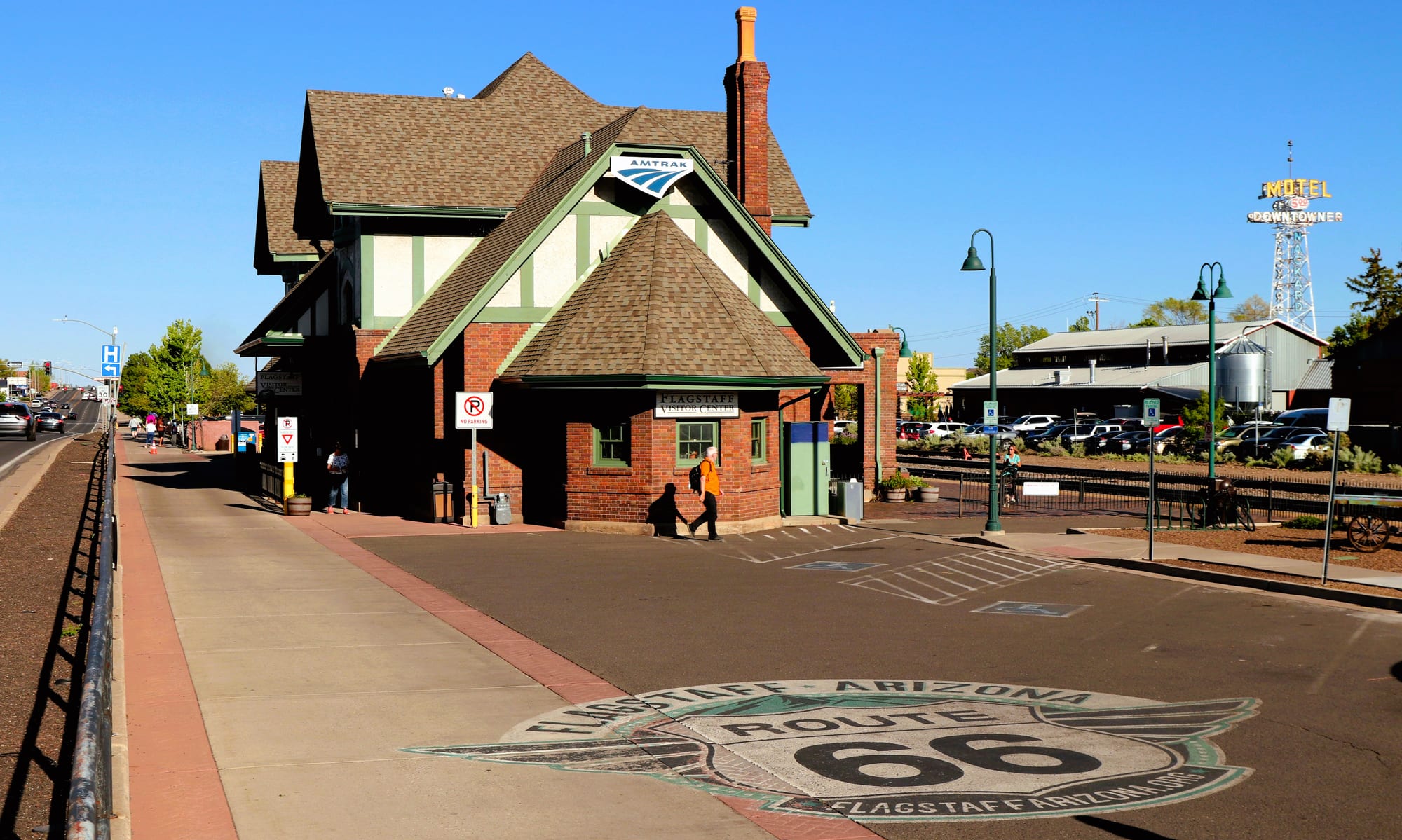
Brick and half-timbered railway station with a large Route 66 shield painted on the road in front, under a blue sky

The Southwest, United States

Flagstaff

The historic railway station on Route 66 in downtown Flagstaff, Arizona. (Thank You (25 Millions ) views / Wikimedia Commons · CC BY 2.0)

A railway and university city of about 77,000 people at almost 7,000 feet in northern Arizona, set in a vast ponderosa pine forest below the San Francisco Peaks. Lumber, the railway and Route 66 built it; Lowell Observatory, where Pluto was found, made it a city of astronomers. Today it is the main gateway to the Grand Canyon's South Rim.

Neighbourhoods

  • Downtown
    • First-time visitors
    • Best for food
    • Nightlife

    The old railway town north of the tracks, built of brick and local sandstone around Heritage Square. Restaurants, breweries, outdoor shops and galleries fill the blocks along San Francisco Street, Leroux Street and Route 66, and the historic station doubles as the visitor centre.

    Open in Maps
  • Southside
    • Historic district
    • Bars
    • Local life

    The small grid of streets between the railway and the university, long home to families of Spanish, Basque and Mexican heritage. Its old houses and churches now sit among cafés, bars and student housing.

    Open in Maps
  • Northern Arizona University
    • Students
    • Quiet and residential

    The large campus on the south side of town, with its sandstone original buildings and the wooden-domed Walkup Skydome. The streets around it are full of student flats and cheap places to eat, and the urban trail network runs through it.

    Open in Maps
  • East Flagstaff and Route 66
    • Road-trip motels
    • Close to the interstate

    A long strip of motels, diners and old neon signs following Route 66 east beside the railway towards the mall and the I-40 junction. It is where many road travellers stop for a night, a short drive from downtown.

    Open in Maps

Things to do

Landmarks and history

  • Lowell Observatorymuseum

    The observatory Percival Lowell founded on Mars Hill in 1894, where Clyde Tombaugh discovered Pluto in 1930; visitors see the historic Clark Telescope and look through telescopes on clear nights.

    Open in Maps
  • Riordan Mansionlandmark

    A large duplex mansion of log and native stone, built in 1904 by two lumber-baron brothers for their families and now a state historic park.

    Open in Maps
  • Flagstaff stationlandmark

    The railway station of 1926 on Route 66, still served by Amtrak and home to the town's visitor centre.

    Open in Maps
  • Northern Arizona Universityattraction

    The university founded as a normal school for training teachers in 1899, whose campus and high-altitude training reputation draw distance runners from around the world.

    Open in Maps

Museums

  • Museum of Northern Arizonamuseum

    A museum founded in 1928 on the northern edge of town, devoted to the natural history of the Colorado Plateau and to Hopi, Navajo and other Native art and archaeology.

    Open in Maps

Mountains and forest

  • Arizona Snowbowlattraction

    The ski area on the slopes of the San Francisco Peaks north of town, whose gondola also runs in summer; the peaks are sacred to the Hopi, Navajo and other nations.

    Open in Maps
  • Humphreys Peaktrail

    The highest point in Arizona, at about 12,600 feet, reached by a long, steep trail from the Snowbowl through forest and above the treeline.

    Open in Maps
  • Mount Eldentrail

    The lava dome on the north-eastern edge of the city, criss-crossed by hiking and mountain-bike trails with views over town.

    Open in Maps

Short trips from the city

  • Walnut Canyon National Monumentpark

    A small canyon just east of the city whose limestone ledges hold cliff dwellings built by the Sinagua people about 800 years ago.

    Open in Maps
  • Sunset Craterpark

    A cinder cone that erupted about 900 years ago, surrounded by black lava flows and short trails, protected as a national monument.

    Open in Maps
  • Wupatki National Monumentpark

    Red sandstone pueblos built by the Sinagua and Ancestral Puebloans on the high desert north of Sunset Crater.

    Open in Maps
  • Meteor Craterattraction

    A meteorite impact crater about three-quarters of a mile across in the desert east of Flagstaff, privately owned, with a visitor centre on its rim.

    Open in Maps
  • Oak Creek Canyonviewpoint

    The steep red-rock and forest gorge that the highway descends south from Flagstaff to Sedona, with swimming in Oak Creek and the natural water slide of Slide Rock State Park.

    Open in Maps
  • Grand Canyon National Parkpark

    The South Rim of the Grand Canyon lies about 80 miles north-west, the main reason many travellers stay in Flagstaff.

    Open in Maps

Seasonal events

  • First Friday ArtWalkfirst Friday of each month

    Galleries and shops downtown stay open into the evening, with street music around Heritage Square.

  • Hopi Festival of Arts and Culturesummer

    A festival of Hopi art, dance and food, with craftspeople selling their own work.

  • Pickin' in the Pinessummer

    A three-day bluegrass and acoustic music festival at the Pine Mountain Amphitheater at Fort Tuthill, just south of the city.

Eat and drink

Long-standing places and food districts in Flagstaff. Hours, ratings and directions come from your maps app, always current.

Flagstaff classics

  • Macy's European Coffeehousecafe

    A coffeehouse on Beaver Street on the south side of the tracks, near the university.

    Open in Maps
  • Beaver Street Breweryrestaurant

    A brewpub and restaurant on Beaver Street near the railway, one of several in the city centre.

    Open in Maps
  • Mother Road Brewing Companyrestaurant

    A brewery named after Route 66's nickname, the Mother Road, on the Southside.

    Open in Maps
  • Lumberyard Brewing Companyrestaurant

    A brewery and restaurant on San Francisco Street by the tracks downtown, with an outdoor area.

    Open in Maps

Food districts

  • Downtown Flagstaffneighborhood

    The densest choice in town: Mexican, Southwestern, Asian and American restaurants, cafés and breweries within a few blocks of Heritage Square.

    Open in Maps
  • Route 66 dinersneighborhood

    Classic road-trip diners and drive-ins along Route 66 east of downtown, serving burgers, breakfasts and green-chile dishes.

    Open in Maps

Experience Flagstaff

History

The land around the San Francisco Peaks has been home to Native peoples for thousands of years. The Sinagua farmed here and built the cliff rooms of Walnut Canyon and the pueblos of Wupatki, and the peaks themselves are sacred to the Hopi, Navajo and other nations. The city's name comes from 1876, when a party of travellers is said to have stripped a tall ponderosa pine and flown the American flag from it for the nation's centennial on 4 July.

Settlement began with sheep ranching, but the railway made the town: the Atlantic and Pacific Railroad arrived in 1882, and timber from the surrounding forest fed sawmills, notably the Riordan brothers' Arizona Lumber and Timber Company. In 1894 Percival Lowell, of Boston's Lowell family, built his observatory on Mars Hill to study the planet he believed held canals; in 1930 a young Clyde Tombaugh found Pluto there. A teachers' college opened in 1899 and grew into Northern Arizona University.

Route 66 came through in 1926, Flagstaff became a city in 1928, and motels and diners spread along the highway as tourism overtook lumber. Astronomy remained central: the US Naval Observatory and the US Geological Survey's astrogeology centre settled here, and astronauts trained here for the Apollo Moon landings. In 2001 Flagstaff became the world's first International Dark Sky City. Wildfires, among them the Schultz Fire of 2010, which burned over 15,000 acres north of the city, have marked recent decades.

Culture & Customs

Flagstaff mixes a mountain college town with a crossroads of Native America. Navajo and Hopi families come into town to shop, work and study, and the Museum of Northern Arizona's summer heritage festivals, along with galleries selling Hopi kachina carvings, Navajo weaving and silver jewellery, keep those cultures visible. The San Francisco Peaks remain a place of prayer for more than a dozen nations, and plans to make artificial snow at the Snowbowl were fought in the courts for years.

The outdoors defines local identity. People ski in winter, hike and mountain-bike in summer, and the altitude has made the city a training base for elite distance runners and swimmers. The dark-sky movement is a source of civic pride: street lights are shielded and dimmed, and public telescope evenings at Lowell draw large crowds.

NAU's students give downtown a younger feel, with live music in bars, breweries on many blocks and a monthly art walk. Summer brings the Pickin' in the Pines bluegrass festival in the pine woods at Fort Tuthill. Manners are relaxed and informal, with fleece and hiking boots acceptable almost everywhere.

Daily Life

About 77,000 people live in Flagstaff, and the population rises sharply in term time when NAU's students return. The university is one of the largest employers, alongside the Flagstaff Medical Center, the school district, tourism, government science agencies and manufacturers such as W. L. Gore & Associates. The railway still matters: long freight trains on the BNSF main line pass through the middle of town day and night.

People live in older houses near downtown and the Southside, in newer subdivisions spreading east and south into the forest, and in apartment complexes around the university. Student demand keeps the rental streets around the campus full.

The rhythm follows the seasons and the weather. Summer means early starts to beat afternoon storms, and the town fills with visitors bound for the canyon. Winter brings heavy snowfall, snowploughs and ski traffic on the road to the Snowbowl. Wildfire smoke, forest closures and water supply are regular subjects of local debate.

Food

Flagstaff has no single signature dish, but it draws on the kitchens of the Southwest around it. Mexican and Sonoran-style food is everyday fare — burritos, enchiladas, carne asada and chiles — and New Mexico-style green chile appears on burgers and breakfast plates. Diners along Route 66 still serve big breakfasts and burgers to road travellers.

Native foods are part of the region's table. Navajo frybread, a puffy disc of fried dough, is eaten with honey or used as the base of a Navajo taco; mutton stew is a Navajo staple, and Hopi cooks make piki, paper-thin rolled sheets of blue-corn bread. These are found most easily at festivals, fairs and markets and on the reservations rather than in downtown restaurants.

The city is best known for drink. Flagstaff has several breweries and brewpubs, many within walking distance of one another downtown and on the Southside, and a strong coffee culture led by long-running student cafés. Mountain air and a young population keep the patios busy on summer evenings.

Planning tools

Budget

Flagstaff is cheaper than the Grand Canyon's rim or Sedona, which is why so many visitors base themselves here, but room prices climb in summer, on holiday weekends and during NAU events. Food and drink are moderately priced. A car is close to essential for the canyon and the monuments, and national park entry fees add to the bill.

Daily Budget Midrange
USD 180–320 (mid-range hotel, sit-down meals, hire car, park and observatory entry)
Daily Budget Shoestring
USD 80–140 (hostel bed or older Route 66 motel, burritos and brewery food, the city buses)

A national parks annual pass can pay for itself quickly when the Grand Canyon and the three national monuments near Flagstaff are all on the list.

Best Time to Visit

Late May to October for hiking and the canyon, when the altitude keeps days cooler than in the desert below; July and August bring afternoon thunderstorms. September and October are often the clearest months, with golden aspens on the peaks. Winter brings heavy snow, skiing at the Snowbowl and quiet, cheaper hotels.

Suggested Number of Days

Two or three days cover the town itself. Most visitors add more for the canyon, the volcanic monuments and the drive south to Sedona, and the number depends mostly on how many day trips by car are planned and how much hiking at altitude feels comfortable.

First Visit
2–3 days
With Surroundings
4–6 days

Transportation

A car is the normal way to get around and the only practical way to reach most sights outside town. Mountain Line buses cover the city, including downtown and the university, and a network of urban trails is good for walking and cycling. Shuttles and tours run to the Grand Canyon.

Winter storms can close or slow I-17 and I-40 and the roads to the canyon; carry warm clothes and check road conditions before driving.

Airport & Station Connections

Flagstaff Pulliam Airport, a few miles south of downtown, has a small number of flights, to Phoenix and Dallas–Fort Worth. Most visitors fly into Phoenix Sky Harbor, about 150 miles south, and drive up I-17, or take an airport shuttle. Amtrak's Southwest Chief between Chicago and Los Angeles stops at the downtown station, and I-40 brings road traffic from east and west.

Walkability

Downtown and the Southside are compact and easy on foot, and the university is a short walk south of the tracks. Beyond that the city spreads out along highways, though paved and dirt urban trails link many neighbourhoods and parks. The altitude makes uphill walking harder than it looks for newcomers, and pavements can be icy in winter.

Safety

Flagstaff is a generally safe small city for visitors; theft from cars and petty crime are the usual concerns. The real hazards are natural: altitude, sudden summer thunderstorms with lightning and flash floods, wildfires and forest closures in dry seasons, and snow and ice in winter.

Drink plenty of water, start hikes early to avoid afternoon storms, and check fire restrictions before visiting the forest. Check current official travel advice before travelling.

Climate

A high, dry mountain climate with four distinct seasons — very different from the desert around Phoenix. Nights are cool all year, a summer monsoon brings afternoon storms, and Flagstaff is one of the snowiest cities in the United States.

Summer
warm days in the high 70s and low 80s °F, cool nights, and frequent afternoon thunderstorms from July
Winter
cold, with frequent heavy snowstorms; January days are often in the 40s °F and nights fall well below freezing

Local Customs

Tipping is expected: roughly 18–22 per cent in restaurants and a dollar or two a drink at a bar. Sales tax is added at the till. Most of Arizona does not change its clocks in summer, but the Navajo Nation to the north-east does, so times differ by an hour there between March and November. Outdoor lighting is limited to protect the night sky; keep car and torch lights low near observatories.

Alcohol is prohibited on the Navajo Nation, and photography and sketching may be restricted at Hopi villages and ceremonies — ask first. The legal drinking age is 21.

Common Payment Methods

The currency is the US dollar. Cards and contactless payment are accepted almost everywhere, and ATMs are easy to find. Carry some cash for roadside craft stalls and small businesses on the reservations.