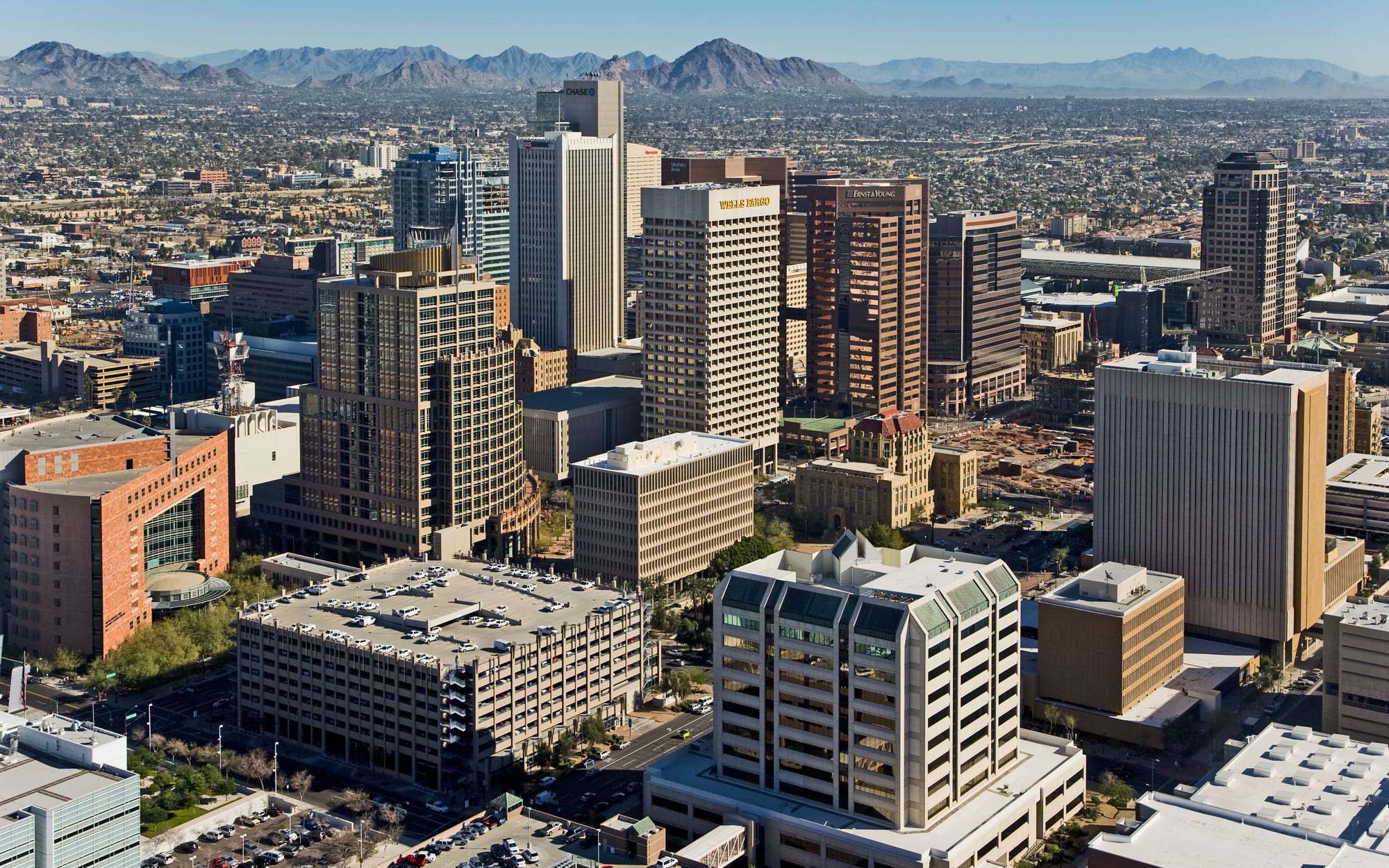
Aerial view of downtown Phoenix's office towers with low-rise city stretching away to Camelback Mountain and desert ranges

The Southwest, United States

Phoenix

Downtown Phoenix seen from the air looking north-east, with Camelback Mountain on the horizon. (DPPed / Wikimedia Commons · CC BY-SA 3.0)

Arizona's capital and largest city, spread across the Salt River Valley of the Sonoran Desert where the Hohokam once dug miles of canals. A farming town until the Second World War, it grew with air conditioning and high-tech industry into the fifth most populous city in the United States — sunny, sprawling, ringed by desert mountains and extremely hot in summer.

Neighbourhoods

  • Downtown
    • First-time visitors
    • Sport and theatre
    • Close to public transport

    The business district around Washington Street and Central Avenue, the point from which the city's street numbers start. Office towers, the ballpark and arena, theatres, Heritage Square, Arizona State University's downtown campus and the state government offices to the west are all here, on the light-rail line.

    Open in Maps
  • Roosevelt Row and Midtown
    • Arts and culture
    • Nightlife
    • Close to public transport

    North of downtown along Roosevelt Street and Central Avenue, where galleries, murals, bars and cafés fill the blocks of the monthly First Friday art walk, and the Heard Museum and Phoenix Art Museum stand on Central further north.

    Open in Maps
  • Arcadia and the Biltmore Area
    • Quiet and residential
    • Best for food
    • Hiking

    Arcadia, at the southern foot of Camelback Mountain, was planted with citrus groves from 1919 and suburbanised after the mid-1950s. The upscale Biltmore Area along Camelback Road lies just to the west.

    Open in Maps
  • Scottsdale
    • Resorts
    • Nightlife
    • Shopping

    A separate city of about 240,000 on Phoenix's eastern edge whose slogan is 'The West's Most Western Town'. Old Town Scottsdale has galleries, old-fashioned shops, restaurants, bars and nightclubs, and the city's resort history goes back to 1909.

    Open in Maps
  • Tempe
    • Students and nightlife
    • Close to public transport

    The university city south-east of Phoenix, home to Arizona State University's main campus and linked to downtown Phoenix and the airport by light rail, with student bars and restaurants close to the campus.

    Open in Maps

Things to do

Museums

  • Heard Museummuseum

    A museum of American Indian art that tells Native stories from a first-person perspective, with a full Navajo hogan and Barry Goldwater's collection of 437 historic Hopi kachina dolls.

    Open in Maps
  • Phoenix Art Museummuseum

    The largest museum for visual art in the south-western United States, with more than 18,000 works of American, Asian, European, Latin American, Western, modern and contemporary art and fashion.

    Open in Maps
  • Musical Instrument Museummuseum

    Opened in 2010 in north Phoenix, the largest museum of its kind in the world, with more than 15,000 instruments and related objects from nearly 200 countries and territories.

    Open in Maps
  • S'edav Va'aki Museummuseum

    The Hohokam platform mound and irrigation canals formerly known as Pueblo Grande, a National Historic Landmark near the airport, with a city-run museum beside them.

    Open in Maps

Downtown landmarks

  • Heritage Squarelandmark

    A block of restored late 19th-century houses anchored by the Rosson House, beside the Arizona Science Center in downtown.

    Open in Maps
  • Arizona State Capitollandmark

    The seat of the state government west of downtown, combining the original Capitol building with the buildings of the two legislative chambers.

    Open in Maps
  • Chase Fieldattraction

    The retractable-roof downtown ballpark of the Arizona Diamondbacks, opened in 1998, the year the team began play.

    Open in Maps

Desert parks and mountains

  • Desert Botanical Gardenpark

    A 140-acre garden in Papago Park, established on the site in 1939, with more than 50,000 desert plants including large collections of agaves and cacti.

    Open in Maps
  • Papago Parkpark

    A park of red sandstone buttes shared by Phoenix and Tempe, with the Phoenix Zoo, the Desert Botanical Garden, a golf course and the Hole-in-the-Rock formation.

    Open in Maps
  • Camelback Mountaintrail

    The highest peak in the metropolitan area, shaped like a kneeling camel, between Arcadia and Paradise Valley, with steep and popular summit trails.

    Open in Maps
  • Piestewa Peaktrail

    The second-highest point of the Phoenix Mountains, rising to 2,610 feet in a recreation area of the Phoenix Mountains Preserve.

    Open in Maps
  • South Mountain Parkpark

    The largest municipal park in the United States, covering 16,500 acres of desert mountains on the south side of the city, with trails and lookouts over the valley.

    Open in Maps

Scottsdale and around

  • Taliesin Westlandmark

    Frank Lloyd Wright's winter home and studio in the McDowell foothills from 1937 until his death in 1959, built of local desert stone and concrete and open for tours.

    Open in Maps
  • Old Town Scottsdaleneighborhood

    Scottsdale's walkable centre of galleries, Western shops, restaurants and bars.

    Open in Maps

Seasonal events

  • First Friday art walkthe first Friday of every month

    An evening art walk around the downtown and Roosevelt Row galleries, held since 1994 and grown into one of the largest monthly art walks in the country.

  • Barrett-Jackson collector car auctionJanuary

    The flagship collector-car auction held each January at the WestWorld event centre in Scottsdale, open to the public.

  • Cactus League spring trainingFebruary to March

    Fifteen Major League Baseball teams hold spring training and play exhibition games in ballparks across the metropolitan area.

Eat and drink

Long-standing places and food districts in Phoenix. Hours, ratings and directions come from your maps app, always current.

Phoenix classics

  • Pizzeria Biancorestaurant

    The pizza restaurant opened by Chris Bianco in 1987 and in downtown's Heritage Square since 1996, nationally recognised for its pizzas.

    Open in Maps
  • Matt's Big Breakfastrestaurant

    A downtown breakfast restaurant on 1st Street.

    Open in Maps
  • Tee Pee Mexican Foodrestaurant

    A Mexican restaurant on Indian School Road.

    Open in Maps

Food districts

  • South and west Phoenix taqueríasneighborhood

    Sonoran-style restaurants and taco shops, especially in the city's south, with 24-hour Mexican food places selling large burritos across the city.

    Open in Maps
  • Roosevelt Rowneighborhood

    Cafés, bars and casual restaurants among the galleries and murals just north of downtown.

    Open in Maps
  • Old Town Scottsdaleneighborhood

    Restaurants, bars and nightlife in the centre of Scottsdale.

    Open in Maps

Experience Phoenix

History

The Hohokam lived in the Salt River Valley for some 2,000 years and dug roughly 135 miles of irrigation canals that turned the desert into farmland; later canals, including the Arizona Canal, followed their paths. Drought and floods between 1300 and 1450 are believed to have driven them away, and the Akimel O'odham, Tohono O'odham and Maricopa, together with Yavapai and Apache groups, later used the area. The O'odham are thought to descend from the Hohokam.

In 1867 Jack Swilling, passing through the valley, saw the old canal lines and formed an irrigation company to grow food for the mining town of Wickenburg. Yavapai County recognised the new settlement in 1868, a townsite with the grid plan that still defines the city was chosen in 1870, and Phoenix was incorporated in 1881 with about 2,500 people. It became territorial capital in 1889 and state capital when Arizona joined the Union in 1912. Cotton, cattle, citrus, climate and copper — the "Five C's" — carried the economy, and the population reached about 48,000 by 1930.

The Second World War brought air fields and pilot-training camps, and in 1948 Motorola opened a research centre, followed by Intel and other high-tech firms. Air conditioning made the long summers bearable, and a town of about 65,000 in 1940 grew into a city of 1.6 million by 2020, averaging four per cent growth a year for four decades. Its growth slowed after the 2008 recession, and the summers of 2023 and 2024 set new heat records.

Culture & Customs

Phoenix's culture is shaped by the desert, by its Native and Mexican roots, and by newcomers from across the country. The city has the largest urban Native American population in Arizona, and the Heard Museum is one of the country's leading museums of American Indian art. Frank Lloyd Wright moved to the area in 1937 and built Taliesin West; his last public building, Gammage Auditorium, stands in Tempe. The Musical Instrument Museum and the Phoenix Art Museum add international collections, and the First Friday art walk has drawn crowds to the downtown galleries since 1994.

Sport is a large part of local life. The Suns, founded in 1968, were the city's first major team; the Diamondbacks, who began play in 1998, won the World Series in 2001; the Cardinals, who moved from St Louis, are the oldest continuously run professional football franchise in the country; and the Mercury are the most successful of all. Every February and March fifteen Major League Baseball teams hold spring training around the valley.

Winter is the social season, when resorts, golf courses and patios fill. In summer life moves indoors or to the early morning, and many residents escape to the pines and lakes of northern Arizona. Hispanic residents make up about 42 per cent of the city, and Spanish is widely heard.

Daily Life

The 2020 census counted just over 1.6 million people in Phoenix, making it the fifth most populous city in the United States and the most populous state capital, and the metropolitan area has an estimated 5.19 million. The city covers almost 518 square miles, mostly low-rise suburbs of single-family houses, and is divided into fifteen planning areas called urban villages. Neighbouring cities — Scottsdale, Tempe, Mesa, Glendale, Chandler and others — merge into it without a break.

The economy is broad. Banner Health, based in Phoenix, is the largest employer in Arizona; Honeywell's aerospace division has its headquarters here; and Intel's site in the valley employs about 12,000 people. Government, Arizona State University's downtown campus, finance, tourism and construction add many more jobs. Neighbourhoods such as South Mountain, Alhambra and Maryvale, once troubled, have stabilised as violent crime has fallen since 2023.

Heat shapes the rhythm of the day. Nearly all homes have air conditioning, though poorer households can struggle to repair or run it. In summer, errands and exercise happen at dawn or after dark, and the hottest hours are spent indoors. Water is a constant issue: the region depends on the Colorado River and on canals that follow the Hohokam's routes. The city even has a feral population of rosy-faced lovebirds, descended from escaped pets.

Food

Mexican food is the city's foundation, and it is overwhelmingly Sonoran in style, from the neighbouring Mexican state of Sonora: large, thin flour tortillas, carne seca (dried beef), chimichangas and the bacon-wrapped Sonoran hot dog. Restaurants and taquerías are spread across the city, and 24-hour Mexican food places sell burritos the size of a forearm. Some restaurants specialise instead in the hotter, chile-heavy cooking of New Mexico.

The valley's restaurants also reach well beyond Mexican food, from fusion kitchens to a Tohono O'odham-owned restaurant serving Native American family recipes. Pizzeria Bianco, opened by Chris Bianco in 1987 and in downtown's Heritage Square since 1996, has been rated the best pizza in the United States by several national magazines, and Matt's Big Breakfast is a downtown breakfast spot.

The farming past survives in the citrus trees of older neighbourhoods like Arcadia and in the "Five C's" that once included citrus. The resort culture of Scottsdale supports many upscale restaurants.

Planning tools

Budget

Phoenix is mid-priced for a big American city. Hotel rates follow the weather: highest in the winter and spring peak season, much lower in the summer heat. Scottsdale is dearer than Phoenix itself. A hire car is the main fixed cost, since the metropolitan area is enormous.

Daily Budget Midrange
USD 200–380 (mid-range hotel, sit-down dinners, museum tickets and a hire car)
Daily Budget Shoestring
USD 90–150 (budget motel, taco shops and diners, light rail and buses)

Summer is the cheapest time to stay, but plan days around the heat; in winter book resorts and spring-training weekends early.

Best Time to Visit

November to April, when days are warm and sunny and the evenings cool; this is peak season. From late May to late September most days pass 100°F, and the monsoon, officially 15 June to 30 September, brings thunderstorms, flash floods and dust storms. Summer suits only those who plan around early mornings, pools and air-conditioned museums.

Suggested Number of Days

Two or three days cover the main museums, a desert garden and a hike. Four to six allow for Scottsdale and Tempe and for excursions into the Sonoran Desert. Distances are long, so the time needed depends heavily on having a car.

First Visit
2–3 days
With Surroundings
4–6 days

Transportation

The city covers about 518 square miles, and most people drive. Valley Metro's light rail runs east–west from downtown past the airport to Tempe and Mesa, and north–south along Central Avenue, and is a practical way to reach downtown, Midtown's museums and Tempe; buses cover the rest, slowly. Streets follow a regular grid numbered from Washington Street and Central Avenue. E-scooters are common downtown.

Never leave children, pets or phones in a parked car in summer, and keep water in the car; for most excursions a hire car is essential.

Airport & Station Connections

Phoenix Sky Harbor International Airport, Arizona's largest and busiest, is 3 miles east of downtown and among the busiest airports in the country, with Southwest Airlines its largest carrier; light rail and buses link it with the city. There is no Amtrak station in Phoenix: the nearest is at Maricopa, 30 miles south of downtown, and Amtrak Thruway buses link the airport with Flagstaff for the Southwest Chief.

Walkability

Downtown, Roosevelt Row, Old Town Scottsdale and the area around Arizona State University in Tempe are walkable, and the light rail joins several of them. Beyond those pockets, the city is built at low density along wide roads, and distances between sights are long. From May to September walking in the middle of the day is dangerous; shade is scarce and pavements radiate heat after dark.

Safety

For most visitors the US is safe, with the main risks being petty theft and car break-ins in tourist areas of some cities, road accidents over long distances, extreme weather, and the hazards of the outdoors. In Phoenix the heat is the main danger, on city streets as well as on desert trails, and recent summers have brought record numbers of days above 110°F. Violent crime has been falling since 2023; property crime and car break-ins are the usual problems for visitors.

Hike only at dawn in summer, carry far more water than seems necessary, and turn back early; keep valuables out of sight in parked cars. Check current official travel advice before travelling.

Climate

A hot desert climate with more sunshine than any other major city on Earth and about 7 inches of rain a year. On average 111 days a year reach 100°F and 21 pass 110°F; the record is 122°F. Recent summers have been hotter still: in 2024 there were 70 days of 110°F or more. Nights can stay very warm: on 19 July 2023 the low was 97°F, a record.

Summer
extremely hot — most days from late May to late September reach at least 100°F, often above 110°F, with monsoon storms from mid-June
Winter
mild and sunny — the Southwest region's figures give daytime highs of about 59–72°F for Phoenix, Tucson and Las Vegas; frost is occasional

Local Customs

Tipping is expected: roughly 18–22 per cent in restaurants. Dress is casual almost everywhere. Arizona is mostly on Mountain Standard Time all year, without daylight saving, though the Navajo Nation in the north of the state does change its clocks. Drink-driving laws are strictly enforced.

Identification is asked for when buying alcohol (the legal age is 21). On desert trails, stay on the path and keep clear of cacti.

Common Payment Methods

The currency is the US dollar. Cards and contactless payment are accepted almost everywhere; a little cash is useful for tips and for some small taco shops. ATMs are easy to find.