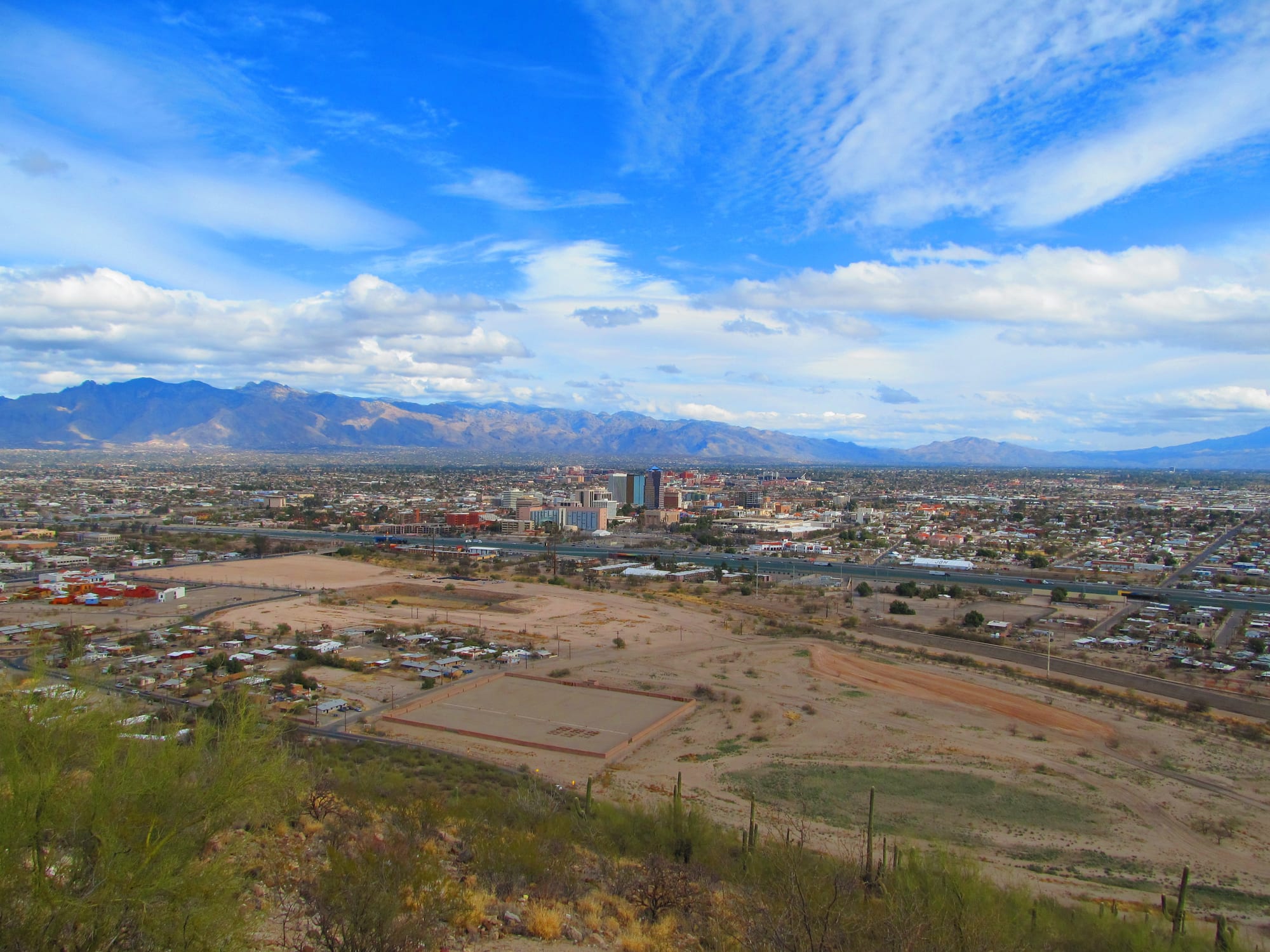
The low, spreading city of Tucson with its small cluster of downtown towers, seen from a desert hillside below the Santa Catalina Mountains

The Southwest, United States

Tucson

Downtown Tucson and the Santa Catalina Mountains seen from Sentinel Peak. (John Diebolt / Wikimedia Commons · CC0)

Arizona's second city, in a Sonoran Desert basin ringed by five mountain ranges in southern Arizona. It grew from a Spanish fort of 1775 beside an O'odham village and a mission, was the territorial capital, and was Arizona's largest city until Phoenix overtook it. Today it is a university city known for its saguaro forests, barrios and Sonoran food.

Neighbourhoods

  • Downtown and the Presidio District
    • First-time visitors
    • Historic district
    • Nightlife

    The old core where the Spanish fort stood, divided into the Presidio District, the Barrio Viejo and the Congress Street arts and entertainment district. Theatres, the Tucson Museum of Art, restaurants and bars are here, on the streetcar line.

    Open in Maps
  • Barrio Viejo
    • Historic district
    • Architecture
    • Quiet and residential

    Also called Barrio Libre or Barrio Histórico, a district of 19th-century adobe houses just south of downtown with the El Tiradito shrine. Neighbouring barrios were razed for urban renewal, which makes the surviving streets all the more prized.

    Open in Maps
  • Fourth Avenue
    • Nightlife
    • Shopping
    • Students

    A street of independent shops, bars and restaurants between downtown and the university, once the gathering place of the city's hippies, which holds a street fair twice a year.

    Open in Maps
  • The University and Sam Hughes
    • Museums
    • Students
    • Close to public transport

    The University of Arizona's campus, with the Arizona State Museum and the art museum, and the busy bars and restaurants of University Boulevard by its Main Gate. To the east the Sam Hughes neighbourhood's historic houses line a quiet bike route.

    Open in Maps
  • Catalina Foothills
    • Resorts
    • Hiking
    • Quiet and residential

    The low-density area on the slopes of the Santa Catalina Mountains north of the city, between Oracle Road and Sabino Creek, with desert homes and easy access to Sabino Canyon.

    Open in Maps
  • South Tucson
    • Best for food
    • Local life

    A separate one-square-mile city surrounded by Tucson south of downtown, where about three in four residents are Hispanic and Mexican restaurants are found throughout.

    Open in Maps

Things to do

Missions and history

  • Mission San Xavier del Baclandmark

    A white Spanish Colonial church on the Tohono O'odham Nation's San Xavier reservation, about 10 miles south of downtown; the mission was founded by Eusebio Kino in 1692 and the church built in 1783–97 is the oldest European structure in Arizona.

    Open in Maps
  • Presidio San Agustín del Tucsónlandmark

    The site of the Spanish fort of 1775 from which the city grew; its original walls were taken down after the Americans arrived.

    Open in Maps
  • El Tiraditolandmark

    A crumbling brick 'wishing shrine' in the Barrio Viejo, where candles are left burning for a legendary sinner said to grant miracles.

    Open in Maps
  • Mission Gardenpark

    A living agricultural museum within adobe walls at the foot of Sentinel Peak, growing heritage crops and heirloom trees that represent more than 4,000 years of farming in the Sonoran Desert.

    Open in Maps

Museums

  • Arizona-Sonora Desert Museummuseum

    Founded in 1952 just west of the city, a combined zoo, botanical garden, aquarium and natural history museum with two miles of paths through the desert and more than 230 animal species.

    Open in Maps
  • Pima Air & Space Museummuseum

    Nearly 400 aircraft displayed indoors and outdoors across 80 acres, with the Arizona Aviation Hall of Fame.

    Open in Maps
  • Tucson Museum of Artmuseum

    An art museum in the Presidio District whose city-block campus includes 19th-century historic houses such as the Cordova House of 1848, with collections of modern, Latin American, Western and Native American art.

    Open in Maps
  • Arizona State Museummuseum

    Founded in 1893 on the University of Arizona campus, a museum of the archaeology and peoples of the Southwest.

    Open in Maps

Desert parks and mountains

  • Saguaro National Parkpark

    Forests of giant saguaro cactus in two separate districts, about 10 miles west and 10 miles east of the city, preserving Sonoran Desert landscapes, plants and wildlife.

    Open in Maps
  • Sabino Canyonpark

    A canyon in the Santa Catalina Mountains north of the city, a favourite place to walk, hike or ride, with waterfalls along Sabino Creek.

    Open in Maps
  • Sentinel Peakviewpoint

    'A' Mountain, the small peak south-west of downtown marked with the university's giant letter, overlooking downtown and the Santa Cruz valley.

    Open in Maps
  • Tohono Chulpark

    A 49-acre botanical garden, nature preserve and cultural museum in Casas Adobes, north of the city, whose name means 'desert corner' in the Tohono O'odham language.

    Open in Maps

Short trips from the city

  • Mount Lemmonviewpoint

    The 9,171-foot summit of the Santa Catalina Mountains in the Coronado National Forest, named after the botanist Sara Plummer Lemmon, who reached the top in 1881.

    Open in Maps
  • Kitt Peak National Observatoryattraction

    One of the largest gatherings of astronomical instruments in the northern hemisphere, on the Tohono O'odham Nation 55 miles west-southwest of Tucson; it reopened to the public in September 2023 after a wildfire.

    Open in Maps

Seasonal events

  • Tucson Gem and Mineral Showlate January and February

    One of the largest gem and mineral gatherings in the world, held since 1955, with dozens of associated shows of gems, fossils and beads across the city.

  • Fiesta de los VaquerosFebruary

    Rodeo week, which marks the start of the rodeo season in the United States, with a parade for which most schools close.

  • Tucson Festival of BooksMarch

    A two-day book festival at the University of Arizona, held since 2009, with an estimated 130,000 visitors in 2024.

  • Tucson International Mariachi ConferenceApril

    A three-day festival of mariachi bands and folklórico dance, held since 1982.

  • Tucson Meet YourselfOctober

    An annual festival celebrating the city's many ethnic groups.

  • All Souls Processionearly November

    A huge sundown procession through downtown honouring the dead, drawing on Mesoamerican, Spanish Catholic and Mexican traditions; it began in 1990.

Eat and drink

Long-standing places and food districts in Tucson. Hours, ratings and directions come from your maps app, always current.

Tucson classics

  • El Charro Caférestaurant

    Founded in 1922 and owned by the Flores family ever since, the oldest Mexican restaurant in the United States owned by the same family, with a location in the El Presidio Historic District downtown.

    Open in Maps
  • Sonoran hot dog standsrestaurant

    Stands and small restaurants selling the bacon-wrapped Sonoran hot dog in a bolillo-style bun, topped with pinto beans, onions, tomatoes and condiments that often include mayonnaise, mustard and jalapeño salsa.

    Open in Maps

Food districts

  • South Tucsonneighborhood

    Family-run Sonoran Mexican restaurants in the small, largely Mexican American city south of downtown.

    Open in Maps
  • Fourth Avenue and downtownneighborhood

    Bars, cafés and restaurants along Fourth Avenue and Congress Street, from casual student spots to newer restaurants.

    Open in Maps

Experience Tucson

History

People have farmed beside the Santa Cruz River at the foot of Sentinel Peak for thousands of years. The Hohokam lived in the area from about AD 600 to 1450, building irrigation canals and making red-on-brown pottery, and the O'odham who followed named the place Cuk Ṣon, "the base is black", for the dark peak — the source of the city's name. In 1692 the Jesuit missionary Eusebio Kino came to the valley and founded San Xavier del Bac in a Sobaipuri O'odham settlement south of today's city.

In 1775 Hugo O'Conor authorised the walled Presidio San Agustín del Tucsón, the fort from which the city grew; the Apache attacked it repeatedly. After 1821 Tucson belonged to the Mexican state of Sonora, and it came to the United States through the Gadsden Purchase in the 1850s. The Civil War brought skirmishes between Union and Confederate cavalry. Tucson was capital of the Arizona Territory from 1867 to 1877 and was incorporated in 1877, the oldest incorporated city in Arizona. The railway brought Chinese workers, and in 1885 the territory founded the University of Arizona.

Tucson was Arizona's largest city until Phoenix overtook it between 1910 and 1920. It kept growing through the 20th century, reaching 37,000 people by 1940 and more than half a million today, but urban renewal destroyed one of its earliest barrios, leaving the adobe Fremont House as a survivor. Today it is the largest city in the lands of the Gadsden Purchase.

Culture & Customs

Tucson's identity rests on its blend of O'odham, Mexican, Spanish and Anglo-American roots and on the desert. About 42 per cent of residents are Hispanic, the Tohono O'odham Nation lies just west and south of the city, and Mexico is close enough that families and traditions move back and forth. The city is proud of its barrios, adobe houses and the white church of San Xavier, a working mission and pilgrimage site.

Festivals fill the cooler months. The gem and mineral shows of late January and February are among the largest in the world, the Fiesta de los Vaqueros rodeo follows in February, the Festival of Books is held at the university in March, and the International Mariachi Conference has brought hundreds of mariachi bands to the city each April since 1982. Tucson Meet Yourself celebrates the city's ethnic groups in October, and the All Souls Procession, begun by the artist Susan Kay Johnson in 1990, is now part of All Souls Weekend events that bring together more than 100,000 people downtown each November in memory of the dead.

The University of Arizona shapes much of the city's life, from its basketball and football teams to its poetry centre and its observatories; Tucson is a centre of astronomy, with Kitt Peak nearby and a university laboratory that casts giant telescope mirrors. The city has long been a filming location for Westerns, most of them made at Old Tucson, and the city has a lively music scene of punk bars, house venues and norteño music.

Daily Life

The 2020 census counted about 543,000 people in Tucson, the second-largest city in Arizona, and the metropolitan area has an estimated 1.08 million. Suburbs such as Oro Valley and Marana spread north-west, Sahuarita lies to the south, and the small city of South Tucson sits inside Tucson south of downtown.

The University of Arizona is the city's largest employer, and Davis-Monthan Air Force Base on the south-eastern edge provides many jobs; military families live in suburbs such as Rita Ranch. Defence and technology companies, Raytheon among them, have large operations here, the city is a hub on the Union Pacific railway linking the Los Angeles ports with the south and east, and the winter gem shows are one of its major annual attractions. About 18 per cent of residents live below the poverty line.

The heat sets the rhythm of the day for half the year: errands and exercise early, the hottest hours indoors, and evenings outside. Locals watch for the first monsoon storm each July, which brings humidity and brief flooding of main streets. At the end of the 2010s the city and its businesses began redeveloping downtown, and the Sun Link streetcar, opened in 2014, links the centre with the university.

Food

In 2015 Tucson became the first city in the United States named a UNESCO City of Gastronomy. Its food heritage reaches back more than 4,000 years in the Sonoran Desert and draws on Hohokam and O'odham, Spanish, Mexican, Chinese and other traditions. Mission Garden, at the foot of Sentinel Peak, grows the heritage crops and fruit trees of those cultures.

Sonoran-style Mexican food is the city's everyday cooking: flour tortillas, carne seca (dried beef), carne asada tacos and chiles rellenos. Tucson has a strong but contested claim to have invented the chimichanga, a deep-fried burrito. A very popular street food is the Sonoran hot dog, sold at more than 200 places in the city by a 2009 estimate — a hot dog wrapped in bacon and grilled, served in a bolillo-style bun and topped with pinto beans, onions, tomatoes and condiments that often include mayonnaise, mustard and jalapeño salsa.

El Charro Café, opened in 1922 and still owned by the Flores family, is the oldest Mexican restaurant in the United States owned by the same family. South Tucson's family restaurants and the bars and cafés of Fourth Avenue and downtown complete the picture, and since 2022 a Chinese Chorizo Festival each October has invited cooks to create new dishes from a sausage that reflects the city's Chinese and Mexican heritage.

Planning tools

Budget

Tucson is good value by American standards. Prices rise in the winter and spring high season, especially during the Gem and Mineral Show in late January and February, and fall in summer. Many of the best things — the barrios, the mission, Sabino Canyon and the Saguaro National Park trails — cost little or nothing beyond park fees.

Daily Budget Midrange
USD 180–340 (mid-range hotel, sit-down dinners, the Desert Museum and park fees, a hire car)
Daily Budget Shoestring
USD 80–140 (budget motel, Sonoran hot dogs and taco shops, buses and the streetcar)

Book early if travelling during the Gem and Mineral Show; in summer plan outdoor sights for early morning.

Best Time to Visit

October to April, when days are warm and sunny and nights cool; this is the season of the gem show, the rodeo and the book festival. Summer is very hot, with highs around 100°F, and the monsoon, usually arriving in early July, brings dramatic afternoon storms through August and often September.

Suggested Number of Days

Two or three days cover the historic centre, the mission and the main desert parks and museums. Four or five allow for the mountains and Kitt Peak. Hikers and birdwatchers often stay longer.

First Visit
2–3 days
With Surroundings
4–5 days

Transportation

Most visitors drive, since the desert parks, the mission and the mountains all lie outside the centre. The Sun Link streetcar runs 3.9 miles linking the university, Fourth Avenue, downtown and the Mercado District west of Interstate 10, and Sun Tran buses cover the wider city. Third Street east of the university is a bike route closed to through traffic.

Take the streetcar between downtown, Fourth Avenue and the university, and hire a car for the parks and the mission.

Airport & Station Connections

Tucson International Airport, the second busiest in Arizona, is 8 miles south of downtown, with Sun Tran bus routes 11 and 25 into the city. The city is a hub on the Union Pacific railway's Sunset Route.

Walkability

Downtown, the Barrio Viejo, Fourth Avenue and the university are close together and pleasant on foot, and the streetcar links them. The rest of the city spreads at low density across the basin, and the main natural sights need a car. In summer, walking in the middle of the day is exhausting and can be dangerous.

Safety

For most visitors the US is safe, with the main risks being petty theft and car break-ins in tourist areas of some cities, road accidents over long distances, extreme weather, and the hazards of the outdoors. In Tucson the summer heat is the main danger on trails. Monsoon rains flood main roads for a few hours at a time because much of the city has no storm sewers, and dry washes can fill fast.

Carry plenty of water and hike early in summer, never drive into a flooded road or wash, and leave nothing visible in parked cars at trailheads. Check current official travel advice before travelling.

Climate

A hot desert climate with about 10.6 inches of rain a year, falling in winter Pacific storms and the summer monsoon. On average 158 days a year reach 90°F, while frost comes on about 12 nights. The record high is 117°F. Snow is rare; the most recent fell in March 2023.

Summer
very hot — average highs of 98–102°F and lows of 71–77°F, with monsoon storms from early July
Winter
mild and sunny — average highs of 65–70°F and overnight lows of 40–44°F, with daily swings often over 30°F

Local Customs

Tipping of roughly 18–22 per cent is expected in restaurants. Dress is casual. San Xavier del Bac is a working church and a pilgrimage site on the Tohono O'odham Nation, so behave as in any place of worship. Spanish is widely spoken, and Mexican and O'odham traditions are part of everyday life.

Identification is asked for when buying alcohol (the legal age is 21). Dress modestly and keep quiet inside the mission church, and respect tribal rules on the reservation.

Common Payment Methods

The currency is the US dollar. Cards and contactless payment are accepted almost everywhere; a little cash is useful for tips, hot dog stands and small Mexican restaurants. ATMs are easy to find.