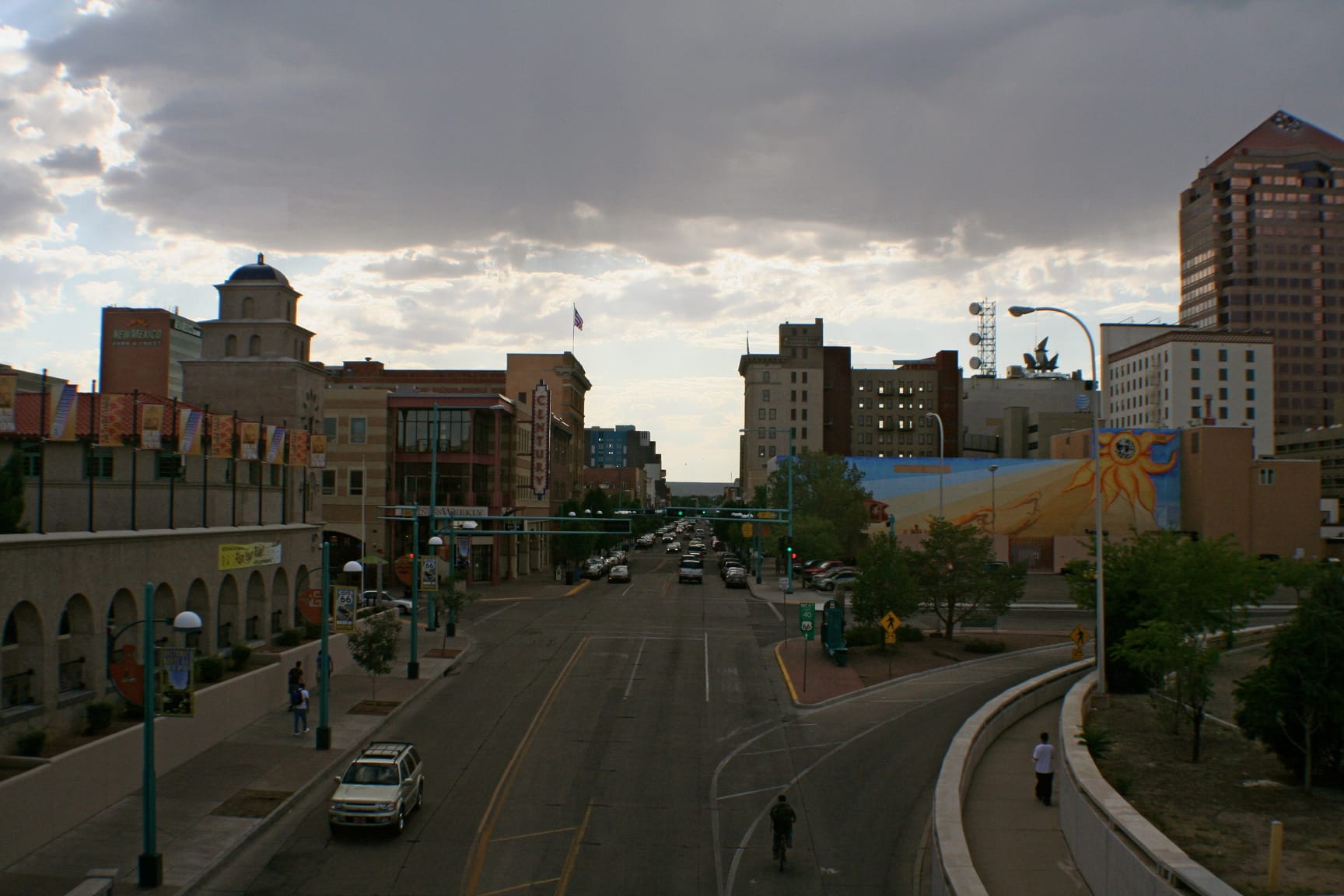
Central Avenue running straight through downtown Albuquerque between low brick buildings and towers under a cloudy sky

The Southwest, United States

Albuquerque

Central Avenue, the old Route 66, running through downtown Albuquerque. (Asaavedra32 / Wikimedia Commons · CC BY-SA 3.0)

New Mexico's largest city, spread across a high desert basin on both banks of the Rio Grande below the Sandia Mountains. Founded as a Spanish villa in 1706, it grew on the railroad, Route 66 and Cold War science, and today mixes an adobe Old Town and pueblo culture with university life, film studios and the world's largest balloon festival.

Neighbourhoods

  • Old Town
    • First-time visitors
    • Historic district
    • Museums

    The original town site of 1706 — about ten blocks of adobe buildings around a shaded plaza and the Spanish colonial San Felipe de Neri Church. Shops, galleries and New Mexican restaurants fill the old houses, and several of the city's main museums stand a short walk to the north-east.

    Open in Maps
  • Downtown
    • Close to public transport
    • Nightlife
    • Architecture

    The railroad-era New Town that grew up around the depot after 1880, cut through by Central Avenue, the old Route 66. Pueblo Deco buildings such as the KiMo Theater stand among office towers, bars and music venues, and the Alvarado Transportation Center gathers trains and buses.

    Open in Maps
  • Nob Hill
    • Best for food
    • Shopping
    • Students and nightlife

    A stretch of Central Avenue east of the University of New Mexico known for its Route 66 neon, independent shops, restaurants and bars, with quiet residential streets behind.

    Open in Maps
  • Barelas
    • Local life
    • Arts and culture

    One of the oldest Hispanic neighbourhoods in the city, south of downtown along Fourth Street, home to the National Hispanic Cultural Center and close to the river and the bosque.

    Open in Maps
  • Northeast Heights
    • Quiet and residential
    • Close to the mountains

    Part of the north-east quadrant, the largest in the city, climbing towards the Sandia foothills — suburban streets, shopping malls in the Uptown area, and the trailheads and tramway at the foot of the mountains.

    Open in Maps

Things to do

Old Town and historic sights

  • Old Town Plazaneighborhood

    The historic plaza at the heart of the 1706 settlement, ringed by adobe buildings and known for its luminaria displays at Christmas.

    Open in Maps
  • San Felipe de Neri Churchlandmark

    The Spanish colonial church of 1793 on the north side of Old Town Plaza, still a working parish.

    Open in Maps
  • KiMo Theaterlandmark

    A downtown theatre in the Pueblo Deco style, mixing Pueblo and Art Deco motifs on historic Route 66.

    Open in Maps

Museums

  • Indian Pueblo Cultural Centermuseum

    A museum and cultural centre run by New Mexico's pueblos, with exhibitions on their history and art.

    Open in Maps
  • Albuquerque Museummuseum

    The city's museum of art and history on the edge of Old Town, covering four centuries of the middle Rio Grande valley.

    Open in Maps
  • New Mexico Museum of Natural History and Sciencemuseum

    A state museum near Old Town known for its dinosaur halls and exhibits on the geology of New Mexico.

    Open in Maps
  • National Museum of Nuclear Science & Historymuseum

    The story of the atomic age, told in a city that grew up around Sandia National Laboratories and Kirtland Air Force Base.

    Open in Maps
  • National Hispanic Cultural Centermuseum

    A centre for Hispanic arts and culture in Barelas, with art galleries, performance venues and a library.

    Open in Maps
  • Anderson-Abruzzo Albuquerque International Balloon Museummuseum

    A museum of ballooning beside Balloon Fiesta Park, in the city that hosts the largest balloon festival in the world.

    Open in Maps

Parks, the river and the mountains

  • Sandia Peak Tramwayattraction

    The longest aerial tramway in the Americas, running from the north-east edge of the city to Sandia Peak on the ridge of the Sandia Mountains.

    Open in Maps
  • Petroglyph National Monumentpark

    Images carved into the basalt of the West Mesa over many centuries, reached on short trails on the city's west side.

    Open in Maps
  • ABQ BioParkpark

    The city's zoo, aquarium and botanic garden, together with Tingley Beach, along the Rio Grande near Old Town.

    Open in Maps
  • Rio Grande Nature Center State Parkpark

    A nature reserve in the bosque, the riverside cottonwood forest, where sandhill cranes can be seen in winter.

    Open in Maps

Sport and nights out

  • Isotopes Parkattraction

    The ballpark of the Albuquerque Isotopes, a minor-league baseball team named after an episode of The Simpsons, and of the New Mexico United soccer club.

    Open in Maps

Short trips from the city

  • Santa Feattraction

    New Mexico's adobe capital to the north-east, founded by the Spanish around 1610 and reached by the Rail Runner commuter train.

    Open in Maps
  • Acoma Puebloattraction

    A pueblo village built on top of a mesa west of the city, one of the oldest continuously inhabited communities in the United States.

    Open in Maps

Seasonal events

  • Albuquerque International Balloon Fiestafirst full week of October

    A nine-day festival of more than 500 hot-air balloons, the largest balloon festival in the world, launched from Balloon Fiesta Park.

  • New Mexico Arts and Crafts Fairsummer

    A show held every year since 1961 exclusively for New Mexico's artists and craftspeople.

  • Christmas Eve luminariasChristmas Eve, December

    Small paper-bag lanterns lit along walls and paths, most famously around Old Town Plaza.

Eat and drink

Long-standing places and food districts in Albuquerque. Hours, ratings and directions come from your maps app, always current.

Albuquerque classics

  • New Mexican kitchensrestaurant

    Enchiladas, carne adovada and sopaipillas, served with red or green chile — the defining food of the city, served everywhere from diners to family restaurants.

    Open in Maps

Food districts

  • Old Townneighborhood

    New Mexican restaurants in old adobe houses around the plaza and the lanes leading off it.

    Open in Maps
  • Nob Hillneighborhood

    Restaurants, cafés, breweries and bars along Central Avenue near the university.

    Open in Maps
  • Downtown Central Avenueneighborhood

    Bars, breweries and restaurants along the old Route 66 through the city centre.

    Open in Maps

Experience Albuquerque

History

People lived along this stretch of the Rio Grande long before the city existed: petroglyphs carved into the basalt of the West Mesa date back many centuries, and by the 1500s around twenty Tiwa pueblos stood along the river. Two of them, Sandia and Isleta, survive on the edges of the modern city. In 1706 the governor of Spanish New Mexico, Francisco Cuervo y Valdés, founded La Villa de Alburquerque, naming it after the Duke of Alburquerque, viceroy of New Spain. It was an outpost on El Camino Real, the trade road linking Mexico City with Santa Fe, and its plaza and the church of San Felipe de Neri remain the heart of Old Town.

After the United States took New Mexico in the 1840s, an army post operated here until 1867. The decisive change came in 1880, when the Atchison, Topeka and Santa Fe Railway arrived and placed its depot about two miles east of the plaza. A New Town grew up around the tracks, and the old settlement remained separate until the 1920s. Tuberculosis patients came for the dry air, among them the future governor Clyde Tingley and the architect John Gaw Meem, whose Pueblo Revival style shaped the University of New Mexico.

Route 66 reached the city in 1926, first along Fourth Street and later along Central Avenue. Kirtland Air Force Base, opened in 1939, and Sandia National Laboratories, founded in 1949, made Albuquerque part of the atomic age, and the population passed 200,000 by 1960. Downtown declined as the city sprawled, and many historic buildings were demolished in the 1960s and 1970s. Microsoft was founded here, and in recent years film and television production has become a large industry.

Culture & Customs

Albuquerque's culture is a meeting of Pueblo, Hispano and Anglo-American traditions. About half of the population is Hispanic or Latino, and the Indian Pueblo Cultural Center, run by the state's pueblos, presents their history and art. The National Hispanic Cultural Center in Barelas is a major venue for Hispanic arts, and Pueblo Revival and Pueblo Deco buildings, adobe walls and Route 66 neon give the city its look.

The Balloon Fiesta each October is the event the city is best known for, the largest balloon festival in the world, with more than 500 balloons rising over the north of the city. Christmas brings luminarias — small paper-bag lanterns lit along paths and walls — above all in Old Town, and the summer New Mexico Arts and Crafts Fair has been held every year since 1961. The Gathering of Nations, long North America's largest powwow, and the New Mexico State Fair have both been held at Expo New Mexico.

The city has become a centre of film and television production, with a major Netflix studio, and several well-known crime dramas have been set and filmed on its streets, drawing fans to their locations. Sport means the Isotopes, a minor-league baseball team whose name comes from an episode of The Simpsons, the New Mexico United soccer club and the University of New Mexico Lobos. Residents call the city ABQ, Burque or the Duke City.

Daily Life

The 2020 census counted about 565,000 people in the city, and the metropolitan area had about 955,000 in 2023, including Rio Rancho and the towns of the Rio Grande valley. Growth is hemmed in by the Sandia and Isleta pueblos to the north and south, Kirtland Air Force Base and the mountains, so new suburbs spread west across the mesa beyond Petroglyph National Monument.

The economy rests on science, medicine and technology — Sandia National Laboratories and Kirtland Air Force Base are major parts of a technology corridor along the Rio Grande — along with the university, retail and film production. Life is shaped by the car and the climate: wide boulevards, low houses, strip malls and long views of the Sandia Mountains.

The city also faces serious problems. About 13.5 per cent of residents lived below the poverty line at the 2020 census, and homelessness, which has grown more visible since the 2000s, is concentrated around downtown and the International District off Central Avenue. The bosque, the riverside cottonwood forest, has shrunk since dams upstream changed the river's flood cycle, and a corridor of it is now protected as a state park.

Food

Albuquerque cooks New Mexican food, a cuisine built on chile grown along the Rio Grande and in the Hatch Valley to the south. The defining question in any restaurant is 'red or green?' — red chile sauce from dried ripe pods or green chile from roasted fresh ones; ordering both is called 'Christmas'. Enchiladas are served rolled or stacked flat, carne adovada is pork slow-cooked in red chile, and sopaipillas, puffy fried bread, are eaten with honey.

Green chile turns up everywhere: in stew, on cheeseburgers, in breakfast burritos wrapped with eggs, potatoes and bacon or sausage, and even in national fast-food chains. Posole, a stew of hominy and pork, is one of the great Christmas traditions, tamales are a common traditional dish, and biscochitos, anise-flavoured biscuits, are the state cookie.

Old Town's restaurants serve New Mexican food in historic adobe houses, while Nob Hill and downtown have most of the newer restaurants, cafés and craft breweries.

Planning tools

Budget

Albuquerque is good value by the standards of the Southwest and far cheaper than Santa Fe or the big coastal cities. Hotels are reasonably priced most of the year but fill up and rise sharply during the Balloon Fiesta in October. A hire car is the main fixed cost, since the city is spread out.

Daily Budget Midrange
USD 190–350 (mid-range hotel, sit-down meals, museum tickets, the tramway, a hire car)
Daily Budget Shoestring
USD 80–130 (hostel or budget motel, New Mexican diners, buses and the Rail Runner)

Book months ahead for Balloon Fiesta week; Old Town, the bosque trails and Petroglyph National Monument's short trails cost little or nothing.

Best Time to Visit

Spring and autumn are the most comfortable seasons, and October is the busiest month because of the Balloon Fiesta. Summer is hot, with the monsoon bringing storms from July to early September. Winters are cool and sunny, with occasional snow, and Christmas Eve brings luminarias to Old Town.

Suggested Number of Days

Two or three days are enough for a first visit to the city itself. Four or five allow time for day trips into the surrounding high desert as well, and a visit timed for the October balloon festival is a reason to stay longer.

First Visit
2–3 days
With Surroundings
4–5 days

Transportation

Albuquerque is a low, spread-out city built around the car, and a hire car is the easiest way to get around. ABQ RIDE buses run from the Alvarado Transportation Center downtown, and Albuquerque Rapid Transit (ART), opened in 2019, runs frequent buses along Central Avenue linking Old Town, downtown, the university, Nob Hill and Uptown. The New Mexico Rail Runner Express commuter train runs north to Santa Fe and south to Belen.

Addresses end in NE, NW, SE or SW: the city is divided into quadrants by Central Avenue and the railroad tracks, so check the quadrant when looking up a street.

Airport & Station Connections

Albuquerque International Sunport, New Mexico's main airport, is about 3 miles south-east of downtown, and Southwest Airlines carries more than half its passengers. Amtrak's Southwest Chief stops at the Alvarado Transportation Center downtown, which is also the Greyhound depot and a Rail Runner station. Interstates 25 and 40 cross in the middle of the city.

Walkability

Old Town and downtown are each easy to explore on foot, and Nob Hill is a pleasant walk along Central Avenue, but the distances between districts are long and the city is one of the least densely populated large cities in the country. The bosque trails along the river are good for walking and cycling. At about a mile above sea level, with strong sun and dry air, walkers need water and sun protection.

Safety

For most visitors the US is safe, with the main risks being petty theft and car break-ins in tourist areas of some cities, road accidents over long distances, extreme weather, and the hazards of the outdoors. Most crime in Albuquerque is property crime, and parts of Central Avenue can be unsafe after dark. Homelessness and drug use are concentrated around downtown and the International District along Central Avenue.

Leave nothing visible in a parked car, use ride-hailing after dark away from the busy areas, and carry water and sun protection on the trails. Check current official travel advice before travelling.

Climate

A dry high-desert climate at about 5,300 feet, with strong sunshine, low humidity, large differences between day and night, and less than 9 inches of rain a year. The monsoon from July to early September brings thunderstorms and the wettest months, July and August.

Summer
hot, and dry until the monsoon arrives in July — on average 64–91 days a year reach 90°F or more, and 1–11 days reach 100°F, mostly in June and July
Winter
cool and mostly sunny — December and January have a daily mean of about 37°F at the airport, and the city averages about 8 inches of snow a winter

Local Customs

Tipping is expected, at roughly 18–22 per cent in restaurants. Restaurants ask 'red or green?' — which chile sauce to serve. The pueblos near the city are sovereign communities with their own rules: many require permits for photography and some forbid photography or sketching altogether, and some ceremonies are closed to visitors.

Identification is asked for when buying alcohol (the legal age is 21). Follow each pueblo's posted rules on photography and sketching.

Common Payment Methods

The currency is the US dollar. Cards and contactless payment are accepted almost everywhere; some small vendors and craft sellers prefer cash, and ATMs are easy to find. Prices are shown without tax, which is added when paying.