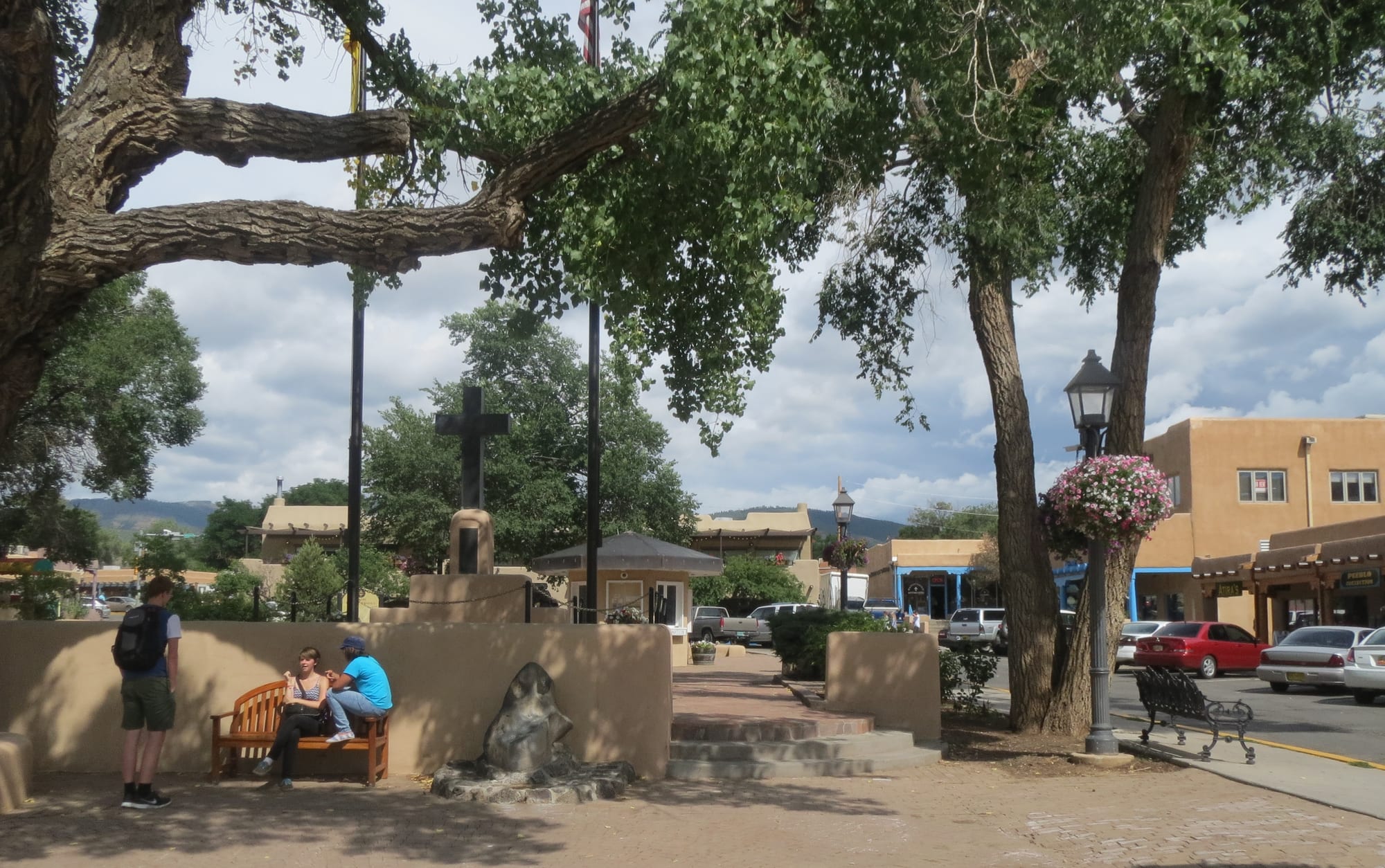
Shady cottonwood trees over a small plaza with a cross, benches, low adobe buildings and wooded hills behind

The Southwest, United States

Taos

Cottonwoods and adobe buildings on Taos Plaza, the historic centre of Taos, New Mexico. (CaroleHenson / Wikimedia Commons · CC BY-SA 4.0)

A small adobe town of about 6,500 people on a high sagebrush plateau in northern New Mexico, below the Sangre de Cristo Mountains and beside Taos Pueblo, lived in for about a thousand years. Spanish settlers, fur trappers and, from 1898, painters followed; today it lives on art, skiing, river and mountain tourism and a long mix of Native, Hispano and Anglo cultures.

Neighbourhoods

  • Taos Plaza and the historic centre
    • First-time visitors
    • Historic district
    • Galleries

    The old Spanish plaza and the lanes around it — Bent Street, Kit Carson Road and Ledoux Street — lined with adobe buildings holding galleries, museums, cafés and craft shops. Most of the town's sights are a short walk apart here.

    Open in Maps
  • Ranchos de Taos
    • Historic church
    • Quiet and residential

    A farming village a few miles south of the plaza, built around the massive adobe church of San Francisco de Asís. Its small historic plaza surrounds the church, and fields spread along the valley around it.

    Open in Maps
  • Arroyo Seco
    • Quiet village
    • Cafés

    A small village north of town on the road to the ski valley, with an old church, a few cafés, galleries and craft shops, and open views of the mountains.

    Open in Maps
  • Taos Ski Valley
    • Skiing
    • Mountain hiking

    An alpine village at the head of a steep canyon in the Sangre de Cristo, built around the ski area. Busy in winter, it is the starting point for summer trails to Wheeler Peak and the high lakes.

    Open in Maps

Things to do

Famous landmarks

  • Taos Pueblolandmark

    Multi-storey adobe houses built roughly a thousand years ago and still lived in by Tiwa-speaking people, a UNESCO World Heritage Site open to visitors except during ceremonies and some closures.

    Open in Maps
  • San Francisco de Asís Mission Churchlandmark

    The adobe church at Ranchos de Taos, built between about 1772 and 1816, with massive buttressed walls, painted by Georgia O'Keeffe and photographed by Ansel Adams.

    Open in Maps
  • Taos Plazalandmark

    The shaded heart of the Spanish town, ringed by adobe buildings, where the American flag is allowed to fly day and night.

    Open in Maps
  • Rio Grande Gorge Bridgeviewpoint

    A steel bridge of 1965 spanning the Rio Grande gorge north-west of town, with walkways looking down about 600 feet to the river.

    Open in Maps

Museums and historic houses

  • Harwood Museum of Artmuseum

    The town's art museum, in an adobe compound near the plaza, covering the Taos artists' colony, Hispanic religious art and modern painters, with a room of Agnes Martin's paintings.

    Open in Maps
  • Millicent Rogers Museummuseum

    A collection of Native and Hispanic art of the Southwest — jewellery, pottery, textiles — built around the holdings of a wealthy collector who settled here in the 1940s.

    Open in Maps
  • Taos Art Museummuseum

    Paintings by the Taos artists, shown in the house of the Russian-born artist Nicolai Fechin, who carved its doors and furniture by hand.

    Open in Maps
  • Kit Carson Housemuseum

    The adobe home of the frontiersman Kit Carson and his family from the 1840s, a short walk east of the plaza.

    Open in Maps
  • Martinez Haciendamuseum

    A fortified Spanish colonial hacienda of 21 rooms around two courtyards, bought by the Martinez family in 1804, now a living museum of colonial life.

    Open in Maps

Short trips from the town

  • Rio Grande del Norte National Monumentpark

    Protected land along the Rio Grande gorge north and west of Taos, with trails, trout fishing and rafting through the gorge.

    Open in Maps
  • Taos Ski Valleyattraction

    A ski area known for steep, challenging terrain, founded in the 1950s at the head of a canyon north-east of town.

    Open in Maps
  • Wheeler Peaktrail

    The highest mountain in New Mexico, at just over 13,000 feet, climbed by long day-hiking trails from Taos Ski Valley in summer.

    Open in Maps

Seasonal events

  • Taos Pueblo Pow WowJuly

    A gathering of dancers, drummers and singers from many Native nations, held on Taos Pueblo land.

  • Fiestas de TaosJuly

    A community celebration on Taos Plaza honouring Santa Ana and Santiago, the town's patron saints, opened with a mass and procession and the crowning of a Fiestas queen.

  • San Geronimo Feast Daylate September

    Taos Pueblo's feast day for its patron saint, San Geronimo, on 30 September; visitors are welcome but must follow the pueblo's rules.

  • Taos Wool FestivalOctober

    A festival bringing together the region's weavers and sheep and alpaca growers, with handmade weavings, yarns, and shearing and dyeing demonstrations.

Eat and drink

Long-standing places and food districts in Taos. Hours, ratings and directions come from your maps app, always current.

Taos classics

  • Michael's Kitchenrestaurant

    A long-established diner and bakery north of the plaza, known for New Mexican breakfasts smothered in red or green chile.

    Open in Maps
  • Orlando's New Mexican Caferestaurant

    A New Mexican café serving the region's red- and green-chile dishes.

    Open in Maps

Food districts

  • Around Taos Plazaneighborhood

    New Mexican kitchens, cafés, bakeries and bars within a few minutes' walk of the plaza and along Bent Street and Kit Carson Road.

    Open in Maps
  • Taos Pueblo breadmarket

    Bread baked in hornos, the beehive-shaped outdoor earth ovens long found in Pueblo and Hispano communities across northern New Mexico.

    Open in Maps

Experience Taos

History

Taos Pueblo has stood at the foot of the mountains for about a thousand years, its people farming the valley and trading with the Plains nations to the east. Spanish explorers reached it in 1540, and a mission followed in the 1600s, but relations were hostile: the Pueblo Revolt of 1680 was organised in part from Taos, under the leader Popé. After the Spanish returned, colonists settled the valley, and the town of Don Fernando de Taos grew up around a fortified plaza in the late 18th century, with farming villages such as Ranchos de Taos nearby.

Taos lay on trade routes linking Mexico with the Plains, and the pueblo's autumn trade fairs drew Comanche and other Plains traders. In the 1820s American fur trappers made it a base; Kit Carson settled here and married into a local family. After US forces took control of New Mexico in 1846, the territory's new governor, Charles Bent, was killed in his Taos house in the revolt of January 1847, and American troops bombarded the pueblo's church, where rebels had taken refuge.

In 1898 two painters, Ernest Blumenschein and Bert Phillips, stopped in Taos after their wagon wheel broke, and stayed; the Taos Society of Artists followed in 1915. The heiress Mabel Dodge Luhan drew D. H. Lawrence, Georgia O'Keeffe and Ansel Adams. In 1970 the federal government returned Blue Lake, the pueblo's sacred lake in the mountains, after a long campaign. The ski valley opened in the 1950s, communes arrived in the 1960s, and art and tourism have shaped the town since.

Culture & Customs

Three cultures live side by side in Taos. Taos Pueblo keeps its own language, Tiwa, and its own government and ceremonies, many of them closed to outsiders; its feast days, dances and pow wow are among the most important events in the valley. Hispano families descended from the Spanish settlers maintain Catholic traditions, adobe chapels, acequias (shared irrigation ditches) and a northern New Mexican Spanish.

The third strand is the artists and newcomers who have arrived since 1898. The Taos Society of Artists painted the pueblo and the landscape in ways that helped create the popular image of the Southwest; later came modernists, writers, the painter Agnes Martin and generations of craftspeople, and galleries still line the streets around the plaza. Mud-plastered adobe, rebuilt and replastered by hand, gives the town its look.

Outdoor life is a large part of local identity: skiing on steep slopes, rafting the gorge, fishing and long mountain hikes. Taos also has a reputation for independent and alternative living, from the experimental Earthship homes first developed near the town to off-grid builders and healers. The tension between a tourist economy and the needs of long-rooted local families is a constant theme in town politics.

Daily Life

About 6,500 people live in the town of Taos, and a few times that many in the surrounding county, spread through villages, the pueblo and scattered homes on the mesa. Tourism, art, skiing, schools, health care and local government provide most jobs, and wages are low by national standards.

Housing is a pressing issue: holiday homes take up part of the stock, and costs are high for many working families and seasonal workers. Water is another: irrigation ditches still divide river water among fields, and drought and wildfire risk weigh on the valley.

The day starts early and ends early. Shops and galleries around the plaza are busiest in daytime, many restaurants close by mid-evening, and nightlife is modest. Weekends bring visitors from Santa Fe and Albuquerque, and from Texas and Oklahoma in summer and ski season. Many people drive to Santa Fe or Albuquerque for big shopping or specialist care.

Food

Taos eats northern New Mexican food. The core is chile, grown in the state and served as a red sauce from dried pods or a green one from roasted fresh chiles; asking for both is called ordering it "Christmas". It is poured over enchiladas, burritos, eggs and potatoes, and comes beside sopaipillas — puffy fried pillows of dough eaten with honey. Posole, a stew of hominy corn with pork and chile, and carne adovada, pork slowly cooked in red chile, are favourites, and blue corn tortillas are a local speciality.

Breakfast is a serious meal: breakfast burritos and huevos rancheros smothered in chile fill the diners in the morning. Bread is traditionally baked in hornos, the beehive-shaped outdoor earth ovens found in both Pueblo and Hispano communities. Biscochitos, crisp anise-flavoured cookies, are the state cookie and a traditional Christmas treat.

The town also has bakeries, coffee shops and restaurants that use local lamb, trout and produce from small farms watered by the acequias, and a farmers' market brings valley growers to town in summer and autumn.

Planning tools

Budget

Taos is a small resort town, and prices follow the seasons: rooms are dearest during ski holidays and summer festivals and cheaper in spring and late autumn. Food is fairly priced, especially New Mexican dishes. A car is needed for almost everything outside the plaza, and pueblo entry, ski passes and river trips are the big extras.

Daily Budget Midrange
USD 200–350 (adobe inn or mid-range hotel, sit-down dinners, hire car, pueblo and museum entry)
Daily Budget Shoestring
USD 90–150 (hostel bed or simple motel, burritos and breakfast plates, a car shared or local buses)

Spring and late autumn are the cheapest seasons, but check that Taos Pueblo is open to visitors on the dates planned.

Best Time to Visit

June to October for hiking, rafting and festivals, with September and October the clearest and calmest, when the aspens turn gold. July and August bring afternoon thunderstorms. December to March is ski season, with snow on the adobe and cold, bright days; spring is windy and muddy.

Suggested Number of Days

Two or three days cover the town and the pueblo. More time is needed for skiing, a climb in the high mountains, rafting or the scenic loop through the surrounding valleys, and many visitors combine Taos with Santa Fe, about two hours' drive south.

First Visit
2–3 days
With Surroundings
4–5 days

Transportation

A car is the practical way to get around; the town, its villages and the sights are spread across the valley. A small regional bus network links Taos with nearby villages and the ski valley, and the historic centre is easily walked. Taxis and ride-hailing are limited.

Snow and ice make the mountain roads and the canyon road to the ski valley difficult in winter; carry chains or use a car with good tyres.

Airport & Station Connections

Most visitors fly to Albuquerque, about three hours' drive south, or to Santa Fe's smaller airport, about two hours away. Taos has a small regional airport with limited service. The drive from Santa Fe follows either the Rio Grande valley or the slower High Road through old Hispano villages.

Walkability

The historic centre around the plaza is compact and pleasant on foot, with the main museums and galleries within about ten minutes of one another. Beyond it, the town stretches along busy Paseo del Pueblo, without pavements in places, and Ranchos de Taos, Taos Pueblo and Arroyo Seco need a car or a bicycle.

Safety

Taos is generally safe for visitors, with petty theft and car break-ins the usual crimes. The main risks are the altitude of nearly 7,000 feet, strong sun, sudden summer storms, river currents, winter road conditions and the sheer drops at the gorge.

Drink plenty of water at altitude, keep to the walkways at the gorge bridge, and check avalanche and weather conditions before mountain trips. Check current official travel advice before travelling.

Climate

A high, dry, sunny climate with four seasons and big swings between day and night. Summers are warm with cool nights and afternoon storms; winters are cold, with snow in town and much more in the mountains.

Summer
warm and sunny — summer days usually reach 70–85°F, with cool nights, and afternoon thunderstorms are common
Winter
cold and bright — winter days usually reach only 30–40°F and nights fall well below freezing, with regular snow

Local Customs

Tipping is expected: roughly 18–22 per cent in restaurants. Taos Pueblo is a sovereign community with its own rules: visitors follow the guides' instructions, keep out of areas marked restricted, do not enter doors or homes not clearly marked as businesses, and follow the pueblo's rules on cameras. Many Hispano families have lived here for centuries, and Spanish is widely heard.

Ask before photographing people, and do not take or move anything from ruins, churches or graves. The legal drinking age is 21.

Common Payment Methods

The currency is the US dollar. Cards and contactless payment are accepted in most shops and restaurants, and the town has several ATMs. Cash is useful at the pueblo, for crafts sold by their makers, and at roadside stalls.