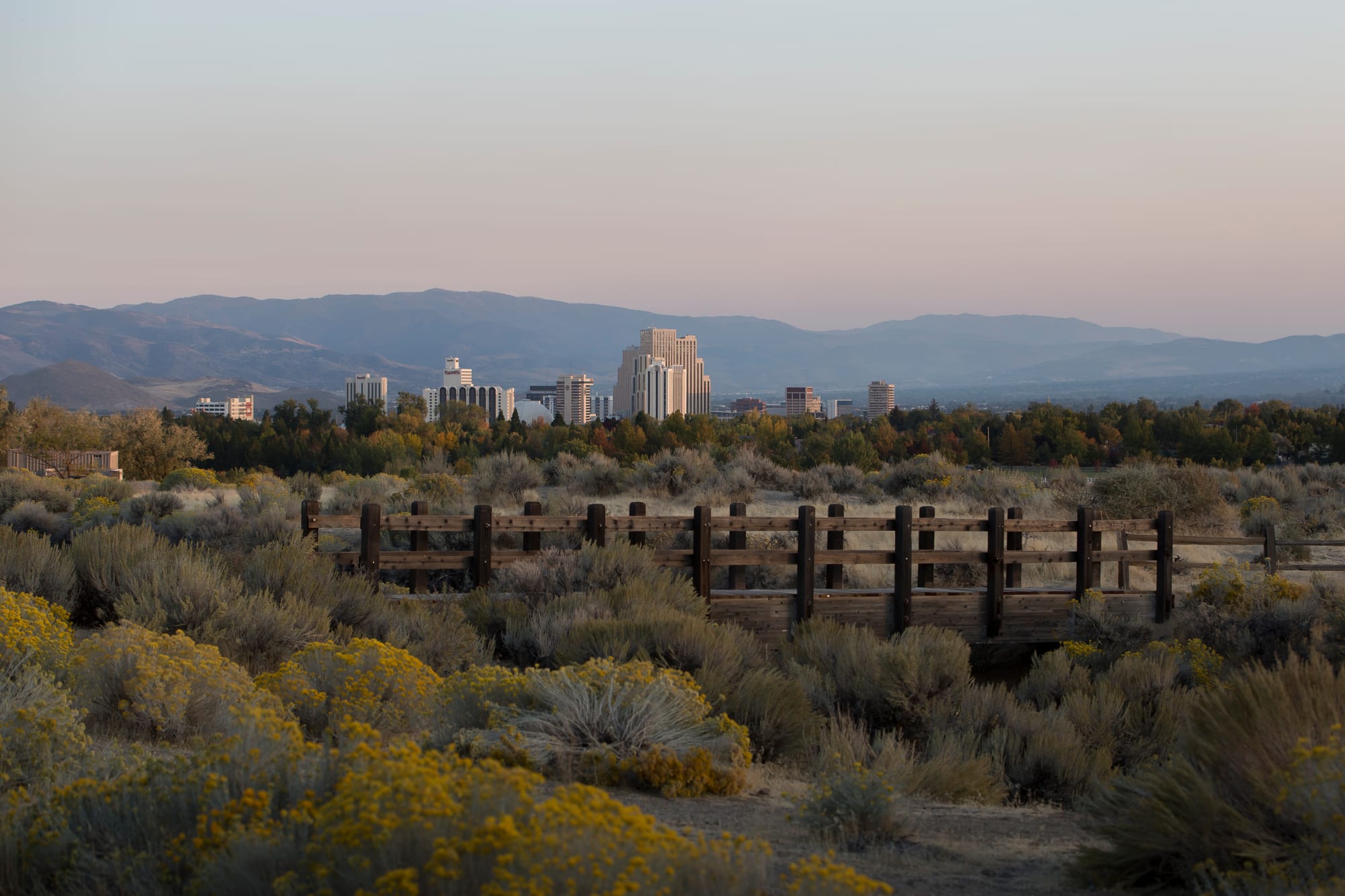
Downtown Reno's towers rising beyond sagebrush, yellow rabbitbrush and a wooden footbridge, with dry mountains behind at dusk

The Southwest, United States

Reno

Downtown Reno's skyline seen across sagebrush and a footbridge, with hills behind. (Trevor Bexon / Wikimedia Commons · CC BY 2.0)

Nevada's largest city outside the Las Vegas Valley, home to about 265,000 people in a high desert valley on the Truckee River at the foot of the Sierra Nevada. A railway town made famous by quick divorces and legal gambling in the 1930s, 'The Biggest Little City in the World' now mixes casinos with a university, a riverside arts scene and a fast-growing tech and logistics economy.

Neighbourhoods

  • Downtown and the Riverwalk
    • First-time visitors
    • Casinos
    • Close to public transport

    The casino district along Virginia Street under the Reno Arch, with high-rise hotel-casinos and a walkway along the Truckee River lined with bars, restaurants, the art museum and a whitewater park. The Amtrak station is in the middle of it.

    Open in Maps
  • Midtown
    • Best for food
    • Bars
    • Local shops

    The stretch of South Virginia Street and the side streets south of downtown, now Reno's liveliest district for independent restaurants, coffee, breweries, vintage shops and murals.

    Open in Maps
  • Old Southwest
    • Historic homes
    • Quiet and residential

    Tree-lined streets of older houses south-west of downtown, around Idlewild Park and the river.

    Open in Maps
  • University district
    • Students
    • Museums

    The hilly campus of the University of Nevada, Reno, just north of downtown, with its old quad and the planetarium, and the cafés and student bars around it.

    Open in Maps
  • Sparks
    • Local life
    • Family events

    A separate city immediately east of Reno, built around a railway yard, with its own casinos, a marina park and a plaza that hosts many of the area's summer events.

    Open in Maps

Things to do

Landmarks and the river

  • Reno Archlandmark

    The illuminated arch over Virginia Street bearing the slogan 'The Biggest Little City in the World', the city's emblem since the 1920s in successive versions.

    Open in Maps
  • Truckee Riverpark

    The river from Lake Tahoe that runs through downtown, with a riverwalk, island parks and a whitewater course where people kayak and tube in summer.

    Open in Maps
  • University of Nevada, Renoattraction

    The state university, founded in Elko in 1874 and moved to Reno in 1885, whose tree-lined quad, modelled on the University of Virginia's, has been the setting for many films.

    Open in Maps

Museums

  • Nevada Museum of Artmuseum

    Nevada's only accredited art museum, in a 2003 building by the architect Will Bruder near the river, with a collection focused on art and the environment.

    Open in Maps
  • National Automobile Museummuseum

    A large collection of historic cars beside the river, built from the collection of the casino owner William F. Harrah.

    Open in Maps
  • Fleischmann Planetarium & Science Centermuseum

    A planetarium on the university campus, opened in 1963 in a building shaped as a hyperbolic paraboloid.

    Open in Maps
  • Wilbur D. May Centermuseum

    A museum and arboretum in Rancho San Rafael park built around the collection of a rancher and world traveller.

    Open in Maps

Parks and nights out

  • Rancho San Rafael Regional Parkpark

    A large park on the north-west side, with lawns, sagebrush hills and trails, which hosts the dawn launches of the balloon race each September.

    Open in Maps
  • Greater Nevada Fieldattraction

    The downtown ballpark of the Reno Aces, a minor-league baseball team.

    Open in Maps

Short trips from the city

  • Virginia Cityattraction

    The silver-mining boom town of the Comstock Lode in the hills about 24 miles south-east, with saloons and historic buildings of the boom years.

    Open in Maps
  • Lake Tahoeattraction

    The large, deep alpine lake on the California–Nevada line, its north shore about an hour's drive from Reno over the mountains.

    Open in Maps
  • Lake Tahoe–Nevada State Parkbeach

    State park land on the lake's Nevada shore, including the clear water and granite boulders of Sand Harbor.

    Open in Maps
  • Mount Rose Ski Tahoeattraction

    The ski area closest to Reno, on the highway between the city and Lake Tahoe.

    Open in Maps
  • Pyramid Lakeattraction

    A large desert lake about 40 miles north-east of Reno, entirely within the Pyramid Lake Paiute Tribe Reservation, named for its pyramid-shaped tufa formations.

    Open in Maps
  • Nevada State Railroad Museummuseum

    In Carson City, the state capital to the south, a museum of locomotives and coaches from the Virginia and Truckee Railroad that served the Comstock mines.

    Open in Maps

Seasonal events

  • ArtownJuly

    A month-long festival of visual and performing arts, with hundreds of events at about 100 locations across the city.

  • Hot August NightsAugust

    A week-long classic-car and rock-and-roll festival with car shows in Reno and Sparks and a parade down Virginia Street.

  • The Great Reno Balloon RaceSeptember

    More than 100 hot-air balloons lift off at dawn from Rancho San Rafael Regional Park.

Eat and drink

Long-standing places and food districts in Reno. Hours, ratings and directions come from your maps app, always current.

Reno classics

  • Louis' Basque Cornerrestaurant

    A Basque restaurant on East Fourth Street, part of the city's Basque dining tradition.

    Open in Maps
  • Picon Punchneighborhood

    A bittersweet cocktail of an orange-flavoured French aperitif, grenadine, soda and brandy, the classic drink of Nevada's Basque bars and restaurants.

    Open in Maps
  • Great Basin Brewing Companyrestaurant

    Nevada's oldest operating brewery, a brewpub opened in Sparks in 1993.

    Open in Maps

Food districts

  • Midtownneighborhood

    The densest choice of independent restaurants, cafés, bakeries and taprooms in the city, along South Virginia Street and its side streets.

    Open in Maps
  • The Riverwalkneighborhood

    Bars, wine bars and restaurants beside the Truckee River downtown, with outdoor seating in summer.

    Open in Maps

Experience Reno

History

The Truckee Meadows were part of the homeland of the Washoe people, with the Northern Paiute living around Pyramid Lake to the north. Emigrant wagon trains followed the Truckee River west towards California on the California Trail, and in 1859 the discovery of the Comstock Lode, a vast silver deposit near Virginia City, brought a rush of miners to the region. A toll bridge built across the river in 1859, later bought by Myron Lake, gave the spot its first name, Lake's Crossing.

The Central Pacific Railroad arrived in 1868, and the town laid out beside the tracks was named after Jesse Lee Reno, a Union general killed in the Civil War. Reno became a railway, ranching and supply town, and its fortunes rose when it became the seat of Washoe County in 1871 and the home of the state university in 1885. In the early 20th century Nevada's short residency requirement made it the divorce capital of the country, and in 1931 the state cut the residency period to six weeks and legalised gambling in the same year.

Reno thrived as a gambling and entertainment city through the mid-century, until Las Vegas overtook it around 1960. Competition from Las Vegas and from tribal casinos in California later hurt business, and several downtown casinos closed or were converted. Since the 2010s the city has been reshaped by warehouses, data centres and battery and electric-car factories in the industrial parks to the east, and by newcomers from California.

Culture & Customs

Reno has long sold itself as a smaller, friendlier alternative to Las Vegas, and casino culture is still visible downtown, from the arch and neon to the slot machines in petrol stations and supermarkets. But the city has built a broader identity: a month-long arts festival every July, murals across Midtown, a well-regarded art museum and a lively independent restaurant and brewing scene.

The outdoors is central to local life. Within an hour people ski in the Sierra, swim and paddle at Lake Tahoe, kayak the whitewater park downtown or ride mountain-bike trails in the hills. Classic cars are a passion too, celebrated each summer at Hot August Nights. In late August the city is also the closest major city for many of the people heading to the Burning Man gathering in the Black Rock Desert to the north.

Reno has a strong Basque heritage, the legacy of immigrants who came to work in Nevada's sheep industry from the late 19th to the mid-20th century; the university has one of only two Basque studies programmes in the country. Native nations remain part of the region, including the Reno-Sparks Indian Colony and the Pyramid Lake Paiute Tribe. People are informal, outdoorsy and proud of the city's independence from both Las Vegas and California.

Daily Life

About 265,000 people live in Reno, and the metropolitan area, which includes Sparks, holds over half a million. Gaming and tourism are still major employers, but the economy has diversified into distribution warehouses, data centres, manufacturing, health care and the University of Nevada, Reno. A favourable state tax climate, lower housing costs and technology jobs have drawn businesses and residents from California.

That growth has made housing costs a major local concern, and population rose by 17 per cent between 2010 and 2020. New subdivisions spread south and north into the desert, and traffic on the freeways has grown.

Daily rhythms are those of a mid-sized western city: commuting by car, weekends in the mountains or at the lake, and casino floors that never close. Water from the Truckee River, wildfire smoke and winter air quality are regular local concerns. In summer, families crowd the river parks downtown on hot afternoons.

Food

Reno's most distinctive tradition is Basque, the legacy of immigrants who worked in Nevada's sheep industry. Basque restaurants such as Louis' Basque Corner on East Fourth Street keep that heritage at the table, and their classic drink is Picon Punch, a bittersweet mix of an orange-flavoured aperitif, grenadine, soda water and brandy.

The casinos added their own traditions: large buffets, steakhouses, coffee shops open around the clock and cheap late-night breakfasts. Mexican food is everywhere, from taco trucks to family restaurants, reflecting a Latino community that makes up about a quarter of the city, and there are many Asian restaurants.

Downtown, the Riverwalk adds bars and restaurants with outdoor seating beside the Truckee River. Midtown has become the centre of the independent scene, with bakeries, coffee roasters, gastropubs and breweries. The region's craft beer is well established, Nevada's oldest operating brewery opened in Sparks in 1993, and summer brings farmers' markets with produce from Nevada and California.

Planning tools

Budget

Reno is cheaper than Lake Tahoe or the San Francisco Bay Area. Casino hotels keep room prices low on weekdays, but rates jump on summer weekends and during Hot August Nights and other big events. Food ranges from cheap taco shops and casino cafés to expensive steakhouses. A car is needed for Tahoe, Virginia City and most trips out of town.

Daily Budget Midrange
USD 180–320 (mid-range casino hotel, sit-down dinners, museum entry, hire car for day trips)
Daily Budget Shoestring
USD 90–150 (weekday casino-hotel room or motel, tacos and brewery food, city buses)

Weekday stays are much cheaper than weekends in the casino hotels; check for resort fees, which are often added to the room rate.

Best Time to Visit

June to September for the river, festivals and Lake Tahoe's beaches, though summer days can be hot and wildfire smoke sometimes drifts in. September and October are often the most pleasant months. Winter is cold and dry in the city, with skiing close by in the Sierra; spring is windy and changeable.

Suggested Number of Days

Two or three days cover the city itself. Most visitors add time for the lake, the old mining towns and Carson City, and the number depends on how many of these day trips are planned and on mountain driving conditions in winter.

First Visit
2–3 days
With Surroundings
4–6 days

Transportation

A car is the easiest way to get around and essential for most trips out of town. RTC buses cover Reno and Sparks, including a rapid line along Virginia Street between downtown, Midtown and the south, and ride-hailing is widely available. The river path is good for walking and cycling.

Mountain roads to Lake Tahoe and over the Sierra can require snow chains or four-wheel drive in winter; check road conditions before setting out.

Airport & Station Connections

Reno–Tahoe International Airport is a few miles south-east of downtown, ten minutes by car, with flights from many western and some eastern cities. Amtrak's California Zephyr between Chicago and the San Francisco Bay Area stops downtown. Interstate 80 brings drivers from Sacramento, about two and a half hours west over Donner Pass.

Walkability

Downtown, the Riverwalk and Midtown are walkable, and the university is a short uphill walk north of the casinos. Beyond them the city spreads into suburbs along wide roads, and walking is practical only for short trips. Winter mornings can be icy.

Safety

Most visits to Reno are trouble-free. Property crime, car break-ins and visible homelessness are concentrated in parts of downtown and along some older motel strips, and the area around the casinos can be rowdy late at night. Natural risks are the dry heat and wildfire smoke in summer and snowstorms in the mountains.

Use well-lit routes or ride-hailing late at night downtown, keep valuables out of sight in parked cars, and carry water on desert hikes. Check current official travel advice before travelling.

Climate

A dry, sunny high-desert climate in the rain shadow of the Sierra Nevada, with hot days and cool nights in summer and cold, mostly dry winters. Big daily temperature swings are normal.

Summer
hot and dry — July days are typically around 90°F, while nights fall into the 50s °F
Winter
cold nights, often in the high teens or 20s °F in January, with occasional snow that rarely lasts long in the city

Local Customs

Tipping is expected: roughly 18–22 per cent in restaurants, a dollar or two a drink at a bar, and casino dealers and cocktail servers are usually tipped too. Gambling and drinking are only for those aged 21 and over. Smoking is still allowed on many casino floors in Nevada, while most other indoor public places are smoke-free.

Cannabis is legal for adults in Nevada but cannot be used in public places or casinos. Prostitution is illegal in Reno and the surrounding county.

Common Payment Methods

The currency is the US dollar. Cards and contactless payment are accepted almost everywhere outside the gaming tables, and casinos have ATMs and cashiers, though casino cash machines usually charge high fees. Cash is useful for tipping.