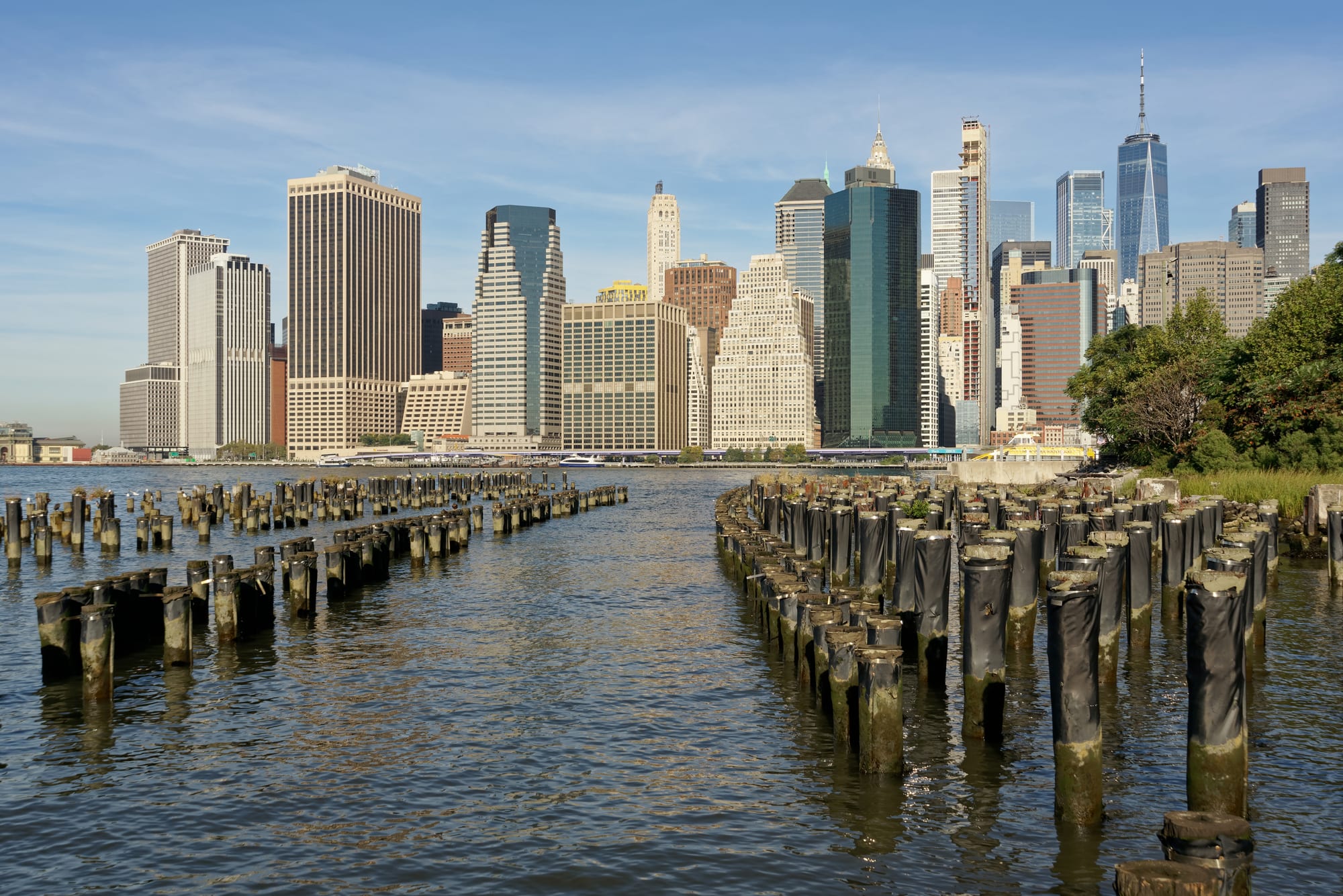
Skyscrapers of Lower Manhattan across the East River, with rows of old wooden pier posts in the water in front

United States

New York & the Mid-Atlantic

Lower Manhattan seen across the East River from Brooklyn Bridge Park, New York City. (Jakub Hałun / Wikimedia Commons · CC BY 4.0)

The densely populated middle of the East Coast — New York, New Jersey, Pennsylvania, Delaware, Maryland and Washington, D.C. — where the nation declared independence and chose its capital, and where the country's largest city sits within a few hours of Philadelphia, Baltimore, the Chesapeake Bay, the Adirondack wilderness and Niagara Falls.

Explore New York & the Mid-Atlantic

History

Before European arrival the Lenape lived around the Delaware and lower Hudson rivers, the Susquehannock along the Susquehanna, and the Haudenosaunee Confederacy — Mohawk, Oneida, Onondaga, Cayuga and Seneca — held most of upstate New York. The Dutch founded New Amsterdam on Manhattan in the 1620s, and Swedes settled on the Delaware; England seized New Netherland in 1664 and renamed it New York. Maryland was founded in 1634 as a refuge for English Catholics, and the Quaker William Penn laid out Philadelphia in 1682.

Philadelphia was the political centre of the Revolution: the Declaration of Independence was adopted there in 1776 and the Constitution drafted there in 1787. George Washington was inaugurated in New York in 1789, and the capital moved to the new federal district on the Potomac in 1800. British troops burned Washington in 1814, and the defence of Fort McHenry in Baltimore inspired the national anthem.

The Erie Canal, opened in 1825, made New York the country's commercial capital. Maryland stayed in the Union during the Civil War though slavery was legal there, and Harriet Tubman escaped from its Eastern Shore to guide others north. The battles of Antietam in 1862 and Gettysburg in 1863 were fought here. Millions of immigrants passed through Ellis Island from 1892, while Pittsburgh's steel mills and Philadelphia's factories drew workers from Europe and Black migrants from the South. The 1963 March on Washington, the Stonewall uprising of 1969 in New York and the attacks of 11 September 2001 on the World Trade Center and near Shanksville, Pennsylvania are among the region's modern landmarks.

Culture & Customs

New York is the country's capital of finance, publishing, theatre and art, and among its most diverse cities: roughly a third of its people were born abroad, and hundreds of languages are spoken. Harlem was the centre of the Harlem Renaissance of the 1920s, and hip-hop began at block parties in the Bronx in the 1970s. Broadway, the Thanksgiving parade and the New Year's Eve ball drop in Times Square are national rituals.

Outside the metropolis, the region divides into strong local identities. Philadelphians are known for their accent, the word "jawn" and famously passionate sports fans, and the city greets each new year with the Mummers Parade. Pittsburghers use "yinz" as a plural form of address, and Baltimore's old working-class greeting is "hon". Pennsylvania Dutch country around Lancaster is home to Amish and Mennonite communities who farm without much modern technology, and Punxsutawney holds the Groundhog Day ceremony every 2 February.

New Jersey's boardwalk towns and its rock tradition, personified by Bruce Springsteen, give the Jersey Shore its own character. Washington, D.C. has a large and long-established Black community, its own go-go music, and a distinctive political status: as a federal district rather than a state, it has no voting member of Congress, a point residents have long protested.

Daily Life

Roughly 50 million people live in these five states and the capital. New York City has about 8.5 million, and its metropolitan area reaches over 19 million, the largest in the country. Philadelphia has about 1.6 million, Washington, D.C. around 700,000, Baltimore under 600,000, and Pittsburgh and Buffalo each around 300,000. Newark, Jersey City, Rochester, Albany and Wilmington are other important centres.

Wall Street, banking, insurance, law, media and fashion drive New York; the federal government and the contractors, lobbyists and think tanks around it dominate Washington and its Maryland suburbs; and New Jersey is home to large pharmaceutical firms. Pittsburgh and Philadelphia have rebuilt around universities and hospitals after the decline of heavy industry, a process still incomplete in many upstate and Rust Belt towns.

Daily life in the cities runs on the subway, the commuter train and the corner deli or bodega. Long commutes, the cost of housing and the contrast between the prosperous metropolitan corridor and struggling smaller industrial towns are the recurring issues.

Food

New York gave the country the bagel with cream cheese and lox, the thin foldable pizza slice, pastrami on rye from Jewish delis, New York cheesecake, the egg cream (milk, chocolate syrup and seltzer, with neither egg nor cream) and the street-cart hot dog. Buffalo invented chicken wings, fried and tossed in hot sauce with blue-cheese dip, and the Finger Lakes produce Riesling and other cool-climate wines.

Philadelphia's cheesesteak is thin-sliced beef on a long roll with melted cheese, alongside the hoagie, the soft pretzel and water ice. Pennsylvania Dutch country adds scrapple, a fried loaf of pork scraps and cornmeal, and shoofly pie, a molasses pie; Pittsburgh favours pierogies and sandwiches with the fries and coleslaw piled inside. The town of Hershey is built around its chocolate factory, and Yuengling in Pottsville is the oldest operating brewery in the country.

Maryland's summer ritual is steamed blue crabs dusted with Old Bay seasoning and picked apart on newspaper, with crab cakes all year. New Jersey has pork roll, also called Taylor ham, on breakfast sandwiches, and saltwater taffy on the boardwalk. Washington's half-smoke sausage and its many Ethiopian restaurants round out the table.

Attractions & Natural Wonders

New York City needs days: the Statue of Liberty and Ellis Island, Central Park, the Metropolitan Museum of Art and MoMA, the Empire State Building, Broadway and Times Square, the Brooklyn Bridge, the 9/11 Memorial and the High Line. Upstate, the Hudson Valley's estates and the Catskills lead north to the Adirondacks, whose park of mountains and lakes includes Lake Placid, twice a Winter Olympic host, and Mount Marcy, the state's highest peak. Far to the west, Niagara Falls State Park frames the American and Bridal Veil Falls, and the Finger Lakes lie in between.

Philadelphia holds Independence Hall, a UNESCO World Heritage Site, the Liberty Bell, the Philadelphia Museum of Art and Reading Terminal Market. Pennsylvania also offers the Gettysburg battlefield, the Amish farmland of Lancaster County, and Pittsburgh, where funicular railways climb Mount Washington above the meeting of three rivers and the Andy Warhol Museum honours a native son; Frank Lloyd Wright's Fallingwater lies in the hills to the south-east.

Washington, D.C.'s National Mall runs from the Capitol past the Washington Monument to the Lincoln Memorial, with the Smithsonian museums, including the National Museum of African American History and Culture, and the White House nearby. Baltimore has its Inner Harbor and Fort McHenry, and the Chesapeake Bay offers Annapolis and the Eastern Shore, while Maryland's Atlantic coast has the wild horses of Assateague Island. The Jersey Shore runs from Asbury Park past Atlantic City's boardwalk to the Victorian resort of Cape May, and Delaware adds Rehoboth Beach.

Cities in New York & the Mid-Atlantic

Planning basics

Budget

New York City and Washington, D.C. are among the most expensive places in the country, and Manhattan hotels often pass USD 300 a night. Philadelphia, Baltimore and Pittsburgh cost noticeably less, and upstate New York, rural Pennsylvania and the Chesapeake's Eastern Shore are cheaper still. The Jersey Shore and the Hamptons charge peak prices in summer.

Daily Budget Midrange
USD 280–550 (mid-range hotel, restaurant meals with tax and tip, shows or museum tickets, trains between cities)
Daily Budget Shoestring
USD 120–200 (hostel or budget hotel outside the centre, pizza slices and delis, subway and intercity buses)

Washington's Smithsonian museums are free, several New York museums offer reduced or suggested-donation admission to some visitors, and staying in Philadelphia or New Jersey can undercut Manhattan rates.

Safety

Most visitors have no trouble. Crime is concentrated in particular neighbourhoods of cities such as Philadelphia and Baltimore rather than in tourist areas, and New York is safer than its old reputation suggests. Pickpocketing and phone snatching in crowded places, summer heat, winter storms and rip currents on Atlantic beaches are the everyday risks.

Watch bags on crowded subways and in Times Square, ask locally about neighbourhoods after dark, and swim only at guarded beaches. Check current official travel advice before travelling.

Climate

The coastal cities from New York to Washington have hot, humid summers and cold winters with occasional heavy snow, while upstate New York and western Pennsylvania are colder, with lake-effect snow around Buffalo and Syracuse that can bury the towns downwind of the Great Lakes. Remnants of Atlantic hurricanes can strike in late summer and autumn, as Sandy did in 2012.

Summer
hot and humid in the cities, 82–91°F, often with thunderstorms; cooler in the Adirondacks
Winter
cold, around 23 to 45°F on the coast and well below freezing upstate, with snowstorms

Transportation

This is the best-connected part of the country without a car. Amtrak's Northeast Corridor links New York, Philadelphia, Wilmington, Baltimore and Washington, and cheap intercity buses run the same route. New York, Washington and Philadelphia have extensive subway, commuter rail and bus systems. A car is needed for the Adirondacks, the Finger Lakes, rural Pennsylvania and much of the Chesapeake shore.

New York to Washington takes roughly three hours by train and Philadelphia about an hour and a half from New York; driving into Manhattan is slow and parking expensive.

Best Time to Visit

April to June and September to November are the most comfortable months; Washington's cherry blossoms bloom around late March and early April, and autumn colour peaks in the Adirondacks and the Catskills around early October. July and August are sticky in the cities but are beach season on the Jersey Shore and the lake season upstate. December brings holiday decorations and crowds to New York.