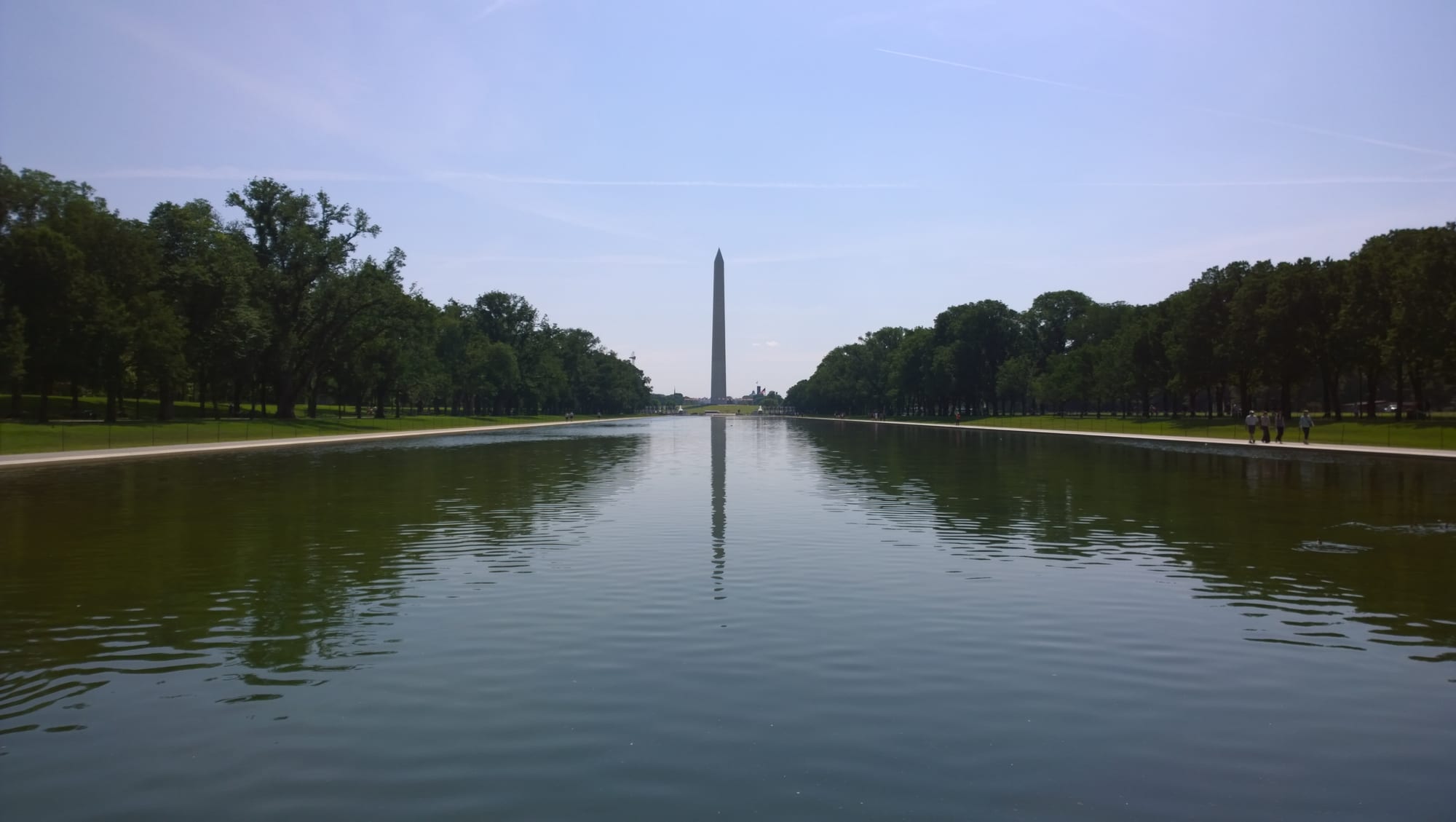
The white obelisk of the Washington Monument reflected in a long pool lined with trees and lawns under a blue sky

New York & the Mid-Atlantic, United States

Washington DC

The Washington Monument seen across the Lincoln Memorial Reflecting Pool on the National Mall. (Kenrick95 / Wikimedia Commons · CC BY-SA 4.0)

The capital of the United States, a federal district on the Potomac River between Maryland and Virginia, laid out to Pierre L'Enfant's plan of 1791. Home to Congress, the White House and the Supreme Court, it is also a city of about 690,000 people with a long Black history, its own music, and the free museums and monuments of the National Mall.

Neighbourhoods

  • National Mall and Downtown
    • First-time visitors
    • Museums
    • Close to public transport

    The landscaped park running from the Capitol to the Lincoln Memorial, lined along Constitution and Independence Avenues by Smithsonian museums and the National Archives, with the White House and the office blocks, theatres and restaurants of downtown just to the north.

    Open in Maps
  • Capitol Hill
    • Historic district
    • Quiet and residential
    • Markets

    The residential neighbourhood behind the Capitol, in the city's Northeast and Southeast quadrants, with streets of rowhouses largely dating from the 19th century and the Eastern Market, a public market in a brick hall.

    Open in Maps
  • Georgetown
    • Historic district
    • Shopping
    • Waterfront

    A historic neighbourhood and commercial district on the Potomac, founded in 1751 as a Maryland port forty years before the capital existed. The Chesapeake and Ohio Canal begins here, and Georgetown University stands on the hill above.

    Open in Maps
  • Dupont Circle
    • Restaurants
    • Embassies
    • Close to public transport

    A historic neighbourhood around a circular park in Northwest, near the stretch of Massachusetts Avenue known as Embassy Row, with coffeehouses, restaurants and bars.

    Open in Maps
  • U Street and Shaw
    • Music
    • Nightlife
    • African American culture

    A largely Victorian neighbourhood that was the heart of Black Washington and its Jazz Age 'Black Renaissance', home to the Howard and Lincoln theatres and Ben's Chili Bowl, and now one of the city's most popular nightlife and entertainment districts.

    Open in Maps
  • Navy Yard and the Wharf
    • Waterfront
    • Sport
    • Nightlife

    Two rebuilt waterfront districts in the south of the city: Navy Yard on the Anacostia River, home to Nationals Park and riverside esplanades, and the Wharf on the Potomac, with new towers and the historic Maine Avenue Fish Market.

    Open in Maps

Things to do

Monuments and government

  • United States Capitollandmark

    The domed seat of Congress at the eastern end of the Mall, whose central sections were completed in 1800, when Congress first met in the new capital; the city's quadrants meet here.

    Open in Maps
  • White Houselandmark

    The official residence and workplace of the president, home to every president since John Adams moved in in 1800.

    Open in Maps
  • Washington Monumentlandmark

    A 555-foot obelisk at the centre of the Mall, built to commemorate George Washington, the first president.

    Open in Maps
  • Lincoln Memoriallandmark

    The temple-like memorial to Abraham Lincoln dedicated in 1922, where Martin Luther King Jr. gave his 'I Have a Dream' speech in 1963.

    Open in Maps
  • Library of Congresslandmark

    The research library of Congress and in effect the national library, founded in 1800 and the oldest federal cultural institution in the country.

    Open in Maps
  • Tidal Basinpark

    A man-made reservoir between the Potomac and the Washington Channel, ringed with cherry trees and memorials, and the focal point of the cherry-blossom festival.

    Open in Maps

Museums

  • National Museum of Natural Historymuseum

    The Smithsonian's natural history museum on the Mall, free to enter and open 364 days a year.

    Open in Maps
  • National Air and Space Museummuseum

    The Smithsonian museum of human flight and space exploration, established in 1946, whose main building opened on the Mall in 1976.

    Open in Maps
  • National Museum of African American History and Culturemuseum

    The Smithsonian museum on the Mall devoted to African American history and culture, established in 2003 and opened in its permanent home in 2016.

    Open in Maps
  • National Gallery of Artmuseum

    The national art museum on the Mall, established in 1937 and free of charge.

    Open in Maps
  • Smithsonian Institution Buildingmuseum

    The red sandstone 'Castle' in Norman Revival style on the Mall, the original building of the Smithsonian Institution, founded in 1846; it closed in February 2023 for a renovation planned to last five years.

    Open in Maps

Parks and the rivers

  • Rock Creek Parkpark

    A large wooded urban park that cuts through the city's Northwest quadrant along Rock Creek, with trails and the National Zoo beside it.

    Open in Maps
  • Chesapeake and Ohio Canaltrail

    The 19th-century canal that begins in Georgetown, built to bypass the rapids of the Potomac; its towpath is a walking and cycling route.

    Open in Maps
  • Theodore Roosevelt Islandpark

    A wooded island in the Potomac with a memorial to Theodore Roosevelt and walking trails.

    Open in Maps

Music, sport and nights out

  • Howard Theatreattraction

    A historic theatre in the U Street area, one of the great stages of Black music during the Jazz Age.

    Open in Maps
  • Lincoln Theatreattraction

    A historic theatre on U Street that was one of the city's major jazz venues, standing beside Ben's Chili Bowl.

    Open in Maps
  • 9:30 Clubattraction

    A music venue in the U Street area that brings popular alternative and indie acts to the city.

    Open in Maps
  • Nationals Parkattraction

    The baseball park of the Washington Nationals in the Navy Yard district beside the Anacostia River.

    Open in Maps

Short trips from the city

  • Arlington National Cemeterylandmark

    Across the Potomac in Virginia, the largest cemetery in the national cemetery system, on the grounds of Arlington House, completed in 1818.

    Open in Maps
  • Mount Vernonlandmark

    George and Martha Washington's former home and plantation on the Potomac in Virginia, its house in a loose Palladian style.

    Open in Maps

Seasonal events

  • National Cherry Blossom Festivalspring, around late March and early April

    A celebration of the cherry trees given to the city by Tokyo's mayor Yukio Ozaki in 1912, extended to two weeks in 1994, with a parade of balloons, floats and marching bands; the Tidal Basin is its focal point.

Eat and drink

Long-standing places and food districts in Washington DC. Hours, ratings and directions come from your maps app, always current.

Washington classics

  • Ben's Chili Bowlrestaurant

    The U Street diner founded in 1958 by Ben Ali, a Trinidadian-born immigrant, and Virginia Rollins, famous for chili dogs and half-smokes and visited by presidents and celebrities.

    Open in Maps
  • Ethiopian restaurantsneighborhood

    Washington is known as one of the best cities in the world for Ethiopian food, thanks to the large community of Ethiopian immigrants who arrived in the 20th century.

    Open in Maps

Markets and food halls

  • Eastern Marketmarket

    A public market on Capitol Hill in a 19th-century brick building, rebuilt after a fire in 2007 and reopened in 2009.

    Open in Maps
  • Union Marketmarket

    A large food hall in Northeast, in a former farmers' and wholesale market building.

    Open in Maps
  • Maine Avenue Fish Marketmarket

    The city's historic fish market on the Potomac at the Wharf.

    Open in Maps

Experience Washington DC

History

The Algonquian-speaking Piscataway lived along the Potomac when Europeans arrived in the early 17th century, and the Nacotchtank had settlements beside the Anacostia River. After independence, the Residence Act of July 1790 created a federal capital on the Potomac, a compromise in which the southern states gained the capital in return for federal payment of state war debts. In 1791 George Washington commissioned the French-born engineer Pierre Charles L'Enfant to design it, with broad avenues radiating across a grid. Maryland and Virginia were slave states, and enslaved labour helped build the White House and the Capitol. Congress first met in the unfinished Capitol in November 1800.

On 24 August 1814, during the War of 1812, British troops occupied the city and burned the Capitol, the White House and other federal buildings before a storm drove them out. In 1846 Congress returned the land south of the Potomac, including Alexandria, to Virginia. In 1862, nine months before the Emancipation Proclamation, Lincoln signed the act that ended slavery in the district, freeing about 3,100 people, and the Civil War brought rapid growth and a large influx of freed people. In 1871 Washington and Georgetown were merged into a single government, and the McMillan Plan of the City Beautiful movement later reshaped the Mall.

The population peaked at about 802,000 in 1950. After Martin Luther King Jr.'s assassination in April 1968, riots burned the U Street, 14th Street, 7th Street and H Street corridors, and rebuilding took until the late 1990s. The Home Rule Act of 1973 gave the city an elected mayor and council, and in 1975 Walter Washington became its first elected mayor. Congress keeps the power to overturn local laws, and a statehood bill passed the House of Representatives in 2021 but not the Senate.

Culture & Customs

Washington lives two lives: the federal city of monuments, museums, embassies and lobbyists, and the home town of hundreds of thousands of residents. The free Smithsonian museums, the National Gallery and the memorials of the Mall draw visitors from across the country, while 177 embassies and international institutions such as the World Bank and the International Monetary Fund give the city a global population of diplomats and officials.

The city has a long and influential Black history. U Street, 14th Street and Shaw were the centre of a Black Renaissance in the Jazz Age, part of the wider Harlem Renaissance, with the Howard and Lincoln theatres among the country's leading stages; Duke Ellington was born in Washington. In the late 1970s the bandleader Chuck Brown popularised go-go, a percussion-driven style of funk and rhythm and blues that is the city's own music. Today the 9:30 Club and other venues around U Street keep the music scene busy.

Political life shapes the calendar and the conversation, and the district's lack of voting representation in Congress is a long-standing local cause: in a 2016 referendum 85 per cent of voters supported statehood. Immigration from El Salvador, Ethiopia, Mexico, Guatemala and China has added new communities, among them a concentration of Salvadorans in Mount Pleasant.

Daily Life

The 2020 census counted 689,545 residents, and weekday commuters from the Maryland and Virginia suburbs push the daytime population above one million. The wider metropolitan area, reaching into Maryland, Virginia and West Virginia, had about 6.3 million people in 2023, the seventh-largest in the country.

The federal government employed about a quarter of the people working in the city in 2022, and much of the rest of the economy serves it: law firms, contractors, lobbyists, think tanks and non-profits clustered around K Street. Universities and hospitals, among them Georgetown and George Washington universities, are major employers, and tourism is the second-largest industry, with about 22 million visitors in 2022.

The city is divided into four quadrants and 131 neighbourhoods, from the rowhouses of Capitol Hill to the new towers of Navy Yard and the Wharf. Residents rely on the Metro and the roads to the suburbs, and long commutes and the cost of housing are recurring issues across the region.

Food

The half-smoke is the city's own sausage: half beef and half pork, served in a hot-dog bun with onions, chili and cheese. Its most famous home is Ben's Chili Bowl on U Street, founded in 1958 and a fixture of Black Washington. The city is also the birthplace of mumbo sauce, a condiment like a sweeter barbecue sauce, often used on meat and chips.

Ethiopian food is a particular strength: Washington is known as one of the best cities in the world for it, thanks to the Ethiopian immigrants who arrived in the 20th century. Dishes are served on injera, a spongy, slightly sour flatbread used to scoop up stews. Salvadoran pupusas, thick stuffed corn tortillas, reflect another large community, and restaurants across the city cover Middle Eastern, African, Asian, European and Latin American cooking.

Markets and food halls are good places to eat well. Eastern Market on Capitol Hill has been a public market since the 19th century, Union Market in Northeast has become a large food hall, and the historic Maine Avenue Fish Market on the Wharf keeps the waterfront's old trade alive. Across the region, Old Bay, a seasoning used chiefly on crab and shrimp, is especially popular in Maryland.

Planning tools

Budget

Washington is one of the most expensive cities in the country for accommodation, and hotel prices rise during the cherry-blossom season, big political events and conferences. The great saving is that the Smithsonian museums, the National Gallery and the monuments are free, so a visit centred on the Mall costs far less than in most capitals.

Daily Budget Midrange
USD 280–520 (mid-range hotel, restaurant meals with tax and tip, Metro and taxis, paid tours or shows)
Daily Budget Shoestring
USD 120–200 (hostel or budget hotel outside the centre, half-smokes and food halls, Metro and walking)

Staying near a Metro station in Arlington or elsewhere outside the centre can lower costs; the museums and monuments themselves are free.

Best Time to Visit

Spring and autumn are the most comfortable seasons. The cherry blossom peaks around late March and early April, bringing the year's biggest crowds. Summers are hot and humid, with heat indices near 100°F at their height. Autumn is mild, and winter is chilly with occasional snow but quieter, with lower hotel prices.

Suggested Number of Days

Three or four days give time for the Mall, its museums and a few neighbourhoods. Five or six allow for the Virginia side of the river and a slower pace through the museums, which could fill weeks on their own.

First Visit
3–4 days
With Surroundings
5–6 days

Transportation

The Metro, opened in 1976, has six lines and 98 stations across the city and its Maryland and Virginia suburbs, and is the easiest way to get around; buses, bike share and taxis fill the gaps. The street plan of L'Enfant's design divides the city into four quadrants meeting at the Capitol, and every address carries its quadrant — NW, NE, SW or SE.

Check the quadrant in any address, since the same street number can exist in more than one; driving and parking in the centre are slow and costly.

Airport & Station Connections

Ronald Reagan Washington National Airport, in Arlington, Virginia, is five miles from the city and on the Metro. Dulles International, the main long-haul airport, lies about 24 miles west of the city in Northern Virginia, and Baltimore/Washington International is 30 miles to the north-east. Union Station, opened in 1907, is Amtrak's second-busiest station, with trains north to Baltimore, Philadelphia, New York and Boston.

Walkability

The National Mall and downtown are walkable, but distances along the Mall are longer than they look: the Capitol to the Lincoln Memorial is a long walk past museum after museum. Georgetown, Dupont Circle, U Street and Capitol Hill are pleasant on foot, and the Metro links them.

Safety

For most visitors the US is safe, with the main risks being petty theft and car break-ins in tourist areas of some cities, road accidents over long distances, extreme weather, and the hazards of the outdoors. The Mall and the main visitor neighbourhoods are busy and heavily policed; the practical risks are pickpocketing in crowds, phone snatching and summer heat.

Watch bags in crowds and on the Metro, carry water in summer, and ask locally about neighbourhoods after dark. Check current official travel advice before travelling.

Climate

A humid subtropical climate: winters are chilly with some snow of varying intensity, while summers are hot and humid. The first frost usually comes around mid-November and the last around late March.

Summer
hot and humid — the July daily average is about 80°F, about 37 days a year reach 90°F or more, and heat indices can approach 100°F
Winter
chilly — about 64 nights a year fall to 32°F or below, with occasional snow

Local Customs

Tipping of roughly 18–22 per cent is expected in full-service restaurants, and bar staff are tipped as well. Politics is the local industry and a common subject of conversation, and many people work for the federal government or around it. Residents are sensitive to their lack of a voting member of Congress, a point they have long protested. Monuments and memorials are places of remembrance, and quiet behaviour is expected at Arlington National Cemetery.

Identification is asked for when buying alcohol (the legal age is 21).

Common Payment Methods

The currency is the US dollar. Cards and contactless payment are accepted almost everywhere, and some places no longer take cash. ATMs are easy to find, and a little cash is useful for tips.