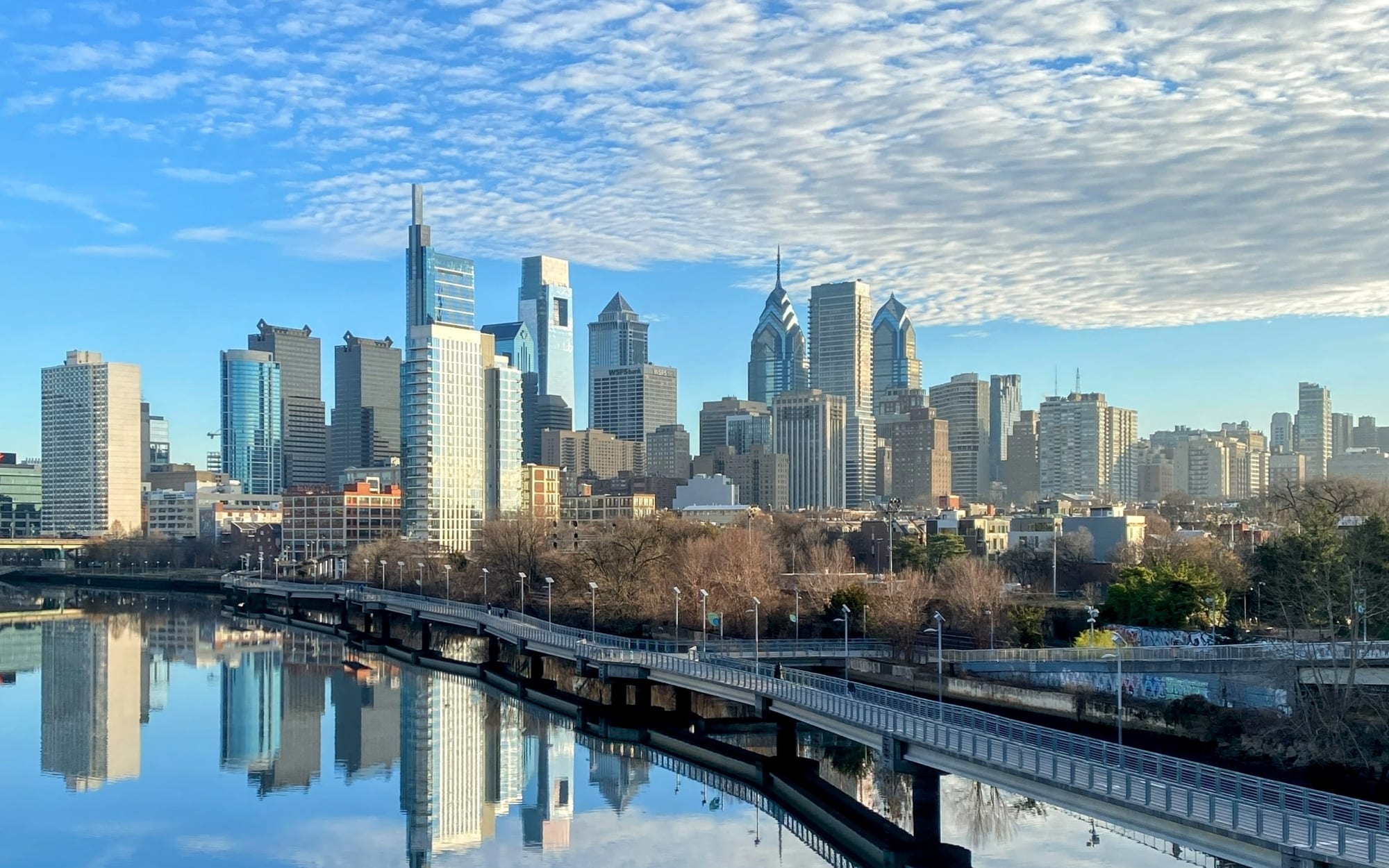
Philadelphia's skyline reflected in the calm Schuylkill River, with a riverside boardwalk curving across the foreground

New York & the Mid-Atlantic, United States

Philadelphia

The Center City skyline seen across the Schuylkill River from the South Street Bridge. (Mefman00 / Wikimedia Commons · CC BY-SA 4.0)

Pennsylvania's largest city, on the Delaware River between New York and Washington — the Quaker town laid out by William Penn in 1682 where independence was declared and the Constitution written. Today it is a city of brick row houses, universities and hospitals, more murals than any other American city, fiercely loyal sports fans and the cheesesteak.

Neighbourhoods

  • Old City
    • First-time visitors
    • Historic district

    The oldest part of the city near the Delaware River waterfront, home to Independence National Historical Park — Independence Hall, the Liberty Bell, Carpenters' Hall and the First and Second Banks of the United States — and to Elfreth's Alley. Galleries, bars and restaurants fill the old warehouse blocks around them.

    Open in Maps
  • Society Hill
    • Historic district
    • Quiet and residential

    One of the oldest residential neighbourhoods in the city, settled in the 1680s and restored from the 1950s. Brick pavements, Franklin street lamps and cobbled streets run between Federal and Georgian row houses — one of the largest groups of 18th- and early 19th-century buildings in the country.

    Open in Maps
  • Rittenhouse Square and Center City West
    • Shopping
    • Best for food
    • Close to public transport

    The polished western half of downtown, built around Rittenhouse Square, one of the five open squares planned by William Penn and his surveyor Thomas Holme. Restaurants, cafés and shops line the streets around it, and City Hall and the Avenue of the Arts are a short walk east.

    Open in Maps
  • South Philadelphia
    • Best for food
    • Local life

    Long known for its large Italian American population, and now also home to Mexican, Central American and Southeast Asian communities. The Italian Market's awnings and curb carts line 9th Street, the rival cheesesteak stands face each other at Passyunk Avenue, and the sports stadiums sit at the far southern end.

    Open in Maps
  • Fishtown
    • Nightlife
    • Bars
    • Music

    A long working-class riverside neighbourhood north-east of Center City, named after its early fishermen, where Penn made his treaty with the Lenape at Shackamaxon. Its row-house streets have seen a large influx of young professionals in recent years.

    Open in Maps
  • University City
    • Students
    • Close to public transport

    The eastern edge of West Philadelphia, across the Schuylkill from Center City, home to the University of Pennsylvania and Drexel University. 30th Street Station and the campuses fill its eastern side, and Victorian houses line the mostly residential streets to the west.

    Open in Maps

Things to do

Independence and famous landmarks

  • Independence Halllandmark

    The old Pennsylvania State House, where the Declaration of Independence and the Constitution were adopted, centrepiece of Independence National Historical Park and a UNESCO World Heritage Site since 1979.

    Open in Maps
  • Liberty Belllandmark

    The bell commissioned in 1752 for the State House steeple, cracked soon after it arrived and twice recast, now shown in its own centre across the street from Independence Hall.

    Open in Maps
  • Philadelphia City Halllandmark

    The seat of the city government and a working courthouse, an ornate Second Empire building at the centre of William Penn's street plan.

    Open in Maps
  • Elfreth's Alleylandmark

    A narrow street in Old City dating from 1703, lined with 32 houses built between 1703 and 1836, with a small museum at numbers 124 and 126.

    Open in Maps
  • Eastern State Penitentiarylandmark

    A vast former prison in Fairmount, in use from 1829 to 1971, that was built to keep prisoners in separate cells as a means of reform rather than punishment.

    Open in Maps

Museums

  • Philadelphia Art Museummuseum

    Known until its rebranding in October 2025 as the Philadelphia Museum of Art, a museum chartered for the Centennial Exposition of 1876, whose 1928 building on Fairmount hill holds more than 240,000 objects; its long flight of front steps became famous through the film Rocky.

    Open in Maps
  • Barnes Foundationmuseum

    Albert C. Barnes's art collection, founded in 1922 in suburban Merion and moved in 2012 to a new building on the Benjamin Franklin Parkway.

    Open in Maps
  • Rodin Museummuseum

    Opened in 1929 on the Parkway, with one of the largest collections of Auguste Rodin's work outside Paris — nearly 150 bronzes, marbles and plasters.

    Open in Maps
  • Museum of the American Revolutionmuseum

    A museum opened in 2017 two blocks from Independence Hall, telling the story of the American Revolution.

    Open in Maps
  • Franklin Institutemuseum

    A science museum founded in 1824 and named after Benjamin Franklin, home to the Benjamin Franklin National Memorial.

    Open in Maps
  • Mütter Museummuseum

    The medical history museum of the College of Physicians of Philadelphia, founded in 1858, with anatomical specimens, wax models and antique medical instruments.

    Open in Maps

Parks, art and the river

  • Fairmount Parkpark

    The city's largest park, more than 2,000 acres split into East and West Park on either side of the Schuylkill River.

    Open in Maps
  • Boathouse Rowlandmark

    Fifteen historic rowing-club boathouses on the east bank of the Schuylkill, just north of the art museum, all at least a century old.

    Open in Maps
  • Rittenhouse Squarepark

    One of the five original squares of Penn's plan, now the leafy centre of the Rittenhouse neighbourhood.

    Open in Maps
  • Philadelphia's Magic Gardensattraction

    Isaiah Zagar's largest work, a mosaic labyrinth on South Street spread over three lots and made from tiles, mirror shards, bicycle wheels and Latin American art.

    Open in Maps

Markets

  • Reading Terminal Marketmarket

    An indoor market opened in 1893 beneath the train shed of the Reading Railroad, with food stalls, grocers and lunch counters under one roof.

    Open in Maps
  • Italian Marketmarket

    The South 9th Street Curb Market, with awning-covered pavements, carts, butchers, cheese shops and bakeries, the social heart of the city's Italian community.

    Open in Maps

Sport and nights out

  • South Philadelphia Sports Complexattraction

    The cluster of stadiums and arenas at the southern end of Broad Street where the Eagles, Phillies, Flyers and 76ers play.

    Open in Maps

Short trips from the city

  • Valley Forge National Historical Parkpark

    The site of the Continental Army's winter encampment of 1777–78, with reconstructed log huts, monuments, a museum and more than 30 miles of trails.

    Open in Maps

Seasonal events

  • Mummers ParadeNew Year's Day

    Held since 1901, the country's longest-running continuous folk parade, with clubs competing in elaborate costumes, string bands and movable scenery.

  • Philadelphia Flower Showearly March

    The oldest and largest indoor flower show in the world, at the Pennsylvania Convention Center, with large landscaped gardens built around a yearly theme.

  • Philadelphia Film FestivalOctober

    An annual festival of two weeks held at theatres across the Philadelphia area.

  • Thanksgiving Day ParadeThanksgiving morning, late November

    The longest-running continuously held Thanksgiving Day parade in the country.

Eat and drink

Long-standing places and food districts in Philadelphia. Hours, ratings and directions come from your maps app, always current.

Philadelphia classics

  • Pat's King of Steaksrestaurant

    The stand founded in 1930 by the brothers Pat and Harry Olivieri, credited with inventing the cheesesteak, at the corner of 9th Street and Passyunk Avenue.

    Open in Maps
  • Geno's Steaksrestaurant

    Pat's rival directly across the intersection, founded in 1966; the two neon-lit stands are the city's best-known cheesesteak contest.

    Open in Maps

Food districts and markets

  • Reading Terminal Marketmarket

    The 1893 indoor market in Center City, where more than a hundred merchants sell Pennsylvania Dutch specialities, cheese, meat, local groceries and food from many cuisines.

    Open in Maps
  • Italian Marketmarket

    Butchers, cheese shops, bakeries and cafés along South 9th Street, now mixed with Mexican taquerías and groceries.

    Open in Maps
  • Chinatownneighborhood

    A compact district just north of the convention centre and Reading Terminal Market, with Chinese and other Asian restaurants and bakeries.

    Open in Maps

Experience Philadelphia

History

The Lenape lived along the Delaware long before Europeans arrived, and Dutch and Swedish settlers came in the 17th century. In 1681 Charles II granted William Penn a charter for Pennsylvania in partial repayment of a debt. Penn, a Quaker and advocate of religious freedom, bought the land from the Lenape, made a treaty of friendship with the chief Tammany at Shackamaxon, and in 1682 founded a city he named Philadelphia — Greek for "brotherly love" — laid out on a grid between two rivers with open squares, gardens and orchards.

The town grew into the largest city of the colonies. The First and Second Continental Congresses met here, the Declaration of Independence was adopted on 4 July 1776 and the Constitution was drafted in 1787. Philadelphia served as the national capital several times until 1800, when the government moved to Washington. In 1793 a yellow fever epidemic killed about a tenth of the population. The Act of Consolidation of 1854 extended the city from the 2 square miles of Center City to the whole of Philadelphia County, and the Centennial Exposition of 1876 celebrated a century of independence.

Industry drew immigrants from Europe and Black migrants from the South; the African American population grew from about 32,000 in 1880 to about 220,000 in 1930. The population passed two million in 1950, then fell by about a quarter as factories closed and families left for the suburbs. In 1985 a police bombing aimed at members of the MOVE group killed 11 people and destroyed 61 homes in the Cobbs Creek neighbourhood. Old City and Society Hill were restored from the 1950s onward, and since 2007 the population has grown again.

Culture & Customs

History is the city's calling card, but Philadelphia's identity is as much about its neighbourhoods. It has more murals than any other American city, thanks to the Mural Arts Program created in 1984, which has funded more than 2,800 murals and educated more than 20,000 young people. The long flight of steps up to the art museum became famous through the film Rocky in 1976. The Philadelphia Orchestra is generally counted among the top five orchestras in the country, and the city has played an important part in R&B, soul and rock.

Sport inspires fierce loyalty. Philadelphia is one of 12 American cities with teams in all four major leagues: the Phillies, formed in 1883, are the oldest team to have played continuously under the same name in the same city; the Eagles won their second Super Bowl after the 2024 season; and the Flyers and 76ers complete the set. The fans' reputation for booing and boisterous behaviour is part of local lore. The city was also one of the host cities of the 2026 FIFA World Cup.

The year begins with the Mummers Parade, held every New Year's Day since 1901, when clubs from South Philadelphia march in elaborate costumes with string bands and comic brigades. Philadelphians are known for a distinctive accent and vocabulary — "jawn" can stand for almost any noun — and for a blunt, unpretentious manner.

Daily Life

About 1.6 million people lived in Philadelphia at the 2020 census, and the city's 2025 estimate was about 1.57 million, making it Pennsylvania's largest city. Center City had an estimated 183,000 residents in 2015, the second-largest downtown population in the country after Midtown Manhattan. Beyond it, the city divides into North, Northeast, South, Southwest, West and Northwest Philadelphia, each made up of many smaller neighbourhoods, most of them streets of brick row houses — Federal-style blocks in Old City and Society Hill, Victorian houses in North Philadelphia and twin houses in West Philadelphia.

After the decline of manufacturing the economy rebuilt itself around universities, hospitals and health care, and the region is now one of the country's largest hubs for technology venture capital, helped by its position between New York and Washington. The University of Pennsylvania and Drexel dominate University City. Revitalisation and gentrification, which began in the late 1970s, have reshaped Center City and University City in particular.

Daily life runs on SEPTA trains, buses and trolleys, corner shops and the row-house stoop. The city has a strong-mayor government; Cherelle Parker, a Democrat, won the mayoral election in November 2023, succeeding Jim Kenney.

Food

The cheesesteak is the city's signature: thin-sliced beef cooked on a griddle and served on a long roll with melted cheese. It was developed by Italian immigrants, and Pat's King of Steaks, founded by the Olivieri brothers in 1930, is credited with inventing it; Geno's, its neon-lit rival since 1966, stands across the intersection at 9th Street and Passyunk Avenue. The roast pork sandwich is another local favourite, and the hoagie — Philadelphia's name for a long sandwich of cold cuts, cheese and salad — is a daily lunch.

The rest of the city's food is just as casual. Soft pretzels are sold from carts and bakeries; water ice is a smooth Italian-style sorbet eaten through the summer; scrapple, a fried slice of pork scraps and cornmeal from the Pennsylvania Dutch kitchen, appears at breakfast; and Tastykakes and Irish potato candy — a Philadelphia sweet that, despite its name, is not from Ireland and usually contains no potato — are local favourites. Stromboli, a rolled stuffed bread, comes from the Italian community.

Reading Terminal Market, open since 1893, gathers grocers, butchers and lunch counters under one roof in Center City, while the Italian Market on South 9th Street mixes old Italian butchers and cheese shops with Mexican taquerías. Chinatown, just north of the market, and the many restaurants along East Passyunk Avenue complete the picture.

Planning tools

Budget

Philadelphia costs noticeably less than New York or Washington, and many visitors stay here and take the train to both. Hotels in Center City are the main expense and rise for big conventions, graduations and home games. Food can be cheap: sandwiches, market lunches and food carts keep costs down, and most of the historic sights in Independence National Historical Park are run by the National Park Service.

Daily Budget Midrange
USD 250–450 (Center City hotel, sit-down dinners with tax and tip, museum tickets, taxis or ride-hailing)
Daily Budget Shoestring
USD 110–180 (hostel bed or budget hotel, cheesesteaks, hoagies and market lunches, buses and the subway)

Rooms are cheapest on winter weeknights; walking the historic district, Elfreth's Alley, the murals and the riverside paths costs nothing.

Best Time to Visit

April to June and September to October are the most comfortable months, with mild weather for walking the historic district and the riverside parks. July and August are hot and humid, with occasional days above 100°F. Winters are cold but usually only lightly snowy, and the Mummers Parade opens the year.

Suggested Number of Days

Two to three days cover a first visit to the city. Four or five allow time for the suburbs and the countryside to the west as well. Visitors with a strong interest in art or history need longer, as the museums are large.

First Visit
2–3 days
With Surroundings
4–5 days

Transportation

Center City is laid out on William Penn's grid between the Delaware and Schuylkill rivers, which makes it easy to navigate. SEPTA runs buses, subway and elevated lines, trolleys and regional rail across the city and its suburbs, and taxis and ride-hailing fill the gaps. A car is not needed in the centre, where parking is limited and expensive.

Regional rail and the subway lines all meet in Center City; 30th Street Station links Amtrak with SEPTA and New Jersey Transit trains.

Airport & Station Connections

Philadelphia International Airport, the largest transatlantic hub of American Airlines, is about 7 miles from Center City, reached by SEPTA's Airport Line regional rail, taxi or ride-hailing. 30th Street Station is the third-busiest Amtrak station in the country, on the Northeast Corridor between New York and Washington, and intercity buses run on the same route.

Walkability

Center City is one of the most walkable downtowns in the country: the historic district, Rittenhouse Square, Reading Terminal Market and City Hall are all within a compact grid, and the Benjamin Franklin Parkway leads on foot to the art museums. South Philadelphia, Fishtown and University City are a longer walk or a short ride away.

Safety

Crime in Philadelphia is concentrated in particular neighbourhoods rather than in the areas most visitors use. Center City, Old City, Society Hill and the Parkway museums are busy and generally safe; pickpocketing in crowds, car break-ins and summer heat are the everyday risks.

For most visitors the US is safe, with the main risks being petty theft and car break-ins in tourist areas of some cities, road accidents over long distances, extreme weather, and the hazards of the outdoors. Leave nothing visible in parked cars, ask locally about unfamiliar neighbourhoods after dark, and use ride-hailing late at night. Check current official travel advice before travelling.

Climate

A humid climate with four distinct seasons. Summers are hot and humid, winters cold, and snowfall varies widely from year to year — some winters bring only light snow, others major snowstorms.

Summer
hot and humid — July averages about 79°F, and temperatures occasionally pass 100°F
Winter
cold — January averages about 34°F, with around 22 inches of snow in an average season

Local Customs

Tipping of roughly 18–22 per cent is expected in restaurants, and sales tax is added at the till. Philadelphians are known for their accent, the all-purpose word 'jawn' and passionate, often loud sports fans; wearing a rival team's shirt to a game invites comment. At the famous cheesesteak stands, regulars order quickly and expect others to do the same.

Identification is asked for when buying alcohol (the legal age is 21). Independence Hall and the Liberty Bell sit in a secure zone, with security screening at the entrances.

Common Payment Methods

The currency is the US dollar. Cards and contactless payment are accepted almost everywhere, though some long-established sandwich shops and market stalls prefer cash, so a small amount is useful. ATMs are easy to find.