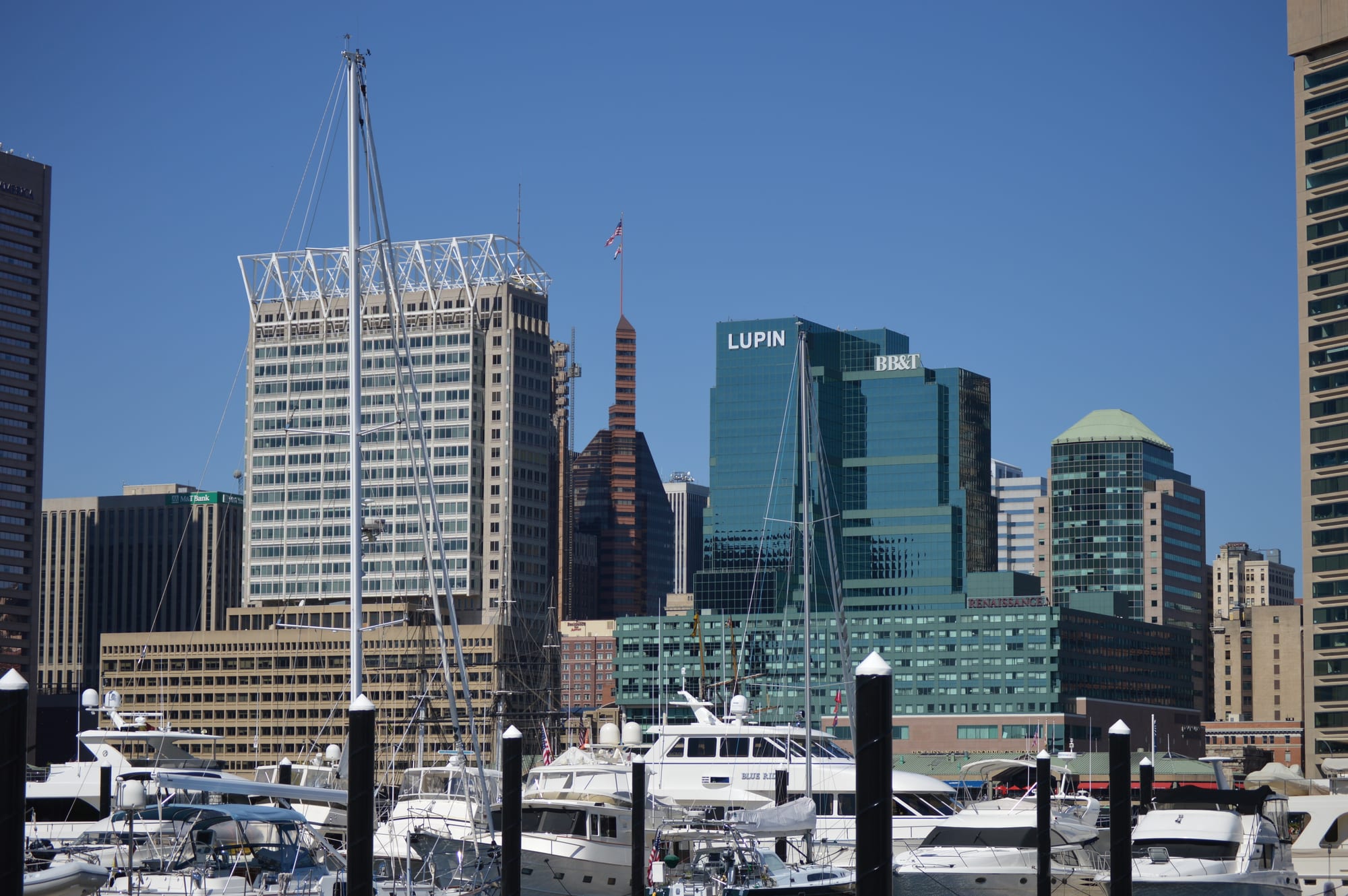
Yachts and sailing masts moored in front of downtown Baltimore's office towers under a clear blue sky

New York & the Mid-Atlantic, United States

Baltimore

Boats moored in the Inner Harbor below the towers of downtown Baltimore. (Kimberlyshorter / Wikimedia Commons · CC BY-SA 4.0)

Maryland's largest city, a port on the Patapsco River close to where it empties into the Chesapeake Bay. Its defence of Fort McHenry in 1814 gave the country its anthem, and its harbour, railways and factories made it one of the largest American cities. Today it is a city of row houses, historic waterfront neighbourhoods, Johns Hopkins and steamed crabs.

Neighbourhoods

  • Inner Harbor and Downtown
    • First-time visitors
    • Museums
    • Close to public transport

    The old seaport at the mouth of the Jones Falls, rebuilt from abandoned warehouses from the 1970s onward into a waterfront of promenades, the National Aquarium, the Maryland Science Center and moored historic ships. The baseball and football stadiums are a short walk west, and many of the city's hotels are here.

    Open in Maps
  • Fells Point
    • Historic district
    • Nightlife
    • Best for food

    A waterfront neighbourhood established around 1763, about 1.5 miles east of downtown, known for its maritime history. Old brick houses and wharves are lined with pubs, restaurants and shops.

    Open in Maps
  • Federal Hill
    • Views
    • Bars
    • Local life

    A row-house neighbourhood on the south shore of the Inner Harbor, named for the hill park from which the classic view of the skyline is photographed. The Cross Street Market and the American Visionary Art Museum are here.

    Open in Maps
  • Mount Vernon
    • Architecture
    • Arts and culture

    The neighbourhood immediately north of downtown, named after George Washington's Mount Vernon estate as the site of the city's Washington Monument, which stands at the centre of its squares. Its squares and the Walters Art Museum make it one of the city's cultural centres.

    Open in Maps
  • Canton
    • Quiet and residential
    • Bars

    A historic waterfront neighbourhood on the outer harbour about 2 miles east of downtown, beside Fells Point and Patterson Park, with streets of row houses and a choice of bars and restaurants.

    Open in Maps
  • Hampden
    • Shopping
    • Local life

    A neighbourhood in north Baltimore, a short distance from the Johns Hopkins Homewood campus, with streets of row houses and a local shopping street of independent shops, cafés and restaurants.

    Open in Maps
  • Little Italy
    • Best for food

    A small, closely knit neighbourhood between the Inner Harbor and Fells Point, still mostly home to descendants of Italian immigrants, with streets of Italian restaurants and bakeries.

    Open in Maps

Things to do

Famous landmarks

  • Fort McHenrylandmark

    The star-shaped fort on Locust Point that held off the Royal Navy on 13–14 September 1814; the flag still flying over it at dawn inspired Francis Scott Key's 'The Star-Spangled Banner'.

    Open in Maps
  • Washington Monumentlandmark

    The column at the centre of Mount Vernon Place, the first major monument to honour George Washington.

    Open in Maps
  • USS Constellationattraction

    A sloop-of-war moored in the Inner Harbor, built in the 1850s as the last sail-only warship designed and built by the United States Navy.

    Open in Maps
  • Edgar Allan Poe House and Museummuseum

    The small row house on North Amity Street where Poe lived in the 1830s, opened as a museum in 1949.

    Open in Maps

Museums

  • National Aquariummuseum

    A large public aquarium on Pier 3 of the Inner Harbor, opened in 1981, with a tropical rainforest, a multi-storey Atlantic coral reef and an open-ocean shark tank.

    Open in Maps
  • Baltimore Museum of Artmuseum

    Founded in 1914, with a collection of 95,000 objects including more than 1,000 works by Henri Matisse, anchored by the Cone Collection of modern art.

    Open in Maps
  • Walters Art Museummuseum

    A public art museum in Mount Vernon, opened in 1934 around the collections of William and Henry Walters.

    Open in Maps
  • American Visionary Art Museummuseum

    A museum of outsider art — work by self-taught artists — on the south shore of the Inner Harbor in Federal Hill.

    Open in Maps
  • B&O Railroad Museummuseum

    Opened by the Baltimore and Ohio Railroad in 1953 at a historic station, now named the National Museum of Railroad History & Innovation, with a large collection of historic locomotives and carriages.

    Open in Maps
  • Reginald F. Lewis Museummuseum

    A Smithsonian-affiliated museum opened in 2005, covering 400 years of African American life in Maryland.

    Open in Maps

Parks and the waterfront

  • Federal Hill Parkviewpoint

    A hilltop park on the south shore of the Inner Harbor with the best-known view of the downtown skyline across the water.

    Open in Maps
  • Patterson Parkpark

    A large urban park in south-east Baltimore beside Canton and Highlandtown.

    Open in Maps
  • Inner Harborneighborhood

    The redeveloped waterfront described in 2009 as 'the model for post-industrial waterfront redevelopment around the world', with a promenade around the harbour basin.

    Open in Maps

Markets

  • Lexington Marketmarket

    Established in 1782 and one of the oldest continuously operating public markets in the country, now in a new market shed completed in 2022 with about 50 merchants.

    Open in Maps
  • Cross Street Marketmarket

    A 19th-century market hall running the length of Cross Street in Federal Hill.

    Open in Maps

Sport

  • Oriole Park at Camden Yardsattraction

    The Orioles' ballpark, opened in 1992 as the first of the 'retro' major league parks, beside the Ravens' M&T Bank Stadium.

    Open in Maps

Short trips from the city

  • Hampton National Historic Sitelandmark

    North of Towson, the remnant of an 18th-century estate with a Georgian mansion, gardens and the original stone slave quarters, owned by the Ridgely family from 1745 to 1948.

    Open in Maps
  • Annapolisattraction

    Maryland's historic capital on the Chesapeake Bay, about 25 miles south, a city with a strong maritime culture.

    Open in Maps

Seasonal events

  • Preakness StakesMay

    The second race of the Triple Crown, first run at Pimlico Race Course in 1873; the 2026 running moved to Laurel Park while Pimlico is rebuilt.

  • ArtscapeMemorial Day weekend, late May

    The country's largest free arts festival, held since 1982 and moved downtown to Memorial Day weekend in 2025.

  • Fourth of July on the Inner Harbor4 July

    The city's Independence Day celebration around the harbour, organised by the city arts council.

Eat and drink

Long-standing places and food districts in Baltimore. Hours, ratings and directions come from your maps app, always current.

Baltimore classics

  • Faidley's Seafoodrestaurant

    A seafood counter inside Lexington Market, one of the oldest of its kind in the Chesapeake Bay area, known for its lump crab cakes.

    Open in Maps
  • Crab housesrestaurant

    Steamed Maryland blue crabs dusted with Old Bay and picked apart at paper-covered tables are the city's summer ritual.

    Open in Maps

Food districts and markets

  • Lexington Marketmarket

    The market founded in 1782, now with about 50 merchants and kiosks, including Faidley's seafood counter.

    Open in Maps
  • Cross Street Marketmarket

    Federal Hill's 19th-century market hall, the neighbourhood's main social and commercial hub.

    Open in Maps
  • Little Italyneighborhood

    Italian restaurants and bakeries in a closely knit old immigrant neighbourhood.

    Open in Maps
  • Fells Pointneighborhood

    Pubs, seafood restaurants and bars in the old waterfront streets.

    Open in Maps

Experience Baltimore

History

People from the Province of Maryland established the Port of Baltimore in 1706 to ship tobacco to Europe, and the town was founded on 8 August 1729 on the north side of the Patapsco River. Fells Point and Jonestown grew up to the east, and the three were incorporated as the City of Baltimore in 1796–97. Lexington Market, founded in 1782, became a centre of trade — including the slave trade.

In September 1814 a British fleet bombarded Fort McHenry; the fort held, and Francis Scott Key's poem about the flag still flying at dawn became "The Star-Spangled Banner", the national anthem since 1931. The city grew quickly: it pioneered gas lighting in 1816, was the country's second most populous city from 1820 to 1850, and built its economy on shipbuilding, textiles and the Baltimore and Ohio Railroad. Its riots earned it the nickname "Mobtown", and in April 1861 a clash between Union soldiers and a secessionist crowd on Pratt Street brought some of the first casualties of the Civil War. The Inner Harbor became the second-busiest port of entry for immigrants after Ellis Island.

On 7 February 1904 the Great Baltimore Fire destroyed more than 1,500 buildings across more than 70 blocks of downtown. The population peaked at about 950,000 in 1950, then fell for decades as industry and white residents left for the suburbs; riots followed the assassination of Martin Luther King Jr. in 1968. From the 1970s the derelict Inner Harbor was rebuilt with a science centre, Harborplace, the National Aquarium and, in 1992, Camden Yards. On 26 March 2024 the container ship Dali struck the Francis Scott Key Bridge, collapsing its main span and killing six maintenance workers; Maryland officials plan to replace the bridge by late 2030.

Culture & Customs

Baltimore has a strong, slightly eccentric identity. The Baltimore-born film-maker John Waters has parodied the city and its accent for decades, and the television series Homicide: Life on the Street and The Wire were set and filmed here. Edgar Allan Poe lived here in the 1830s, and the Baltimore Symphony Orchestra, founded in 1916, is internationally known. Artscape, first held in 1982, calls itself the largest free arts festival in America.

The city's neighbourhoods carry their own loyalties: almost two million immigrants — German, Polish, English, Irish, Russian, Lithuanian, Greek and Italian among them — arrived between 1820 and 1989, and there is a large Caribbean community, mainly Jamaican and Trinidadian. Baltimore is a majority-Black city, and the Reginald F. Lewis Museum tells the story of African American Marylanders over 400 years. Row houses, many faced with formstone, which John Waters called "the polyester of brick", are part of the city's look.

Sport is followed closely: the Orioles play at Camden Yards and the Ravens next door, and the Preakness Stakes, the second race of the Triple Crown, was first run in Baltimore in 1873. Local brands are a point of pride, above all National Bohemian beer — "Natty Boh" — whose mascot appears on merchandise across the region.

Daily Life

About 586,000 people lived in Baltimore at the 2020 census, and the 2025 estimate was about 570,000; the metropolitan area has about 2.86 million. The city lost population for decades after its 1950 peak, but grew in 2024 for the first time in decades. Johns Hopkins Hospital and University are the top employers, and downtown has a growing technology sector.

Row houses are the city's dominant house type. Central Baltimore includes downtown and the Inner Harbor; north Baltimore has leafy neighbourhoods such as Roland Park, Guilford and Hampden; and the south and south-east hold the waterfront districts of Federal Hill, Locust Point, Fells Point and Canton, with Highlandtown and Greektown beyond. Gentrification since 2000 has been concentrated in East Baltimore, downtown and around the Johns Hopkins Homewood campus.

Poverty is high — about a fifth of residents in 2020 — and violent crime has been a long-standing concern, though homicides fell sharply in 2023 and 2024. The current mayor is Brandon Scott. The collapse of the Key Bridge in 2024 cut a main route across the harbour, and its replacement is a long-running project.

Food

Maryland blue crabs define Baltimore's table. In summer they are steamed with Old Bay — a blend of herbs and spices created in Baltimore in 1939 — tipped onto paper-covered tables and picked apart by hand, and crab cakes are eaten all year. Faidley's, a seafood counter in Lexington Market, is one of the oldest of its kind in the Chesapeake Bay area and is known for them.

Pit beef — usually top round roasted over a charcoal fire, sliced thin and served on a Kaiser roll with horseradish or "tiger sauce" and raw onion — is the city's barbecue, and it gained a national reputation through The Wire. The "chicken box", fried wings with french fries, is a staple of corner carry-outs. Berger Cookies, cake-like biscuits under a thick layer of chocolate fudge frosting, are made by a local bakery.

Lexington Market, founded in 1782 and rehoused in a new shed in 2022, and the Cross Street Market in Federal Hill are the classic places to eat on the hoof. Little Italy keeps its Italian restaurants and bakeries, Fells Point its pubs and seafood houses, and National Bohemian beer remains the local staple, though it is now brewed outside Maryland.

Planning tools

Budget

Baltimore costs noticeably less than Washington or New York, and is an easy rail trip from both. Hotels around the Inner Harbor are the main expense and rise on game days and during big conventions. Crab feasts are the splurge; pit beef and market food are cheaper.

Daily Budget Midrange
USD 230–420 (Inner Harbor hotel, crab dinners with tax and tip, aquarium and museum tickets, taxis or ride-hailing)
Daily Budget Shoestring
USD 100–170 (hostel or budget hotel, market lunches and pit beef, buses and the free Circulator)

The free Charm City Circulator buses and walking along the harbour promenade cover most central sights at no cost.

Best Time to Visit

Late spring and early autumn are the most comfortable seasons. Summer is hot and humid, with frequent days above 90°F, but it is also crab season and the busiest time on the waterfront. Winters range from chilly to mild, with only sporadic snow.

Suggested Number of Days

Two or three days are enough for a first visit to the city. Four or five allow time for the Chesapeake Bay and the countryside around the city as well; the museums are numerous, so art lovers may want longer.

First Visit
2–3 days
With Surroundings
4–5 days

Transportation

The Maryland Transit Administration runs buses, the Metro Subway and a north–south light rail line through downtown. The free Charm City Circulator shuttle buses link downtown with nearby neighbourhoods, and water taxis run six routes around the harbour. Taxis and ride-hailing fill the gaps; a car is useful for the suburbs and the bay.

The water taxis are a pleasant way to move between the waterfront neighbourhoods.

Airport & Station Connections

Baltimore/Washington International Airport is about 9 miles south of downtown and was the first airport in the country with its own intercity rail station; the light rail also runs there from downtown. Penn Station is one of the busiest Amtrak stations on the Northeast Corridor, and MARC commuter trains link the city with Washington's Union Station.

Walkability

The Inner Harbor promenade, Federal Hill, Little Italy and Fells Point are linked by an easy walk around the water, and Mount Vernon is a short walk north of downtown. Hampden and the Baltimore Museum of Art are further north, a bus or taxi ride away. Some blocks between districts are empty, so routes are worth checking after dark.

Safety

Baltimore has had a high violent-crime and homicide rate for decades; homicides fell from more than 300 a year until 2022 to 200 in 2024. The Inner Harbor, Federal Hill, Fells Point, Canton and Mount Vernon are busy and well used.

For most visitors the US is safe, with the main risks being petty theft and car break-ins in tourist areas of some cities, road accidents over long distances, extreme weather, and the hazards of the outdoors. Use taxis or ride-hailing between districts late at night, leave nothing visible in parked cars and ask locally about unfamiliar areas. Check current official travel advice before travelling.

Climate

Hot, humid summers with late-day thunderstorms, and winters that range from chilly to mild, with sporadic snowfall and occasional Arctic cold snaps.

Summer
hot and humid — July averages about 81°F, and about 43 days a year reach 90°F or more
Winter
chilly to mild — January averages about 36°F, often reaching 50°F but occasionally dropping below 20°F

Local Customs

Tipping of roughly 18–22 per cent is expected in restaurants, and sales tax is added at the till. The city is affectionately known as Charm City. Crab feasts are informal and messy, eaten with mallets and fingers off paper-covered tables. Orioles and Ravens colours are everywhere on game days.

Identification is asked for when buying alcohol (the legal age is 21). Fort McHenry is a national monument; treat it as a place of remembrance.

Common Payment Methods

The currency is the US dollar. Cards and contactless payment are accepted almost everywhere, and ATMs are easy to find; a few market stalls and crab houses may prefer cash.