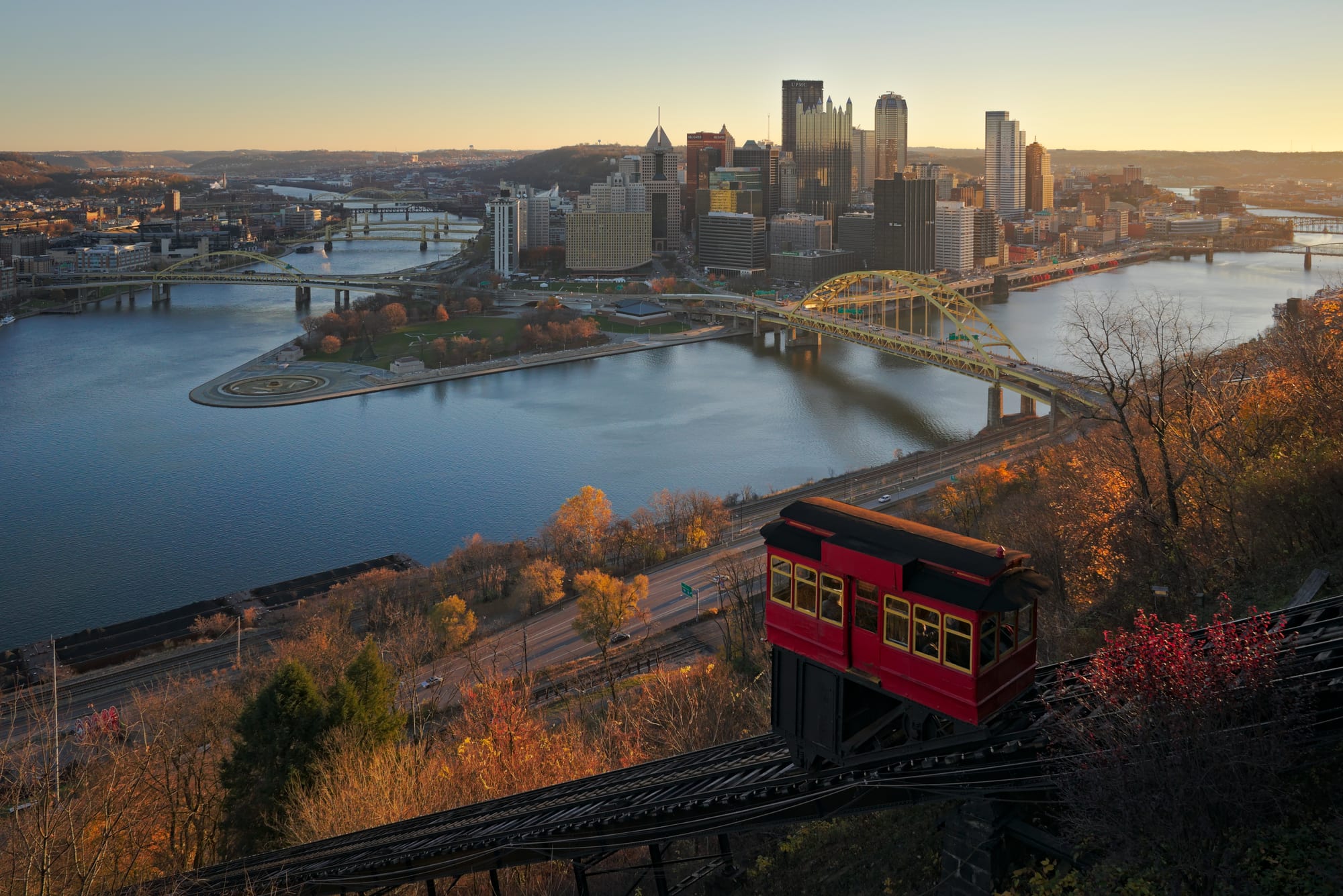
A red incline car climbing a wooded slope above the rivers, with downtown Pittsburgh's towers, the Point and yellow bridges beyond

New York & the Mid-Atlantic, United States

Pittsburgh

Downtown Pittsburgh and the Point, seen from the top of the Duquesne Incline on Mount Washington. (Dllu / Wikimedia Commons · CC BY-SA 4.0)

Pennsylvania's second city, built where the Allegheny and Monongahela rivers meet to form the Ohio. Fought over by the French and British, it became the Steel City, producing up to half the nation's steel; after the mills collapsed in the 1980s it rebuilt itself around universities, hospitals and robotics, and its hills, rivers and 446 bridges remain its signature.

Neighbourhoods

  • Downtown (the Golden Triangle)
    • First-time visitors
    • Theatre
    • Close to public transport

    The wedge of land between the two rivers, ending at Point State Park, where the fortunes of Carnegie, Frick, Heinz, Mellon and Westinghouse were made. Office towers including the glass spires of PPG Place stand beside a 14-block Cultural District of theatres along the Allegheny.

    Open in Maps
  • North Side and North Shore
    • Museums
    • Sport
    • Historic homes

    Across the Allegheny from downtown, once the separate Allegheny City until it was annexed in 1907. The riverfront holds the baseball and football stadiums, the Andy Warhol Museum and the science centre, and the streets behind hold the National Aviary and the Mattress Factory.

    Open in Maps
  • Strip District
    • Best for food
    • Markets

    A half-square-mile strip along the Allegheny just north-east of downtown, once full of factories and warehouses. It is an open-air marketplace by day, with grocers, food stalls and the Heinz History Center, and a busy nightlife area after dark.

    Open in Maps
  • Lawrenceville
    • Bars
    • Local life
    • Shopping

    One of the city's largest neighbourhood areas, north-east of downtown along the river, with an industrial past and streets of narrow row houses and old warehouses; once working-class, it has become a byword for the city's gentrification.

    Open in Maps
  • South Side and Mount Washington
    • Nightlife
    • Views

    South of the Monongahela, the South Side Flats keep one of the city's largest groups of 19th-century houses, and East Carson Street is lined with bars and restaurants. Above it, the two inclines climb Mount Washington to the best-known views of downtown.

    Open in Maps
  • Oakland
    • Museums
    • Students

    The academic and healthcare centre of the city, home to the University of Pittsburgh with its Cathedral of Learning, Carnegie Mellon University, the Carnegie museums and Schenley Park with the Phipps Conservatory.

    Open in Maps
  • Squirrel Hill and Shadyside
    • Quiet and residential
    • Shopping

    Two residential neighbourhoods of the East End. Squirrel Hill is the hub of Jewish life in Pittsburgh, with about 20 synagogues, and Shadyside, named after a 19th-century railway station, has shopping streets close to the universities.

    Open in Maps

Things to do

The rivers and the inclines

  • Point State Parkpark

    A 36-acre park at the tip of downtown where the Allegheny and Monongahela meet to form the Ohio River.

    Open in Maps
  • Fort Pitt Museummuseum

    A museum inside Point State Park on the site of the forts the French and British built to control the forks of the Ohio.

    Open in Maps
  • Duquesne Inclineattraction

    A funicular completed in 1877, originally steam-powered, that climbs 400 feet up Mount Washington at a 30-degree angle to an observation deck over the Point.

    Open in Maps
  • Monongahela Inclineattraction

    Built in 1870 near the Smithfield Street Bridge, the oldest continuously operating funicular in the United States.

    Open in Maps

Museums

  • Andy Warhol Museummuseum

    The largest museum in North America devoted to a single artist, on the North Shore, with a large collection of art and archives from the Pittsburgh-born pop artist.

    Open in Maps
  • Carnegie Museum of Natural Historymuseum

    Founded by Andrew Carnegie in 1896 in Oakland, holding some 22 million specimens, with especially strong palaeontology and insect collections.

    Open in Maps
  • Carnegie Museum of Artmuseum

    The art museum sharing the Carnegie building in Oakland, which began as the Department of Fine Arts of the Carnegie Institute.

    Open in Maps
  • Heinz History Centermuseum

    Pennsylvania's largest history museum, a Smithsonian affiliate in the Strip District.

    Open in Maps
  • Mattress Factorymuseum

    A North Side museum that pioneered site-specific installation art, with permanent works by Yayoi Kusama, James Turrell and Greer Lankton.

    Open in Maps
  • The Frick Pittsburghmuseum

    The museum and gardens at Clayton, the East End home of the industrialist and art collector Henry Clay Frick.

    Open in Maps
  • Randylandattraction

    Randy Gilson's brightly painted house and yard of found-object art on the North Side, one of the most colourful public art sites in the country.

    Open in Maps

Landmarks and parks

  • Cathedral of Learninglandmark

    The 42-storey Gothic Revival tower at the centre of the University of Pittsburgh, at 535 feet the tallest educational building in the Western Hemisphere.

    Open in Maps
  • Phipps Conservatory and Botanical Gardenspark

    A historic glasshouse and botanical garden in Schenley Park.

    Open in Maps
  • Schenley Parkpark

    A large historic park between Oakland, Greenfield and Squirrel Hill.

    Open in Maps
  • National Aviaryattraction

    The country's largest indoor aviary, on the North Side, the only one given honorary 'National' status by Congress.

    Open in Maps

Sport

  • PNC Parkattraction

    The Pirates' steel-and-limestone ballpark on the Allegheny, opened in 2001, with a view across the river to the downtown skyline.

    Open in Maps

Short trips from the city

  • Kennywoodattraction

    An amusement park in West Mifflin, just south-east of the city, opened in 1898 as a trolley park.

    Open in Maps
  • Fallingwaterlandmark

    Frank Lloyd Wright's house built partly over a waterfall on Bear Run, designed as a weekend retreat for the Pittsburgh department-store owner Edgar J. Kaufmann Sr.

    Open in Maps

Seasonal events

  • Three Rivers Arts FestivalJune

    An outdoor festival of music, performance and visual art centred on Point State Park.

  • Picklesburghsummer

    A pickle-themed street festival held downtown every summer since 2015.

Eat and drink

Long-standing places and food districts in Pittsburgh. Hours, ratings and directions come from your maps app, always current.

Pittsburgh classics

  • Primanti Bros.restaurant

    Opened in the Strip District in 1933, known for sandwiches of grilled meat, cheese, oil-and-vinegar coleslaw, tomato and French fries piled between thick slices of Italian bread.

    Open in Maps
  • Pierogies and kielbasarestaurant

    Dumplings and sausages from the city's Polish and Eastern European heritage, served across the city.

    Open in Maps

Food districts

  • Strip Districtneighborhood

    The city's open-air market street of grocers, bakeries, food stalls and restaurants.

    Open in Maps
  • Lawrencevilleneighborhood

    Bars and restaurants in a revitalised row-house neighbourhood.

    Open in Maps
  • South Side Flatsneighborhood

    East Carson Street's long line of bars and restaurants.

    Open in Maps

Experience Pittsburgh

History

The forks of the Ohio were Native American country long before Europeans arrived, and the French explorer La Salle passed down the Ohio in 1669. In the 1750s France built Fort Duquesne at the confluence; a British force under Edward Braddock, with the young George Washington as his aide, failed to take it, and General John Forbes finally captured the forks in 1758. He began building Fort Pitt, named after the British statesman William Pitt, and the settlement became "Pittsborough". A confederation of Native American nations besieged the fort during Pontiac's War in 1763, and after independence it became the main base for settlers heading into the Northwest Territory. Glassmaking began in 1797, and Pittsburgh became a city on 18 March 1816.

Coal, iron and the rivers made it an industrial centre. Welsh steelworkers arrived in the 1830s, and in 1875 Andrew Carnegie began making steel at the Edgar Thomson Works, the start of the Carnegie Steel Company, later merged into U.S. Steel. By 1910 Pittsburgh was the country's eighth-largest city, producing between a third and a half of the nation's steel, and immigrants from Europe and Black migrants from the South came for the mill jobs. During the Second World War the mills ran around the clock.

The population peaked at about 680,000 in 1950. In the early 1980s the region's steel and electronics industries collapsed, bringing mass layoffs, and several large corporations left. The city reinvented itself around health care, education, finance and technology such as robotics, and steel sites such as the South Side Works were redeveloped. Ed Gainey, elected in 2021, became the city's first African American mayor, and Corey O'Connor took office as mayor in 2026; the same year the city hosted the NFL draft for the first time.

Culture & Customs

The steel barons left the city an unusually rich set of cultural institutions: the Carnegie Museums, the Carnegie Library, Heinz Hall and the Benedum Center, home to the Pittsburgh Symphony Orchestra and Pittsburgh Opera, and a downtown Cultural District of theatres. Andy Warhol was born here, and the museum devoted to him is the largest in North America for a single artist. The playwright August Wilson came from the Hill District, where his house is now an arts centre, and Pittsburgh's public television gave the country Mister Rogers' Neighborhood.

Pittsburghese is a point of pride. Shaped by Scots-Irish, German and Eastern European immigrants and by African Americans, it has its own words — "yinz", a plural form of address, "slippy", "redd up", "gum bands" — loans from Polish and other European languages such as "babushka" and "halušky", and a staccato rhythm; speakers are affectionately called "Yinzers". German, Irish, Italian and Polish are the largest European ancestries, and Squirrel Hill, with around 20 synagogues, is the centre of Jewish life.

Sport binds the city together. The Steelers, the Penguins and the Pirates all wear black and gold, the official city colours. The Steelers, owned by the Rooney family since 1933, have won six Super Bowls and sold out every home game since 1972; the Penguins have won five Stanley Cups. The rivers host regattas every year, and the city's conventions range from the INPEX invention fair to Anthrocon.

Daily Life

About 303,000 people lived in Pittsburgh at the 2020 census, making it Pennsylvania's second-largest city, while the metropolitan area has over 2.43 million people, the largest in the Ohio Valley and Appalachia. The city proper has less than half its 1950 population even though the metropolitan area has grown again.

The University of Pittsburgh Medical Center and Allegheny Health Network are the giants of the economy, alongside 68 colleges and universities, among them Carnegie Mellon, Duquesne and the University of Pittsburgh, and a technology sector strong in robotics, software and energy research. Large companies including PNC, PPG, U.S. Steel and Kraft Heinz still have their headquarters here.

The city is divided into downtown — the Golden Triangle — and the North Side, South Side, East End and West End, each a patchwork of neighbourhoods separated by hills, valleys and rivers. The city has about 800 sets of public stairways, including hundreds of streets made entirely of steps, and crossing a bridge is part of many daily journeys. Lawrenceville and other old mill districts have been transformed by new restaurants and residents, while some outlying neighbourhoods are still marked by the loss of industry.

Food

Pittsburgh's food comes from its mill-town immigrants. Pierogies — filled dumplings — and kielbasa are local specialities, and halušky is part of the local vocabulary. The chipped chopped ham sandwich, made with very thinly sliced processed ham, is a local lunch, and Klondike bars are also counted among the city's specialities.

The city's most famous sandwich comes from Primanti Bros., which opened in 1933 in the Strip District, then an area of factories, warehouses and shipyards: grilled meat, melted cheese, oil-and-vinegar coleslaw, tomato slices and French fries all piled between two thick slices of Italian bread.

The Strip District is the place to shop and graze — an open-air marketplace of grocers, bakeries and food stalls by day. The Kraft Heinz Company still has its headquarters in the city, and the summer Picklesburgh festival celebrates the pickle with downtown street stalls. Lawrenceville and East Carson Street on the South Side are the busiest areas for bars and restaurants.

Planning tools

Budget

Pittsburgh costs noticeably less than New York or Washington. Downtown hotels are the main expense and rise on Steelers game weekends and during big conventions. Food is generous and cheap, and many of the sights are the hills, rivers and bridges, which cost nothing.

Daily Budget Midrange
USD 220–400 (downtown hotel, sit-down dinners with tax and tip, museum tickets and incline rides, taxis or ride-hailing)
Daily Budget Shoestring
USD 100–160 (hostel or budget hotel, sandwiches and pierogies, buses and the light rail)

Walking or cycling the riverfront trails and the bridges is free, and an incline ride is an inexpensive way to reach the city's best viewpoint.

Best Time to Visit

Late spring to early autumn is the best time, with riverfront festivals, baseball at PNC Park and long evenings on the water; June brings the Three Rivers Arts Festival. Autumn colours the hillsides and is football season. Winters are cold, grey and often wet, with December and January the days with the most precipitation.

Suggested Number of Days

Two or three days cover a first visit to the city. Four or five allow time for the hills and countryside of south-western Pennsylvania as well; the hilly layout means getting between districts takes longer than the map suggests.

First Visit
2–3 days
With Surroundings
4–5 days

Transportation

Pittsburgh Regional Transit runs buses and a light rail system that runs underground through downtown and on to the North Shore. The two inclines link the South Side with Mount Washington. Hills, rivers, bridges and tunnels make driving confusing for newcomers, and locals call the interstates fanning out from downtown the 'parkways'.

Allow extra time for the tunnels and bridges at rush hour, and use the light rail between downtown, the North Shore and the stadiums.

Airport & Station Connections

Pittsburgh International Airport is about 17 miles west of downtown, reached by the Parkway West through the Fort Pitt Tunnel and over the Fort Pitt Bridge — the famous entrance to the city. Amtrak serves Pittsburgh Union Station with the Capitol Limited between Chicago and Washington and the Pennsylvanian to New York. Cyclists can ride all the way from Washington, D.C. on the Great Allegheny Passage and the C&O Canal Towpath.

Walkability

Downtown is compact and flat, and bridges across the Allegheny link it with the North Shore stadiums and museums. Beyond that the city is hilly, with many public stairways, and walking between neighbourhoods often means a steep climb. Riverfront trails run along all three rivers.

Safety

Pittsburgh is generally calm for visitors, and downtown, the North Shore, Oakland, the Strip and Lawrenceville are busy and well used. Winter ice on steep streets and stairways is a real hazard.

For most visitors the US is safe, with the main risks being petty theft and car break-ins in tourist areas of some cities, road accidents over long distances, extreme weather, and the hazards of the outdoors. Leave nothing visible in parked cars and take care on icy hills in winter. Check current official travel advice before travelling.

Climate

A humid continental climate on the edge of the humid subtropical zone. Summers are warm and humid, though the elevation keeps 100°F readings very rare; winters are cold and cloudy, and May is the wettest month.

Summer
warm and humid — July averages about 73°F, and highs reach 90°F on about nine or ten days a year
Winter
cold — January averages about 29°F, and December and January have the most days with precipitation

Local Customs

Tipping of roughly 18–22 per cent is expected in restaurants, and sales tax is added at the till. Pittsburghers speak a distinctive dialect, Pittsburghese: 'yinz' is a plural form of address, to 'redd up' is to tidy, and a car 'needs washed'. Black and gold, the colours shared by the Steelers, Penguins and Pirates, are the city's official colours and are everywhere on game days.

Identification is asked for when buying alcohol (the legal age is 21). Sports talk is a reliable way to start a conversation.

Common Payment Methods

The currency is the US dollar. Cards and contactless payment are accepted almost everywhere, and ATMs are easy to find; a few long-established sandwich shops and market stalls prefer cash.