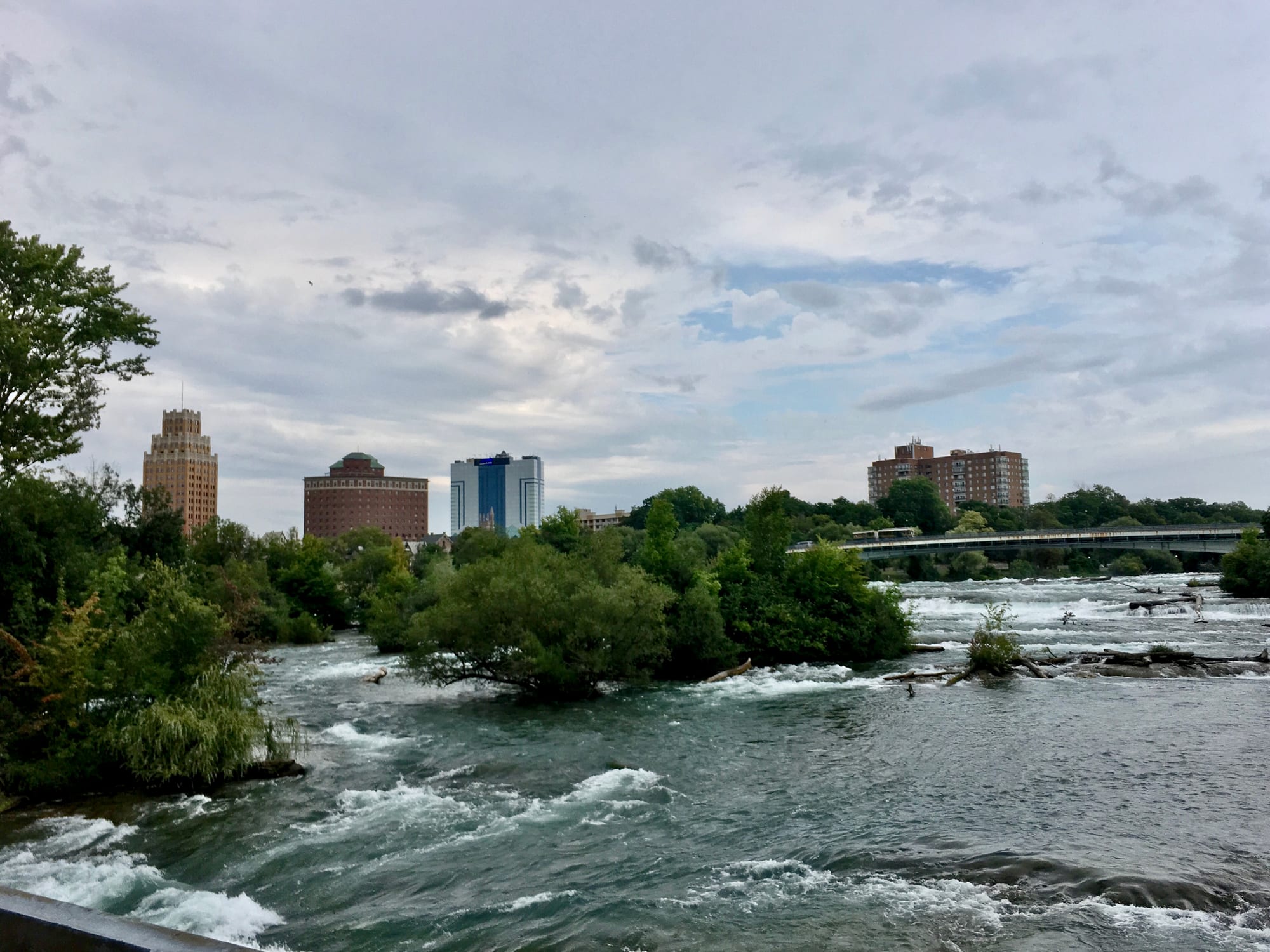
White-water rapids of the Niagara River around small wooded islets, with brick towers of Niagara Falls, New York, beyond under a cloudy sky

New York & the Mid-Atlantic, United States

Niagara Falls

The Niagara River rapids and the Niagara Falls, New York skyline, seen from the Goat Island Bridge in Niagara Falls State Park. (Andre Carrotflower / Wikimedia Commons · CC BY-SA 4.0)

The New York city on the American shore of Niagara Falls, facing its Canadian namesake across the Niagara River. Cheap hydroelectric power made it an industrial city of chemical and metal works; since the 1960s it has lost more than half its people, and tourism to Niagara Falls State Park, recognised as the oldest state park in the United States, now drives the economy.

Neighbourhoods

  • Downtown and the falls
    • First-time visitors
    • Close to the falls

    The blocks around the falls, home to hotels, the Seneca Niagara Casino, the Niagara Falls Culinary Institute and the entrance to Niagara Falls State Park. The Rainbow Bridge to Canada lands here, and the Prospect Point Observation Tower stands in the park.

    Open in Maps
  • Goat Island
    • Views of the falls
    • Walks

    A largely wooded island in the middle of the falls, between the Bridal Veil Falls and the Horseshoe Falls, laced with footpaths. Two bridges link it to the mainland and a footbridge to little Luna Island beside the American Falls; Terrapin Point looks into the Horseshoe Falls.

    Open in Maps
  • Little Italy
    • Best for food
    • Local life

    Pine Avenue, historically home to a large Italian American community, runs east from Main Street to Hyde Park Boulevard and is known for its shops and restaurants. The Aquarium of Niagara is close by.

    Open in Maps
  • DeVeaux
    • Quiet and residential
    • Gorge walks

    A residential area in the north-west of the city along the Niagara Gorge, built up between the 1920s and 1940s and named after Judge Samuel DeVeaux, whose estate became a college for orphans in 1853 and is now the site of DeVeaux Woods State Park. The gorge-top parks of Whirlpool and Devil's Hole are close by.

    Open in Maps

Things to do

The falls

  • Niagara Falls State Parkpark

    Established as the Niagara Reservation in 1885 and recognised as the oldest state park in the United States, it holds the American Falls, the Bridal Veil Falls and part of the Horseshoe Falls.

    Open in Maps
  • American Fallsviewpoint

    The broad waterfall on the American side of the river, seen close up and at a steep angle from the American bank, and head-on from the Canadian shore.

    Open in Maps
  • Cave of the Windsattraction

    Named after a cave behind the Bridal Veil Falls that a rock fall closed in 1920; since 1924 visitors have descended from Goat Island to decks and walkways at the foot of the falls, where the wind can reach storm strength.

    Open in Maps
  • Maid of the Mistattraction

    Boat tours that leave from the American side, at the foot of the observation tower, and run up to the base of the falls, crossing briefly into Canadian waters; sightseeing boats have run here since 1846.

    Open in Maps
  • Goat Islandpark

    The wooded island between the American and Horseshoe falls, with viewpoints including Terrapin Point and a footbridge to Luna Island.

    Open in Maps
  • Rainbow Bridgelandmark

    A steel arch bridge across the Niagara River linking the two cities called Niagara Falls, open to cars, cyclists and pedestrians.

    Open in Maps

Museums and the city

  • Aquarium of Niagaramuseum

    An aquarium opened in 1965 with seals, sea lions and Humboldt penguins, and a second building, Great Lakes 360, opened in July 2024 and devoted to the Great Lakes.

    Open in Maps
  • Niagara Falls Underground Railroad Heritage Centermuseum

    A museum opened in 2018 in an 1863 customhouse beside the Amtrak station, telling the story of the Underground Railroad and those who crossed to freedom in Canada.

    Open in Maps
  • Seneca Niagara Casinoattraction

    The casino built by the Seneca Nation in the city's former convention centre, opened in 2002 to compete with the casinos across the river.

    Open in Maps

The Niagara Gorge

  • Niagara Gorgeviewpoint

    A canyon about 7 miles long carved by the river below the falls, whose rapids are among the most powerful river currents in the world.

    Open in Maps
  • Whirlpool State Parkpark

    A park on the gorge rim north of the city, overlooking the Niagara Whirlpool and the lower gorge.

    Open in Maps
  • Devil's Hole State Parkpark

    A small day-use park overlooking the lower Niagara River Gorge.

    Open in Maps

Short trips from the city

  • Artparkpark

    A state park in the village of Lewiston devoted to the arts, with performances and outdoor events.

    Open in Maps
  • Old Fort Niagaralandmark

    A fort built by New France where the river meets Lake Ontario, taken by the British in 1759 and handed to the United States only in 1796.

    Open in Maps
  • Buffaloattraction

    New York State's second-most populous city, at the head of the Niagara River, the home of the chicken wing and of beef on weck.

    Open in Maps

Eat and drink

Long-standing places and food districts in Niagara Falls. Hours, ratings and directions come from your maps app, always current.

Niagara Falls classics

  • Niagara Falls square pizzaneighborhood

    The local style is baked in a square pan and cut into squares, with a thin but soft crust and a lightly sweet sauce; the stretch of Niagara Street between Portage Road and Hyde Park Boulevard is known for it.

    Open in Maps
  • Wings and beef on weckrestaurant

    Buffalo's two contributions to bar food — chicken wings tossed in hot sauce with blue-cheese dip, and roast beef on a kummelweck roll — are served in bars across the city.

    Open in Maps

Food districts

  • Little Italy, Pine Avenueneighborhood

    The old Italian American main street, with restaurants serving large portions of American and Italian food.

    Open in Maps
  • Niagara Falls Culinary Instituterestaurant

    A cooking school in the former Rainbow Centre outlet mall downtown, whose restaurant serves pizza, pasta, steaks and seafood.

    Open in Maps

Experience Niagara Falls

History

The French first built at the mouth of the Niagara River with the permission of the Iroquois, and later raised Fort Niagara there to control the route between the Great Lakes; the British took the fort in 1759 and stayed until 1796. The Seneca Nation, one of the Iroquois nations, runs a casino downtown today. The falls drew visitors from early on — sightseeing boats have run below them since 1846 — and the villages of Manchester and Suspension Bridge grew up along the river.

Scientists and businessmen in the 19th century began harnessing the river for electricity, and cheap hydroelectric power drew manufacturers. The city of Niagara Falls was incorporated on 17 March 1892 from Manchester and Suspension Bridge, and for much of the 20th century petrochemical, abrasive and metallurgical plants were its main employers, drawing large numbers of immigrant workers. Meanwhile campaigners to free the falls from private development won the creation of the Niagara Reservation in 1885, now Niagara Falls State Park.

In 1956 part of the gorge wall collapsed onto the Schoellkopf Power Plant just downstream of the American Falls, and Robert Moses built a new plant in nearby Lewiston. After the 1960s industry declined. In 1978 toxic waste from a chemical landfill beneath the Love Canal neighbourhood led President Jimmy Carter to declare a state of emergency, the first for a disaster that was not natural, and most of the area was evacuated. The city's population has since fallen from over 102,000 in 1960 to less than half that, and it has tried repeatedly to reinvent itself around tourism.

Culture & Customs

Life here is shaped by the falls and by the border. The two cities called Niagara Falls face each other across the gorge, and the contrast is part of local conversation: the Canadian side is more commercialised, while on the American side the shore around the falls has been a public reservation since 1885. A statue of Nikola Tesla in the state park honours the role of the falls in the history of electric power.

The region's Haudenosaunee heritage is visible in the Seneca Nation's casino and hotel downtown, opened in 2002 in the former convention centre, and the city's place on the Underground Railroad is told at the heritage centre in the old customhouse by the station. Pine Avenue's Little Italy recalls the immigrant workers who came for the factory jobs.

Like much of Western New York, Niagara Falls is a working-class place that shares Buffalo's food traditions. Niagara University and SUNY Niagara, the county's two colleges, add students to the area.

Daily Life

About 48,700 people lived in the city at the 2020 census, less than half its 1960 peak of about 102,000, as manufacturing jobs disappeared. Tourism, driven by the falls, is now the main industry, alongside the Seneca casino and the Niagara Falls Air Reserve Station. A 2012 state report described a city that had "struggled through decades of population losses, rising crime and repeated attempts to reinvent itself".

Residents live in neighbourhoods such as DeVeaux by the gorge, the North End along Highland Avenue, Hyde Park near the municipal golf course, Little Italy along Pine Avenue and LaSalle in the east, built up from the 1940s to the 1960s. Most of the Love Canal neighbourhood was evacuated in the 1980s.

The city has a strong-mayor government; the current mayor is Robert Restaino. Daily life is car-based and suburban in rhythm, with the downtown tourist district busiest in summer and quiet in the snowy winters.

Food

Niagara Falls has its own style of pizza: baked in a square pan and cut into squares, with a thin crust that stays soft and a sauce seasoned with oregano and a faint sweetness. The stretch of Niagara Street between Portage Road and Hyde Park Boulevard is known for the pizzerias that make it, and the big national chains have little presence in the city.

The rest of the menu is shared with Buffalo, a short drive up the river, which invented chicken wings — fried and tossed in hot sauce, served with blue-cheese dip — and beef on weck, thin-sliced roast beef on a salty kummelweck roll with horseradish. Wings are standard in the city's bars, and frozen custard, ice cream and Italian water ice are summer favourites.

Pine Avenue's Little Italy has long been the place for Italian American cooking in large portions. Downtown, the Niagara Falls Culinary Institute occupies the former Rainbow Centre outlet mall, and its restaurant serves pizza, pasta, steaks and seafood.

Planning tools

Budget

Hotels near the falls are the main cost and are dearest in summer; rooms a little away from the park or across the river vary widely. The park itself is free to walk, and paying for the boat and the Cave of the Winds is where most of the money goes. Food is mostly casual and inexpensive.

Daily Budget Midrange
USD 220–400 (hotel near the falls, sit-down dinners with tax and tip, boat and walkway tickets, parking or ride-hailing)
Daily Budget Shoestring
USD 100–170 (budget motel, pizza and diners, local buses and walking)

Walking the state park, Goat Island and the gorge-top paths costs nothing; parking near the falls adds up, so staying within walking distance can pay for itself.

Best Time to Visit

Summer is the busiest season, when the falls draw the largest crowds and the boat tours and walkways are at their busiest. Late spring and early autumn are quieter and mild. Winters are cold and snowy, and the town is much quieter.

Suggested Number of Days

One or two days are enough for most first visits. Three or four allow time for the surrounding area and the Canadian side of the river as well.

First Visit
1–2 days
With Surroundings
3–4 days

Transportation

The falls, the state park and downtown are compact and easy to manage on foot, and a trackless sightseeing train runs around Goat Island. Local buses, including a trolley route from the airport along Pine Avenue to the casino and hotel district, cover the city. A car is useful for the gorge parks, Lewiston and Buffalo.

Parking close to the falls is paid and fills up in summer; leaving the car at the hotel and walking is often easier.

Airport & Station Connections

Buffalo Niagara International Airport, just outside Buffalo, is the major airport, with flights across the United States; the small Niagara Falls International Airport, the closest to the falls, is served by low-cost airlines, and Toronto Pearson lies across the border in Canada. Amtrak's Maple Leaf and Empire Service trains stop at the Niagara Falls station. Many arrive by car on Interstate 190.

Walkability

The area around the falls is very walkable: downtown, Prospect Point, Goat Island and Luna Island are linked by footpaths and bridges, and the Rainbow Bridge has a pavement for walking to Canada. Beyond downtown the city spreads out and is easier by car or bus.

Safety

The state park and downtown tourist area are busy and generally safe. Away from them, parts of the city have struggled with decades of population loss, vacant buildings and crime. The real hazards are natural: wet, slippery paths near the water and the powerful currents of the river and gorge.

For most visitors the US is safe, with the main risks being petty theft and car break-ins in tourist areas of some cities, road accidents over long distances, extreme weather, and the hazards of the outdoors. Stay behind railings and on marked paths, never enter the river, and leave nothing visible in parked cars. Check current official travel advice before travelling.

Climate

Cold, snowy winters and very warm, humid summers. Snowfall is above the national average but lower than in nearby Buffalo and Rochester, and thaws above freezing are common in winter.

Summer
very warm and humid — the hottest reading in the decade to 2015 was 97°F
Winter
cold and snowy, with regular thaws above 32°F; the coldest reading in the decade to 2015 was −13°F

Local Customs

Tipping of roughly 18–22 per cent is expected in restaurants, and sales tax is added at the till. The two cities of Niagara Falls face each other across the gorge, and each side keeps its own currency, prices and laws.

Identification is asked for when buying alcohol (the legal age is 21). Crossing to Canada over the Rainbow Bridge, on foot or by car, requires a passport or another document proving identity and citizenship.

Common Payment Methods

The currency is the US dollar. Cards and contactless payment are widely accepted, and ATMs are easy to find downtown.