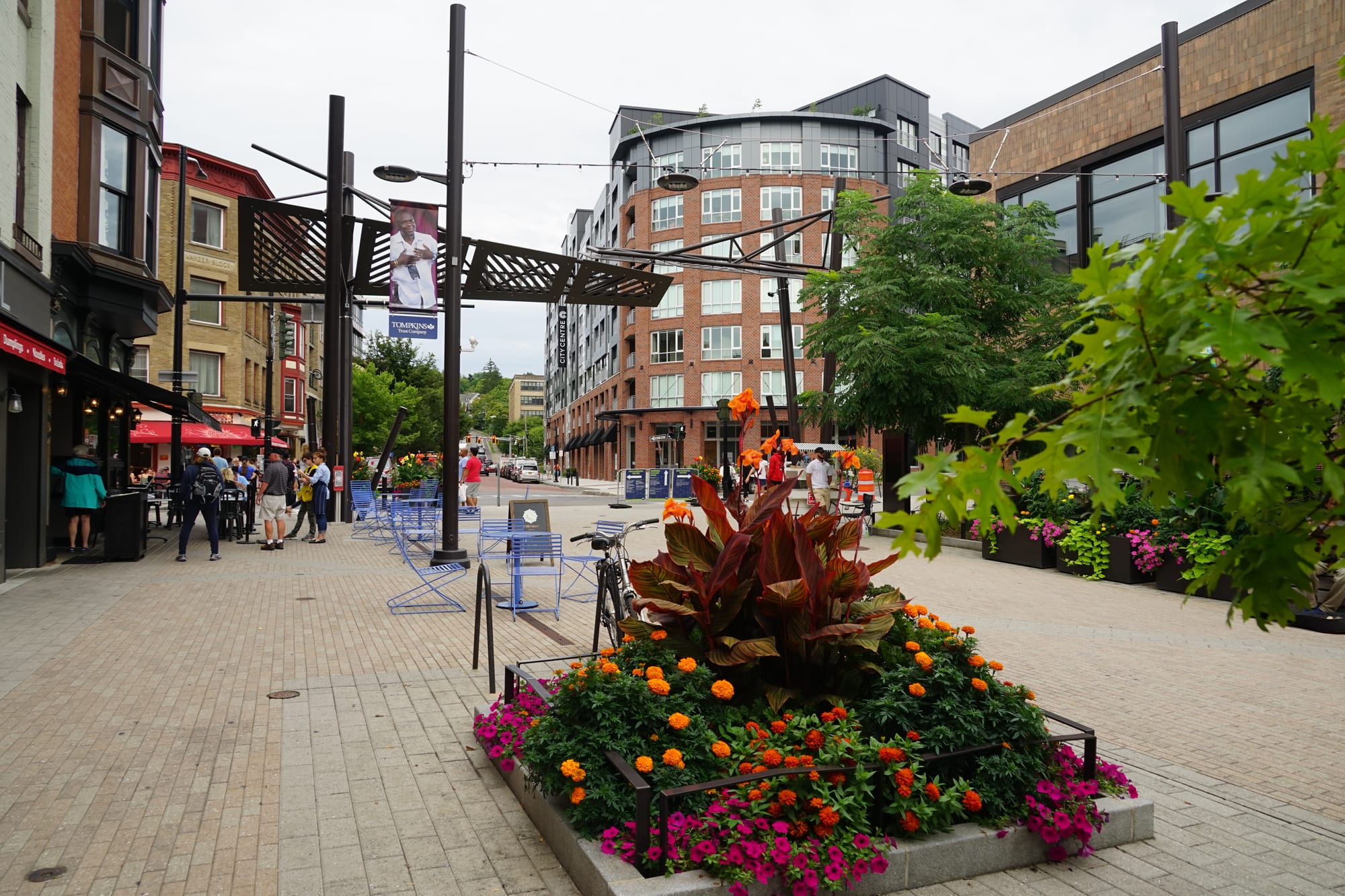
The pedestrian Ithaca Commons in summer, with flower beds, café tables, a brick apartment building and wooded hills in the distance

New York & the Mid-Atlantic, United States

Ithaca

The Ithaca Commons, the pedestrian street at the centre of downtown Ithaca, in August. (Cheburashka007 / Wikimedia Commons · CC BY-SA 4.0)

A small city at the southern tip of Cayuga Lake in New York's Finger Lakes, built on flat land between steep hills cut by gorges and waterfalls. Cornell University on its East Hill and Ithaca College on its South Hill make it a college town with a liberal, outdoorsy character, a strong vegetarian and farm-to-table food scene and the lake's wineries close by.

Neighbourhoods

  • Downtown and the Commons
    • First-time visitors
    • Best for food
    • Close to public transport

    The flat centre of the city around the Ithaca Commons, a pedestrian street of restaurants, bars, bookshops and a cinema, with the State Theatre, the main bus stops and most of the hotels nearby. The rest of the city rises steeply on every side.

    Open in Maps
  • Collegetown
    • Nightlife
    • Students
    • Budget food

    The dense student district on East Hill just below the Cornell campus, with cheap restaurants, bars, late-night takeaways and blocks of student flats. Lively in term, quiet in summer, and a steep climb from downtown.

    Open in Maps
  • Cornell campus and East Hill
    • Architecture
    • Walks and viewpoints
    • Museums

    The university's hilltop campus between two gorges, with the Arts Quad, McGraw Tower and its chimes, the Johnson Museum of Art, the botanic gardens and views across the lake. The streets of large old houses on the hill behind it are where many faculty live.

    Open in Maps
  • Fall Creek
    • Quiet and residential
    • Historic homes
    • Close to the lake

    A grid of wooden Victorian houses between downtown and the lake, beside the creek that gives it its name, with Ithaca Falls at its edge and an easy walk to the Commons and the farmers market.

    Open in Maps
  • South Hill
    • Students
    • Quiet and residential

    The hill south of downtown topped by Ithaca College, with student housing on its lower slopes, Buttermilk Falls at its foot and a quieter, more residential feel than the Cornell side.

    Open in Maps
  • The Waterfront and West End
    • Lake views
    • Families
    • Walks

    The low ground where the Cayuga Inlet meets the lake: Stewart Park, the farmers market at Steamboat Landing, the Sciencenter, marinas and the Cayuga Waterfront Trail, with hotels and larger shops along the inlet.

    Open in Maps

Things to do

Gorges and waterfalls

  • Ithaca Fallsattraction

    A 150-foot waterfall, 175 feet wide, on Fall Creek a few blocks from downtown, reached by a short path.

    Open in Maps
  • Cascadilla Gorgetrail

    A gorge trail of about 1.3 miles climbing past cascades between downtown and the Cornell campus, the classic way up to Collegetown; its lower section closes in winter.

    Open in Maps
  • Fall Creek Gorge and the suspension bridgetrail

    The deeper gorge on the north side of the campus, crossed by a footbridge high above the water and lined with trails to Triphammer Falls and the Beebe Lake path.

    Open in Maps
  • Buttermilk Falls State Parkpark

    A state park at the southern edge of the city where Buttermilk Creek drops about 600 feet through a series of falls and pools beside a gorge trail.

    Open in Maps
  • Robert H. Treman State Parkpark

    A few miles south-west, the gorge of Enfield Glen with 115-foot Lucifer Falls, trails along the creek and a swimming area beneath the lower falls.

    Open in Maps
  • Taughannock Falls State Parkpark

    About 9 miles north on the lake's west shore, a single 215-foot plunge waterfall — taller than Niagara — seen from a flat gorge trail or an overlook on the rim.

    Open in Maps

Cornell

  • Herbert F. Johnson Museum of Artmuseum

    Cornell's art museum in a concrete building by I. M. Pei, opened in 1973, with a collection spanning six millennia and most world cultures, and panoramic views of Cayuga Lake.

    Open in Maps
  • McGraw Towerlandmark

    The clock tower at the centre of the campus, finished in 1891, home to the Cornell Chimes, which play music three times a day during the school year.

    Open in Maps
  • Cornell Botanic Gardenspark

    Gardens, an arboretum and natural areas on the campus edge, with flowering trees in May and an herb garden.

    Open in Maps
  • Cornell Lab of Ornithologyattraction

    A bird research centre a few miles north-east in the 300-acre Sapsucker Woods Sanctuary, with a visitor centre and more than 5 miles of trails around a pond.

    Open in Maps

Downtown

  • Ithaca Commonslandmark

    The two-block pedestrian mall at the heart of downtown, opened in 1975 and reopened after rebuilding in 2015, with shops, restaurants, summer concerts and the city's festivals.

    Open in Maps
  • State Theatre of Ithacaattraction

    A movie palace on the Commons that opened in 1928, saved and restored by a community project from 1998.

    Open in Maps
  • Sciencentermuseum

    A hands-on science museum for children near the waterfront, with an outdoor science park and the Sagan Planet Walk, an outdoor scale model of the Solar System.

    Open in Maps
  • Hangar Theatreattraction

    A summer theatre in a converted municipal airport hangar by the lake, with a main season and children's shows each summer.

    Open in Maps

The lake

  • Stewart Parkpark

    The city's lakeside park at the southern tip of Cayuga Lake, with willows, a carousel, a pavilion and sunset views up the water.

    Open in Maps
  • Cayuga Waterfront Trailtrail

    A wide, flat path along the inlet and the lakeshore linking the farmers market at Steamboat Landing with Stewart Park, popular for walking and cycling.

    Open in Maps
  • Cayuga Lake Scenic Byway and the wineriesattraction

    A drive around the lake's 95 miles of shoreline past vineyards, wineries and small villages; the Cayuga Lake Wine Trail, created by four wineries in 1981, was New York State's first wine-tourism venture.

    Open in Maps

Short trips from the city

  • Watkins Glen State Parkpark

    About 20 miles west at the foot of Seneca Lake, a gorge known for its stone walls and bridges, where a trail of more than 800 stone steps passes 19 waterfalls in about 2 miles.

    Open in Maps
  • Women's Rights National Historical Parkmuseum

    In Seneca Falls, about 36 miles north, the chapel where the first women's rights convention met in 1848, with a visitor centre.

    Open in Maps
  • Corning Museum of Glassmuseum

    About 35 miles south-west, a museum with more than 50,000 glass objects, some over 3,500 years old, and daily live glassblowing.

    Open in Maps

Seasonal events

  • Ithaca FestivalEvery year

    The city's annual community celebration, held on the Commons or in Stewart Park and often built around a theme.

  • Finger Lakes GrassRoots FestivalJuly

    A four-day festival of more than 70 musicians, bands and dance troupes on four stages at the fairgrounds in Trumansburg, about 10 miles north, started in 1991.

  • Cornell commencement and student returnlate May and late August

    Graduation at the end of May and the return of students in late August fill every hotel room in the city.

  • Apple Harvest FestivalAutumn

    An autumn festival of apples and cider, sponsored by the city and town.

Eat and drink

Long-standing places and food districts in Ithaca. Hours, ratings and directions come from your maps app, always current.

Ithaca classics

  • Moosewood Restaurantrestaurant

    A natural-foods restaurant founded as a worker collective in 1973 in the DeWitt Building downtown, whose highly influential vegetarian cookbooks have won James Beard awards.

    Open in Maps
  • Ithaca Farmers Marketmarket

    A cooperative market, first held on Saturdays in 1973, at Steamboat Landing on the inlet, where Cayuga Lake steamboats once docked, with farm stalls, baked goods and cooked food.

    Open in Maps
  • Finger Lakes wine and ciderrestaurant

    Tasting rooms along both shores of Cayuga Lake pour the region's Rieslings and other cool-climate wines, and the area also makes cider.

    Open in Maps

Food districts

  • The Commons and downtownneighborhood

    The densest cluster of restaurants in the city — vegetarian and farm-to-table places, Asian, Mexican and Indian kitchens, bars and ice cream — on and around the pedestrian street.

    Open in Maps
  • Collegetownneighborhood

    Cheap, fast and international: pizza, noodles, Korean, Thai and late-night sandwiches for the Cornell crowd on the slope below the campus.

    Open in Maps

Experience Ithaca

History

The land at the head of Cayuga Lake belonged to the Cayuga, one of the six nations of the Haudenosaunee, whose villages and stored crops were destroyed by the Sullivan Expedition in 1779 during the Revolutionary War. The state carved the region into the Military Tract for veterans, surveyed under the Surveyor General Simeon De Witt, who later moved to the settlement on the flats and renamed it Ithaca, after the Greek island home of Ulysses. It grew as a lake port, trading in salt and gypsum, and became an incorporated village in 1821.

The railway reached the lake in the 1830s, but what made the town was Ezra Cornell, who made a fortune in the telegraph and in 1865 founded, with Andrew Dickson White, a university on his farm on East Hill. Cornell University drew the city uphill and gave it a purpose beyond trade. Ithaca became a city in 1888. A conservatory of music founded in 1892 grew into Ithaca College, which moved to a new campus on South Hill in the 1960s. From 1915 to 1919 the town was also a centre of silent film-making, with the Wharton brothers' studio, on the site of today's Stewart Park, using the local scenery.

Industry — Ithaca Gun, the Morse Chain works — faded through the 20th century, leaving the two colleges as the economy. The Commons was built as a pedestrian mall in 1974–75 to revive downtown and rebuilt in 2015, and the waterfront has been opened up with parks and the Cayuga Waterfront Trail. Today the city's story is one of a liberal college town coping with its own popularity and the cost of living it brings.

Culture & Customs

The gorges set the tone. Ithaca sells itself on the slogan 'Ithaca is Gorges', and residents hike, swim and run in the ravines that cut through the city as a matter of routine. Cornell brings a large international population, lectures, concerts and museums, and its chimes ring over the city from McGraw Tower. Ithaca College adds music and theatre; the two give the city of 32,000 an unusual number of bookshops, cinemas, galleries and venues for its size.

Politics is reliably progressive. The city's voters are more liberal than the rest of the county; it was early to vegetarian restaurants, food co-operatives and community currencies, with Ithaca Hours one of the first in the country, and prides itself on environmentalism and tolerance. The Moosewood collective's cookbooks, written here from the 1970s, spread a whole way of eating across the country, and the annual Ithaca Festival celebrates the city's self-image, often turning a political statement into a festive event.

Music runs from Cornell's concert series to the folk and roots scene around the GrassRoots Festival in nearby Trumansburg, and the restored State Theatre stands downtown. Sport means Cornell's ice hockey at Lynah Rink, where some fans throw fish on the ice when Harvard visits, and college rowing from the boathouse on the inlet. Manners are informal and friendly, with a strong volunteering culture, a love of farmers' markets and a mild contempt for pretension; the town-and-gown divide exists but is softened by how many graduates never leave.

Daily Life

About 32,000 people live in the city and around 105,000 in Tompkins County, with Cornell's roughly 27,000 students and Ithaca College's few thousand making up a large share of both and emptying the place noticeably each summer. Cornell dominates the economy, with Ithaca College and the businesses that serve both behind it; there is little industry left.

The city's shape governs daily life. Downtown, Fall Creek and the Northside sit on the flats; Collegetown and the Cornell neighbourhoods are on East Hill; Ithaca College's slopes are South Hill; West Hill holds newer suburbs. Students rent in Collegetown and the lower hills, faculty and professionals in the big old houses of East Hill and Fall Creek, and many workers commute in from cheaper villages because housing in the city is scarce and expensive — the dominant local issue.

The rhythm is academic. Late August brings the return of students and the noise of Collegetown, May brings graduation and then a quiet, green summer that year-round residents treasure. Saturday means the farmers market at Steamboat Landing, winter means snow shovelling and ice on the gorge trails, and the TCAT bus and the bicycle are respectable ways to get about.

Food

Ithaca's food reputation rests on vegetables. Moosewood Restaurant, founded as a collective in 1973, made the city a byword for vegetarian cooking through its cookbooks, and farm-to-table has long been the norm rather than a fashion: the Ithaca Farmers Market, a cooperative at Steamboat Landing on the inlet since 1973, is where the city buys its weekend breakfast, cheese, vegetables and bread from the farms of Tompkins County and the lake shores.

The town has a claim to the ice cream sundae. A local account holds that a fountain-shop owner, Chester Platt, created it for a local clergyman in 1892, and the Unitarian church holds a 'Sundae Sunday' every September. Apples matter in autumn, when the Apple Harvest Festival celebrates them, and the region's dairy farms supply the cheese, with Cornell's Dairy Bar on campus. Collegetown feeds students cheaply with pizza, noodles, Korean and Thai food and late-night sandwiches, and the Commons has a wide range of Asian, Mexican, Indian and Middle Eastern kitchens for a city this size.

Drink is the Finger Lakes' strength. The wineries along both shores of Cayuga Lake and across Seneca Lake are known for Riesling and other cool-climate grapes, the Cayuga Lake Wine Trail, founded in 1981, being New York State's first wine-tourism venture, and the area's orchards supply cider makers. Ithaca is also known for its microbreweries, and coffee houses are as much a part of student life as the bars.

Planning tools

Budget

Ithaca is far cheaper than New York City but not cheap for its size, and hotel prices jump several times a year — Cornell's graduation in late May, student move-in and homecoming, reunion weekend in June and the peak foliage weekends of October — when rooms must be booked far ahead. Food is good value, the gorges and campus are free, and the state parks charge a modest parking fee in season.

Daily Budget Midrange
USD 220–380 (downtown or waterfront hotel, restaurant dinners with tax and tip, rental car for the wineries and parks, museum tickets)
Daily Budget Shoestring
USD 90–150 (hostel or budget motel, Collegetown takeaways and market lunches, TCAT buses, state-park camping)

Avoid university weekends unless attending them; mid-week in June or September is pleasant and far cheaper.

Best Time to Visit

Late May to mid-October. Summer is warm, the waterfalls are swimmable, the farmers market and the lake are at their best and the students are away; early October brings foliage and the apple harvest. Winter is long, grey and snowy, though the city carries on and the gorges freeze into ice walls. Spring is wet, with the waterfalls at full volume in April and May.

Suggested Number of Days

Two days cover the city and the gorges around it. Add two or three for the state parks, the wineries along the lake and the other Finger Lakes towns, which need a car.

First Visit
2 days
With Surroundings
3–5 days

Transportation

Downtown and the waterfront are flat and walkable; the hills are another matter, and most people take the bus up to Cornell. TCAT buses run frequently between downtown, the campus, Ithaca College and the airport. A car is needed for the state parks beyond the city, the wineries and the wider Finger Lakes; bike hire and ride-hailing cover the rest.

Parking is in garages downtown and metered on the hills; some gorge trails close in winter for ice, so check before setting out.

Airport & Station Connections

Ithaca Tompkins International Airport, about three miles north-east of downtown, has daily flights to New York JFK and Newark. Syracuse, about an hour's drive north, has more. There is no passenger train; intercity buses run frequently to Binghamton and New York City, with fewer to Syracuse, Rochester and Buffalo. By road Ithaca is about four hours from New York City, two from Rochester and three from Buffalo.

Walkability

The flat centre is easy: the Commons, Fall Creek, the waterfront and the farmers market are within a mile or two on level ground. Everything else is up steep hills, and the climb from downtown to Collegetown or the Cornell campus gains several hundred feet, by stairs through Cascadilla Gorge or long streets. Pavements are often snowy or icy from December to March.

Safety

A safe small city with low violent crime. The real hazards are the gorges: swimming outside the designated areas is dangerous, rocks are slippery, and some trails close in winter for ice. Winter driving on the hills can be difficult, and deer ticks are common in the woods.

Swim only at the guarded areas in the state parks, keep to the marked gorge trails, and check for ticks after walks. Check current official travel advice before travelling.

Climate

A humid continental climate with warm summers and long, cloudy, snowy winters, the lake moderating temperatures a little at its southern tip. Rain falls throughout the year, and winter skies are usually cloudy.

Summer
warm — July highs around 80°F with cool nights, and humidity lower than the coast
Winter
cold and snowy — January highs in the low 30s °F, nights in the teens, and about 67 inches of snow a year

Local Customs

Tipping is expected: 18–22 per cent in restaurants, a dollar or two a drink. New York State and county sales tax is added at the till. Ithaca is famously progressive and informal — 'Ithaca is Gorges' bumper stickers, vegetarian menus and a strong environmental streak — and dresses for hiking rather than dinner. Town and gown mostly mix easily, but residents are tired of student noise in Collegetown and of weekend traffic.

The drinking age is 21 and identification is checked; cannabis is legal for adults in New York but not in parks or on campus.

Common Payment Methods

The currency is the US dollar. Cards and contactless payment are taken nearly everywhere, including most farmers' market stalls, and ATMs are plentiful downtown and in Collegetown. A little cash helps at farm stands and smaller wineries.