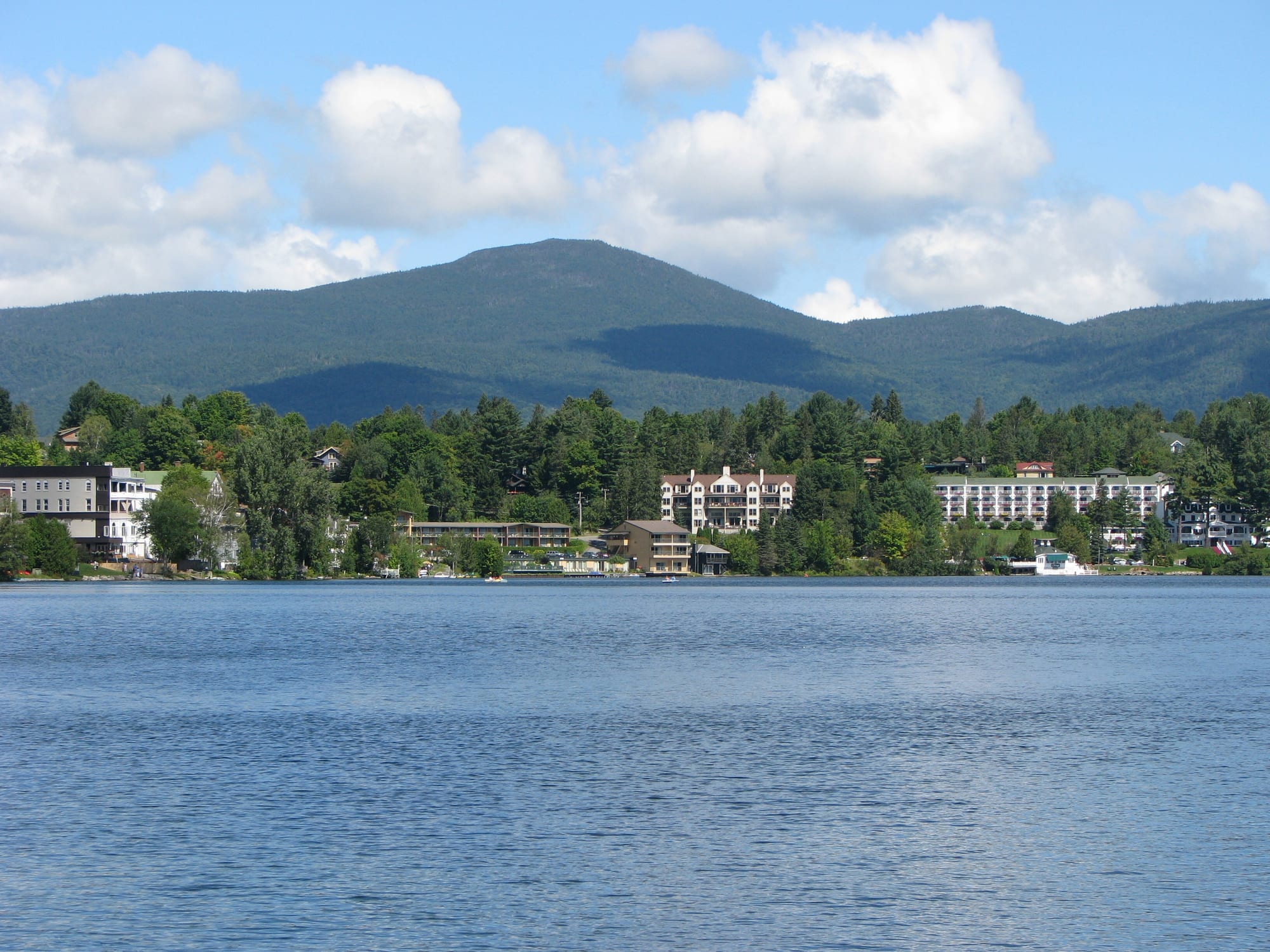
Blue water of Mirror Lake in front of a wooded shore lined with buildings, with a forested mountain rising behind under white clouds

New York & the Mid-Atlantic, United States

Lake Placid

Mirror Lake and the village of Lake Placid, looking north from the public beach on the south shore. (Mwanner / Wikimedia Commons · CC BY-SA 3.0)

A small village in New York's Adirondack Mountains, on Mirror Lake beside the lake that gave it its name. Founded for iron mining and made fashionable by Melvil Dewey's Lake Placid Club, it hosted the Winter Olympics in 1932 and 1980, and today lives on winter sport, its Olympic venues and the hikers bound for the High Peaks.

Neighbourhoods

  • Main Street and Mirror Lake
    • First-time visitors
    • Shopping
    • Lakeside walks

    The heart of the village, strung along the shore of Mirror Lake, a small lake of about 124 acres at the centre of the village. Main Street holds the shops, restaurants and the Palace Theatre, a cinema open since 1926, and a free trolley runs along the lake.

    Open in Maps
  • The Olympic Center
    • Olympic history
    • Winter sport

    The sports complex at the centre of the village that served as the Olympic Park for both the 1932 and 1980 Games, with its ice arenas, the outdoor speed-skating oval and the Olympic museum.

    Open in Maps
  • Lake Placid lakeshore
    • Quiet and residential
    • Lake views

    The larger lake on the northern side of the village, the one that gave Lake Placid its name, surrounded by wooded mountains and quieter than the village centre.

    Open in Maps

Things to do

Olympic venues

  • Olympic Centerattraction

    The arena complex that was the Olympic Park in 1932 and 1980, where the 'Miracle on Ice' hockey game was played, and the main venue of the 2023 Winter World University Games.

    Open in Maps
  • Lake Placid Olympic Museummuseum

    Opened by New York State in 1994 inside the Olympic Center, with the 'Fram III' bobsled of 1932, Jack Shea's skates and memorabilia of the 1980 hockey team.

    Open in Maps
  • Olympic Ski Jumping Complexattraction

    The two jump towers built for the 1980 Games, modernised and lengthened in 2021, the only jumps in North America approved for both winter and summer competition.

    Open in Maps
  • Mt. Van Hoevenberg Olympic Bobsled Runattraction

    The bobsleigh, luge and skeleton track at the Olympic Sports Complex, first built in 1930 and used at both the 1932 and 1980 Games.

    Open in Maps

History and the lakes

  • John Brown Farm State Historic Sitelandmark

    The home and grave of the abolitionist John Brown, about 3 miles south-east of the village, where he moved in 1849 to teach farming to African Americans.

    Open in Maps
  • Mirror Lakepark

    The small lake beside Main Street, used in winter for a pond hockey tournament.

    Open in Maps

Mountains and short trips

  • Whiteface Mountainviewpoint

    At 4,867 feet the fifth-highest mountain in New York; its ski area has the greatest vertical drop east of the Rockies and held the 1980 alpine events, and a road, tunnel and elevator reach the summit view.

    Open in Maps
  • Mount Marcytrail

    The highest point in New York at 5,343 feet, in the heart of the High Peaks Wilderness south of the village, a popular destination for hikers.

    Open in Maps
  • High Peaks Wilderness Areapark

    The largest wilderness area of New York's Forest Preserve, with the trails to the state's highest summits.

    Open in Maps
  • Saranac Lakeattraction

    The largest community in the Adirondack Park, a neighbouring village to the west, linked to Lake Placid by the Jackrabbit ski trail.

    Open in Maps

Seasonal events

  • Pond hockey tournamentFebruary

    A Canadian–American outdoor hockey tournament played on the frozen surface of Mirror Lake.

  • Ironman Lake Placidsummer

    A triathlon held every year since 1999 in the village and the surrounding mountains, the longest-running Ironman in North America after the world championship.

  • Lake Placid ice dance competitionJuly or August

    An annual ice dance competition in the 1980 Olympic Arena.

Eat and drink

Long-standing places and food districts in Lake Placid. Hours, ratings and directions come from your maps app, always current.

Food districts

  • Main Streetneighborhood

    The village's restaurants, cafés and bars line Main Street along the shore of Mirror Lake.

    Open in Maps
  • Saranac Lakeneighborhood

    The neighbouring village has its own cluster of restaurants and bars.

    Open in Maps

Local produce

  • Adirondack maple syrupmarket

    Local farms around the village sell maple syrup and maple sugar, boiled down from sap at the spring thaw.

    Open in Maps

Experience Lake Placid

History

Lake Placid was founded in the early 19th century to develop an iron ore mine; as late as 1840 nearby North Elba had just six families. In 1845 the philanthropist Gerrit Smith bought large amounts of land in the area and granted tracts of it to former slaves. The abolitionist John Brown heard of the scheme and in 1849 moved to a farm in North Elba to teach farming to African Americans. He asked to be buried there, and the farm is now a state historic site.

In the late 19th century the wealthy discovered the area as a resort. In 1895 Melvil Dewey, inventor of the Dewey Decimal System, founded what became the Lake Placid Club in a hotel on Mirror Lake, and the village took the name Lake Placid when it was incorporated in 1900. In 1929 Dewey's son Godfrey persuaded the International Olympic Committee that it had the best winter sports facilities in the country.

The 1932 Winter Olympics brought the bobsled run on Mount Van Hoevenberg, built in 1930, and the local skater Jack Shea became the first American to win two gold medals at one Winter Games. The village hosted again in 1980, when an American hockey team of mostly college players beat the Soviet Union 4–3 in the "Miracle on Ice" and went on to take gold. The Lake Placid Club closed that same year. It has also hosted the 2000 Goodwill Games and the Winter World University Games of 1972 and 2023, and in June 2026 New York's governor formed an exploratory committee to study a potential joint New York City–Lake Placid bid for the 2042 Winter Olympics.

Culture & Customs

Lake Placid is one of only four places — with St. Moritz, Innsbruck and Cortina d'Ampezzo — to have hosted the Winter Olympics twice, and the Games are at the centre of its identity. The Olympic venues are still in use: the Olympic Center's arenas, the ski jumps modernised in 2021 and the bobsled run on Mount Van Hoevenberg host international competitions, and the Olympic museum keeps the memory of 1932 and 1980 alive with Jack Shea's skates and the Miracle on Ice team's memorabilia.

Sport fills the calendar in every season. The Ironman Lake Placid triathlon, held since 1999, is the longest-running Ironman in North America after the world championship; horse shows have been held at the North Elba Showgrounds since 1969; an ice dance competition takes place each summer in the 1980 Olympic Arena; and a pond hockey tournament is played on frozen Mirror Lake in February.

The village is also a gateway to the Adirondack Park, a vast area in which private land and the publicly owned Forest Preserve are mixed together. Hikers come to climb the High Peaks, including Mount Marcy, the highest point in New York, and the outdoor, informal character of the place shows on Main Street year-round. The Palace Theatre, opened in 1926, still shows films in its original setting.

Daily Life

About 2,200 people lived in the village at the 2020 census, down from about 2,600 in 2000. It sits near the centre of the town of North Elba in Essex County, about 50 miles south-west of Plattsburgh, and its neighbour Saranac Lake is the largest community in the Adirondack Park. The village covers only about 1.5 square miles, about a tenth of it water, and holds both Mirror Lake and the southern shore of Lake Placid itself within easy reach.

Tourism and sport are the economy. The Olympic museum is part of the work of New York State's Olympic Regional Development Authority, and the venues still host international competitions. Hotels, restaurants, outfitters and shops along Main Street depend on the visitors who come for winter sport, summer hiking and the autumn foliage.

Life follows the weather. Winters are long and very cold, with temperatures that can fall far below zero and dangerous wind chill, and residents plan around snow, ice and the ski calendar. Summer brings the lakes, the trails and the triathlon crowds.

Food

Lake Placid's food is that of a mountain resort rather than a distinct local cuisine. Main Street along Mirror Lake holds most of the village's restaurants, cafés and bars, close to the water's edge, serving the hearty food that suits a day of skiing or hiking. Neighbouring Saranac Lake, the largest community in the Adirondack Park, has its own restaurants and bars, and the Jackrabbit ski trail links the two villages in winter.

The local product with deepest roots is maple syrup. Each year, as the spring thaw arrives, the smell of sap being boiled down fills the mountain air, and farms around the village, such as G+G Maple Farms, sell syrup and maple sugar directly to visitors. Syrup and maple sugar are the classic things to take home. The Uihlein Sugar Maple Field Station nearby is a research centre with exhibits on how syrup is made, open to the public.

Planning tools

Budget

Lake Placid is a resort, and rooms are dearest at peak times: summer, the autumn foliage, winter weekends and big sporting events, when the village fills up. Olympic venue tours, lift tickets at Whiteface and equipment hire are the other large costs; hiking, the lakeshore and Main Street cost nothing.

Daily Budget Midrange
USD 230–420 (village hotel, restaurant dinners with tax and tip, Olympic venue tickets or a lift pass, car and fuel)
Daily Budget Shoestring
USD 110–180 (motel, hostel or campsite nearby, diners and self-catering, hiking)

Book well ahead for winter holidays and major sporting events, when rooms in the village sell out.

Best Time to Visit

Winter, roughly December to March, is the season for skiing at Whiteface, skating and the Olympic venues. Summer is mild and the best time for hiking, paddling and swimming. Autumn brings colour to the Adirondack forests, and spring is quieter, when the maple sap runs.

Suggested Number of Days

Two or three days suit a first visit to the village. Allow four to six for hiking in the High Peaks or a full ski trip; walkers who want to climb the highest summits need extra days in reserve for bad weather.

First Visit
2–3 days
With Surroundings
4–6 days

Transportation

The village centre is easy to get around on foot, and a free trolley runs along the lake. Main Street traffic is often slow. A car is needed for nearly everything beyond the village — the ski area, the trailheads, the bobsled run and the neighbouring villages.

A car is the practical way to reach the trailheads, the ski area and the bobsled run.

Airport & Station Connections

The village is about 50 miles south-west of Plattsburgh in the Adirondacks. The closest airport with scheduled flights is Adirondack Regional Airport near Saranac Lake; the nearest international airports are Albany, Burlington and Montreal. Amtrak's nearest station is at Westport, about 40 miles east, and Adirondack Trailways coaches run from New York City and Albany. Most visitors drive.

Walkability

Main Street, Mirror Lake, the Olympic Center and the ski jumps are close together and easy to walk, and the path around Mirror Lake is a popular loop. The bobsled run, Whiteface and the trailheads are a drive away.

Safety

The village itself is quiet and safe. The real risks are in the mountains: winter cold with dangerous wind chill, fast-changing weather on exposed summits, slippery rock and long trails where help can be far away.

For most visitors the US is safe, with the main risks being petty theft and car break-ins in tourist areas of some cities, road accidents over long distances, extreme weather, and the hazards of the outdoors. Carry warm layers, a map and plenty of water on any hike, check the forecast before heading above the treeline, and drive carefully on winter roads. Check current official travel advice before travelling.

Climate

A cold mountain climate with no dry season. Summers are mild and mostly comfortable, though spells of heat and humidity occur; winters are long and severe, with extreme cold and strong wind chill at times.

Summer
mild — every month averages below 72°F, though heat-index values above 90°F occur in hot spells
Winter
long and very cold — the coldest night of an average year falls to around −24°F, and the record low is −39°F

Local Customs

Tipping of roughly 18–22 per cent is expected in restaurants, and sales tax is added at the till. Dress is outdoor and informal everywhere. Hikers in the High Peaks are expected to stay on marked trails, carry out their rubbish and follow the Forest Preserve's rules on camping and fires.

Identification is asked for when buying alcohol (the legal age is 21). John Brown's grave is a place of remembrance; treat it with respect.

Common Payment Methods

The currency is the US dollar. Cards and contactless payment are widely accepted in the village, and there are ATMs in the village; a little cash is useful at trailheads and roadside farm stands.